

 by dr Andrzej Jakubiec - adwokat, mediator
Child Custody in Poland — A Guide for Foreign Parents
Child custody cases in Poland are not simply legal disputes. They unfold in a system that is slow, conservative, deeply formalistic — and profoundly shaped by cultural assumptions that foreign parents rarely anticipate. For many expats, the first shock is discovering that Polish family courts operate according to rules that are not written in any statute but dominate outcomes far more than the law itself. This guide explains the real mechanics of custody litigation in Poland: the psychology, the strategy, the hidden rules, and the risks that matter more than anything else — especially for foreign parents navigating an unfamiliar system. I try to answer one question: Why the Polish Family Court System Operates in a World of Its Own?
How Child Custody Works in Poland (For Foreigners)
Child custody in Poland is theoretically decided based on the best interests of the child, with courts focusing on stability, continuity, and parental cooperation.
Polish custody law is built around two separate decisions:
- Parental authority (legal custody) — who makes decisions about education, health, travel, therapy, religion.
- Residence and contact (physical custody) — where the child lives and how time is divided.
Naturally, money is a cornerstone factor influencing every other aspect of a custody battle. Sometimes it is the cause; other times, it is the consequence. More often than not, we are looking at a complex feedback loop—a constant search for balance in a shifting reality. In practice, I often see the child treated as an object: an asset, a hostage, or a tool for leverage. Their ‘best interests’ frequently become a hollow cliché with no basis in fact. I observe firsthand how ordinary parents fall into a spiral of mutual suspicion, accusations, and demands, losing sight of what truly matters. One father—a successful businessman—once told me: ‘When they grow up, they’ll understand I was right.’ This perfectly illustrates how easily one can lose their way.
Foreign parents often search for answers to questions like:
- “Can a foreign parent get custody in Poland?”
- “What rights do expats have in Polish custody cases?”
- “Does the mother automatically get custody in Poland?”
And one practical truth emerges again and again:
In many cases we handle, the parent who acts first effectively defines the entire trajectory of the custody dispute.
The short answer: Foreign parents can win custody cases in Poland — but only if they understand how the system really works.
1. The Polish Family Court System: A Separate Universe
1.1. Why Foreign Parents Are Shocked
Foreign parents expect active judges, dynamic hearings, and evidence‑based reasoning. Instead, they encounter a world built on procedural formalism and institutional inertia. The system rewards patience, documentation, and stability — not emotion, not narrative, and not even truth presented without the right procedural framing.
Foreign parents quickly notice:
- extreme formalism
- slow pace
- reliance on paper files
- conservative judicial culture
- limited trust in private experts
- strong preference for maintaining the status quo
1.2. OZSS: The Gatekeeper of Custody Decisions
OZSS it is in Polish Opiniodawczy Zespół Specjalistów Sądowych. In custody cases, the OZSS (family diagnostic center) becomes the single most influential institution. Courts rely on OZSS opinions to such an extent that one report can shape the entire case for years. The problem is structural: OZSS teams are overloaded, under‑resourced, and often rely on outdated psychological tools. Waiting times of 12–18 months are standard.
This means that at least until the opinion is issued—and in practice, often much longer—all matters will be governed by an interim court order (postanowienie o zabezpieczeniu) regarding contacts, alimony, and place of residence. Crucially, the court usually issues these orders based solely on the parties’ own claims, as no other expert evaluation is yet available. This is a critical turning point right at the start of the proceedings. While waiting for the OZSS opinion, the court defines—theoretically only temporarily—how the family will function from the child’s perspective. This is vital because courts are notoriously reluctant to change these ‘temporary’ arrangements later on. Read more in the point 2.3. below.
CTA: 👉 If you are facing an OZSS assessment, early strategy is critical. A single report can shape your case for years.
1.3. Private Psychological Opinions: Why Courts Distrust Them
Foreign parents are often surprised to learn that private psychological evaluations — even from top specialists — are treated with skepticism. Judges prefer “neutral” OZSS opinions, even when they are superficial or inconsistent. This is not personal; it is cultural. The Polish system is built on institutional hierarchy, not expertise.
“Furthermore, there are certain psychological ‘centers’ known for producing tailored reports ‘on demand.’ This significantly undermines the credibility of the entire profession. While such ‘specialists’ are well-known to the courts and experienced lawyers, they still cause immense procedural chaos. The inevitable result is that the court defaults to an OZSS evaluation—which, as we know, is far from perfect itself.
2. Legal vs. Physical Child Custody in Poland
2.1. Legal Custody (Parental Authority)
Decision‑making power: school, health, therapy, travel, religion. Courts rarely remove parental authority unless there is severe neglect or violence.
2.2. Physical Custody (Residence + Contact Schedule)
Where the child lives and how time is divided. This is the most emotionally charged part of the case.
Against this backdrop, intense disputes arise. People want to insulate themselves against every possible future scenario, trying to anticipate years in advance. They fight for maximum contact or—conversely—to restrict the other party as much as possible. I know of a mother who, after separating from her partner, insisted that he only see their daughter at her home and in her presence. She refused to let him take the child to a playground or to his own house. One can only ask: what purpose does this truly serve?
2.3. Why Residence Usually Goes to the Mother — And the Hidden Rule That Decides Everything
The single most powerful force in Polish family courts is not a written statute, but the unwritten Rule of Continuity (Zasada Ciągłości). Judges are profoundly risk‑averse. They operate under a deep fear of disrupting a child’s current environment, even if that environment was created through manipulation or tactical blocking of contact.
In practice, this means the system often rewards the parent who creates a fait accompli. This leads to a dangerous dynamic where:
- the parent who first secures the child’s residence gains a massive lead
- time becomes a weapon — the longer the status quo lasts, the harder it is to challenge
- judges prefer to sanction the existing reality rather than bear responsibility for changing it
For a foreign parent, understanding this rule is the difference between a successful intervention and a multi‑year procedural trap.
If the status quo is forming against you, delay can decide the case.
3. Foreign Parents: Why Your Country of Origin Matters More Than You Think
Polish courts — though they will never state it in the written justification — assess a parent’s stability through the lens of:
- citizenship
- place of residence
- EU vs non‑EU status
- long‑term “center of life”
- cultural and linguistic continuity
- predictability of the child’s future environment
This creates a real, though unspoken, hierarchy.
TABLE 1 — How Polish Courts Usually Perceive Foreign Parents (Practical Stability Ranking)
| Parent Profile | Court’s Perceived Stability | Practical Consequence |
|---|---|---|
| EU citizen living in Poland | Very high | Strong chance of shared care or broad contact |
| EU citizen living in EU | High | Relocation possible; continuity still key |
| Non‑EU citizen living in Poland | Medium | Court examines long‑term stability and integration |
| Non‑EU citizen living in EU | Medium‑low | Court questions permanence and cultural continuity |
| Non‑EU citizen living outside EU | Low | High risk of limited contact or supervised transitions |
3.1. Child custody in Poland. Cultural and Religious Factors (Never Written, Always Present)
Courts protect:
- cultural continuity
- linguistic continuity
- religious continuity
They are more open to relocation for example to Germany than to Algeria — even if both parents are equally competent.
3.2. Regional Differences Within Poland
- Courts in eastern Poland strongly protect keeping the child in Poland.
- Courts in western Poland are more open to EU mobility.
4. What Increases a Foreign Parent’s Chances in Polish Custody Cases
Polish courts look for predictability, continuity, and cultural safety. Foreign parents often assume they are at a disadvantage — but that is simply not true. Many of them can significantly improve their chances by consciously building an image of stability and integration.
TABLE 2 — Factors That Increase a Foreign Parent’s Chances
| Factor | Why It Matters | Strategic Effect |
|---|---|---|
| Learning Polish (even basic level) | Shows commitment to integration and communication with the child | Strongly increases credibility |
| Child attending Polish school abroad | Preserves linguistic and cultural continuity | Courts view relocation more favorably |
| Strong Polish community (Polonia) in the parent’s country | Reduces cultural disruption | Helps justify relocation |
| Stable employment in Poland or EU | Predictability and continuity | Major positive factor |
| Moving to Poland or declaring intent to relocate | Eliminates relocation risk | Can dramatically shift the case |
| Living in a family‑friendly neighborhood | Shows social anchoring | Courts value community stability |
| Parenting competence courses / therapy | Demonstrates responsibility and growth | Very persuasive for judges |
| Documented involvement in daily care | Shows real parenting, not symbolic | Crucial for shared custody |
5. What Decreases a Polish Parent’s Chances Against a Foreign Parent
Polish parents often assume that “the court will naturally be on their side.” This is not true. In disputes with a foreign parent, a Polish parent can lose their advantage if they lack stability, support, or parenting competence — or if they engage in behaviors courts strongly disapprove of.
TABLE 3 — Factors That Decrease a Polish Parent’s Chances
| Factor | Why It Hurts the Case | Court’s Reaction |
|---|---|---|
| Unemployment or unstable income | Signals unpredictability | Strong negative |
| Addictions | Direct risk to child | Often leads to supervision |
| Lack of family support | No safety net | Court prefers stable environment |
| Low parenting competence | Poor routines, chaos, inconsistency | Negative OZSS outcomes |
| Hostile or entitled behavior | Seen as emotional immaturity | Judges react strongly |
| Obvious alienation attempts | Courts increasingly reject this | Can reverse custody |
| Blocking contact | Violates child’s right to both parents | Judges punish this |
| Unstable relationships | Perceived instability | Weakens credibility |
6. The Persistent Myth: “The Mother Has More Rights”
Despite legal equality, many parents believe that mothers have more rights. This belief is reinforced by cultural norms and by the Rule of Continuity. In some cases, one parent may attempt to control contact in ways that effectively limit the other parent’s role — conditioning access on behavior, financial compliance, or emotional loyalty.
Foreign parents often react differently:
- Western European fathers are more assertive
- Polish fathers are more passive
- Eastern European and Asian fathers are often the most vulnerable to gatekeeping
The law gives equal rights. The practice requires strategy.
7. The Dark Side of Custody Litigation
Some custody disputes escalate because one party introduces allegations of violence or inappropriate behavior — sometimes prematurely or without sufficient evidence. This can trigger long investigations, supervised contacts, and years of litigation.
Parental alienation is another battlefield. In Poland, it is politicized: some deny it exists, others weaponize it. For deeper insight, see our analysis of parental alienation dynamics (link to Adrianna Rybarska’s article).
Children pay the price.
8. Psychological Impact on Children
Custody disputes leave deep psychological marks on children. They experience loyalty conflicts, guilt, and fear of abandonment. Many believe they caused the separation or failed to meet expectations. The tragedy is that many children never learn that the parent they lost contact with fought for them — filed motions, requested contact, tried to stay present.
At the same time, some fathers do give up quickly because the system is exhausting. Children interpret this as rejection.
9. Heuristics for Foreign Parents
Foreign parents often search for guidance on questions like:
- “Can a foreign parent get custody in Poland?”
- “What rights do expats have in Polish custody cases?”
- “How does the Polish court assess a foreign parent’s stability?”
Here are the strategic rules that matter most:
- If you want shared custody → stability matters more than emotion.
- If you want more contact → document everything.
- If the other parent blocks contact → act early.
- If you live outside the EU → expect higher scrutiny.
- If you rely on private experts → prepare for skepticism.
- If you expect a fast process → adjust expectations.
- If you want to protect your child → reduce conflict, not escalate it.
10. Child Custody in Poland — Key Questions Answered (Q&A)
Can a foreign parent get custody in Poland?
Yes — but the court will examine stability, residence, EU ties, and continuity.
Does the mother have priority?
Legally no. Culturally — often yes. But this can be overcome.
How long does a custody case take?
12–48 months, depending on OZSS timelines.
What is the role of OZSS?
Central. Their opinion often decides the case.
How does custody relate to divorce strategy?
Custody outcomes are often shaped by how the divorce itself is structured — including whether fault is alleged. See: Fault vs No‑Fault Divorce in Poland. You can hear my one of my podcast’s episodes concerning the (non)sense of making Fault-Divorce decision.
11. Child custody in Poland. Your First Step (the missing piece)
Before filing anything, foreign parents should take one step that dramatically increases their chances:
👉 Request a confidential conflict‑check and strategic intake session.
This serves three purposes:
- We confirm there is no conflict of interest
- We sign an NDA to protect your information
- Our lawyers map your custody risks and opportunities based on nationality, residence, continuity, evidence, and psychological dynamics.
This is the moment where strategy begins — long before the first hearing.
12. Child custody in Poland. Conclusion
Polish custody cases are shaped by unwritten rules, cultural assumptions, and procedural inertia. Foreign parents can win — but only with early, strategic preparation.
Strategic preparation in cross-border custody cases often determines the outcome before the first hearing.
We help foreign parents understand the system, prepare for OZSS, counteract continuity traps, and protect their relationship with their child.
👉 If you need a strategy — not just representation — this is the moment to act.
by dr Andrzej Jakubiec - adwokat, mediatorDivorce in Poland: Fault vs. No-Fault — A Strategic Guide for Foreigners
Fault vs. No-Fault. The Decision That Shapes Everything. For foreigners divorcing in Poland, the question “Fault or No-Fault?” is not a legal formality. It is a strategic decision that determines how long divorce in Poland will take and the ultimate cost of divorce in Poland. This choice dictates: 1) the duration and intensity of the proceedings, 2) the total legal and emotional investment, 3) how much of your private life enters the public record, 4) whether you retain control — or hand it over to the court. Ultimately, the goal is to decide whether you want to be right or whether you want to be finished. This guide explains the law, psychology, and strategy behind the Polish system.
1. Fault vs. No-Fault. The Great Dilemma: Emotional Justice vs. Legal Strategy
For many international clients, the idea of “fault” carries heavy emotional weight: clearing one’s name or establishing a moral truth. However, the Polish legal system is formalistic and evidence-driven, often differing from more flexible or “no-fault-only” systems found in other jurisdictions.
The Foreigner’s Perspective: Clients from the US, UK, or Western Europe often expect a streamlined process with a clear moral verdict. In practice, Polish courts focus on strict legal definitions of the “complete and permanent breakdown of marriage,” which rarely provides the emotional closure many seek.
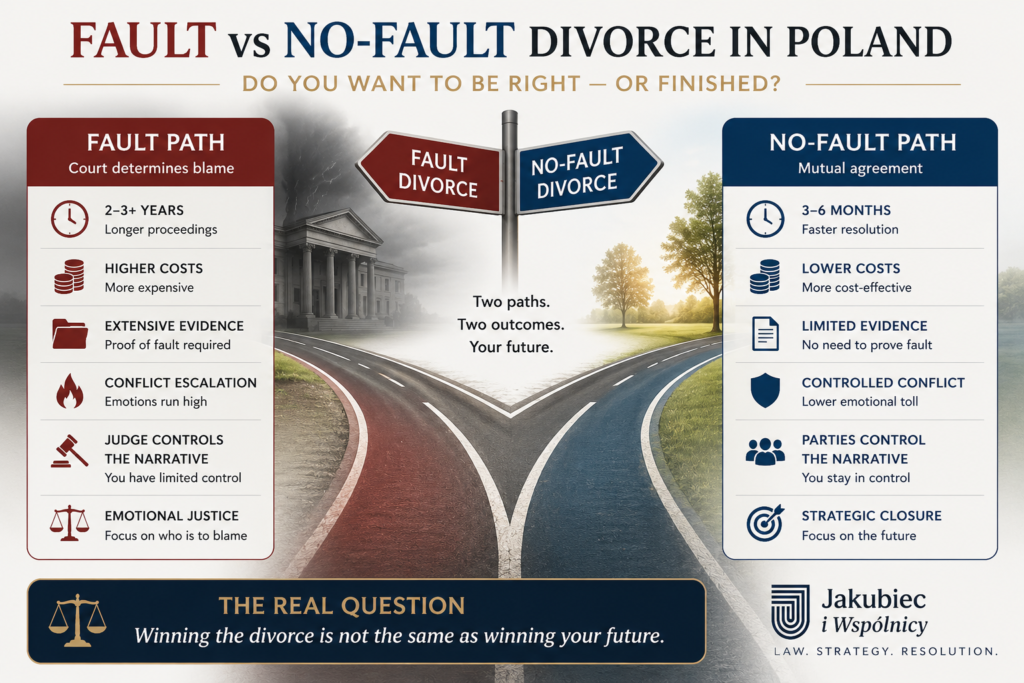
Two paths. Two outcomes. Your future. This infographic illustrates the strategic choice between fault and no‑fault divorce in Poland — not just a legal decision, but a direction for your life and emotional closure.
2. The Time & Process Trap: What to Expect
- The Complexity of Fault: A fault-based divorce in Poland typically lasts 2–3 years in the first instance, plus potential appeals. Every witness and every digital record becomes a procedural step that can extend the timeline indefinitely.
- The Efficiency of Pragmatism: Conversely, a no-fault divorce is in many cases finalized within 3–6 months, depending on court schedules and the parties’ cooperation. For an expat, this speed is often the most critical factor in securing a new start.
3. The Digital Evidence Trap: Screenshots vs. Reality
Foreigners often underestimate how long divorce in Poland can take when the case relies on contested digital evidence.
Digital Burden: “Most foreigners overestimate the value of screenshots and underestimate the evidentiary burden in Polish courts.”
Polish courts require strict authentication. A WhatsApp screenshot may be dismissed unless it meets specific metadata and context standards. We provide an Evidence Strategy Review to ensure your digital files are admitted as credible proof rather than ignored as “unverified copies.” To be clear: digital evidence—such as IT data, screenshots, copies of correspondence, and recordings—is admissible in Polish courts. However, you must know how to collect it legally, how to secure it, and exactly when and in what context to present it to the court.
4. When “Fault” Actually Makes Sense: Strategic Use Cases
In professional practice, “Fault” is treated as a strategic lever, not a destination. It is considered primarily in the following scenarios:
| Scenario (The Case) | Strategic Justification (The Reason) |
|---|---|
| 1. Massive Income Disparity | A sole-fault ruling may secure lifetime alimony if one’s standard of living drops significantly. |
| 2. Egregious Financial Abuse and Financial Violence | In extreme cases, proving fault can be a prerequisite for seeking an unequal division of marital assets. |
| 3. Jurisdiction Protection | Filing for fault in Poland may prevent a spouse from successfully moving the case to a less favorable foreign court. |
| 4. Documented Severe Addiction | Formal proof of guilt can support necessary restrictions on visitation or court-ordered therapy. |
| 5. Strategic Leverage | A credible, evidence-backed threat of fault can often compel an uncooperative spouse to settle in mediation. |
| 6. Wearing down the opponent | One party counts on exhausting the other, hoping they will eventually agree to unfavorable terms regarding alimony, child custody, or residency. In other cases, the goal is to force the opponent to drop their lawyer to avoid further costs and continue the case alone—which is a critical mistake. |
5. Strategic Comparison: Fault vs. No-Fault at a Glance
| Feature | Fault-Based Divorce | No-Fault Divorce |
|---|---|---|
| Time | Typically 2–3 years (plus appeals) | Typically 3–6 months |
| Costs | Higher (experts, private investigators) | Minimal / Fixed legal fees |
| Stress Level | High (public disclosure of private life) | Low to Moderate |
| Evidence | Hard proof required for every claim | Basic proof of marriage breakdown |
| Alimony | Potential lifetime obligation | None or limited to 5 years |
| Risk | High (Mutual guilt is a common outcome) | Typically very low |
| Narrative Control | Handed over to the Judge | Retained by the Parties |
| Escalation of conflict | strong, non-controlled, vertical and horizontal | weak and almost fully controlled |
6. Who Should Avoid Pursuing the ‘Fault’ Path?
Choosing fault without a clear strategy can lock you into years of litigation with no financial upside. We generally advise against this path for:
- Those lacking “Hard Evidence”: If it is simply your word against theirs, you risk being defeated and ending up in a significantly worse position.
- Parents of Minor Children: Guilt-based proceedings are a significant factor increasing the risk of parental conflict and alienation. We are aware that, unfortunately, the presence of children is often the strongest factor that antagonizes both parties. It drives them toward a fault-based battle. However, for the children, this is always a source of immense stress that impacts their daily functioning and psychological well-being. It is worth pausing to consider whether it is truly worth it.
- High Earners: If you are the primary breadwinner, a fault ruling against you can trigger a permanent spousal support obligation.
- High-Conflict or Personality-Driven Opponents: Certain personalities thrive on courtroom drama; choosing no-fault is often the only way to “starve” the conflict.
- People with a history of addiction or criminal convictions: They are typically viewed much more unfavorably by the courts. In such cases, the opposing party can easily construct a damaging narrative against them.
7. Fault vs. No-Fault. The Mediation Advantage: Saving Face & Privacy
“Not to Lose Face”: For clients from cultures where public courtroom humiliation is devastating (e.g., Middle East, Asia, Southern Europe), mediation protects dignity. Resolving the “guilt” aspect behind closed doors is a premium move that protects your professional reputation and mental health.
In Poland, we frequently encounter the opposite problem: for many, simply entering negotiations is perceived as a risk of losing face. You must understand that in Polish culture, an ‘honorable’ defeat after a long struggle is often valued more highly than dialogue or compromise. Poles tend to elevate legal disputes to the level of core values, where there is no room for negotiation. Consequently, the greatest challenge is often simply convincing someone that it is worth talking at all.
8. Fault vs. No-Fault and the AI Problem: Tunnel Vision in Fault-Based Strategies
A major role is played here by a phenomenon well-known in psychology: the fundamental attribution error. This is a cognitive bias that leads us to explain others’ behavior through their character traits—usually negative ones during a dispute—rather than considering the external circumstances they are facing.
Consider what happens when two parties, both under the influence of this bias, analyze each other’s intentions, statements, and actions using AI models.
This problem becomes particularly dangerous in fault-based strategies. People increasingly arrive with AI-generated “diagnoses” of their spouse. They create a dangerous feedback loop where the AI reinforces your existing biases.
Often, the drive for “Fault” is fueled by a coupled confirmation bias, where each party filters reality to fit their own narrative. Professional mediation breaks this cycle of escalating conflict on both sides.
The Clash of Algorithms: The situation escalates when parties use different AI models to interpret the conflict. This AI-amplified certainty makes parties:
- less willing to negotiate,
- more convinced of their “moral right” regardless of legal reality,
- more likely to pursue a destructive “Fault” path that the evidence cannot support.
“Our research shows that while most of us use AI—including many who use it to scrutinize the other party’s intentions—most people are not yet ready to admit to it.
9. Strategic Conclusion: Justice vs. Freedom
I discussed in detail why insisting on a fault-based divorce isn’t always the best strategy in one of my podcast episodes. In practice, most well-advised clients choose no-fault. They do that not because they “give up,” but because they understand the strategic cost of proving fault. In Poland, choosing “fault” is often choosing time, cost, and public exposure. Choosing “no-fault” is choosing speed, control, and privacy.
The real question is not “Who is right?” but rather: “Do you want to be right — or do you want to be finished?”
The cost of divorce in Poland is measured in both money and time. Do not spend either without a plan.
- [Book a Strategic Consultation] – Define your goals with our cross-border experts.
- [Evidence Strategy Review] – Let us evaluate whether your digital evidence meets Polish standards.
- [Case Risk Assessment] – Professional analysis: Should you fight for fault or secure a quick, clean win?
Remember: The strategy should be decided before filing the petition.
Last sentense of mine
I repeat often:
If you take only one thing from this: there is no single ‘right’ answer to whether it is better to divorce with a fault ruling or without one. These options are worlds apart. They carry vastly different risks and financial, emotional, reputational, and organizational costs. They also offer entirely different opportunities and satisfy different needs. So, here is my advice—do not listen to ‘advisors.’ Make a decision that aligns with what you truly feel, not with what they expect from you, whether they say it out loud or not. And remember: if the choice is still yours to make, things are not as bad as they seem.