

 by dr Andrzej Jakubiec - adwokat, mediator
The Decision to End a Business Partnership is a Process
I know people who stay for years in relationships that drain them, limit them, and take away their joy in life. By “relationships” I mean family relationships, intimate relationships, and business cooperation (regardless of its legal form). In this article, I will focus on the decision to end cooperation with a business partner.
I know something about this. I have made such decisions myself when I wanted to end cooperation with my partners. Someone once made such a decision about me. I also decided to leave the University of Łódź, which was very difficult, but something pushed me to do it. And finally, I have advised on such matters hundreds of times as a lawyer. Initially, I focused on legal aspects, but the psychological knowledge I gained over time allowed me to look at these issues much more broadly. Today I know that the law is only a tool — it sets certain boundaries that must be taken into account, like trees when we run through a forest. But they do not determine our decision to run, the route, the pace, or whether it will be a single run or become our routine. Most partners don’t leave because they can’t for legal reasons — they stay because they don’t understand the decision mechanism.
Is Ending a Partnership Something Bad?
No. You have the right to end any cooperation. If you feel that this time is coming to an end, you have the moral right to use the legal tools that serve to end that cooperation. You do not need to feel any guilt because of it. Companies and contracts define people’s behavior for a certain period of time. People agree to this because they assume that during that time, cooperation will benefit them more than the lack of cooperation. If for any reason that assessment has changed, you can end the cooperation.
The Law Does Not Recognize Contracts That Bind Us Forever
Every legal relationship can be terminated — from an employment contract, through a commercial company, to marriage. It does not always mean ending it without cost or immediately, but in most cases it is possible. The law confirms the rule of the “temporariness” of cooperation by allowing contracts to be terminated so that we can use this possibility. Without guilt. Without shame.
If you remain in a relationship against yourself, feeling that you are losing in it, then someone is probably parasitizing on you and wants it to last forever. After all, they gain a lot with very little effort — at your expense.
What Drives Us to Make the Decision to End Cooperation?
Professional reports state that the most common cause of conflicts between partners is financial issues. I agree — but only partially. I believe that the financial area is where deeper causes of conflict most easily concentrate, and it is also the easiest to explain to everyone around. But if those deeper causes did not exist, there would usually be no financial dispute at all. Today, let’s look at how to make the decision to part ways without analyzing the cause or the level at which the conflict has grown.
Three Elements of the Decision to End Cooperation with a (Business) Partner
In modern psychology there is a lot of decision making models. Here I’ll present you one of them: simple and elegant Fogg’s Decision Making Model. The matter turns out to be quite simple with this model. To make a decision, three elements must occur:
- motivation
- ability (perceived ease)
- a trigger — an impulse to act
Importantly, all three elements must occur together. If even one is missing, the decision will not be made.
Motivation to Exit the Company and End Cooperation
What is motivation? Motivation is a state resulting from our emotions that make us strive for something or avoid something. Motivation has an affective, biological basis. Its social and psychological aspects are secondary. And that’s good — because it makes the matter much simpler. If we function well, we are motivated to achieve what is good for us and avoid what is bad for us. Yes, we can make mistakes in judgment, but that is another issue.
Assessing the Difficulty of the Decision to End Cooperation
Ability — or our assessment of how difficult the action is — is a key factor. We must remember that we tend to rationalize and justify passivity because it is convenient for us. Change requires effort, so our mind subconsciously suggests that we should like the situation we are in. It does this in two ways: it tells us that “here” is good and that “there” is bad, dangerous, uncertain. This means that we deceive ourselves into believing that change is harder than it really is. We do this out of laziness and we are brilliantly creative at it.
The Impulse to Act
The trigger is the impulse to behave in a certain way, to make a decision. We say that “the last drop spilled the cup.” A trigger can be almost anything, but most often they appear regularly — we just silence them when we lack motivation or when the change seems associated with real or imagined difficulties. When motivation appears and the task becomes realistically possible, we only need to wait for the trigger. But if motivation is lacking or the task seems too difficult, the trigger will not cause action.
The Fogg Curve — When Do We Make the Decision (to Exit the Company)?
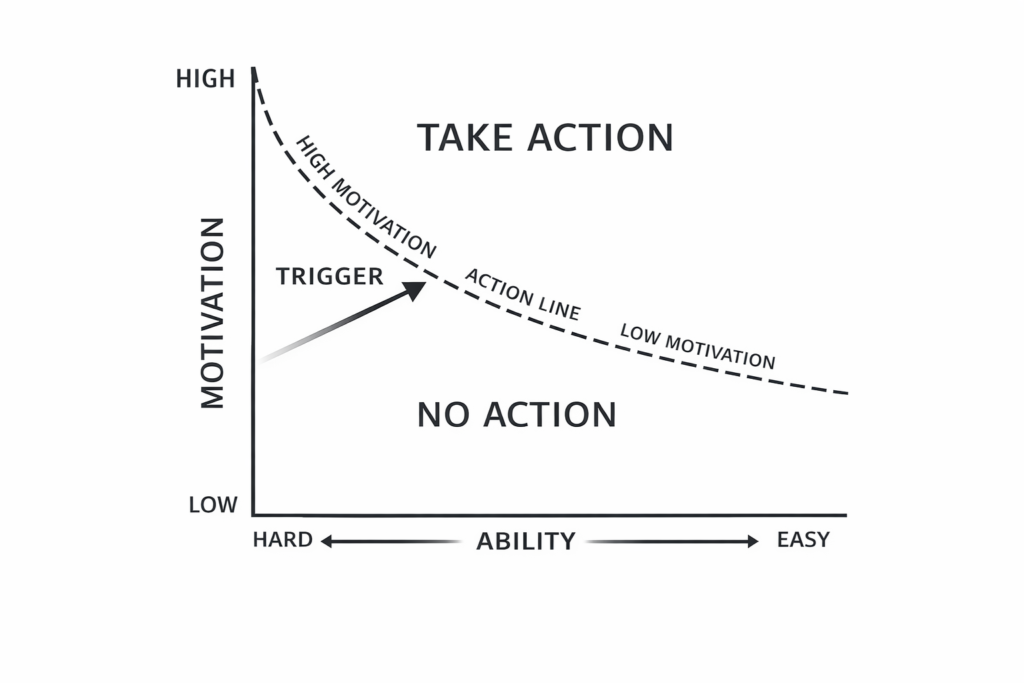
What is the Fogg’s decision making model? The factors influencing our decisions can be presented graphically using the Fogg Curve. It looks like this:
We can see that:
- we are likely to make a decision if we have high motivation and the task is easy (as long as a trigger appears);
- we are unlikely to act if we have low motivation and the task is difficult (even if a trigger appears).
The Decision to End Cooperation. What Should Make You Reflect on Ending Cooperation?
Intuition
Our strongest weapon and unconscious competence. When I listened to it, I succeeded; when I ignored it, I got into trouble. Only deeper studies in psychology and behavioral analysis made me understand how powerful a tool each of us has. And I write this with full responsibility also as a lawyer.
Guilt
Especially if it is being induced in you by your partner — this is a clear red flag. Making you feel guilty is one of the strongest mechanisms of manipulation.
Lack of space to talk about what matters to you
Caring for the relationship between partners is as important as in a marriage. If you do not talk about your fears, plans, ambitions, it means things are already very bad.
Being promised the future
Plans must be:
- real,
- measurable,
- time‑bound,
- concrete.
If they are not, and your partner only tells you to “work hard so that someday it will be better,” then change the plan — or the partner.
You get nothing out of it
We work for a purpose. If you feel that you give everything, but in this personal arrangement your energy, time, and abilities are being burned — let it go. You have only one life; you can have many partners.
If some of these points apply to you, it means you are aware that you are stuck somewhere you do not want to be. And that is already the basis for change.
Deadlock
Deadlock is one of the most destructive situations in business relationships. It is not just a red flag — it is a structural breakdown.
When shareholders hold equal power, even simple decisions can become impossible. As a result, the company may stop functioning altogether while the conflict continues to escalate.
Deadlock occurs when the conflict itself becomes more important than the business. At that point, rational decision-making is replaced by control, ego, and escalation.
This is the moment when waiting becomes the most expensive strategy.
Red Flags and Their Meaning When Deciding to End Cooperation
| Red flag / warning sign | How it looks in practice | What it means psychologically | Consequences for you and the company |
|---|---|---|---|
| Intuition says “something is wrong” | Unexplained tension, discomfort, the feeling that “something is off” | Intuition is unconscious analysis — a signal that your brain sees danger | Ignoring intuition leads to years of losses and burnout |
| Guilt induced by the partner | Suggestions like “you won’t manage without me,” “you’ll let the company down” | Classic manipulation and a tool of control | Loss of agency, emotional dependence, bad decisions |
| No space to talk about important matters | Avoiding difficult topics, gaslighting, belittling your needs | The relationship is one‑sided and communication is toxic | Growing tension, no room for development, escalating conflict |
| Being promised the future | Promises without deadlines, without specifics, without measurable effects | A mechanism keeping you in place — “carrot on a stick” | Blocked career, no real influence, wasted years |
| No real benefits from cooperation | You work more than others and gain the least | Exploitation, asymmetry of effort and reward | Burnout, frustration, sense of injustice |
| Rationalizing passivity (“here is safe”) | Delaying decisions, excusing the partner, justifying pathology | A defense mechanism — avoiding effort and change | Staying in a bad relationship, rising psychological and financial costs |
| Ignored triggers | Repeated “last drops” that change nothing | Lack of connection between motivation and ability | The trigger never becomes a decision — you stay stuck for years |
| Distorted perception of difficulty | “It will be too hard,” “I can’t,” “I have no options” | Your brain is deceiving you — avoidance mechanism | Decision postponed indefinitely, rising risks |
| Lack of trust in the partner | Hidden information, unclear actions, lack of transparency | The relationship is already dead — it’s only a matter of time | Conflict escalates, costs rise every month |
The Fogg Curve in the Context of Exiting a Company
| Element of the Fogg Model | What it means in the context of a partner | How it looks in practice | What happens when one of the three elements is missing |
|---|---|---|---|
| Motivation | The emotional and psychological reason to end cooperation | Exhaustion, frustration, sense of injustice, intuition saying “this is not it,” lack of trust | The partner stays in the relationship despite harm; rationalizes the situation; “maybe it will get better” |
| Perceived ability | Assessment of whether exiting is realistically possible — legally, financially, organizationally | Consulting a lawyer, analyzing the contract, assessing risks, understanding procedures | The partner believes “it can’t be done,” “it’s too hard,” “I have no options”; decision paralysis; or they haven’t been hurt enough yet (no trigger) |
| Trigger | The impulse that initiates action | Another manipulation, lack of payment, broken promise, humiliation, value conflict | If motivation or ability are low — the trigger changes nothing; passivity returns |
| High motivation + high ability + trigger | Optimal point for making a decision | The partner sees the sense of change and knows how to execute it | The decision is made quickly and consciously; determination is high; change will happen |
| High motivation + high difficulty | You want to leave but “don’t know how” | Fear, delaying the decision, excuses | Triggers do not lead to action; frustration grows; your future depends on whether you seek solutions or wither where you are |
| Low motivation + high ability | You can leave but feel no need | “It’s fine,” “It’s not ideal but it’s okay,” “I don’t want to waste energy” | You may be in the right place and not need to change anything |
| Low motivation + low ability | You don’t want to leave | Passivity, comfort, but you couldn’t leave even if you wanted to | The decision will never happen without a change in motivation; only then will you consider ability |
Legal audit is the foundation and it’s role in Decision to End a Business Partnership
In this situation, you must know where you stand. It is not enough to simply read the contract you signed years ago. The contract is not everything. You are also bound by what is not in the agreement:
- thousands of applicable regulations that were not “repeated” in the written contract;
- the principles of interpretation of those regulations;
- customs and principles of social coexistence;
- judicial case law.
I know it sounds daunting, but: 1) that is why you have a lawyer to analyze it, and 2) to tell you exactly where you stand. Do not worry—the other party has the same problem.
However, it is crucial to know exactly what can and cannot be changed in a given situation right now. It is worth knowing how to shape the situation so that new opportunities appear on your side or options available to your partner disappear.
You must identify and assess the risk, including legal risk. Do not expect 100% certainty here—it does not exist in law. Expect a level of certainty and probability significant enough to allow for rational decision-making.
Remember, however, that the law only opens or closes certain doors. It is entirely up to you, though, whether and through which of the open doors you choose to walk. The fact that you have a certain right does not mean it will be purposeful, right, or beneficial to exercise it at this moment. That is a matter of strategy, which I will help you develop.
Decision to End a Business Partnership. Invitation to cooperation
Often, the first step to ending an unfavorable cooperation with a business partner is starting a good cooperation with a lawyer who understands not only the regulations but also the mechanics of such conflicts.
This is exactly what I offer you:
- a detailed legal analysis of your situation;
- defining realistic goals and alternatives (including the preparation of a BATNA);
- developing a strategy for action;
- support in negotiations, mediations, or litigation;
- conducting the entire process—from the decision to its implementation.
I will not influence your motivation—that is not my role. To push you toward a decision I will not either. I can, however, do something much more important: show you the real level of difficulty of this decision, limit the risk, and guide you through the entire process in a thoughtful and safe manner.
If you are at a point where:
- you are considering ending the cooperation,
- you have doubts about what you can do,
- or you feel that “something is wrong” but you don’t know how to organize it,
…then do not act in the dark. One ill-considered decision can cost years of dispute and very significant money. I know you may not know where to start. That is normal.
Contact me: 📩 kancelaria@jakubieciwspolnicy.pl 📞 536 270 935
FAQ – Questions about Decision to End a Business Partnership
Can I end cooperation with a partner in any situation?
As a rule—yes. Almost every legal relationship is resolvable. What differs, however, are:
- the procedure,
- the time,
- the costs,
- the risks.
The key question is not “if you can,” but “how to do it so you don’t pay more than necessary.” There are, however, exceptions: the law recognizes the concept of a “prisoner in a limited liability company.” which concerns a minority shareholders. In such cases, other measures must be considered to persuade the partners to “let you go.”
Do I need a “valid reason” to exit the company?
This depends on the legal structure of the company. In some companies, a valid reason is significantly taken into account and allows, for example, for the company to be dissolved earlier. In other cases, it may be the basis for excluding a partner from a limited liability company. However, the lawyer’s role is to persuade the other party to make a concession even when they are not legally obliged to do so.
What if my partner does not agree to end the cooperation?
This is a standard situation. A lack of consent from the other party:
- does not block all scenarios,
- but it does change the strategy.
In such cases, it is crucial to:
- build a negotiating advantage,
- prepare alternatives (BATNA),
- use legal tools appropriately.
In any case, remember that the field of play is fluid and we can shape it. If the partner’s consent is required today, we can attempt to change the circumstances so that it is no longer required—or so that they want to grant it. A partner will always make the best decision for themselves. Therefore, one must influence the environment so that it is more profitable for them to agree to part ways than to keep you in the company against your will.
Is it better to negotiate or go to court?
This is not an “either-or” choice. In practice:
- a well-prepared path to court often strengthens negotiations,
- and negotiations without a real alternative in the form of a lawsuit are usually ineffective.
First, you build your position, then you choose the tool. I view negotiations very broadly; litigation is like the use of kinetic force in politics. There, war is a way of conducting policy. Similarly in business—litigation is a clash intended to serve a purpose. It is a form of forceful negotiation. And during a trial, you can always negotiate in parallel: directly and verbally, through intermediaries, or via the method of faits accomplis. Yes, people don’t talk about it, but… non-verbal negotiations exist!
How long does it take to end cooperation?
From a few weeks to several years. It depends mainly on:
- the level of conflict,
- the legal structure,
- the preparation of the parties,
- the determination of the parties,
- external and random factors.
The most common mistake: starting actions without preparation, which extends the entire process manifold.
Can I exit “without losses”?
There are no completely cost-free solutions. But let’s distinguish costs from losses. There will always be costs: notary fees, taxes, costs of consultants and lawyers. But these are calculated costs. Will you exit without losses? It happens that partners exit companies with a great profit; other times, they accept certain losses just to end it or protect the rest of their capital.
The question is: is the cost of exiting lower than the cost of staying? And that is a strategic decision, not just a legal one.
How do I know if it’s the right moment for a decision?
If:
- you are losing trust,
- your communication is not functioning,
- your work does not translate into real benefits,
- your intuition tells you it’s time to leave,
…then leave.
by dr Andrzej Jakubiec - adwokat, mediatorThe Decision to End a Business Partnership is a Process
I know people who stay for years in relationships that drain them, limit them, and take away their joy in life. By “relationships” I mean family relationships, intimate relationships, and business cooperation (regardless of its legal form). In this article, I will focus on the decision to end cooperation with a business partner.
I know something about this. I have made such decisions myself when I wanted to end cooperation with my partners. Someone once made such a decision about me. I also decided to leave the University of Łódź, which was very difficult, but something pushed me to do it. And finally, I have advised on such matters hundreds of times as a lawyer. Initially, I focused on legal aspects, but the psychological knowledge I gained over time allowed me to look at these issues much more broadly. Today I know that the law is only a tool — it sets certain boundaries that must be taken into account, like trees when we run through a forest. But they do not determine our decision to run, the route, the pace, or whether it will be a single run or become our routine. Most partners don’t leave because they can’t for legal reasons — they stay because they don’t understand the decision mechanism.
Is Ending a Partnership Something Bad?
No. You have the right to end any cooperation. If you feel that this time is coming to an end, you have the moral right to use the legal tools that serve to end that cooperation. You do not need to feel any guilt because of it. Companies and contracts define people’s behavior for a certain period of time. People agree to this because they assume that during that time, cooperation will benefit them more than the lack of cooperation. If for any reason that assessment has changed, you can end the cooperation.
The Law Does Not Recognize Contracts That Bind Us Forever
Every legal relationship can be terminated — from an employment contract, through a commercial company, to marriage. It does not always mean ending it without cost or immediately, but in most cases it is possible. The law confirms the rule of the “temporariness” of cooperation by allowing contracts to be terminated so that we can use this possibility. Without guilt. Without shame.
If you remain in a relationship against yourself, feeling that you are losing in it, then someone is probably parasitizing on you and wants it to last forever. After all, they gain a lot with very little effort — at your expense.
What Drives Us to Make the Decision to End Cooperation?
Professional reports state that the most common cause of conflicts between partners is financial issues. I agree — but only partially. I believe that the financial area is where deeper causes of conflict most easily concentrate, and it is also the easiest to explain to everyone around. But if those deeper causes did not exist, there would usually be no financial dispute at all. Today, let’s look at how to make the decision to part ways without analyzing the cause or the level at which the conflict has grown.
Three Elements of the Decision to End Cooperation with a (Business) Partner
In modern psychology there is a lot of decision making models. Here I’ll present you one of them: simple and elegant Fogg’s Decision Making Model. The matter turns out to be quite simple with this model. To make a decision, three elements must occur:
- motivation
- ability (perceived ease)
- a trigger — an impulse to act
Importantly, all three elements must occur together. If even one is missing, the decision will not be made.
Motivation to Exit the Company and End Cooperation
What is motivation? Motivation is a state resulting from our emotions that make us strive for something or avoid something. Motivation has an affective, biological basis. Its social and psychological aspects are secondary. And that’s good — because it makes the matter much simpler. If we function well, we are motivated to achieve what is good for us and avoid what is bad for us. Yes, we can make mistakes in judgment, but that is another issue.
Assessing the Difficulty of the Decision to End Cooperation
Ability — or our assessment of how difficult the action is — is a key factor. We must remember that we tend to rationalize and justify passivity because it is convenient for us. Change requires effort, so our mind subconsciously suggests that we should like the situation we are in. It does this in two ways: it tells us that “here” is good and that “there” is bad, dangerous, uncertain. This means that we deceive ourselves into believing that change is harder than it really is. We do this out of laziness and we are brilliantly creative at it.
The Impulse to Act
The trigger is the impulse to behave in a certain way, to make a decision. We say that “the last drop spilled the cup.” A trigger can be almost anything, but most often they appear regularly — we just silence them when we lack motivation or when the change seems associated with real or imagined difficulties. When motivation appears and the task becomes realistically possible, we only need to wait for the trigger. But if motivation is lacking or the task seems too difficult, the trigger will not cause action.
The Fogg Curve — When Do We Make the Decision (to Exit the Company)?
What is the Fogg’s decision making model? The factors influencing our decisions can be presented graphically using the Fogg Curve. It looks like this:
We can see that:
- we are likely to make a decision if we have high motivation and the task is easy (as long as a trigger appears);
- we are unlikely to act if we have low motivation and the task is difficult (even if a trigger appears).
The Decision to End Cooperation. What Should Make You Reflect on Ending Cooperation?
Intuition
Our strongest weapon and unconscious competence. When I listened to it, I succeeded; when I ignored it, I got into trouble. Only deeper studies in psychology and behavioral analysis made me understand how powerful a tool each of us has. And I write this with full responsibility also as a lawyer.
Guilt
Especially if it is being induced in you by your partner — this is a clear red flag. Making you feel guilty is one of the strongest mechanisms of manipulation.
Lack of space to talk about what matters to you
Caring for the relationship between partners is as important as in a marriage. If you do not talk about your fears, plans, ambitions, it means things are already very bad.
Being promised the future
Plans must be:
- real,
- measurable,
- time‑bound,
- concrete.
If they are not, and your partner only tells you to “work hard so that someday it will be better,” then change the plan — or the partner.
You get nothing out of it
We work for a purpose. If you feel that you give everything, but in this personal arrangement your energy, time, and abilities are being burned — let it go. You have only one life; you can have many partners.
If some of these points apply to you, it means you are aware that you are stuck somewhere you do not want to be. And that is already the basis for change.
Deadlock
Deadlock is one of the most destructive situations in business relationships. It is not just a red flag — it is a structural breakdown.
When shareholders hold equal power, even simple decisions can become impossible. As a result, the company may stop functioning altogether while the conflict continues to escalate.
Deadlock occurs when the conflict itself becomes more important than the business. At that point, rational decision-making is replaced by control, ego, and escalation.
This is the moment when waiting becomes the most expensive strategy.
Red Flags and Their Meaning When Deciding to End Cooperation
| Red flag / warning sign | How it looks in practice | What it means psychologically | Consequences for you and the company |
|---|---|---|---|
| Intuition says “something is wrong” | Unexplained tension, discomfort, the feeling that “something is off” | Intuition is unconscious analysis — a signal that your brain sees danger | Ignoring intuition leads to years of losses and burnout |
| Guilt induced by the partner | Suggestions like “you won’t manage without me,” “you’ll let the company down” | Classic manipulation and a tool of control | Loss of agency, emotional dependence, bad decisions |
| No space to talk about important matters | Avoiding difficult topics, gaslighting, belittling your needs | The relationship is one‑sided and communication is toxic | Growing tension, no room for development, escalating conflict |
| Being promised the future | Promises without deadlines, without specifics, without measurable effects | A mechanism keeping you in place — “carrot on a stick” | Blocked career, no real influence, wasted years |
| No real benefits from cooperation | You work more than others and gain the least | Exploitation, asymmetry of effort and reward | Burnout, frustration, sense of injustice |
| Rationalizing passivity (“here is safe”) | Delaying decisions, excusing the partner, justifying pathology | A defense mechanism — avoiding effort and change | Staying in a bad relationship, rising psychological and financial costs |
| Ignored triggers | Repeated “last drops” that change nothing | Lack of connection between motivation and ability | The trigger never becomes a decision — you stay stuck for years |
| Distorted perception of difficulty | “It will be too hard,” “I can’t,” “I have no options” | Your brain is deceiving you — avoidance mechanism | Decision postponed indefinitely, rising risks |
| Lack of trust in the partner | Hidden information, unclear actions, lack of transparency | The relationship is already dead — it’s only a matter of time | Conflict escalates, costs rise every month |
The Fogg Curve in the Context of Exiting a Company
| Element of the Fogg Model | What it means in the context of a partner | How it looks in practice | What happens when one of the three elements is missing |
|---|---|---|---|
| Motivation | The emotional and psychological reason to end cooperation | Exhaustion, frustration, sense of injustice, intuition saying “this is not it,” lack of trust | The partner stays in the relationship despite harm; rationalizes the situation; “maybe it will get better” |
| Perceived ability | Assessment of whether exiting is realistically possible — legally, financially, organizationally | Consulting a lawyer, analyzing the contract, assessing risks, understanding procedures | The partner believes “it can’t be done,” “it’s too hard,” “I have no options”; decision paralysis; or they haven’t been hurt enough yet (no trigger) |
| Trigger | The impulse that initiates action | Another manipulation, lack of payment, broken promise, humiliation, value conflict | If motivation or ability are low — the trigger changes nothing; passivity returns |
| High motivation + high ability + trigger | Optimal point for making a decision | The partner sees the sense of change and knows how to execute it | The decision is made quickly and consciously; determination is high; change will happen |
| High motivation + high difficulty | You want to leave but “don’t know how” | Fear, delaying the decision, excuses | Triggers do not lead to action; frustration grows; your future depends on whether you seek solutions or wither where you are |
| Low motivation + high ability | You can leave but feel no need | “It’s fine,” “It’s not ideal but it’s okay,” “I don’t want to waste energy” | You may be in the right place and not need to change anything |
| Low motivation + low ability | You don’t want to leave | Passivity, comfort, but you couldn’t leave even if you wanted to | The decision will never happen without a change in motivation; only then will you consider ability |
Legal audit is the foundation and it’s role in Decision to End a Business Partnership
In this situation, you must know where you stand. It is not enough to simply read the contract you signed years ago. The contract is not everything. You are also bound by what is not in the agreement:
- thousands of applicable regulations that were not “repeated” in the written contract;
- the principles of interpretation of those regulations;
- customs and principles of social coexistence;
- judicial case law.
I know it sounds daunting, but: 1) that is why you have a lawyer to analyze it, and 2) to tell you exactly where you stand. Do not worry—the other party has the same problem.
However, it is crucial to know exactly what can and cannot be changed in a given situation right now. It is worth knowing how to shape the situation so that new opportunities appear on your side or options available to your partner disappear.
You must identify and assess the risk, including legal risk. Do not expect 100% certainty here—it does not exist in law. Expect a level of certainty and probability significant enough to allow for rational decision-making.
Remember, however, that the law only opens or closes certain doors. It is entirely up to you, though, whether and through which of the open doors you choose to walk. The fact that you have a certain right does not mean it will be purposeful, right, or beneficial to exercise it at this moment. That is a matter of strategy, which I will help you develop.
Decision to End a Business Partnership. Invitation to cooperation
Often, the first step to ending an unfavorable cooperation with a business partner is starting a good cooperation with a lawyer who understands not only the regulations but also the mechanics of such conflicts.
This is exactly what I offer you:
- a detailed legal analysis of your situation;
- defining realistic goals and alternatives (including the preparation of a BATNA);
- developing a strategy for action;
- support in negotiations, mediations, or litigation;
- conducting the entire process—from the decision to its implementation.
I will not influence your motivation—that is not my role. To push you toward a decision I will not either. I can, however, do something much more important: show you the real level of difficulty of this decision, limit the risk, and guide you through the entire process in a thoughtful and safe manner.
If you are at a point where:
- you are considering ending the cooperation,
- you have doubts about what you can do,
- or you feel that “something is wrong” but you don’t know how to organize it,
…then do not act in the dark. One ill-considered decision can cost years of dispute and very significant money. I know you may not know where to start. That is normal.
Contact me: 📩 kancelaria@jakubieciwspolnicy.pl 📞 536 270 935
FAQ – Questions about Decision to End a Business Partnership
Can I end cooperation with a partner in any situation?
As a rule—yes. Almost every legal relationship is resolvable. What differs, however, are:
- the procedure,
- the time,
- the costs,
- the risks.
The key question is not “if you can,” but “how to do it so you don’t pay more than necessary.” There are, however, exceptions: the law recognizes the concept of a “prisoner in a limited liability company.” which concerns a minority shareholders. In such cases, other measures must be considered to persuade the partners to “let you go.”
Do I need a “valid reason” to exit the company?
This depends on the legal structure of the company. In some companies, a valid reason is significantly taken into account and allows, for example, for the company to be dissolved earlier. In other cases, it may be the basis for excluding a partner from a limited liability company. However, the lawyer’s role is to persuade the other party to make a concession even when they are not legally obliged to do so.
What if my partner does not agree to end the cooperation?
This is a standard situation. A lack of consent from the other party:
- does not block all scenarios,
- but it does change the strategy.
In such cases, it is crucial to:
- build a negotiating advantage,
- prepare alternatives (BATNA),
- use legal tools appropriately.
In any case, remember that the field of play is fluid and we can shape it. If the partner’s consent is required today, we can attempt to change the circumstances so that it is no longer required—or so that they want to grant it. A partner will always make the best decision for themselves. Therefore, one must influence the environment so that it is more profitable for them to agree to part ways than to keep you in the company against your will.
Is it better to negotiate or go to court?
This is not an “either-or” choice. In practice:
- a well-prepared path to court often strengthens negotiations,
- and negotiations without a real alternative in the form of a lawsuit are usually ineffective.
First, you build your position, then you choose the tool. I view negotiations very broadly; litigation is like the use of kinetic force in politics. There, war is a way of conducting policy. Similarly in business—litigation is a clash intended to serve a purpose. It is a form of forceful negotiation. And during a trial, you can always negotiate in parallel: directly and verbally, through intermediaries, or via the method of faits accomplis. Yes, people don’t talk about it, but… non-verbal negotiations exist!
How long does it take to end cooperation?
From a few weeks to several years. It depends mainly on:
- the level of conflict,
- the legal structure,
- the preparation of the parties,
- the determination of the parties,
- external and random factors.
The most common mistake: starting actions without preparation, which extends the entire process manifold.
Can I exit “without losses”?
There are no completely cost-free solutions. But let’s distinguish costs from losses. There will always be costs: notary fees, taxes, costs of consultants and lawyers. But these are calculated costs. Will you exit without losses? It happens that partners exit companies with a great profit; other times, they accept certain losses just to end it or protect the rest of their capital.
The question is: is the cost of exiting lower than the cost of staying? And that is a strategic decision, not just a legal one.
How do I know if it’s the right moment for a decision?
If:
- you are losing trust,
- your communication is not functioning,
- your work does not translate into real benefits,
- your intuition tells you it’s time to leave,
…then leave.
by dr Andrzej Jakubiec - adwokat, mediatorBehavior Parameters Model: A Framework for Analyzing Behavior
I focus on decisions. In my job, I help clients make good decisions. And I protect them from the consequences of bad ones.
For a long time, however, I was interested in more than the legal aspects of decisions. I decided to examine the decision-making process from a much broader perspective.
Then, I studied the basic literature on the neurological and psychological aspects of decision-making. I also examined the role of decisions in game theory and conflict strategy.
Finally, I explored the behavioral approach, which focuses on external manifestations of behavior rather than internal beliefs and conscious motivation.
This approach convinced me the most. Therefore, I decided to make an important change compared with the previously described Decision Parameters Model.
I had even compared that model functionally with, among other things, A. Damasio’s somatic marker theory.
The model I present here does not describe the decision-making process. It describes behavior.
The Behavior Parameters Model (BPM) does not describe what a person thinks. It describes what they do.
This makes it possible to analyze strategy in conflicts based on facts rather than declarations. I believe it is worth using alongside the Fogg Behavior Model.
The Heuristic Behavior Parameters Model
The Behavior Parameters Model is a binary, three-parameter heuristic model. It classifies observable behavior in a specific strategic context.
It also helps formulate and test competing hypotheses about an unknown parameter of that behavior.
What do I mean by its binary nature? Each parameter has two possible values.
How does this relate to the need to formulate at least two hypotheses when identifying an unknown parameter?
The point is that each possible value of every parameter contains many possibilities. Sometimes, these possibilities may even contradict each other.
Consider the example of marriage. Filing for divorce indicates a desire for change. But what kind of change? Does it mean ending the marriage, or trying to repair it?
Purpose of the Behavior Parameters Model
My model aims to describe as many types of behavior as possible in a simple way. I wanted it to be intuitive, although this is highly subjective, and useful.
Its usefulness lies in its simplicity. The model automatically assumes an alternative and encourages intellectual effort to consider another option.
If we see someone’s right hand, we should assume that a left hand exists. Likewise, each behavioral parameter adopted by the model contains two possibilities.
Awareness of this fact has value in itself. It helps us better understand the other party’s behavior and consider alternatives to our own actions.
I believe I achieved the model’s intuitive nature by basing it on fundamental concepts. These concepts should be obvious to everyone, or at least to most people.
Of course, the readers will ultimately decide whether this assumption is correct.
I therefore propose a heuristic model for describing behavior in strategy. Its usefulness includes:
- forcing consideration of alternative hypotheses about an unknown element of behavior;
- facilitating the search for an unknown parameter by identifying a field for developing working hypotheses.
Description of the Behavior Parameters Model
I provisionally named my model the Behavior Parameters Model. The model uses three parameters. Let us examine them.
3 Behavioral Parameters
I propose assigning 3 parameters to behavior.
The 3 behavioral parameters are: vector, dynamics, and momentum.
Vector
The first parameter is the vector. Its reference point is (usually) the current state, or status quo.
The vector determines the direction in which behavior affects the current state. Its value is 0 or 1.
Let 0 indicate a tendency to remain in the current arrangement, while 1 leads to change.
Challenges of the Vector
I realize that the current state may be highly complex. Some elements may be desirable, while others may not.
I also recognize that this state may be dynamic and change in a particular direction, or several directions.
In such a situation, someone may accept the direction of change, but not its speed, scope, or method.
Another obvious problem concerns defining the reference point itself. What constitutes the status quo?
Is it the revolution, or the regime that the revolution overthrew? Is the reference point the state being changed, the process of change, or the resulting state?
At an abstract level, there are no answers to these questions.
At a concrete level, I believe we should choose the simplest reference point directly affected by the behavior.
The simplest reference point is probably the current state, insofar as the behavior relates to it. I think we should start there.
This does not change the fact that searching for the broadest possible context remains justified.
The example at the end of this article will show the practical benefits of considering the reference point itself.
It significantly expands the space for formulating testable hypotheses.
Dynamics
The second behavioral parameter is dynamics. Let us distinguish 2 values of dynamics: (+) and (-).
Here, (+) means action, while (-) means passivity.
Challenges of Dynamics
For clarity, I use the term “behavior” to include both traditional action and passivity.
The first type is deliberate and conscious passivity. In legal terminology, we could compare it to an “omission.”
However, passivity does not necessarily have a negative meaning in this model.
The second type is unconscious and unintended passivity. It may result from powerlessness, regardless of its cause, attitude toward it, or consequences. This is also one of the model’s strengths, because such passivity can still have a significant effect on reality.
The third problem I see here concerns the number of possible paths toward a given goal.
There may be many such paths, and they do not always exclude one another. Some may even operate simultaneously and independently.
In this version, my model describes the dynamics of a single behavior. There is no obstacle, however, to describing several behaviors within a particular state. Each behavior can then receive its own value, expressed as D(n)(-/+).
Momentum
The third behavioral parameter is Momentum, which I previously called Determination.
I decided to change the name for three reasons. First, using physical terms for all three parameters makes the model more internally consistent. Second, using the first letter avoids repetition between Determination and Dynamics. Finally, Momentum refers less to conscious volition and more directly to behavior. Determination answers the question of what the subject wants. Momentum describes what happens to the subject. This better captures the external, behavioral aspects of this parameter.
Momentum describes the degree to which someone maintains or increases engagement in a given behavior despite incurred or anticipated costs, losses, and risks.
Momentum therefore has two possible values: (L) means low, while (H) means high.
Challenges of Momentum
I am fully aware that Momentum may be a complex factor. Describing it through two values necessarily simplifies it. Its value may change over time. It may also differ depending on the type of cost, such as financial or reputational costs. Also, it may differ depending on a particular strategy. It may also depend on multiple sequences of moves and their scope.
Thus, this represents an extreme simplification. Yet this is precisely where its advantage lies.
The model allows us to simplify something that may otherwise appear complex and chaotic.
If we understand what these terms may encompass, they can prove useful. They work much like the terms “cheap” and “expensive.”
Behavioral Parameters as an Element of Strategy
The vector defines the relationship between behavior and the reference point.
Behavior that protects the status quo or results in its change may take the form of action or passivity.
This corresponds to dynamics (+ or -).
Momentum describes maintaining or increasing engagement in a given behavior despite costs, losses, and risks.
Vector, dynamics, and momentum form a simplified heuristic model that I developed.
At least, I am not aware of any publications that use these parameters in this way.
I developed the model to describe behavior. Its usefulness certainly requires testing.
At present, it remains purely a hypothetical model.
Table 1: 3 Behavioral Parameters
| Behavioral parameter | Parameter value | Description and significance |
|---|---|---|
| Vector | 0 | Tendency to maintain the current state |
| 1 | Tendency to change the current state | |
| Dynamics | + | Active behavior |
| – | Passive behavior | |
| Momentum | L | Low maintenance or increase of engagement despite costs, losses, and risks |
| H | High maintenance or increase of engagement despite costs, losses, and risks |
Determining the Missing Parameter
Importantly, identifying and correctly interpreting the factors underlying two behavioral parameters gives us data that suggest a direction for searching for the third.
Knowing two parameters does not determine the third. However, it allows us to construct focused hypotheses about its value, grounded in the actual context.
Testing these hypotheses requires analyzing additional observable behaviors and the surrounding context.
Importantly, we should test these hypotheses not only against each other, but above all against the facts.
Each pair of parameters creates a hypothesis space for the third
I emphasize that knowing two parameters does not allow us to infer the value of the third. It does, however, allow us to construct focused hypotheses about its possible value. Moreover, we should assume that this approach may only work within a specific context. By this, I mean that we need to understand the environment and relationships in which the strategy operates.
If we know how person X’s behavior relates to the status quo (V), and we have identified their behavior (D), we can more easily construct two context-grounded hypotheses about their Momentum (P).
If we observe behavior (D) and a particular Momentum (P), we can formulate competing hypotheses about its effect on the status quo (V).
We can then test these hypotheses against known facts and further observations.
If we know a person’s relationship to the status quo (V) and their Momentum (P), we can more easily construct two opposing hypotheses about how they pursue their goal (D).
We can then test these hypotheses against known facts and against each other.
Limitations of the Behavior Parameters Model
A defining feature of my model is that it says nothing about the value of the missing parameter. We cannot infer its value in any way from the values of the two known parameters. This limitation, however, is also the model’s greatest strength. It allows us to use the two known parameters as a starting point for developing and testing hypotheses about the third. Moreover, it forces us to construct at least two opposing hypotheses about the value of the missing parameter.
Hypotheses and Truth
We must always assume that none of the hypotheses created in this way will prove true. In particular, falsifying one hypothesis does not automatically establish the truth of the other. Surviving successive attempts to falsify a hypothesis increases the justification for treating it as a working hypothesis. It does not prove that the hypothesis is true (Popper, The Logic of Scientific Discovery). Since each parameter is at least binary, not knowing its value allows us to formulate at least two competing hypotheses. We should then confront these hypotheses with each other and with known facts through logical analysis.
Behavior Instead of Declarations
The model therefore assumes that we should give greater weight to observable behavior and its consequences when identifying parameters.
We should give less weight to declarations about one’s own intentions. We can try to identify the missing information by analyzing behavior through abductive reasoning.
The model does not predict the missing parameter. It helps us search for it. Any conclusion about the third parameter depends on correctly identifying the two initial parameters. However, an error in identifying them does not necessarily make our hypothesis about the third parameter immediately false. Likewise, confirming the correctness of earlier assumptions does not determine the truth of the second hypothesis. Nor does falsifying one hypothesis establish the truth of the other.
I emphasize that not every hypothesis logically consistent with two known parameters is equally justified.
We should evaluate a hypothesis primarily by its consistency with observable facts, context, and subsequent behavior.
Boundaries of the Model
My model does not address the decision-making process itself. It has nothing to do with neurological or psychological processes.
The model describes behavior that may form part of a strategy identified through observable behavior in a specific context.
The model also does not address declared or concealed motivation, values, or ideology. It does not describe awareness of the situation’s importance, its causes, or its consequences.
It says nothing about what a person thinks. Instead, it organizes what they do, helping us understand it.
The Problem of Passivity
My previous Decision Parameters Model did not include passivity understood as ambivalence, indifference, or lack of engagement. It clearly distinguished such passivity from “conscious persistence” or “holding one’s position.”
The Behavior Parameters Model, however, includes both activity and passivity, regardless of their causes or the subject’s attitude toward them. In other words, when describing behavioral consequences and their effects on the current state, the cause of passivity does not matter. The current state represents the first working reference point selected for the analysis. It does not matter whether passivity results from an adopted strategy or from an inability to recognize one’s role and its consequences. It also does not matter whether inaction results from acceptance, procrastination, waiting, ambivalence, continuous deliberation, intimidation, or unawareness of the choice itself.
Internal motivational and decision-making processes are irrelevant here. The same applies to the causes behind adopting a particular position, whether conscious or unconscious. These causes may be genuine, verbalized, concealed, subconscious, internal, or external. We do not describe or analyze the goals, motivations, or value systems underlying them.
The Benefits
This produces several benefits:
- We avoid psychologizing and trying to get inside another person’s head.
- We describe what is expressed and observable: behavior.
- We describe actual rather than intended consequences of behavior.
- Miscalculations and possible cognitive errors become irrelevant.
I want to make one point clear. These limitations apply only to the description of behavior. When we use the model to construct hypotheses about an unknown parameter, however, we must consider these factors. We should nevertheless follow the principle of maximizing the use of facts and minimizing psychologizing without factual support.
The Problem of Activity
We should therefore ask an analogous question about activity. Can we assume that conscious rationality underlies activity and places the behavior within the context we are analyzing?
That would be equally wrong. It is more appropriate to describe individual behaviors and their consequences. We can then use induction to construct hypotheses about the strategy adopted by the other party.
From our perspective, it again does not matter whether the behaviors are deliberate, conscious, or planned. Nor does it matter whether an ideology or value system underlies them, or what that ideology might be. It also does not matter whether the subject recognizes all their consequences within the field that interests us.
Can We Speak of Strategy?
It is reasonable to ask whether we can speak of strategy at all in light of the previous observations. I believe we can, provided that we adopt a broad, functional understanding of strategy. If we strip strategies of motivation, consciousness, ideology, values, and conscience, we reduce them to behavior. When considered collectively, such behavior may lead with sufficient consistency to a particular outcome. In this sense, I consider it possible to reconstruct the existence of a given strategy from observed behavior. Under certain conditions, this may also allow for limited predictions.
Example of Applying the Behavior Parameters Model
Recently, a client came to me regarding a divorce case. He had received a divorce petition and was completely surprised. What is important, he still lived with his wife, they did not argue, and there was no violence, alcohol abuse, or infidelity in their relationship. He could not understand the situation in which he found himself. We tried to analyze it through the lens of behavior.
Determining the Parameters
The wife took specific, visible actions. She went to a lawyer and paid for the divorce petition. We therefore have positive dynamics (D+).
What else can we assume? The mere fact that she took action involving real financial and organizational costs also involved reputational risk and family consequences. This provides a strong basis for a working hypothesis of high Momentum in her behavior (MH). We do not treat this as certain, however. A final assessment would require observing her subsequent behavior. We would need to see whether she consistently maintains her engagement despite the costs, risks, and possibility of withdrawal.
Without the Behavior Parameters Model, a natural and unreflective assumption would be that filing for divorce itself means seeking to end the marriage permanently. The model, however, encourages us to ask further questions.
What Is the Reference Point?
We can therefore begin by identifying the status quo and asking whether it is:
Status quo 1 – the parties’ marriage as such, or
Status quo 2 – the parties’ marriage in its current form?
Recognizing this alternative is a breakthrough in our example. We must consider exactly what the divorce petition negated.
This dramatically expands the field for formulating hypotheses. We move from asking, “Why does the wife want a divorce?” to asking, “What state did her behavior negate?”
Constructing Hypotheses
We can try to answer this question by formulating two hypotheses:
Hypothesis H1: Filing the petition is an action aimed at permanently ending the marriage.
Hypothesis H2: Filing the petition is an action aimed at ending the marriage in its existing form.
H2 contains two further hypotheses:
H2a – filing the petition aims to end the marriage in its current form through divorce;
H2b – filing the petition aims to end the marriage in its current form by changing that form and saving the marriage.
H2b may initially seem absurd. That is precisely why it is worth formulating: under what circumstances could filing for divorce be an attempt to save the marriage rather than end it?
| Hypothesis | Description | Strategic consequences |
|---|---|---|
| H1 | Petition = seeking to end the marriage | Vector 1, Dynamics +, Momentum H |
| H2a | Petition = ending the current form of the marriage through divorce | Vector 1, Dynamics +, Momentum H |
| H2b | Petition = attempting to change the form of the marriage and save it | Vector 1, Dynamics +, Momentum H |
Table 2: Hypotheses in the selected example
The Problem of the Vector in Table 2
It is important to note that the vector is described as 1 in every case, meaning a tendency toward change. However, the nature of that change differs completely between H1 and H2a, on the one hand, and H2b, on the other.
H1 and H2a involve divorce, while H2b involves repairing the marriage. Both tendencies negate the existing state, but they do so in completely opposite ways.
We can avoid this apparent contradiction by adopting a different reference point. If we treat marriage as such as the reference point, rather than marriage in its current form, the wife’s behavior would have a Vector of 1 in H1 and H2a.
Under H2b, it would have a Vector of 0. In every case, the Dynamics would be positive and Momentum high, as we may reasonably hypothesize.
In the circumstances of a particular dispute, it may turn out that the petition was a kind of “cry of despair.” It may have been a final attempt to provoke a reaction from the husband, a drastic test of his commitment, or an attempt to force him to take real action to save the relationship.
Conclusions from the Example
The model does not determine which of these hypotheses is true or which is more likely. Its role is to show that the same observable behavior may require consideration of more than one strategic interpretation.
Further analysis should therefore focus on facts that allow us to distinguish between these hypotheses.
This is where the model’s practical value becomes clear: it does not provide answers where we lack sufficient data. Instead, it forces us to formulate competing hypotheses and search for facts that can allow us to reject one of them.
The Behavior Parameters Model: observable behavior → three parameters → two known parameters → hypothesis space for the third → observable facts → testing/falsification.
by dr Andrzej Jakubiec - adwokat, mediatorAI and the Dynamics of a Dispute Between 3 Partners
Let us examine AI and the escalation of a dispute between three partners. In several previous articles, I described, among other things, two groups of issues. The first: the causes of instability in a three-partner system. The second: the potential impact of AI on the escalation of disputes and the concept of coupled confirmation bias. Today, I will draw attention to the area where these issues intersect—namely, the dynamics of relations among three partners, each of whom uses AI to analyze and predict the moves of the remaining partners.
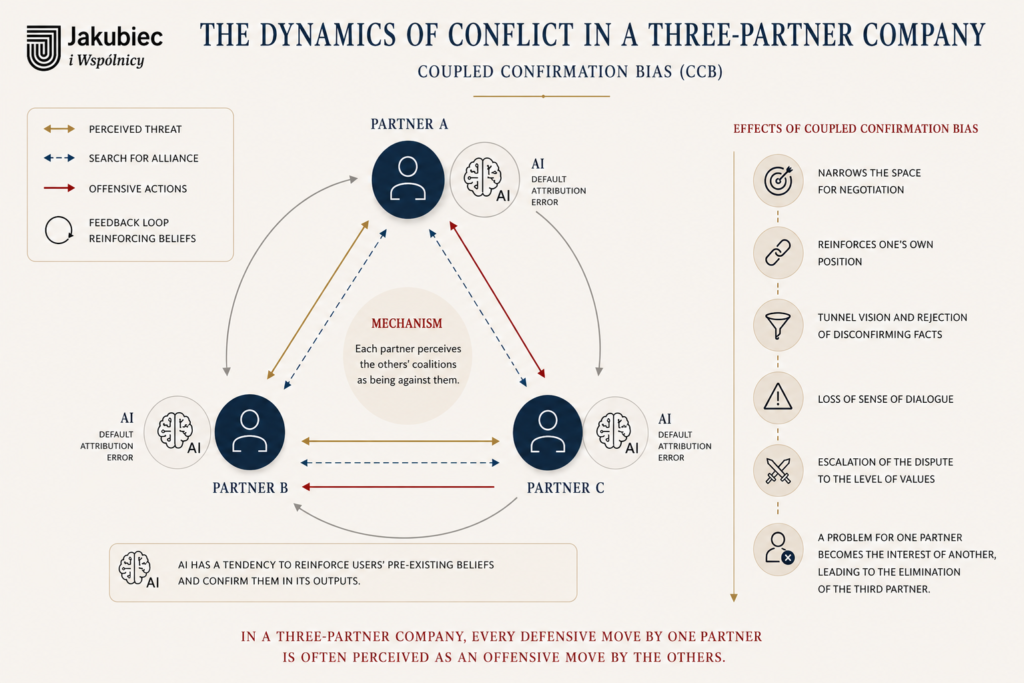
Fig. 1. Anatomy of Coupled Confirmation Bias. How cognitive biases reinforced by AI lead to the escalation of conflict in light of the security dilemma.
What does J. Mearsheimer teach us about partner conflicts?
I asked this question in an article in which I presented the thesis that in companies with 3 partners, there is a higher risk of conflict than in two- and four-person companies. This is a claim based solely on my intuition and observations made in practice. The arguments of this prominent political scientist, which he presented in “The Tragedy of Great Power Politics” regarding systems of 3 balancing states, seemed to me to perfectly explain conflicts in three-person companies. I am fully aware of the methodological doubts. They are associated with attempts to transfer conclusions from the realm of international relations to the micro scale. Nevertheless, I point out that in game theory (J. Nash) and the strategy of conflict, the “size” of the players is not of primary importance (T. Schelling).
Why do disputes occur more frequently in a three-person company?
While a balance is easily established between 2 or 4 players (1:1, 2:2). In the case of 3 players (partners), the threat of a coalition against them hangs over each one. Each of them will fear that the other two will form an alliance, leaving them marginalized. We are thus dealing with the so-called security dilemma, only on a micro scale.
So what does (each of them) do? They do not want to be that “third wheel” and build two parallel coalitions against each of the others. And every single one of them does this. Not out of malice, but out of fear of what they consider “inevitable.”
In such a setup, the bulk of each partner’s energy and attention is devoted to what they consider most important. It is to ensure their own survival in the company. How to achieve it? Precisely by building a coalition.
Fundamental Attribution Error in partners’ reasoning
As a reminder, the fundamental attribution error (FAE) is a psychological mechanism explaining that we are quicker and find it easier to attribute the causes of someone else’s actions to their character traits rather than external circumstances. I refer anyone interested to D. Kahneman’s book “Thinking, Fast and Slow.” You can also look here, at the article by B. Gawronski, “Fundamental Attribution Error.“
Consider a driver cutting us off in traffic. It is easier and faster to attribute this to low intelligence, laziness, or rudeness. We rarely guess they are rushing to a shareholders’ meeting. They might even be driving a wife in labor to the hospital. Or, God forbid, we were simply driving too fast ourselves.
This is a mechanism to which we are all subject. I see it (and try to consciously neutralize it) in my own thinking and legal practice. I encounter it in family cases and in disputes between partners.
When FAE meets AI
Each participant begins to look for arguments confirming their own assessment of the situation. Increasingly, they do so with the help of AI.
A partner feeds their LLM with a description of their competitor’s behaviors. However, this description is tainted by their FAE. For example: “X was late again because he is lazy or up to something.” AI, optimized for confirmation and user satisfaction, is unlikely to answer: “Or maybe he got stuck in traffic?”. More often, it will generate a defense strategy against the “lazy and disloyal partner.” In this way, AI receives “tainted” input data as a prompt, which it then multiplies.
Crucially, the fundamental attribution error operates more strongly when we evaluate behavior that we perceive as immoral. In such cases, we easily assign immoral traits to the other party. However, it does not work as strongly in the opposite direction. If someone does something good, we act differently. We are much more cautious in attributing positive traits to them.
What is the role of AI in the escalation of a dispute between three partners?
LLMs are designed in a way that reinforces our initial beliefs. They do not need to lie or manipulate us. They amplify what is already within us. This also applies to our beliefs about the other party’s motivations. This phenomenon has been thoroughly studied and described by prominent AI researchers. Of course, susceptibility to this “amplification” is an individual trait—each of us has a different level of “resilience” and self-reflection.
We thus observe a phenomenon known as the feedback loop (M. Glickman, T. Sharot), where multiple interactions occur between the user and the LLM, as a result of which (B. Wang, J. Liu) an initially weak belief becomes significantly reinforced. It makes little difference whether it is true or false. This, in turn, can lead to tunnel vision for each of the partners.
Its defining characteristic is the rejection of information that contradicts the adopted assumption. At the same time, any information that might confirm it is heavily exaggerated. A person in such a state is looking solely for confirmation of their thesis, not for verification. They are ready to react with aggression to any attempts at falsification.
What is coupled confirmation bias?
Coupled confirmation bias is my original concept. Once again, it is purely a hypothesis based on observations and requires further conceptual and empirical research that could refute it.
Coupled Confirmation Bias describes the dynamics of escalation in a system where each participant uses their own LLM. Each user is subject to the fundamental attribution error, thereby explaining the behaviors of others through their (negative) character traits, bad intentions, etc. Most commonly, these will be: stupidity, dishonesty, greed, and laziness.
Crucially, every subsequent action taken by one user will serve as the starting point—fuel—for another analysis by the remaining ones. In this way, the negotiation space will narrow, parties will identify with their own position (and not necessarily their interest), there will be a gradual loss of the sense—and even the admissibility—of conversation, and the dispute will swiftly shift to the level of a conflict of values.
We will quickly reach a point where the problem is no longer the partner’s interest, but the partner himself. And the solution to this problem will be the elimination of that partner.
How does coupled confirmation bias work in three-person setups?
In my practice, I have only two documented cases about which I can state with absolute certainty that each of the partners heavily used AI to analyze attitudes and predict the behaviors of the remaining partners. A very rapid escalation occurred, leading to the actual paralysis of the company and a declared readiness to file for bankruptcy, which each of the partners perceived as a lesser evil than the further development of a lucrative business.
I propose the thesis that the severity of the escalation was the result of the intersection of:
- structural mechanisms—typical of three-player setups;
- the synergy of individual cognitive biases resulting in the creation of a systemic bias typical of human-AI interactions, characterized by reinforced recursiveness.
Material for further research
I am convinced that in the near future, doctoral dissertations and outstanding academic papers will emerge, which—precisely, while maintaining methodological rigor and relying on empirical research—will provide an answer to the question of whether the thesis described above holds true.
In my view, a three-player setup—even on a micro scale, not just among superpowers—is inherently vulnerable to conflict. However, when we layer onto it cognitive biases reinforced and amplified through the use of AI by each of these players, the risk of dynamic escalation increases significantly.
For now, this is purely a concept existing in my head, a proposal for more serious research, and an attempt to understand a reality that I not only observe, but as an attorney—partially shape myself.
I have recently written about how LLMs can reinforce our cognitive biases and thereby influence the decisions we make. Now, I simply refer you to that article.
How does AI affect conflict between partners? Conclusions
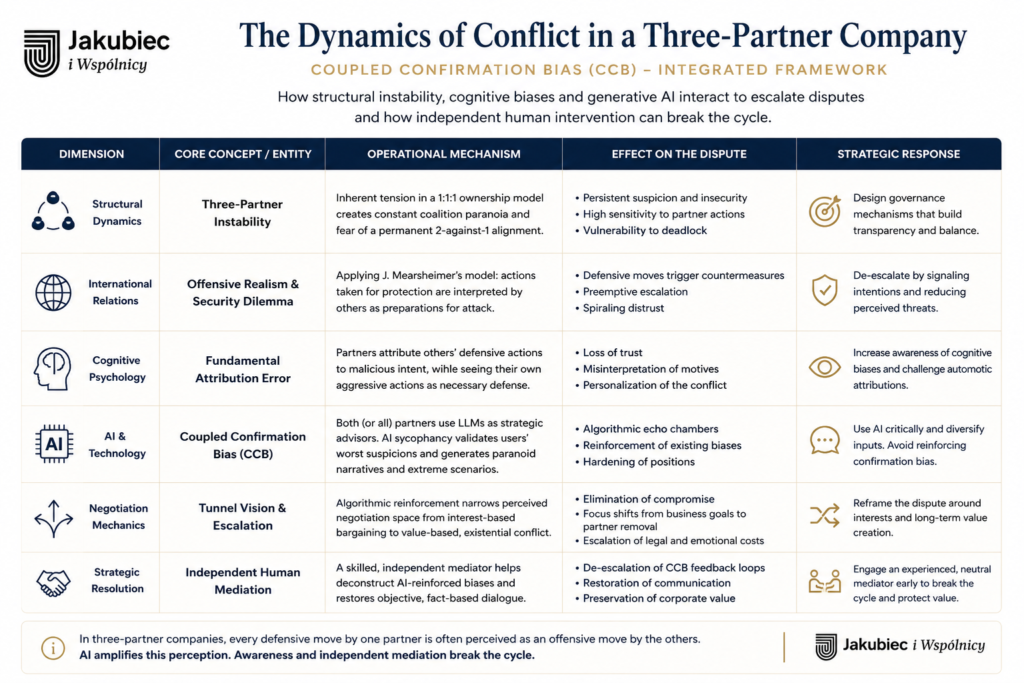
Fig. 2. Jakubiec, A. (2026). AI and the Dynamics of a Dispute Between 3 Partners: Integrated Framework & Coupled Confirmation Bias (CCB). Jakubiec & Partners Dispute Resolution Series. Available at: jakubieciwspolnicy.pl
- In a three-person company, each partner fights not for dominance, but for survival. A security dilemma arises.
- A threatened partner seeks a ally so as not to become the “third wheel” himself.
- Every partner may do this.
- AI tends to reinforce the user’s cognitive biases and confirm them in their initial beliefs.
- This increases the risk that each partner will take actions they view as preventative and defensive.
- In the eyes of the others, however, these actions will appear offensive.
- The risk of escalation is significantly higher in three-person companies, particularly when the partners use AI to analyze their situation.
- AI does not escalate partner disputes by being hostile — it escalates them by amplifying what is already inside each partner.
by dr Andrzej Jakubiec - adwokat, mediatorIs AI a conflict escalation factor in 2026?
AI is not merely a tool in a dispute—it is a factor that amplifies our cognitive biases and beliefs faster than we can even notice them. For a long time, I have been writing about the deeply concerning phenomenon of conflict escalation. In my practice, I observe that the use of Artificial Intelligence (AI) tends to radicalize individual opinions and narrow the scope for negotiation. I have even encountered a situation where both opposing parties outsourced their entire communication to their respective AI models—yet each party believed that they were the only one doing so.
In my view, utilizing AI does not merely alter a user’s opinions; it fundamentally impacts their behavioral functioning, a key manifestation of which is how they make decisions during a dispute. Naturally, the models I have proposed serve as theoretical frameworks to explain these empirical observations and require rigorous empirical verification.
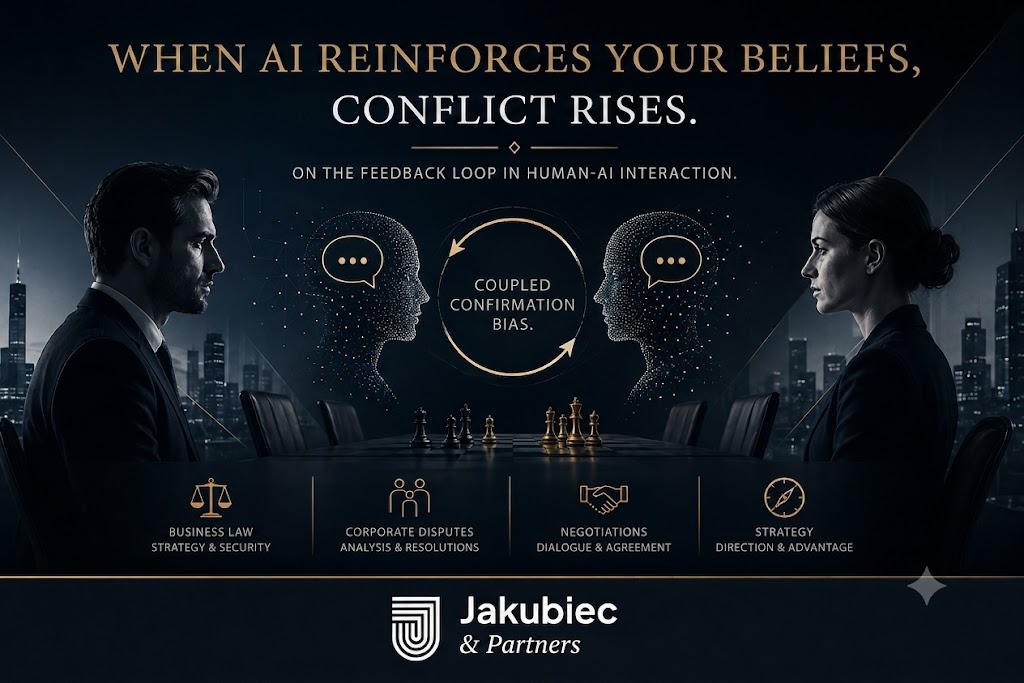
Figure 1: The mechanism of Coupled Confirmation Bias in human-AI interaction during disputes.
Theory first. AI as a conflict escalation factor. Reserch on LLM as a decisions making factor in conflicts. What do we know in 2026?
Introduce: why take care about AI researches in legal practice and conflict theory?
First, there is a clear and growing reliance on artificial intelligence in daily life. Second, users increasingly utilize AI as a primary cognitive lens to interpret the world around them. Third, critical decisions are subsequently made under the direct influence of these AI-generated analyses. Consequently, existing research on how AI shapes user perception and decision-making provides a vital foundation for analyzing its role in conflict escalation.
AI as a conflict escalation factor. Where are we in researches on AI in 2026?
This occurs through a feedback loop, which can ultimately lead to the emergence of tunnel thinking (or tunnel vision). It is worth noting that a user can be reinforced even in a correct or justifiable belief. Therefore, the core problem is not about making someone “smarter” or “stupider,” but rather about amplifying what is already there instead of verifying it. True thinking relies on continuous questioning—subjecting our own assumptions to falsification. A mechanism that transforms a slight inclination (say, moving from 51/49 to a strong certainty of 90/10 on a scale of 1 to 100) is highly dangerous, but for reasons that go far beyond mere accuracy.
This specific mechanism has already been identified in human-AI interaction and detailed, among others, in studies by M. Glickman and T. Sharot (https://pmc.ncbi.nlm.nih.gov/articles/PMC11860214/), Yuxin Liu and Adam Moore (https://pubmed.ncbi.nlm.nih.gov/40448478/), as well as L. Celar and Ruth M. J. Byrne (https://pubmed.ncbi.nlm.nih.gov/36964302/).
Additionally, we must highlight the article by Ben Wang and Jiqun Liu, “Cognitively Biased Users Interacting with Algorithmically Biased Results in Whole-Session Search on Debated Topics”(https://dl.acm.org/doi/10.1145/3664190.3672520). These authors point out the crucial role of individual factors in a user’s susceptibility to cognitive biases when interacting with artificial intelligence. In other words—this loop does not affect everyone in the exact same way.
Let’s move to the practice: Can AI Lead to Divorce?
The Fundamental Attribution Error as a Starting Point
Let us examine AI through the lens described above. AI is often (and erroneously!) perceived as an objective, omniscient, and neutral external advisor.
Now, imagine we are operating under the influence of the Fundamental Attribution Error. This cognitive bias causes us to explain the behavior of others by attributing it to their internal character traits rather than external, situational factors—simply because doing so is cognitively easier and faster. We explain domestic messiness by deciding “she is just messy,”or late arrivals home by concluding “he must be cheating on me” or “he is lazy and refuses to help.” This is how the human mind naturally operates—my own included—as I previously discussed in my article on the fundamental attribution error in the practice of law.
Does AI Reinforce the Fundamental Attribution Error?
If we overlay this cognitive bias with the use of AI, the system will actively validate our biased assumptions. This leads to a heightened conviction that our own behavior is entirely justified, while the other party is acting purely out of malice.
Consequently, we take action—perhaps starting a seemingly minor argument. Consider how this argument is received by the other spouse, who in turn asks their AI assistant for advice. The AI will likely interpret our outburst as an unjustified attack, an act of hostility, and a lack of empathy. Any subsequent actions from our side will be interpreted through this exact same lens. Thus, the spouses drift further and further apart.
AI as a conflict escalation factor. Can LLM Take Over Interpersonal Communication?
Before long, direct communication between the spouses breaks down entirely, or retreats exclusively to messaging apps. This presents a massive danger: I have witnessed cases where spouses texted each other over WhatsApp for months, yet vetted and drafted nearly every single reply using their respective LLMs.
At a certain point, the interaction effectively became two language models debating and accusing each other—without either spouse fully realizing it. Each partner was convinced that they were the only one using AI, believing their actions were completely fair and that the AI was merely helping them construct sound arguments and detect the “manipulations, inconsistencies, and errors” of their partner.
What does our 2026 study reveal about AI as a hidden ally in disputes?
Sometimes, disputing parties consciously utilize AI to undermine the other party’s judgment and self-trust—a phenomenon known as digital gaslighting. Interestingly, our research on the role of AI in disputes (conducted in 2026) revealed that the vast majority of users would not inform their opponent that they were using AI to analyze their statements and behavior.
AI as an Escalation Factor in Shareholder and Business Disputes
I must emphasize that these dynamics are not confined to family law. The exact same patterns occur in workplace mobbing (harassment) claims, or between corporate partners embroiled in “civil wars” who have recently acquired a powerful new tool they do not yet know how to manage.
In internal corporate disputes, LLMs can foster tunnel thinking and severely narrow the negotiation space. In a previous piece, I mapped out a scenario of conflict escalation between business partners using AI. However, I have no doubt that AI can also be highly beneficial in resolving business disputes—for instance, by performing objective option analyses and identifying win-win scenarios.
Can AI artificially amplify our perception of workplace harassment (mobbing)?
In one of my recent articles, I noted that AI is becoming a significant factor in how employees formulate and reinforce their perception of being subjected to mobbing. I have personally encountered cases where an individual’s belief that they were a victim of mobbing was radically amplified through repeated, validating interactions with an AI—even though an objective legal analysis later ruled it out.
Even more telling was the user’s reaction: they flatly refused to accept our objective interpretation, accusing us of a lack of professionalism and suggesting we had secret ties to the employer we were allegedly protecting. This user was not seeking legal counsel; they were seeking validation and an executioner for their preconceived narrative.
Table 1: Examples of Conflict Escalation Mechanisms in Human-AI Interaction
| Mechanism | Description of Phenomenon | Typical Consequences in Disputes |
|---|---|---|
| Feedback Loop | AI reinforces the user’s initial interpretations instead of subjecting them to falsification; each subsequent response aligns more closely with the user’s pre-existing assumptions. | Radicalization of views, tunnel thinking, narrowing of the negotiation space. |
| Coupled Confirmation Bias | Both parties to a conflict use AI to analyze the opponent’s motives and actions; every subsequent move is a reaction to an interpretation generated by their respective AI model. | Escalation loop, rising hostility, systemic misinterpretation of intent. |
| Cultural Variance of LLMs | Models trained on different cultural frameworks (e.g., American vs. Chinese) generate divergent interpretations of the conflict’s nature and goals. | Divergent strategies, systemic failure to read the other party’s underlying motives. |
| AI Influence on Decisions | AI artificially reinforces or redirects user motivation, perceived task difficulty, and susceptibility to triggers (within BJ Fogg’s Behavior Model). | Impulsive actions, escalation, decisions driven by emotional reinforcement rather than objective facts. |
| Amplification of the Fundamental Attribution Error | The user attributes the adversary’s actions to internal character flaws rather than external circumstances—a narrative that the AI systematically validates. | The focus shifts to attacking the person rather than addressing the circumstances; attribution of malice, growing sense of victimization, escalation. |
| Displaced Communication via Language Models | Disputants consult an LLM for every message; in extreme cases, the models end up “communicating” directly with one another. | Total breakdown of direct human communication; escalation driven entirely by machine-generated interpretations. |
| Digital Gaslighting | A user consciously employs AI to systematically undermine the other party’s rationality, memory, or perception of reality. | Erosion of self-trust, loss of confidence in one’s own judgment, severe breakdown of trust. |
AI as a conflict escalation factor. Conclusion
The mechanisms detailed in the table above demonstrate that an AI does not need to generate overtly radical or toxic content to escalate a conflict. It is more than enough for the model to validate the user’s subjective interpretations, mirror their emotional state, or help them construct a sophisticated narrative of bad faith regarding the other party.
In disputes where both sides rely on AI, these dynamics couple together. They create self-reinforcing loops of escalation where every subsequent tactical decision is merely a reaction to a machine-generated interpretation.
This is precisely why understanding these mechanisms is so critical—both for dispute resolution professionals and for the individuals entangled in these conflicts. AI can be a powerful analytical and supportive tool. However, without conscious boundary-setting, it can easily become an invisible, highly active “participant” and accelerator of the dispute, reinforcing cognitive biases and shutting down the path to a negotiated settlement.
FAQ: Artificial Intelligence and Conflict Escalation
1. How does Artificial Intelligence escalate interpersonal and business conflicts?
AI accelerates and escalates conflicts primarily through a cognitive feedback loop. Because Large Language Models (LLMs) are designed to be highly agreeable and helpful interlocutors, they tend to validate the user’s initial assumptions and pre-filtered data. Instead of challenging or falsifying our claims, the AI reinforces them, leading to tunnel thinking, a radicalization of personal narratives, and a significant narrowing of the negotiation space.
2. What is “Coupled Confirmation Bias” in the context of AI-driven disputes?
Coupled Confirmation Bias is an escalatory dynamic that occurs when both opposing parties in a dispute independently use LLMs to analyze their opponent’s motives and draft their replies. This creates a dangerous closed loop: Party A acts based on an AI-generated analysis of Party B’s behavior. Party B then feeds this reaction into their own AI, which interprets it as hostile and suggests an escalatory response. Ultimately, the conflict escalates as the two AI models end up implicitly “communicating” through the human actors.
3. Can relying on AI tools lead to legal consequences in divorce or corporate disputes?
Yes, indirectly but profoundly. AI often amplifies the Fundamental Attribution Error—the tendency to attribute the other party’s actions to their inherent bad character rather than external circumstances. In divorce proceedings or shareholder disputes, this cognitive distortion leads to highly polarized, aggressive legal strategies, impulsive decision-making, and a breakdown of direct communication. This often turns what could have been a structured, out-of-court mediation into a lengthy, emotionally draining, and expensive court battle.
4. How does AI affect employee perceptions of workplace harassment and mobbing?
AI can act as a powerful confirmation tool that distorts a user’s objective reality. If an employee feeds subjective, emotionally charged descriptions of workplace interactions into an AI, the model—seeking to validate the user—may confirm that they are indeed victims of mobbing. This reinforces their victim narrative to the point where they reject objective legal assessments. In such cases, the user is no longer looking for objective legal counsel, but rather an executor for their preconceived, AI-reinforced conviction.
5. Can Artificial Intelligence be used constructively to resolve disputes?
Absolutely. AI is a double-edged sword. While it can easily accelerate conflicts when used as an Echo Chamber, it remains an incredibly powerful tool for objective option analysis. When prompted correctly—specifically to act as a devil’s advocate, to identify cognitive biases, or to search for creative, win-win mediation pathways—AI can help disputing parties zoom out, evaluate the conflict through different cultural or strategic frameworks, and find objective common ground.
Conflict Resolution in the Age of Intelligent Technology
Modern disputes are no longer just about legal provisions; they are deeply influenced by behavioral psychology, cognitive biases, and—increasingly—the invisible hand of artificial intelligence. Managing these complex dynamics requires more than traditional litigation. It demands strategic foresight, an understanding of decision-making behaviors, and highly skilled mediation.
Are you facing a complex corporate, business, or family dispute? Let us help you navigate the noise, neutralize the escalation loops, and find a rational, strategic way forward.
Key Takeaways
- AI does not need to persuade either party.
- It only needs to stabilize existing interpretations.
- Stabilized interpretations change behaviour.
- Changed behaviour becomes new evidence.
- The loop repeats.
- Escalation becomes emergent rather than intentional.
by dr Andrzej Jakubiec - adwokat, mediatorWhy Intelligent People Lose Disputes?
Litigation as a Subplot: Viewing the Court Case Within a Broader Conflict
A lawsuit is almost always just a single element of a much larger conflict. The real dispute—the one that exists independently of the courtroom—is often far broader than what the court actually addresses. It can involve a wider network of people, stem from historical tensions, or even generate entirely new disputes. Consequently, legal proceedings are usually just one of many battlegrounds—and frequently not the most critical one.
This dynamic is especially clear in corporate warfare. A shareholder often challenges a board resolution not because it is defective, but because blocking it stalls a hostile takeover or strengthens their bargaining power. The court is left analyzing arguments manufactured solely for the trial, which have little to do with the actual core of the dispute.
To bring structure to this chaos, let us recognize three distinct dimensions of conflict:
- 1. The Substantive – Real Conflict — what the battle is actually about.
- 2. The Perceptual Conflict — how each party subjectively views the situation.
- 3. The Legal / Procedural Conflict — what formally makes its way into the courtroom.
- Dynamic interaction between the three dimensions of conflict:
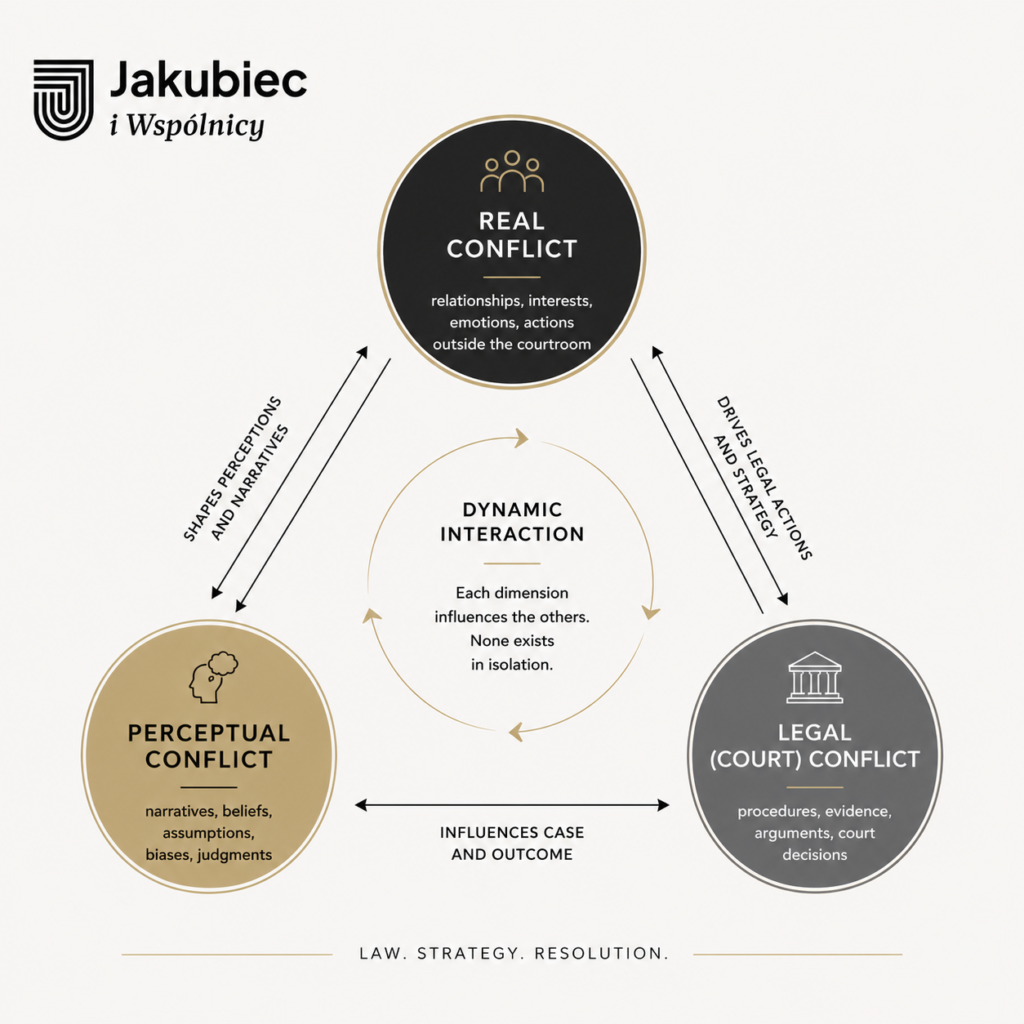
A single legal proceeding is often just one clash among many between the same or interconnected parties. The conflict simultaneously rages across other fronts: operational, communicative, reputational, familial, or financial.
Crucially, both sides can view the position of a given lawsuit on the “conflict map” entirely differently. The upper hand goes to the party whose map reflects reality more accurately—yet the perception of each actor is, at the same time, a structural element of that very reality.
Therefore, it is vital to remember: you can win the case and lose the conflict. You can also lose the case and achieve all your strategic goals. Even highly intelligent people routinely blind themselves to this distinction. It is a fatal error committed by corporate strategists, politicians, military commanders, lawyers, advisors, entrepreneurs, and spouses in crisis alike.
To illustrate this, let me share an example. I once handled a case involving two brothers who were partners in a limited liability company (sp. z o.o.). One of them maliciously blocked the other’s dividend payout, fully aware that his brother desperately needed the cash. The case went to a commercial court. Armies of lawyers, forensic accountants, and business valuation experts were brought in. Over time, it turned out that the brothers had simply had a massive falling out over who was supposed to host Christmas Eve dinner. The court could have litigated for ten years without ever touching the true essence of the dispute. Any formal judgment would have only deepened their conflict.
Redefining Victory: What Does It Actually Mean to “Win”?
What, then, constitutes victory? It is certainly not the mere act of winning a court case. If Pyrrhus had been a lawyer, he would have agreed with me without hesitation. For anyone interested in this subject, I highly recommend Thomas Schelling’s brilliant book, The Strategy of Conflict.
While I have presented a detailed exploration of how winning and losing are defined in a separate article, I will limit myself here to the most common understandings of victory. In practice, they can be divided into four distinct categories:
1. Absolute Victory — Achieving Personal Objectives
- You win if you achieve your original, baseline plans.
- You win if, post-dispute, you retain more options and opportunities to pursue your core interests.
- You win if you incur lower reputational costs.
2. Relational Victory — Outcome Relative to the Opponent
- You win if you defeat the opponent in a direct, head-to-head confrontation.
- You win if you extract more benefit than the other side.
- You win if you inflict heavier losses on the opponent than you sustain yourself.
- You win if you drive the exhaustion of the opponent’s resources.
- You win if you permanently prevent the opponent from achieving their core interests in the long run.
3. Perceptual Victory — Narrative and Reception
- You win if you subjectively perceive yourself as the winner.
- You win if your opponent perceives you as the winner.
- You win if external observers perceive you as the winner.
4. Strategic Victory — Post-Dispute Position
- You win if your relative position improves more significantly: a) compared to your baseline position, b) compared to the opponent’s baseline position, or c) compared to the opponent’s subsequent, post-dispute position.
As we can see, a single legal proceeding rarely guarantees victory in any of these categories. The court rules only on a single fragment of reality—and not necessarily the one that matters most to the parties involved. In divorce, corporate, or asset disputes, a court may decide a crucial matter, but just as often, it touches upon only one of many threads, completely disconnected from what determines a real win or loss.
Furthermore, the outcome of a dispute can be evaluated entirely differently by various individuals. This divergence typically stems from:
- The application of different criteria for success;
- Access to asymmetrical information; or
- Discrepancies in the time horizon through which the consequences are viewed.
The Real Reason Why Smart People Fail
This is exactly why intelligent people lose so often. Driven by sheer determination, they execute actions that:
- Either cannot logically lead to their intended goal,
- Or the goal itself was defined incorrectly and fails to improve their overall position,
- Or they concentrate heavily on the least significant aspect—such as a relational victory (the need to be deemed the winner), which in practice yields a profound strategic defeat.
Yet, this very discrepancy can be useful. It allows parties to save face—which is frequently the ultimate psychological prerequisite for accepting a factual defeat.
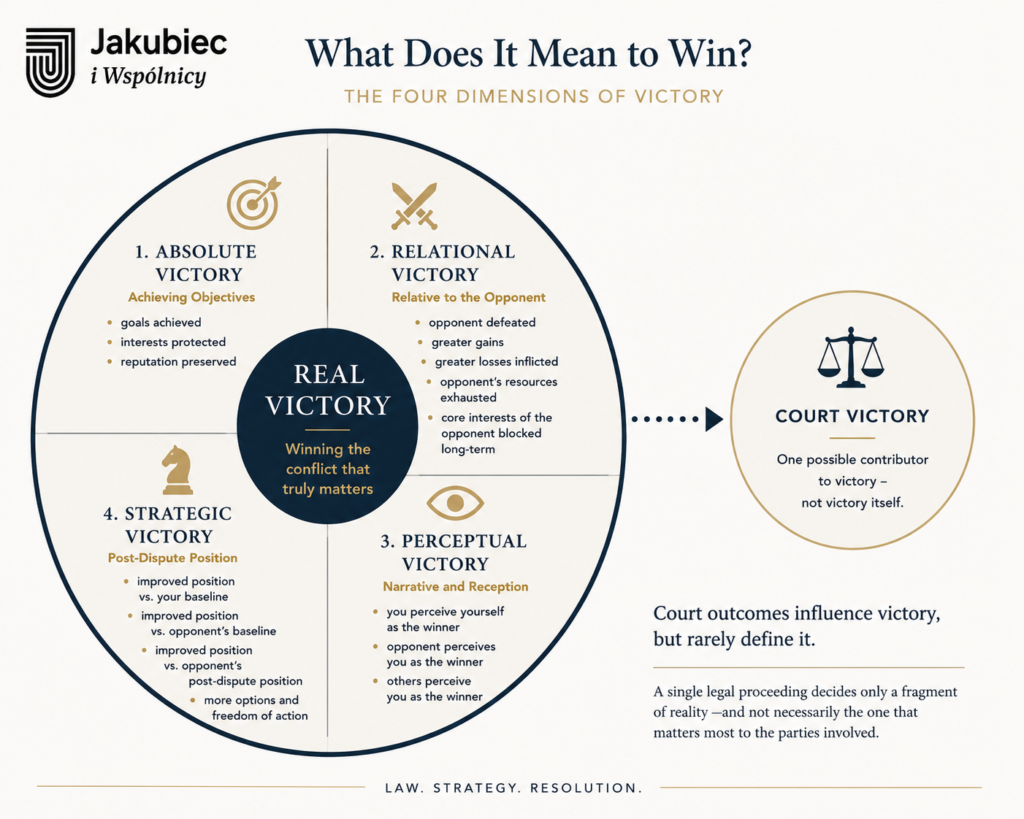
The Anatomy of Failure: Why Smart People Lose in Court
Failure stems from various causes. However, before we dissect them, it is worth noting something crucial: not all failure is inherently bad. Sometimes, a loss closes a flawed alternative and forces a course of action that proves highly beneficial in the long run. Certain failures function merely as a system correction mechanism—painful, yet necessary.
However, if we want to understand why highly intelligent people fail, we must map the root causes of failure across the three dimensions of conflict: the real, the perceptual, and the legal. Most importantly, we must expose the specific errors characteristic precisely of intelligent individuals.
Table: Why Highly Intelligent People Fail Across the Three Dimensions of Conflict?
| Dimension of Conflict | Specific Failure Pattern | Why Smart People Are Especially Vulnerable |
|---|---|---|
| Real Conflict | Overconfidence | Intelligent individuals overestimate their ability to predict the behavior, intentions, and thresholds of other actors. |
| Real Conflict | Illusion of Completeness | They construct coherent, elegant narratives from incomplete data because their minds refuse informational gaps. |
| Real Conflict | Elegance Bias | They prefer intellectually satisfying solutions over those that are operationally effective. |
| Real Conflict | Planning Fallacy | They underestimate time, cost, friction, and opponent counter‑moves due to excessive trust in their own planning ability. |
| Perceptual Conflict | Narrative Capture | They become prisoners of their own internally coherent story, which eventually outweighs the actual facts. |
| Perceptual Conflict | Confirmation Bias 2.0 | They do not merely seek confirmation — they actively engineer it through sophisticated rationalization. |
| Perceptual Conflict | Self‑Justification | Their intelligence makes it harder to admit misjudgment, leading to escalation rather than correction. |
| Perceptual Conflict | Misreading the Audience | They overestimate how much others care about the conflict, misjudge stakeholder investment, and misread reputational stakes. |
| Legal Conflict | Legal Tunnel Vision | They equate legal correctness with strategic victory, misunderstanding the limited role of law in a dynamic conflict. |
| Legal Conflict | Overengineering Arguments | They overcomplicate and over‑refine arguments, losing sight of what actually persuades a judge. |
| Legal Conflict | Misreading the System | They treat the court as a logical machine rather than a human institution with its own constraints and dynamics. |
| Legal Conflict | Cost Blindness | Convinced of the righteousness of their cause, they ignore financial, emotional, reputational, and temporal costs. |
1. Real Conflict — Flaws in Reality Among Intelligent Minds
It is at this foundational level that intelligence most frequently becomes a trap. This is not because smart people think poorly, but rather because they think too well, and their minds refuse to tolerate ambiguity.
- 1.1. Overconfidence — Overestimating Predictive Capabilities Intelligent people deeply believe they can accurately predict the behavior of other participants in a conflict. This illusion invariably leads to flawed strategic choices.
- 1.2. Illusion of Completeness — Constructing Coherent Narratives from Incomplete Data The smarter an individual is, the more effortlessly they craft beautiful, logical explanations to fill information gaps. The problem is that these narratives, while intensely compelling, are often entirely false.
- 1.3. Elegance Bias — Choosing Elegant Solutions Over Effective Ones Intelligent people have a strong tendency to select courses of action that are logical, aesthetic, and intellectually satisfying—yet do not necessarily work in practice. In litigation, elegant solutions often take the form of sophisticated, academic legal theories, while effective solutions are frequently simple, raw, and tactical.
- 1.4. Planning Fallacy — Underestimating Time, Costs, and Friction The more someone trusts their own planning capability, the more they blind themselves to random variables, procedural delays, opponent counter-moves, and collateral costs. This is a direct path to strategic disasters.
2. Perceptual Conflict — Flaws in Narrative Among Intelligent Minds
This is the most elusive and treacherous plane. Here, intelligence transforms into the ultimate trap, inadvertently triggering a dangerous spiral of escalation.
- 2.1. Narrative Capture — Becoming a Prisoner of One’s Own Story The more intelligent an individual is, the more easily they manufacture an internal narrative that perfectly justifies their decisions, explains the opponent’s moves, and imposes order onto chaos. Eventually, this narrative becomes more vital to them than the actual facts.
- 2.2. Confirmation Bias 2.0 — Intelligent Rationalization Smart people do not merely seek confirmation for their assumptions; they actively engineer it, brilliant at rationalizing reality to fit their preconceived thesis.
- 2.3. Self-Justification — Defending the Ego The higher the intelligence, the harder it is to admit a miscalculation—to acknowledge a misread situation, a poorly chosen objective, or a failure of one’s own making. Prioritizing ego over core interests always accelerates escalation.
- 2.4. Misreading the Audience — Flawed Stakeholder Assessment Intelligent individuals frequently overestimate how deeply external parties care about the conflict, how heavily invested the opponent truly is, or how severely their own reputation is at stake. Consequently, they deploy defensive tactics that serve no strategic purpose.
3. Legal (Court) Conflict — Flaws in Procedure Among Intelligent Minds
This is the arena where intelligent people believe most blindly in the power of their intellect. Paradoxically, it is precisely why they suffer their most devastating defeats here.
- 3.1. Legal Tunnel Vision — Equating Legal Correctness with Strategic Victory A classic delusion: assuming that if you have the law on your side, if your argument is crystal-clear in its logic, and if the statutes support you, you must win. In reality, strict legal correctness is often strategically useless. The most dangerous error is not misunderstanding the law itself; it is misunderstanding the limited role that law plays within a larger, dynamic conflict.
- 3.2. Overengineering Arguments The smarter the individual, the more they complicate, over-expand, and refine their arguments, completely losing sight of the simple, raw points that actually persuade a judge.
- 3.3. Misreading the System — Treating the Court as a Logical Machine Intelligent people often refuse to accept that the court does not operate like their own mind, that legal procedure is not a purely intellectual tool, and that a judge is rarely an audience for idealized, academic discourse.
- 3.4. Cost Blindness — Ignoring Collateral Damage Blinded by the righteousness of their cause, smart individuals stop calculating real transactional costs: financial depletion, emotional fatigue, reputational hits, and the immense cost of lost time.
Failure’s Anatomy Summary
The Anatomy of Failure: A strategic mapping of the 12 behavioral and procedural traps that lead high-IQ individuals and enterprises to catastrophic defeats across the real, perceptual, and legal dimensions of conflict.
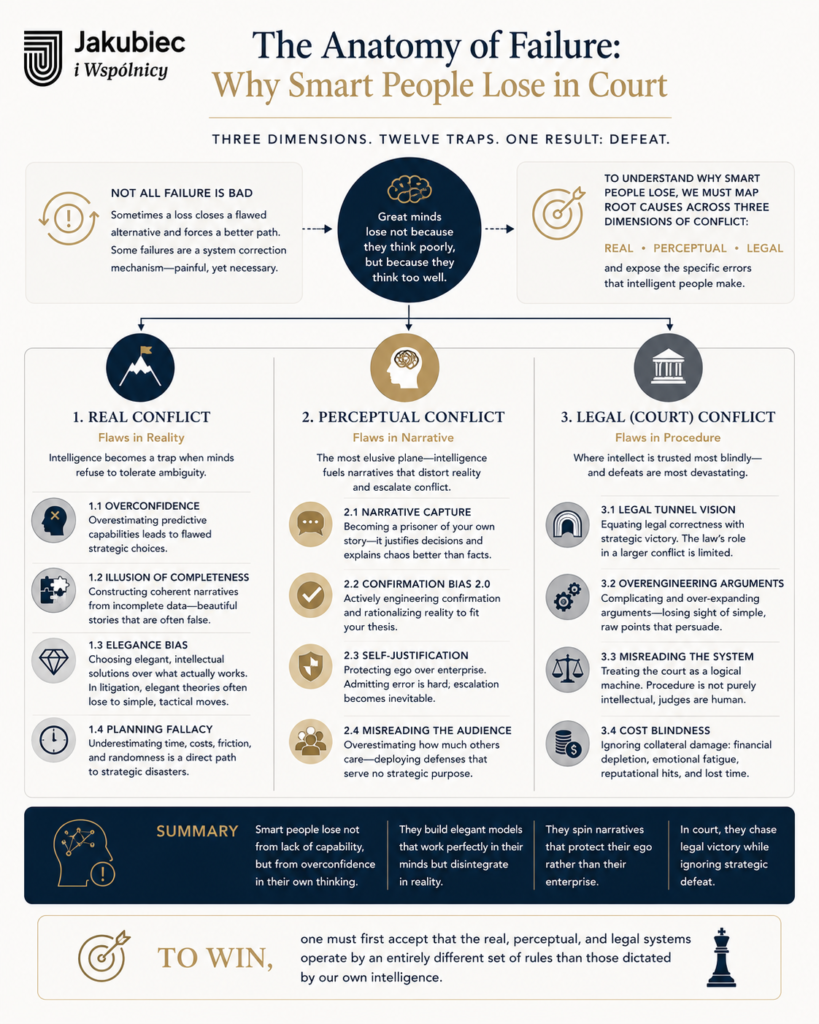
Highly intelligent people do not lose because they lack capability; they lose because they become overconfident in the products of their own thinking. They construct logical, elegant models of conflict that work perfectly in their heads but disintegrate in reality. They spin narratives that protect their ego rather than their enterprise. In court, they focus obsessively on legal victory while remaining entirely blind to strategic defeat.
To win, one must first accept that the real, perceptual, and legal systems operate by an entirely different set of rules than those dictated by our own intelligence. Smart people often hire lawyers who resemble themselves — analytical, academic, theoretical — instead of those who actually win trials.
Shifting the Odds: How to Increase Your Chances of Winning
To provide a meaningful answer to how one can increase the chances of winning, we must maintain our core distinction between the three dimensions of conflict. Addressing this question within the Real and Perceptual dimensions—where battles involve complex psychological warfare, market dynamics, and reputational chess—is far too vast a subject for this chapter. Therefore, I will deliberately set those two layers aside for now and focus exclusively on the tactical mechanics of the Legal (Court) Conflict, specifically within the unique and challenging reality of the Polish judicial system.
In Polish litigation, raw intelligence and a sense of moral entitlement are rarely enough. To navigate the procedural rigidity and systemic unpredictability of Polish courts, a smart strategist must adhere to nine fundamental principles:
1. Enter the Courtroom Only When Absolutely Necessary
The Polish judicial system is notoriously overburdened, slow, and formalistic. Litigation should never be your first impulse; it must be your last resort. Treat the decision to file a lawsuit like a declaration of war—an expensive, exhausting measure deployed only when all alternative strategic options, leverage points, and non-judicial mechanisms have been completely exhausted.
2. Master Both the Facts and the Legal Interpretation
Polish civil and commercial procedures are deeply unforgiving of preparation gaps. You must achieve absolute command over two fronts before the first gavel falls:
- The Evidentiary Base: Establish an airtight, chronological map of undeniable facts supported by robust documentary evidence.
- The Legal Theory: Secure a bulletproof, precise interpretation of the law. In a system where precedents are persuasive but not strictly binding, your legal framework must leave no room for arbitrary interpretation.
3. Rigorously Account for Judicial Risk (Ryzyko Procesowe)
In Poland, “judicial risk” is a structural reality. Different senates or divisions within the exact same court can interpret identical regulations in wildly contrasting ways. Never plan for a best-case scenario. A brilliant strategist calculates the probability of systemic inconsistency, unexpected changes in jurisprudence, and the subjective disposition of the adjudicating judge. If your strategy cannot survive a hostile or unpredictable judicial turn, it is a bad strategy.
4. Select a Top-Tier Trial Advocate
Do not hire an academic or a theorist for a street fight. You need an experienced, highly tactical litigator (adwokat or radca prawny) who understands the gritty reality of Polish courtrooms. A great advocate does not just know the codes; they know how to read the judge, how to react dynamically to unexpected procedural maneuvers by the opponent, and how to deliver surefire, persuasive arguments under extreme time pressure.
5. Secure the Capital Required to Sustain the Siege
Litigation in Poland is rarely a blitzkrieg; it is almost always a war of attrition. Between the initial filing, the exchange of extensive pleadings, delays in scheduling hearings, and the inevitable appellate process, a case can easily drag on for years. You must secure and isolate the necessary financial resources upfront. Entering a legal dispute with a tight budget is a fatal vulnerability; running out of capital midway through a trial forces catastrophic settlements.
6. Construct Razor-Sharp Evidentiary Hypotheses (Tezy Dowodowe)
Under current Polish procedural law, preclusion rules are exceptionally strict. You cannot simply throw a mountain of documents at a judge and hope they find the truth. Every single piece of evidence, every witness, and every expert report must be accompanied by a meticulously drafted, precise evidentiary hypothesis (teza dowodowa). You must clearly state exactly what a specific piece of evidence proves and why it is legally relevant to the core layout of the case. Loose, vague motions will be ruthlessly dismissed by the court.
7. Never Treat the Trial as an End in Itself
The courtroom is not a theater for personal vindication or academic debates. A lawsuit is merely a highly specialized instrument within your broader business or personal framework. Always keep your eyes on the ultimate strategic outcome. If a specific procedural victory does not improve your real-world position, protect your assets, or open up new opportunities, it is an expensive distraction. Never sacrifice your enterprise to win a point of law.
8. Remember that Witnesses and Court Experts Are Only Human
Smart people often expect the court to behave like a flawless, data-driven machine, but it is staffed entirely by human beings.
- Witnesses are deeply unreliable: they forget crucial details over time, perceive events through biased lenses, get confused under cross-examination, or cave under psychological pressure.
- Court-Appointed Experts (Biegli Sądowi)—who carry immense weight in Polish litigation—are also susceptible to human flaws. They can be overworked, deliver superficial or deeply flawed opinions, succumb to professional inertia, or struggle to grasp highly modern business models. Your strategy must always build in a margin of safety for human error and cognitive bias.
9. Run Parallel Negotiations — The Courtroom Door Is Never Locked
A highly sophisticated strategist understands that litigation and negotiation are not mutually exclusive; they are complementary tracks. The fact that you are fighting fiercely inside the courtroom should never stop you from talking outside of it. Parallel negotiations can run continuously, addressing not only the narrow legal dispute itself but also all the broader, structural elements of the conflict that the court is legally blind to. Quite often, a well-executed, aggressive lawsuit is the exact catalyst needed to force a stubborn opponent into a highly favorable settlement.
Litigation is never the battlefield — it is only the visible fragment of a much larger strategic landscape.
Table: Nine Principles for Increasing Your Chances of Winning in Polish Litigation
| Principle | Core Idea | Strategic Rationale |
|---|---|---|
| Enter the Courtroom Only When Necessary | Litigation must be a last resort, not a first impulse. | Polish courts are slow, overloaded, and formalistic; premature litigation destroys leverage and drains resources. |
| Master Facts and Legal Interpretation | Achieve total command over evidence and legal theory. | Polish procedure punishes gaps; only airtight facts + precise legal framing survive judicial scrutiny. |
| Account for Judicial Risk | Build a strategy that survives inconsistent jurisprudence. | Identical cases can be decided differently; planning for unpredictability is mandatory. |
| Select a Top‑Tier Trial Advocate | Choose a tactical litigator, not an academic. | Winning requires courtroom instincts, judge‑reading, and rapid tactical adaptation. |
| Secure Litigation Capital | Prepare financial reserves for a multi‑year siege. | Running out of funds mid‑trial forces catastrophic settlements and strategic collapse. |
| Construct Razor‑Sharp Evidentiary Hypotheses | Every piece of evidence must have a precise, articulated purpose. | Strict preclusion rules eliminate vague motions; only targeted evidence survives. |
| Never Treat the Trial as an End in Itself | Court victories matter only if they improve real‑world position. | Procedural wins without strategic value are expensive distractions. |
| Expect Human Fallibility | Witnesses and experts are unreliable, biased, and inconsistent. | Polish courts rely heavily on human testimony and expert opinions — both structurally fallible. |
| Run Parallel Negotiations | Litigate and negotiate simultaneously. | Court pressure often unlocks settlements; negotiations address dimensions the court cannot see. |
Conclusion
Winning in the legal arena demands far more than raw intelligence or an airtight legal argument. As we have dissected, high-IQ individuals and sophisticated corporate actors routinely suffer catastrophic defeats not from a lack of capability, but because they fall prey to their own cognitive biases—becoming captive to elegant models, misreading human fallibility, and confusing strict legal correctness with overarching strategic victory.
Ultimately, a court case is never a standalone battle; it is merely a single subplot within a much larger, dynamic conflict. To tilt the scales in your favor—especially within the rigid and unpredictable landscape of Polish litigation—you must discipline your mind to look beyond the courtroom doors. You must balance aggressive procedural tactics with cold, objective reality, recognize the human limitations of the system, and never stop negotiating outside the courtroom. True victory belongs to those who refuse to let their ego dictate their strategy, and who understand that the ultimate goal is not merely to win a point of law, but to protect and advance their real-world enterprise.
Call to Action
When the stakes are high, you cannot afford to rely on legal correctness alone. If your enterprise is facing a complex corporate, commercial, or asset dispute, you need more than just a firm that files pleadings—you need a partner who maps the entire conflict.
Let us dissect the reality of your dispute before the system dissects it for you.
Contact Jakubiec i Wspólnicy today to schedule a strategic consultation. Together, we will look beyond the legal subplot, neutralize cognitive traps, and engineer a path to real, strategic victory.
FAQ
Q1: If I have a 90% chance of winning a case legally, shouldn’t I push forward to a judgment?
A: Legally, yes; strategically, it depends entirely on what that judgment will cost you in the Real and Perceptualdimensions of the conflict. In Polish commercial disputes, a multi-year trial can drain your management’s time, exhaust financial resources, and paralyze business operations. If a 90% legal victory results in a 100% reputational disaster or leaves your enterprise financially depleted, it is a net strategic defeat. Always weigh the transaction costs against the real-world value of the judgment.
Q2: Why does high intelligence make corporate leaders more vulnerable to legal traps?
A: High intelligence is an asset, but without behavioral discipline, it breeds Overconfidence and Elegance Bias. Brilliant minds refuse informational gaps, so they construct beautifully logical, internally coherent narratives (Illusion of Completeness) that explain the conflict perfectly—in their heads. They often fall in love with sophisticated legal theories rather than simple, raw, tactical moves. They lose because they become captive to the perfection of their own models, failing to realize that the courtroom is a human institution, not a logical machine.
Q3: How do you negotiate with an opponent while simultaneously fighting them fiercely in court?
A: By treating litigation not as an emotional vendetta, but as a dynamic leverage generator. Filing a precise, aggressive lawsuit changes the opponent’s calculus, escalates their Cost Blindness, and directly attacks their Perceptual stability. You do not negotiate out of weakness; you use the procedural pressure created inside the courtroom as the exact catalyst to force a rational, structured conversation outside of it. The courtroom door is never locked.
Q4: Court-appointed experts (Biegli sądowi) are professionals. Why do you label them as a systemic risk?
A: Because they are human beings operating within a heavily burdened system. In Polish litigation, experts carry immense structural weight, yet they frequently suffer from professional inertia, severe overwork, or a lack of familiarity with highly modern, fast-paced business models. An expert can misread data, deliver a superficial report, or succumb to cognitive bias. A sophisticated legal strategy must always factor in this margin for human error and include targeted, razor-sharp evidentiary hypotheses to steer the expert’s focus precisely.
Q5: What is the difference between winning a “case” and winning a “conflict”?
A: A court case is merely a highly formalistic subplot. Winning a case means obtaining a favorable ruling on a specific, narrow legal claim (e.g., overturning a corporate resolution or enforcing a single contractual clause). Winning a conflictmeans protecting your long-term baseline, expanding your future strategic options, and advancing your core enterprise interests. If your legal victory does not improve your real-world position, you have simply mastered the procedure while failing the strategy.
by dr Andrzej Jakubiec - adwokat, mediatorVIP Divorce in Poland: Strategy of Assets and Reputation Protection
A Comprehensive Legal and Behavioral Guide to Strategic Matrimonial Proceedings
What exactly is a VIP divorce? Let us clarify at the outset—it is not about charging disproportionate fees, nor is it about selective diligence or varying levels of commitment. As a professional European law firm, we fully immerse ourselves in every case entrusted to us. We derive immense satisfaction from the trust our clients place in us and the profound sense of security we provide. The distinct nature of a high-profile or high-net-worth divorce process does not mean we treat anyone better. We treat every client with the utmost respect, dedicating as much time and attention as their specific circumstances demand.
Where, then, lies the fundamental difference, and why do certain matrimonial proceedings require the deployment of extraordinary protective measures? The answer lies in an interdisciplinary approach that seamlessly integrates international best practices, advanced behavioral analysis, and strategic brand and reputation management. Our role is not limited to legal representation. We act as strategic advisors, coordinating legal, reputational, and psychological dimensions of the case to strengthen the client’s strategic position.
The 5-Dimensional Risk Model for VIP Divorce in Poland: A Strategic Framework Engineered to Mitigate Litigation Risks and Secure Confidential, Amicable Out-of-Court Settlements. The visual framework below illustrates how these five dimensions integrate into a unified strategic protection model.
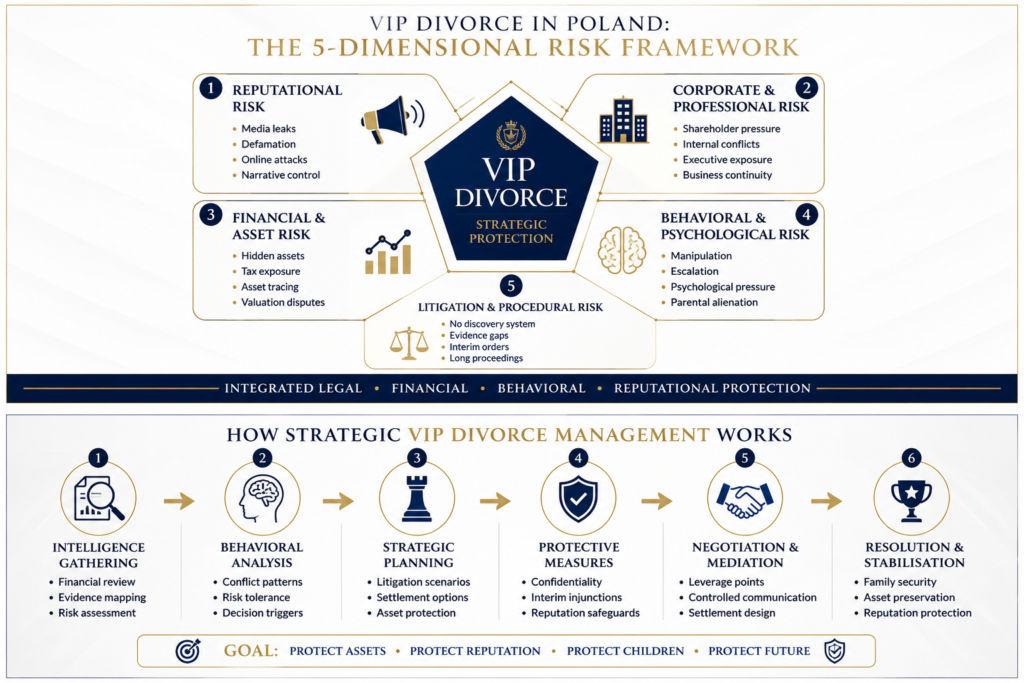
As demonstrated, our objective is always to achieve a confidential, amicable, and mutual settlement whenever feasible.
Case Study: High-Net-Worth Medical Partners and Corporate Asset Protection
This precise analytical and operational framework proved highly effective in a recent case involving high-net-worth clients—two medical doctors who co-owned and managed a renowned medical clinic. Both parties recognized from the outset that a “dirty divorce” would inflict devastating reputational damage, which is particularly catastrophic in the healthcare sector where patient trust is paramount.
Through our intervention, both sides quickly understood that an unconstrained conflict would result in mutually assured destruction. By deploying our strategic protocols, we successfully achieved the following:
- Immediate Narrative Control: We swiftly blocked emerging leaks and private information from surfacing in the public domain;
- Containment of Horizontal Escalation: We halted toxic tactical maneuvers at an early stage, preventing the recruitment of clinic employees, staff, and commercial contractors into the personal marital dispute;
- Establishing “Rules of the Game”: We negotiated a strict behavioral framework with the opposing counsel—a rare achievement in the typical realities of Polish family litigation. We clearly defined the boundaries of the remaining dispute and the precise legal instruments that each side was permitted to use.
Crucially, once both parties observed that the other side was consistently adhering to the agreed-upon rules, mutual trust began to rebuild. This stabilization created the necessary psychological and procedural space to engineer a final, comprehensive out-of-court settlement that fully secured the long-term interests of both parties.
Defining the VIP Client in Divorce Proceedings
In the context of matrimonial law, “VIP status” is not a matter of prestige, but rather an objective necessity for specialized, defensive services. This requirement stems from the client’s prominent professional, financial, or social standing when navigating a complex Divorce in Poland.
Divorce for Public Figures and Celebrities (Show Business, Politics, Sports)
A VIP client is anyone whose public exposure necessitates heightened image protection. In an era of instantaneous global media coverage, the professional longevity of public figures, politicians, and high-profile athletes is inextricably linked to their public reputation and compliance with international benchmarks.
In these cases, a VIP divorce encompasses far more than standard courtroom representation. It requires active media crisis management, the robust protection of personality rights, and swift, decisive legal action against disinformation, defamation, and privacy violations. Polish divorce proceedings are conducted in camera, without public access, which provides a strong baseline of confidentiality that we actively reinforce under international privacy standards.
Divorce for Business Leaders and Corporate Executives (Corporate Divorce)
The VIP tier also includes individuals who may not be household names but whose reputational stability is vital within their organization and among key commercial partners. This category comprises business owners, founders, and C-suite executives of major corporate entities.
During a marital crisis, these individuals often become targets of tactical maneuvers orchestrated by the opposing party, designed to undermine their corporate standing or standing among shareholders. We frequently encounter hostile public relations campaigns, deliberate provocations, or fabricated allegations aimed at proving that the executive is acting to the detriment of the company or failing to exercise due diligence. Our firm has developed structured protocols to mitigate the risk of corporate destabilization. Where appropriate, we implement protective corporate structures and strict confidentiality mechanisms, utilizing tools discussed in our comprehensive overview of the NDA in Poland and Contractual Penalties.
Divorce for High-Net-Worth Individuals (HNWI) & Complex Asset Division
Another critical group consists of high-net-worth individuals facing intense, multi-layered financial disputes. Under these high-stakes conditions, a thorough financial audit and division of marital assets become paramount. One of the most critical strategic choices early on is evaluating the impact of fault on asset division, spousal maintenance, and corporate standing. We guide our clients through these high-stakes decisions by analyzing the nuances of Fault vs. No-Fault Divorce options under Polish law.
We provide sophisticated legal counsel that includes tracing complex cash flows, analyzing separate versus marital property contributions, and meticulously establishing a realistic lifestyle analysis for alimony and child support determinations. We work in close coordination with specialized tax advisors to ensure that asset restructuring does not trigger unforeseen tax liabilities. Our team possesses extensive experience in protecting and dividing both traditional assets (real estate portfolios, corporate shares, fine art) and modern financial instruments, including cryptocurrencies and digital tokens.
VIP Divorce Risk Matrix: Key Threats and Strategic Countermeasures
The matrix below summarises the five dimensions of risk and the corresponding strategic countermeasures applied in VIP divorce cases.
| Risk Category | Typical Threats in VIP Divorce | Strategic Countermeasures | Relevant Tools & Procedures |
|---|---|---|---|
| Reputational Risk | Media leaks, defamation, hostile PR, online harassment, narrative manipulation | Controlled communication strategy; rapid legal response; personality-rights protection | PR consultants; cease-and-desist letters; injunctive relief; confidentiality protocols |
| Corporate & Professional Risk | Attempts to undermine position in company; fabricated allegations; provoked incidents | Pre-emptive documentation; internal-risk mapping; corporate-structure shielding | NDAs; contractual penalties; internal compliance procedures |
| Financial & Asset Risk | Hidden assets; complex structures; tax exposure; aggressive claims | Forensic audit; lifestyle analysis; asset-tracing; tax-neutral restructuring | Tax advisors; financial experts; valuation reports; cryptocurrency tracing |
| Behavioral & Psychological Risk | Manipulation, provocation, escalation, parental alienation | Behavioral profiling; conflict-pattern analysis; scenario planning | Psychologists; OZSS preparation; mediation strategy |
| Procedural & Litigation Risk | No discovery; evidentiary gaps; interim-order pressure; long litigation | Independent evidence building; early injunctions; mediation leverage | Interim injunctions; private investigators; AI-assisted data analysis |
A Strategy Anchored in Conflict Theory and Behavioral Analysis
A modern, high-stakes divorce cannot be confined solely to traditional litigation. Understanding the dynamics of complex strategic interactions, our firm implements advanced methods rooted in conflict theory (drawing upon classical strategic models such as Thomas Schelling’s game theory).
Poland does not have a discovery system, which fundamentally changes the evidentiary strategy. Since parties are not legally forced to disclose all documents automatically, building an independent evidentiary foundation is essential. To maintain an edge in data compilation and pattern recognition, we integrate modern technology into our workflow, leveraging AI in Family Law Cases to analyze vast amounts of financial and communication data.
By collaborating with specialized psychologists and behavioral analysts, we construct a lawful and highly accurate psychological profile of the opposing party. This strategic intelligence allows us to anticipate with high probability:
- The opponent’s risk tolerance or risk aversion;
- Preferred tactical maneuvers (confrontational escalation vs. defensive insulation);
- Critical leverage points where an amicable, out-of-court settlement becomes the most rational outcome for both sides.
By replacing guesswork with calculated behavioral data, we systematically navigate the strategic landscape to protect your interests.
Evidentiary Realities and Parental Matters in the Polish System
Navigating the Polish courts requires a deep understanding of domestic procedural reality. Because there is no jury, the strategy must be strictly tailored to objective, legal, and behavioral proof that satisfies a professional judge.
When children are involved, a priority is establishing clear custody and residency structures. You can learn more about how judges approach these determinations in our practical guide to Child Custody in Poland. Furthermore, high-profile divorces often trigger toxic litigation tactics, including parental alienation. We specialize in protecting the child’s psychological well-being and managing international mobility issues, specifically in Holidays Abroad with a Foreign Father and Defeating Parental Alienation Tactics in Polish Courts.
Expert opinions from the Court-Appointed Team of Expert Witnesses (OZSS – Opiniodawczy Zespół Sądowych Specjalistów) often play a decisive role in parental matters. We prepare our clients thoroughly for these evaluations, ensuring that behavioral and psychological indicators are accurately understood. Furthermore, we place a strong emphasis on the role of prelitigation mediation and the strategic application for interim injunctions (zabezpieczenie roszczeń). Securing financial maintenance or temporary child custody at the very beginning of the process prevents a war of attrition and stabilizes the conflict early on.
VIP Divorce: An Interdisciplinary Team of Experts
Effectively shielding a client’s interests requires a cross-functional network. Within our VIP protocols, our law firm coordinates a dedicated circle of external experts:
- Specialised PR Consultants – Deployed to neutralize hostile media narratives and maintain a strictly controlled, professional message;
- Private Investigators – Utilizing discrete investigative services to secure reliable, legally admissible evidence for court;
- Psychologists and Psychiatrists – Safeguarding the mental well-being of our client and providing specialized support for their children to minimize emotional trauma;
- Tax Advisors and Financial Experts – Guaranteeing structural and fiscal security during complex financial restructuring.
The Standards of Jakubiec & Partners Law Firm
At Jakubiec & Partners, absolute discretion, unyielding loyalty, and the emotional and legal security of our clients form our foundational pillars. We recognize that in VIP matrimonial matters, attorney-client privilege and strict confidentiality are paramount. Furthermore, the protection of the children’s best interests remains our ultimate priority, and we continuously strive to insulate them entirely from the adversarial process.
To gain a deeper understanding of our strategic approach to high-stakes family law, asset protection, and legal crises, you can listen to expert discussions on My Official Podcast on Spotify:
- 🎧 Listen here: The divorce of married business partners (My Official Podcast)
- 🎧 Listen here: Has a guilty-divorce any sense?
- 🎧 Listen here: The owner’s divorce as a reason of the company’s fall down
Seeking discreet, strategic matrimonial representation? We protect your assets, your reputation, and your future in full alignment with the Polish Law. Contact a Trusted Law Firm in Poland directly to schedule a private consultation and formulate your bespoke legal strategy: [Contact Jakubiec & Partners].
VIP Divorce in Poland. Frequently Asked Questions:
1. Are VIP divorce proceedings automatically closed to the public in Poland? Yes. Under Polish law, divorce cases are conducted behind closed doors (in camera) to protect family privacy. However, our VIP protocols implement additional, internal operational security measures to completely eliminate the risk of leaks from case files, court registries, or legal pleadings.
2. How does a behavioral profile aid in a divorce dispute without a US-style discovery system? Since Poland lacks a discovery system, we cannot force the other side to hand over hidden documents at the start. Behavioral profiling allows us to read between the lines, mapping out the opponent’s psychological triggers and decision-making patterns. Knowing their risk aversion helps us predict where assets might be hidden and precisely time negotiation leverage, frequently securing a favorable resolution without enduring years of draining litigation.
3. How are corporate assets and company shares protected during a high-stakes divorce? Asset protection relies on advanced business valuations, clear separation of pre-marital or gifted equity, and a deep analysis of corporate bylaws and shareholder agreements. We structure our strategy so that matrimonial claims cannot paralyze the day-to-day operations or liquidity of your business.
4. What role do interim injunctions (zabezpieczenie roszczeń) play in a VIP divorce? They are crucial. An interim injunction is a court order issued early in the proceedings to secure claims before the final judgment. In VIP cases, we use them strategically to instantly secure child support, temporary alimony, or use of a family residence, preventing the opposing party from using financial pressure as a weapon.
by dr Andrzej Jakubiec - adwokat, mediator5 Key Elements in a Contract with a Polish Company
Commercial disputes involving foreign companies in Poland rarely erupt overnight. They grow quietly — from subtle shifts in behaviour, small contractual ambiguities, misaligned expectations, or early warning signs that go unnoticed because both sides assume the relationship is still working. In cross-border business, these early signals matter far more than most companies realise. They reveal not only the health of the cooperation, but also the strength — or weakness — of the contract that governs it.
In my work with international businesses, I repeatedly encounter the same pattern: the outcome of a dispute is often determined long before the conflict becomes visible. Jurisdiction clauses, governing law provisions, the way contractual obligations are defined, the mechanisms securing performance, and the choice between litigation and arbitration shape not only how a dispute will be resolved, but whether it can be avoided altogether.
Understanding these structural elements is essential for any foreign company operating in Poland. They form the backbone of the five critical contract provisions discussed below — provisions that often determine whether a business relationship remains productive, deteriorates into a dispute, or ultimately ends in costly litigation.
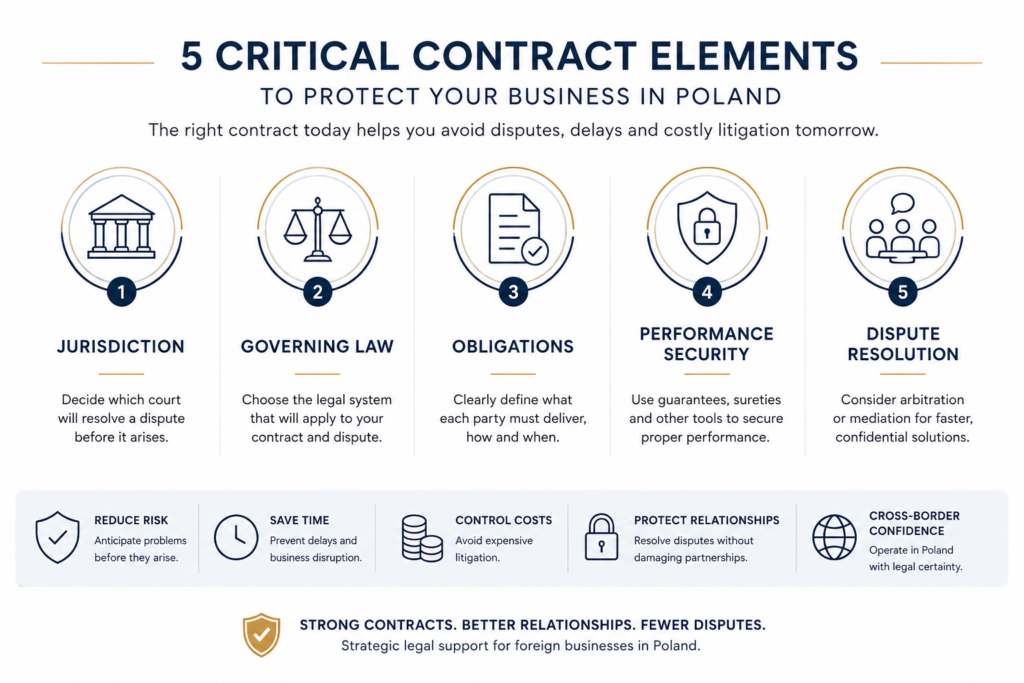
5 key elements in a contract with a Polish company
In cross‑border contracts with Polish companies, there are several elements that foreign businesses should always pay close attention to. Addressing them early significantly reduces the risk of misunderstandings, non‑performance, or costly disputes in the future. Here are the five most important points every international company should consider when drafting or negotiating a contract in Poland. The framework also aligns with OECD guidelines on responsible business conduct for cross-border commerce.
Table 1. Five Critical Contract Elements in Cross‑Border Agreements with Polish Companies
| Contract Element | What It Really Means | Key Risks if Ignored | Recommended Actions |
|---|---|---|---|
| Jurisdiction | Which court will hear the dispute. | Case may end up in an unexpected court; delays; strategic disadvantage. | Add a clear jurisdiction clause; choose forum strategically. |
| Governing Law | Which legal system applies to the contract and dispute. | Foreign law may apply unexpectedly; costly conflict‑of‑law battles. | Specify governing law explicitly; align with jurisdiction. |
| Obligations | What each party must deliver, how, and when. | Misaligned expectations; conflicting interpretations; hidden liabilities. | Define obligations in detail; avoid relying on local defaults. |
| Performance Security | Tools ensuring the contract is performed properly. | Non‑performance; delays; financial exposure. | Use guarantees, sureties, staged payments, performance bonds. |
| Alternative Dispute Resolution | Arbitration or mediation instead of court litigation. | Slow, formalistic court process; higher costs; loss of control. | Add arbitration/mediation clause; choose reputable institutions. |
1. Choice of Jurisdiction: Which Court Will Resolve a Dispute with a Polish Company
Many businesses confuse jurisdiction with applicable law, even though these are two separate and equally important issues. Jurisdiction determines which court has the authority to hear the dispute, and while this is usually obvious when both parties are from the same country, it becomes a critical question in cross‑border contracts. As a rule, the parties may choose the courts of a specific country — typically the courts of one party’s home state or the courts of the place where the contract is performed.
If the contract does not include a clear jurisdiction clause, the dispute will be governed by the default rules of each potentially relevant legal system, which may point to different courts depending on the circumstances. This can lead to uncertainty, delays, and strategic disadvantages. For that reason, it is essential to resolve this fundamental issue at the contract‑drafting stage, rather than during a dispute. A well‑drafted jurisdiction clause is not just a formality — it is a strategic tool.
To illustrate this with an example from my own practice: In one of my recent cases, the parties drafted a seemingly simple contract where they granted jurisdiction to both the Polish courts and the courts of the counterparty’s home country. Their intention was likely to ensure a sense of equality and fairness. However, this reciprocal clause was entirely counterproductive and created severe ambiguity. It required substantial legal work to establish that the party who actually managed to file the lawsuit first effectively locked in that country’s jurisdiction. This case perfectly illustrates that mistakes in cross-border contracting do not only stem from ignoring a problem, but also from trying to solve it in a fundamentally flawed way.
2. Governing Law: Which Legal System Applies to Your Contract and Dispute in Poland
Governing law determines which legal system will be used to interpret the contract, assess performance, and resolve claims — even after termination or withdrawal. The fact that a Polish court has jurisdiction does not mean it will automatically apply Polish law. I recently handled a case in which a Polish court applied Swiss law in a succession dispute, simply because the governing‑law rules required it.
Choosing the applicable law is one of the most fundamental decisions in any cross‑border agreement. If the parties fail to specify it, a complex network of international conventions, EU regulations, and internal conflict‑of‑law or external conflict-of-law rules will decide the issue for them. These instruments may assign governing law — or even jurisdiction — in ways neither party expected. When that happens, the parties lose control not only over the likely outcome, but even over the rules of the game.
Once a dispute begins, fighting over which law should apply becomes extremely expensive, highly technical, and strategically risky. It also unfolds under pressure, which rarely helps resolve the matter efficiently. We help foreign companies navigate these complexities from the first warning signs. This is why foreign businesses should always address governing law at the contract‑drafting stage, not during litigation.
3. How to Clearly Define the Parties’ Obligations in a Cross‑Border Contract
When companies from different countries work together, what seems “obvious” to one party may be interpreted completely differently by the other. A contract that carries the same name in Poland and Spain may impose entirely different warranty obligations, delivery terms, performance standards or timelines — all shaped by local law, business practice and commercial custom. The overall purpose of the agreement may be similar, but dozens of operational details can diverge in ways that create real legal and financial risk.
If the parties fail to define their obligations with precision, they effectively leave key issues to unknown conflict‑of‑law rules, local default provisions and judicial interpretation — none of which they control. This can lead to unexpected liabilities, disputes over performance, or outcomes that neither side anticipated when signing the contract.
For businesses operating outside the EU, it is also essential to remember that Poland is part of the European Union, and EU law forms an integral part of Polish domestic law. This means that obligations may be interpreted not only through the lens of Polish statutes, but also through EU regulations and directives that apply automatically.
Clear, detailed drafting is therefore not a formality — it is the only reliable way to avoid costly misunderstandings and ensure that both parties operate under the same expectations from day one. When facing difficulties with international agreements, consulting a contract dispute lawyer in Poland is the best way to safeguard your interest.
4. How to Secure Performance of the Contract
In international business relationships, securing proper performance of the contract is not a formality — it is good practice and a critical risk‑management tool. If you want to avoid problems with execution, delays or non‑performance, you must address these issues at the very beginning of the cooperation, not once difficulties arise. Contract breaches in cross‑border projects often do not stem from bad faith, but from factors partially outside the contractor’s control. That does not change the reality: you do not want their problems to become your problems.
For this reason, foreign companies should consider robust mechanisms to secure payment and performance, such as bank guarantees, sureties, or promissory notes. For non‑financial obligations, staged payments tied to documented progress, milestone acceptance, or performance bonds can significantly reduce exposure. These tools ensure that even if difficulties arise, the foreign company retains leverage and the project remains under control.
5. Does an Arbitration or Mediation Clause Make Sense in Poland
Arbitration and commercial mediation do make sense in Poland — and often a great deal of sense. Polish state courts are overloaded, formalistic and slow, with commercial cases frequently lasting several years. By contrast, arbitration and mediation offer procedures that are faster, more flexible and far less burdensome for foreign businesses. As a mediator myself, I see how effective these methods can be: mediation allows parties to resolve disputes quickly, confidentially and at a fraction of the cost of litigation, and I regularly represent clients in such proceedings as their counsel.
Arbitration is also gaining popularity in Poland, especially in cross‑border disputes where parties value expertise, predictability and enforceability of awards. However, it is important to remember that mediation is entirely voluntary — no clause can force a party to negotiate in good faith if it does not wish to participate. Even so, including an arbitration or mediation clause in a contract with a Polish company is often a strategic advantage, giving both sides a faster and more business‑oriented path to resolving conflicts.
Whether you are facing a breach of contract or a wider corporate conflict, an experienced commercial dispute lawyer in Poland can guide you through alternative dispute resolution.
Key Things to Know About Commercial Court Proceedings in Poland
Commercial litigation in Poland is highly formalistic, and foreign companies are often surprised by how rigid and document‑driven the process is. The starting point is the court fee: in most commercial cases, the claimant must pay 5% of the value of the dispute, in addition to covering the costs of legal representation, court‑appointed experts, and certified translations — the latter being both expensive and slow, yet unavoidable in cross‑border cases. Delays in Polish litigation can disrupt operations and weaken your negotiating position. Although many hearings can technically be held online, we prefer to appear in person, because being physically present in the courtroom allows us to read the room, assess the judge’s reactions, and evaluate witnesses more effectively.
Polish commercial proceedings rely primarily on documents, while witness testimony plays a supplementary role. Expert opinions often become decisive, especially in technical or financial disputes, and they can significantly influence the outcome. After the judgment, both parties may file an appeal, and in certain cases even a cassation complaint to the Supreme Court. As an experienced business litigation lawyer in Poland, I know that commercial litigators form a distinct professional niche — and we are proud to be part of that group, navigating clients through a system that demands precision, strategy and endurance.
Call to Action — Strategic Support for Foreign Businesses in Poland
Commercial disputes in Poland require not only legal knowledge, but also strategic judgment, experience with cross‑border matters and a deep understanding of how Polish courts, arbitration tribunals and business practices operate. If your company is facing a contract disagreement, a shareholder conflict, payment delays or early warning signs of a dispute, early action is essential.
We support foreign businesses from the first signal of risk — analysing contracts, assessing exposure, preparing negotiation strategies and representing clients in mediation, arbitration and commercial litigation. If you need guidance on contract disputes in Poland, commercial litigation or preventing a conflict before it escalates, we are ready to help.
Contact us to schedule a confidential consultation and discuss the most effective strategy for your situation:
📩 kancelaria@jakubieciwspolnicy.pl
📞 536 270 935
Q&A — Frequently Asked Questions About Commercial Disputes in Poland
1. What should I do if a Polish company stops paying or delays payment?
The first step is to secure documentation: invoices, delivery confirmations, correspondence and any agreed payment terms. Early action is crucial — delays often escalate quickly. A contract dispute lawyer in Poland can help assess your leverage and prepare an effective recovery strategy.
2. Can I sue a Polish company from abroad?
Yes, but whether you should depends on the jurisdiction clause in your contract. If no clause exists, EU regulations and conflict‑of‑law rules will determine where the case must be filed. A commercial litigation lawyer in Poland can analyse your position and recommend the most efficient forum.
3. How long do commercial court proceedings take in Poland?
Most cases last 2–4 years, depending on complexity, expert evidence and court workload. Delays in Polish litigation can disrupt operations and weaken your negotiating position, which is why many foreign companies prefer arbitration or mediation.
4. Is arbitration in Poland enforceable internationally?
Yes. Poland is a party to the New York Convention, which means arbitral awards issued in Poland are enforceable in over 160 countries. This makes arbitration a strong option for cross‑border disputes.
5. Do I need to translate documents into Polish for court?
In most cases — yes. Certified translations are required for key documents and can be costly and time‑consuming. This is one of the reasons why early preparation is essential.
6. What if my company is outside the EU — does that change anything?
Yes, significantly. Non-EU companies must navigate international treaties alongside EU regulations (such as Rome I, Rome II, and Brussels I bis) which automatically apply in Poland. These frameworks directly dictate which country’s laws govern your contract and where lawsuits can be filed.
7. When should I contact a lawyer?
At the very first sign of friction—whether it is an unexplained payment delay, minor contract breaches, or a breakdown in communication with your Polish partner. Legal intervention at this early stage usually prevents the conflict from escalating into a full-scale court battle, saving both time and money.
8. What should I check before signing a contract with a Polish company?
To protect yourself before signing a contract with a Polish company, you should first verify the company’s official data in the National Court Register (KRS), including its current management board and the rules of representation. It is also essential to confirm whether the company is not undergoing bankruptcy or restructuring proceedings. Finally, it is worth consulting a Polish attorney who can provide practical insights, background information, and reputation signals that you will not find in official registers.
by dr Andrzej Jakubiec - adwokat, mediatorHolidays Abroad with a Foreign Father: Defeating Parental Alienation
For a foreign father living thousands of miles away, securing international vacation time is far more than just a holiday — it is the frontline defense against parental alienation. In Poland, alienating parents often weaponize fabricated “safety concerns,” refuse to release passports, or manipulate school schedules to block travel, exploiting the slow pace of the courts to gradually erase your presence from your child’s life. Overcoming this requires more than emotional appeals; it demands a precise, strategic legal offensive that cuts through procedural delays, neutralizes bias, and forces the court to act.
Parental alienation is currently the subject of a fierce public debate in Poland. Extreme viewpoints polarize the discourse: ranging from the outright denial of the phenomenon’s existence—dismissing it as a fabrication used by abusive men—to accusations of its instrumental weaponization by fathers seeking to reduce child support payments. One thing is certain—the topic of alienation sparks raw, intense emotions across the country. An entire social movement dedicated to combating this phenomenon is rapidly emerging. Indeed, many researchers directly define it as a form of violence.

Understanding Parental Alienation in Poland: Why Foreign Fathers Are Especially Vulnerable
In cross‑border custody disputes, parental alienation is rarely an emotional outburst — it is a deliberate manipulation of time, distance, and narrative designed to gradually overwrite a child’s memory. Foreign fathers are uniquely exposed to these tactics because physical separation eliminates spontaneous contact, giving the resident parent in Poland the ability to reshape the father’s image without immediate correction.
This vulnerability is amplified by language barriers, limited access to Polish family‑court procedures, and a system that moves slowly enough for alienation to take root. Alienating parents exploit this information asymmetry to portray the father’s absence as indifference or abandonment, even when the distance is the result of work, visas, or international relocation.
A common example illustrates the pattern: a parent may suddenly claim that the child is “too anxious to fly” or that “international travel is unsafe,” despite years of uneventful trips — a tactic designed not to protect the child, but to block contact and control the narrative.
As I explain in my core guide, Child Custody in Poland – A Guide for Foreign Parents, systemic delays in Polish family courts unintentionally reinforce these tactics by allowing the alienating parent to maintain exclusive control during the most formative months of the child’s perception.
For a non‑resident parent, recognizing this structural disadvantage is essential. International holidays are not merely vacation time — they are critical behavioral checkpoints, the rare moments when your relationship with your child can be rebuilt, reinforced, or, if blocked, quietly dismantled.
The Legal Reality: How Polish Courts View International Travel, Passports, and “Safety Concerns”
When foreign fathers enter a Polish family court, they often encounter a profound clash of expectations. You arrive with a straightforward premise: “I am a loving parent with court‑ordered contact, and I want to take my child on vacation.” But Polish family judges — especially at the District Court level (Sąd Rejonowy) — do not always evaluate international travel only through the lens of parental rights. They evaluate it through the lens of institutional risk management. To navigate this system effectively, you must understand the unspoken psychological blueprint that shapes their decisions.
The Phantom of International Abduction
The dominant, often subconscious fear in Polish family courts is simple: Once a child leaves Polish jurisdiction, they may never return.
This anxiety is especially strong when the destination is outside the EU — places like USA, Canada, Australia, or the Middle East. Judges are aware of the Hague Convention, but they also know its limitations. They fear a scenario where a child “disappears” into a foreign legal system, rendering Polish rulings unenforceable.
As a result, when the resident parent raises vague, fabricated “safety concerns” — “the father might keep the child abroad,” “the child cannot adapt to a foreign environment,” “the trip is too dangerous” — the court’s instinctive reaction is to freeze the status quo. In their internal calculus, denying a vacation feels like the “safe” option, while granting it feels like a potential career‑ending mistake.
You must understand that a judge who grants international travel permission takes on a severe professional and reputational liability. If a parental abduction actually occurs, that judge bears the systemic fallout—after all, they chose to ignore a resident mother who was loudly sounding the alarm. This professional vulnerability inevitably breeds a culture of paralyzing hyper‑caution, protecting the court’s own record at the absolute expense of an innocent foreign father who has zero malicious intent.
The Passport Trap: Article 97 of the Family and Guardianship Code
Under Article 97 of the Polish Family and Guardianship Code, obtaining a passport or crossing an international border is classified as a “substantial matter” (istotna sprawa) requiring the consent of both parents.
This creates a predictable chain reaction:

If the mother refuses to sign the passport application or physically withholds the existing passport, you must petition the court for substitute consent (zastępcza zgoda sądu). This is where many foreign fathers lose momentum. Approaching the court defensively — arguing that the mother is “unfair” or “uncooperative” — only reinforces judicial caution. The court delays, requests more documents, and schedules hearings weeks or months away, effectively destroying your holiday window.
Overcoming Judicial Paralysis
Winning a travel dispute in Poland requires a strategic shift. You cannot rely on the court’s sense of fairness. You must neutralize judicial risk aversion by constructing a framework where the judge does not need to trust you — they only need to trust the process.
This is achieved for example by presenting a high‑security, precision‑engineered travel plan that eliminates ambiguity and reframes the decision as routine rather than risky.
The Strategic Reframe: Transforming Risk Into Certainty
Instead of a vague request for “vacation time,” you present a structured, verifiable protocol:
- Pre‑booked round‑trip flights with fixed, non‑modifiable return dates.
- A detailed day‑by‑day itinerary, including verified addresses, phone numbers, and emergency contacts.
- Proactive legal safeguards, such as offering to file a Mirror Order in your home jurisdiction or agreeing to enforceable financial penalties for any non‑compliance.
- Written commitments to return the child on a specific date, supported by documentation from your employer, school calendars, or immigration requirements.
By shifting the payoff matrix for the judge, you transform what appears to be a high‑risk decision into a legally safe, administratively predictable outcome. At that point, the resident parent’s fear‑based objections lose their persuasive power, and the court can no longer justify blocking the trip.
“I am fully aware that this represents a textbook, ideal scenario—one where you already hold the tickets and count on the court to move with absolute urgency. In practice, real-world logistics can complicate this approach, meaning we must defuse the court’s anxiety through other, equally precise legal safeguards.
Common Alienation Tactics Used to Block Holidays Abroad — and How to Expose Them
Parental alienation in cross‑border cases rarely appears as open defiance. Instead, it unfolds through a series of plausible‑sounding, behaviorally predictable tactics that masquerade as responsible parenting. When international travel approaches, alienating parents in Poland often deploy a coordinated pattern of excuses designed to run out the clock, disrupt logistics, and create just enough confusion for the trip to collapse. These tactics are well‑documented in forensic psychology and appear with striking regularity in Polish family‑court disputes involving foreign fathers.
Below are the four most common maneuvers — and the strategic countermeasures required to expose them.
1. The Sudden Medical Emergency
A child who has been perfectly healthy for weeks suddenly develops a high fever, stomach pain, or a vague psychosomatic symptom 24–48 hours before departure. The timing is never accidental. How to expose it: Immediately request independent, court‑approved medical verification. When the alleged illness evaporates under objective examination, the pattern becomes clear.
2. The Weaponized Anxiety Narrative
The resident parent claims the child is “too anxious to fly,” “terrified of leaving Poland,” or experiencing a sudden psychological crisis. These narratives often appear only when international travel is imminent. How to expose it: Demand a neutral psychological assessment. Courts take professional reports far more seriously than parental assertions, and fabricated anxiety collapses under clinical scrutiny.
3. The Passive‑Aggressive Bureaucratic Block
The passport is “misplaced,” withheld, or allegedly sent for renewal without your knowledge. This tactic exploits the fact that Polish courts often treat such excuses at face value unless confronted with structured evidence. How to expose it: Force all communication into written, timestamped channels. Document every request, reminder, and refusal. A clear paper trail transforms vague excuses into provable obstruction of international travel consent.
4. The Strategic Schedule Overlap
Sudden “mandatory” summer camps, family events, or therapy sessions appear exactly during your court‑ordered holiday window. These conflicts are engineered to create the illusion of competing obligations. How to expose it: Demonstrate the pattern of timing. When these events occur exclusively during your scheduled contact periods, the court can no longer ignore the intentional interference.
Turning Patterns Into Evidence
Polish family courts often struggle to distinguish genuine concerns from manipulative tactics — unless the behavior is presented as a structured, chronological pattern. Your goal is to shift from emotional argument to a cold, objective behavioral audit:
A. Document every interaction;
B. Preserve every message;
C. Track every “coincidence”;
D. Demand independent verification for every alleged crisis.
Once these incidents are mapped out, the pattern becomes undeniable: the child’s “illness,” “anxiety,” or “schedule conflict” appears only when an international departure is approaching. At that point, the court is no longer evaluating excuses — it is evaluating bad‑faith obstruction.
Table: Common Alienation Tactics, How to Detect Them, and How to Counter Them
| Tactic | How to Detect It | How to Counter It |
|---|---|---|
| Sudden Medical Emergency | Symptoms appear only 24–48 hours before departure; no prior medical history; inconsistent or unverifiable explanations from the resident parent. | Demand an independent, court‑approved medical evaluation; document timing; demonstrate recurring patterns across multiple travel attempts. |
| Weaponized Anxiety Narrative | Child suddenly “fears flying” or “cannot leave Poland”; uses adult terminology (“trauma,” “stress,” “instability”); anxiety appears only in the context of international travel. | Request a neutral psychological assessment; present evidence of prior positive travel experiences; highlight inconsistencies in the narrative. |
| Passive‑Aggressive Bureaucratic Block (Passport Withholding) | Passport is “lost,” “at the office,” or “awaiting renewal”; unanswered requests; sudden administrative complications. | Force all communication into written channels; file for interim release of the passport; request substitute judicial consent for passport issuance. |
| Strategic Schedule Overlap | “Mandatory” camps, therapies, or family events appear exactly during your holiday window; no prior notice; conflicts arise only when you plan international travel. | Show the timing pattern; present prior agreements; request fixed, non‑negotiable holiday windows in the parenting plan. |
| Coached Resistance | Child repeats rehearsed phrases; uses legal or adult language; presents a black‑and‑white narrative (“one parent perfect, the other unsafe”); lack of spontaneity. | Do not confront the child; allow evaluators to observe inconsistencies; request OZSS or independent psychologist evaluation. |
| Last‑Minute Logistical Sabotage | Delayed packing, intentional lateness, sudden “technical problems” on the day of departure; child not prepared for travel. | Document every incident; request financial penalties for non‑delivery; include precise handover times in the final order. |
| False Safety Concerns | Claims that the destination is “dangerous” or “unstable” without evidence; concerns appear only when the child travels with the foreign father. | Provide a detailed travel plan, insurance, addresses, and emergency contacts; demonstrate lack of real risk; request standing travel rights in the final order. |
Building a Winning Strategy: Evidence, Expert Opinions, and Procedural Tools That Shift the Court’s Perspective
Winning an international travel dispute in Poland requires moving far beyond the emotional “he‑said, she‑said” dynamic that routinely paralyzes family courts. Polish judges are exhausted by parental conflict and will dismiss unstructured complaints almost instantly. To shift the court’s perspective, your strategy must rely on structural evidence, forensic‑grade psychological assessments, and procedural leverage that fundamentally alters the opposing parent’s incentive structure.
1. The Structural Evidence Matrix
Polish judges do not sift through hundreds of chaotic WhatsApp screenshots. They respond to clarity, chronology, and structure. Your evidence must function as a behavioral audit, not a data dump.
Your matrix should include:
- The Communication Log — A clean, tabulated spreadsheet documenting every travel request, the exact date, and the resident parent’s response (or silence). Judges rely heavily on patterns, and this format makes obstruction unmistakable.
- Logistical Readiness — Timestamped proof of your readiness to travel: flight reservations or payment confirmations, travel insurance, accommodation bookings, and written requests for passport delivery. This demonstrates that you are organized and the obstruction is unilateral.
- The Contrast Record — Evidence of a historically positive relationship (photos, videos, prior trips) contrasted with sudden, unsubstantiated claims of “anxiety” or “fear of flying.” Polish courts react strongly to abrupt behavioral shifts without a developmental cause.
Together, these elements create a structured narrative that courts can process quickly — and trust.
2. Navigating the Forensic Psychological Evaluation (OZSS)
In cross‑border custody disputes, the opinion of the Court Expert Diagnostic Team (OZSS) or court‑appointed psychologists carries enormous weight. Alienating parents often treat this evaluation as their ultimate weapon, coaching the child to repeat rehearsed phrases such as “I am afraid to fly with daddy” or “I don’t want to leave Poland.”
The forensic trap for foreign fathers is simple: If you spend your limited evaluation time attacking the mother, you confirm the expert’s suspicion of conflict alignment.
Court psychologists are trained to detect:
- coaching,
- pathological alignment,
- adult terminology in a child’s speech,
- rigid, one‑sided narratives.
Your strategy must be entirely child‑centric:
- Expose Coaching Indirectly — Do not argue with a coached child. Let them speak. Experienced evaluators immediately recognize rehearsed narratives and developmental inconsistencies.
- Demonstrate Calm Behavioral Continuity — During the observation phase, focus solely on natural interaction: warmth, play, emotional stability. Your calm presence will contrast sharply with the artificial tension engineered by the alienating parent.
Handled correctly, the OZSS evaluation becomes a powerful counterweight to alienation tactics.
3. Procedural Leverage: Altering the Payoff Matrix
Under Polish law — specifically Article 598¹⁵ of the Code of Civil Procedure — courts possess a potent enforcement tool: financial penalties for each violation of a contact order (zagrożenie nakazaniem zapłaty sumy przymusowej).
The mechanism is simple:

Alienating parents continue their behavior because, until now, it has been cost‑free. By proactively petitioning the court for an emergency enforcement order that sets a specific cash penalty for every day a holiday is blocked or a passport is withheld, you fundamentally change the economics of obstruction.
Suddenly:
- delaying becomes expensive,
- refusing becomes risky,
- compliance becomes the rational choice.
This is how you transform psychological obstruction into a financial liability — and force behavioral change.
4. Emergency Measures and Fast-Track Solutions When the Other Parent Refuses Consent or Withholds the Passport
When a planned international vacation is only weeks away, waiting for a standard court ruling in Poland is a death sentence for your holiday plans. Alienating parents understand this perfectly; they exploit the court’s calendar to run out the clock, knowing that a delay is as good as a victory. To defeat this tactical foot-dragging, you must immediately shift from the standard litigation track to the court’s emergency fast-track mechanisms.
In Polish family procedure, your primary weapons are interim injunctions (zabezpieczenie roszczenia), which allow a judge to issue temporary, enforceable orders before the final trial ever takes place.
1. The Interim Travel Injunction (Wniosek o zabezpieczenie)
You cannot afford to wait months for a final verdict on international contact. Simultaneously with your main petition, your lawyer must file an urgent motion for an interim injunction under Article 730 and 755 of the Code of Civil Procedure.
This motion explicitly requests the court to secure your upcoming vacation dates immediately.
- The Evidentiary Threshold: To win an interim injunction, you do not need to fully prove your case yet; you only need to credibilize it (uprawdopodobnienie). By presenting the Structural Evidence Matrix (the communication log showing unilateral obstruction and your pre-booked return flights), you prove that immediate judicial intervention is necessary to prevent irreversible damage to the child-parent bond.
- The Timeline: By law, emergency motions for interim custody or contact security are meant to be processed swiftly, often without a full hearing, giving you a critical window to bypass procedural delays.
2. Fast-Tracking Substitute Passport Consent
If the child lacks a valid passport, or if the resident parent refuses to hand it over, the administrative deadlock is absolute. To break it, your emergency motion must target the root of the blockade through a dual-track procedural request:

Your legal offensive must ask the judge to:
- Grant substitute judicial consent (zastępcza zgoda) for the passport application, which legally replaces the mother’s missing signature at the passport office.
- Issue an interim order compelling the immediate release of the existing physical passport, under a strict, time-sensitive deadline (e.g., 3 days from the delivery of the order).
3. Securing Judicial Execution with Financial Teeth
An emergency order is only as good as its enforcement mechanism. If the court grants your interim travel injunction but fails to attach consequences, the alienating parent may still choose to ignore it on the day of departure, gambling that you cannot react in time.
To neutralize this, your emergency motion must combine the travel permission with a proactive request for threatened financial penalties (zagrożenie nakazaniem zapłaty sumy przymusowej) specifically calibrated for the upcoming holiday.
The Tactical Advantage: You ask the court to rule that if the passport is not delivered by X date, or if the child is not handed over for the flight on Y date, the blocking parent is automatically penalized a substantial, non-negotiable cash amount per day of non-compliance.
When faced with a court order that transforms psychological defiance into a sudden, compounding financial crisis, the alienating parent’s legal counsel will almost always advise them to comply. You shift the reality from a slow-moving bureaucratic debate into a high-stakes financial penalty phase where defiance carries immediate, painful costs.
Long-Term Protection: Court Orders, Parenting Plans, and Preventive Clauses That Secure Future International Travel
Winning an emergency travel injunction solves a immediate crisis, but it does not cure the underlying pathology of parental alienation. If your final court order or parenting plan contains vague, standard language, you condemn yourself to fighting the exact same battle every single summer and winter. Long-term victory requires establishing a permanent structural equilibrium—a legally binding framework that transitions your travel rights from a matter of ongoing dispute to an automated, self-enforcing routine.
To achieve long-term insulation from obstruction, your final court order or parenting plan (Plan Wychowawczy) must bypass the need for parental negotiation entirely, replacing it with algorithmic precision and preventive clauses.
1. Algorithmic Precision in Parenting Plans
The single greatest mistake in international custody agreements is the use of the phrase “to be mutually agreed upon by the parents.” In an alienation dynamic, mutual agreement is a statistical impossibility. Your parenting plan must be engineered so that no communication, negotiation, or consent is required to trigger a vacation.
Your final order must explicitly define:
- Fixed Calendars: Instead of specifying “two weeks in July,” designate exact windows (e.g., “From July 1st at 9:00 AM until July 15th at 6:00 PM in odd-numbered years”).
- Automated Document Release: The order must state that the resident parent is legally obligated to hand over the child’s physical passport and travel documents at least 14 days prior to any international travel, without requiring a separate request.
- The Travel Boundary: Specify that the father possesses a standing, unrestricted right to travel with the child outside the borders of Poland to any country within the EU, the Schengen Zone, or specific non-EU jurisdictions (e.g., the United States), provided a basic itinerary is sent via a designated communication channel.
2. The Permanent Passport Protocol
If the resident parent has a history of withholding documents, leaving the passport in their exclusive possession is a perpetual security risk. Your strategy should aim for a structured, court-mandated custody protocol for the child’s travel documents:

Alternatively, petition the court to allow you to permanently hold the child’s foreign or secondary passport, or mandate that the documents be deposited with a neutral third party (such as a notary or legal counsel) or held in alternating custody. If the child holds dual citizenship (e.g., Polish and American), the court can rule that the foreign passport remains permanently in the foreign father’s custody, effectively neutralizing the administrative blockade.
3. Institutionalizing the Enforcement Penalty
An alienating parent will eventually test the boundaries of a permanent court order. To prevent a relapse into obstruction, the financial penalties discussed in Section 4 must not be temporary—they must be institutionalized directly into the final judgment.
Ensure your final ruling contains a standing threat of execution (związane z zagrożeniem nakazaniem zapłaty):
“For every single instance where the resident parent fails to release the child for international travel, or fails to deliver the required travel documents within the mandated deadline, a standing penalty of [Amount] PLN per day of non-compliance shall be automatically levied, enforceable without the need for a new trial on the merits.”
Shifting from Conflict to Compliance
By embedding these structural guarantees into your long-term legal strategy, you completely rewrite the psychology of the relationship. You strip the alienating parent of their ability to manipulate the calendar, weaponize bureaucracy, or force you into constant litigation. Compliance becomes the only logical, low-risk option for the other parent, finally allowing you to focus on what matters most: rebuilding, reinforcing, and enjoying your unhindered bond with your child.
Executive Summary: Cross‑Border Custody Disputes and International Travel in Poland
International travel disputes involving foreign fathers in Poland sit at the crossroads of high‑conflict family law, cross‑border custody dynamics, and the growing problem of parental alienation. When a resident parent blocks holidays abroad, raises fabricated “safety concerns,” or engages in withholding a child’s passport, distance and bureaucratic inertia can quietly erode the father–child relationship.
Polish judges approach international travel consent not as a question of parental rights, but as an exercise in institutional risk management. This is why foreign fathers seeking Polish family court travel permission must rely on structured, objective tools: a clear evidence matrix, forensic‑grade psychological insight, and fast‑track procedural mechanisms capable of overcoming delay tactics.
Long‑term protection requires transforming international contact rights into a self‑executing, algorithmic routine embedded directly in the final parenting plan. For any foreign father navigating custody in Poland, this shift — from discretionary negotiation to automatic enforcement — is the only reliable safeguard against recurring obstruction.
Take Control Before the System Takes It From You
International travel disputes in Poland are not won by waiting, hoping, or appealing to fairness. They are won by strategy, precision, and speed. If you are facing passport obstruction, fabricated “safety concerns,” or escalating parental alienation, every week of delay strengthens the other parent’s position and weakens your bond with your child.
You do not have to navigate this alone.
My team specializes in cross‑border custody disputes, international travel permissions, and high‑conflict parental alienation cases involving foreign fathers. We represent clients from the United States, the United Kingdom, Australia, the EU, and beyond, and we act quickly, because in these cases time is the most powerful weapon.
Your initial consultation is not a generic conversation — it is a strategic session, during which we analyze your evidence, identify procedural leverage, and outline the fastest path to securing your travel rights.
Your relationship with your child is too important to leave to chance. Take the first step now — before the next holiday window closes.
FAQ: International Travel, Parental Alienation, and Polish Courts
1. What should I do if the other parent refuses to sign the passport application?
File a dual‑track motion:
- petition for substitute consent, and
- interim motion for immediate document release. This breaks the administrative deadlock and forces the court to act before your travel window expires.
2. Can I get emergency permission to travel if the vacation is soon?
Yes. Polish courts can issue interim injunctions (zabezpieczenie) within days, sometimes without a hearing, if you credibilize the urgency.
3. What if the other parent hides the passport?
Request an interim order compelling immediate release of the document under a strict deadline, backed by financial penalties for every day of non‑compliance.
4. How do Polish courts view international travel with a foreign father?
With caution. Judges fear international abduction and often freeze the status quo unless you present a structured, risk‑free travel plan.
5. Can I prevent future obstruction permanently?
Yes — through a precise parenting plan with fixed calendars, automated passport release, and standing financial penalties.
6. What is your fee for handling these cases?
It depends on the complexity and urgency of the matter, but our standard fee for representing a foreign parent in an international travel obstruction case typically ranges between 20,000 PLN and 30,000 PLN and an additional 2,000 PLN per hearing.
7. Can you help even if I live outside Poland?
Yes. We regularly represent clients living in the US, UK, Canada, Australia, and across the EU. Most of the process can be handled remotely.
8. What if the child refuses to travel?
Polish courts distinguish genuine reluctance from coached resistance. Properly handled forensic evaluation (OZSS) can expose manipulation.
9. Do your attorneys attend hearings remotely, or do they physically appear in court?
We make every effort to attend all key court hearings in person. While remote (online) participation is legally permissible in Poland, we are firmly convinced that we can protect your interests far more effectively by being physically present in the courtroom. High-conflict custody and travel disputes require reading the room, reacting instantly to sudden tactical maneuvers, and commanding the judge’s full attention—dynamics that are heavily diluted over a video screen. We travel to courts across Poland to ensure our physical advocacy matches our strategic commitment.
10. How can I get in touch with you to start my case?
You can email us directly at kancelaria@jakubieciwspolnicy.pl—you can expect a direct response within 24 hours. For immediate or urgent matters, you can also reach me directly via WhatsApp at +48 536 270 935. I invite you to schedule your initial strategy consultation so we can thoroughly analyze your situation. While no ethical attorney can promise a guaranteed victory in court, I give you my personal word that we will do absolutely everything in our power to fight for you, protect your rights, and restore your bond with your child.
11. How can I know that I can trust you with such a sensitive case?
We understand that trust is not granted — it must be earned. And we also understand the dilemma: how can you trust a lawyer you have not met yet, especially in a case involving your child, international travel, and parental alienation?
We address this directly, through concrete, verifiable commitments:
- A precise written agreement You receive a clear, detailed contract that defines our obligations, timelines, scope of work, and the exact structure of our fees — with no ambiguity and no hidden clauses.
- A signed NDA with a contractual penalty in your favor We protect your privacy not only ethically, but legally. If we breach confidentiality, you are entitled to a financial penalty.
- A written conflict‑of‑interest declaration — with liability We provide a formal statement confirming that we have no professional, business, or social ties to the other parent. If it ever turned out that we knowingly misrepresented this, we pay you a contractual penalty.
- Professional liability insurance of EUR 2.5 million This is significantly above the industry standard and reflects the complexity and international nature of the cases we handle.
- My personal, unlimited liability with my own assets I made a deliberate decision to assume full, personal responsibility for all obligations of our Firm — with my private assets. I did not have to do this. I chose to do it to show that I stand behind my work not only with words, but with my own money.
Because trust is built through actions — not promises. Read more here.
by dr Andrzej Jakubiec - adwokat, mediatorThe Decision to End a Business Partnership is a Process
I know people who stay for years in relationships that drain them, limit them, and take away their joy in life. By “relationships” I mean family relationships, intimate relationships, and business cooperation (regardless of its legal form). In this article, I will focus on the decision to end cooperation with a business partner.
I know something about this. I have made such decisions myself when I wanted to end cooperation with my partners. Someone once made such a decision about me. I also decided to leave the University of Łódź, which was very difficult, but something pushed me to do it. And finally, I have advised on such matters hundreds of times as a lawyer. Initially, I focused on legal aspects, but the psychological knowledge I gained over time allowed me to look at these issues much more broadly. Today I know that the law is only a tool — it sets certain boundaries that must be taken into account, like trees when we run through a forest. But they do not determine our decision to run, the route, the pace, or whether it will be a single run or become our routine. Most partners don’t leave because they can’t for legal reasons — they stay because they don’t understand the decision mechanism.
Is Ending a Partnership Something Bad?
No. You have the right to end any cooperation. If you feel that this time is coming to an end, you have the moral right to use the legal tools that serve to end that cooperation. You do not need to feel any guilt because of it. Companies and contracts define people’s behavior for a certain period of time. People agree to this because they assume that during that time, cooperation will benefit them more than the lack of cooperation. If for any reason that assessment has changed, you can end the cooperation.
The Law Does Not Recognize Contracts That Bind Us Forever
Every legal relationship can be terminated — from an employment contract, through a commercial company, to marriage. It does not always mean ending it without cost or immediately, but in most cases it is possible. The law confirms the rule of the “temporariness” of cooperation by allowing contracts to be terminated so that we can use this possibility. Without guilt. Without shame.
If you remain in a relationship against yourself, feeling that you are losing in it, then someone is probably parasitizing on you and wants it to last forever. After all, they gain a lot with very little effort — at your expense.
What Drives Us to Make the Decision to End Cooperation?
Professional reports state that the most common cause of conflicts between partners is financial issues. I agree — but only partially. I believe that the financial area is where deeper causes of conflict most easily concentrate, and it is also the easiest to explain to everyone around. But if those deeper causes did not exist, there would usually be no financial dispute at all. Today, let’s look at how to make the decision to part ways without analyzing the cause or the level at which the conflict has grown.
Three Elements of the Decision to End Cooperation with a (Business) Partner
In modern psychology there is a lot of decision making models. Here I’ll present you one of them: simple and elegant Fogg’s Decision Making Model. The matter turns out to be quite simple with this model. To make a decision, three elements must occur:
- motivation
- ability (perceived ease)
- a trigger — an impulse to act
Importantly, all three elements must occur together. If even one is missing, the decision will not be made.
Motivation to Exit the Company and End Cooperation
What is motivation? Motivation is a state resulting from our emotions that make us strive for something or avoid something. Motivation has an affective, biological basis. Its social and psychological aspects are secondary. And that’s good — because it makes the matter much simpler. If we function well, we are motivated to achieve what is good for us and avoid what is bad for us. Yes, we can make mistakes in judgment, but that is another issue.
Assessing the Difficulty of the Decision to End Cooperation
Ability — or our assessment of how difficult the action is — is a key factor. We must remember that we tend to rationalize and justify passivity because it is convenient for us. Change requires effort, so our mind subconsciously suggests that we should like the situation we are in. It does this in two ways: it tells us that “here” is good and that “there” is bad, dangerous, uncertain. This means that we deceive ourselves into believing that change is harder than it really is. We do this out of laziness and we are brilliantly creative at it.
The Impulse to Act
The trigger is the impulse to behave in a certain way, to make a decision. We say that “the last drop spilled the cup.” A trigger can be almost anything, but most often they appear regularly — we just silence them when we lack motivation or when the change seems associated with real or imagined difficulties. When motivation appears and the task becomes realistically possible, we only need to wait for the trigger. But if motivation is lacking or the task seems too difficult, the trigger will not cause action.
The Fogg Curve — When Do We Make the Decision (to Exit the Company)?
What is the Fogg’s decision making model? The factors influencing our decisions can be presented graphically using the Fogg Curve. It looks like this:
We can see that:
- we are likely to make a decision if we have high motivation and the task is easy (as long as a trigger appears);
- we are unlikely to act if we have low motivation and the task is difficult (even if a trigger appears).
The Decision to End Cooperation. What Should Make You Reflect on Ending Cooperation?
Intuition
Our strongest weapon and unconscious competence. When I listened to it, I succeeded; when I ignored it, I got into trouble. Only deeper studies in psychology and behavioral analysis made me understand how powerful a tool each of us has. And I write this with full responsibility also as a lawyer.
Guilt
Especially if it is being induced in you by your partner — this is a clear red flag. Making you feel guilty is one of the strongest mechanisms of manipulation.
Lack of space to talk about what matters to you
Caring for the relationship between partners is as important as in a marriage. If you do not talk about your fears, plans, ambitions, it means things are already very bad.
Being promised the future
Plans must be:
- real,
- measurable,
- time‑bound,
- concrete.
If they are not, and your partner only tells you to “work hard so that someday it will be better,” then change the plan — or the partner.
You get nothing out of it
We work for a purpose. If you feel that you give everything, but in this personal arrangement your energy, time, and abilities are being burned — let it go. You have only one life; you can have many partners.
If some of these points apply to you, it means you are aware that you are stuck somewhere you do not want to be. And that is already the basis for change.
Deadlock
Deadlock is one of the most destructive situations in business relationships. It is not just a red flag — it is a structural breakdown.
When shareholders hold equal power, even simple decisions can become impossible. As a result, the company may stop functioning altogether while the conflict continues to escalate.
Deadlock occurs when the conflict itself becomes more important than the business. At that point, rational decision-making is replaced by control, ego, and escalation.
This is the moment when waiting becomes the most expensive strategy.
Red Flags and Their Meaning When Deciding to End Cooperation
| Red flag / warning sign | How it looks in practice | What it means psychologically | Consequences for you and the company |
|---|---|---|---|
| Intuition says “something is wrong” | Unexplained tension, discomfort, the feeling that “something is off” | Intuition is unconscious analysis — a signal that your brain sees danger | Ignoring intuition leads to years of losses and burnout |
| Guilt induced by the partner | Suggestions like “you won’t manage without me,” “you’ll let the company down” | Classic manipulation and a tool of control | Loss of agency, emotional dependence, bad decisions |
| No space to talk about important matters | Avoiding difficult topics, gaslighting, belittling your needs | The relationship is one‑sided and communication is toxic | Growing tension, no room for development, escalating conflict |
| Being promised the future | Promises without deadlines, without specifics, without measurable effects | A mechanism keeping you in place — “carrot on a stick” | Blocked career, no real influence, wasted years |
| No real benefits from cooperation | You work more than others and gain the least | Exploitation, asymmetry of effort and reward | Burnout, frustration, sense of injustice |
| Rationalizing passivity (“here is safe”) | Delaying decisions, excusing the partner, justifying pathology | A defense mechanism — avoiding effort and change | Staying in a bad relationship, rising psychological and financial costs |
| Ignored triggers | Repeated “last drops” that change nothing | Lack of connection between motivation and ability | The trigger never becomes a decision — you stay stuck for years |
| Distorted perception of difficulty | “It will be too hard,” “I can’t,” “I have no options” | Your brain is deceiving you — avoidance mechanism | Decision postponed indefinitely, rising risks |
| Lack of trust in the partner | Hidden information, unclear actions, lack of transparency | The relationship is already dead — it’s only a matter of time | Conflict escalates, costs rise every month |
The Fogg Curve in the Context of Exiting a Company
| Element of the Fogg Model | What it means in the context of a partner | How it looks in practice | What happens when one of the three elements is missing |
|---|---|---|---|
| Motivation | The emotional and psychological reason to end cooperation | Exhaustion, frustration, sense of injustice, intuition saying “this is not it,” lack of trust | The partner stays in the relationship despite harm; rationalizes the situation; “maybe it will get better” |
| Perceived ability | Assessment of whether exiting is realistically possible — legally, financially, organizationally | Consulting a lawyer, analyzing the contract, assessing risks, understanding procedures | The partner believes “it can’t be done,” “it’s too hard,” “I have no options”; decision paralysis; or they haven’t been hurt enough yet (no trigger) |
| Trigger | The impulse that initiates action | Another manipulation, lack of payment, broken promise, humiliation, value conflict | If motivation or ability are low — the trigger changes nothing; passivity returns |
| High motivation + high ability + trigger | Optimal point for making a decision | The partner sees the sense of change and knows how to execute it | The decision is made quickly and consciously; determination is high; change will happen |
| High motivation + high difficulty | You want to leave but “don’t know how” | Fear, delaying the decision, excuses | Triggers do not lead to action; frustration grows; your future depends on whether you seek solutions or wither where you are |
| Low motivation + high ability | You can leave but feel no need | “It’s fine,” “It’s not ideal but it’s okay,” “I don’t want to waste energy” | You may be in the right place and not need to change anything |
| Low motivation + low ability | You don’t want to leave | Passivity, comfort, but you couldn’t leave even if you wanted to | The decision will never happen without a change in motivation; only then will you consider ability |
Legal audit is the foundation and it’s role in Decision to End a Business Partnership
In this situation, you must know where you stand. It is not enough to simply read the contract you signed years ago. The contract is not everything. You are also bound by what is not in the agreement:
- thousands of applicable regulations that were not “repeated” in the written contract;
- the principles of interpretation of those regulations;
- customs and principles of social coexistence;
- judicial case law.
I know it sounds daunting, but: 1) that is why you have a lawyer to analyze it, and 2) to tell you exactly where you stand. Do not worry—the other party has the same problem.
However, it is crucial to know exactly what can and cannot be changed in a given situation right now. It is worth knowing how to shape the situation so that new opportunities appear on your side or options available to your partner disappear.
You must identify and assess the risk, including legal risk. Do not expect 100% certainty here—it does not exist in law. Expect a level of certainty and probability significant enough to allow for rational decision-making.
Remember, however, that the law only opens or closes certain doors. It is entirely up to you, though, whether and through which of the open doors you choose to walk. The fact that you have a certain right does not mean it will be purposeful, right, or beneficial to exercise it at this moment. That is a matter of strategy, which I will help you develop.
Decision to End a Business Partnership. Invitation to cooperation
Often, the first step to ending an unfavorable cooperation with a business partner is starting a good cooperation with a lawyer who understands not only the regulations but also the mechanics of such conflicts.
This is exactly what I offer you:
- a detailed legal analysis of your situation;
- defining realistic goals and alternatives (including the preparation of a BATNA);
- developing a strategy for action;
- support in negotiations, mediations, or litigation;
- conducting the entire process—from the decision to its implementation.
I will not influence your motivation—that is not my role. To push you toward a decision I will not either. I can, however, do something much more important: show you the real level of difficulty of this decision, limit the risk, and guide you through the entire process in a thoughtful and safe manner.
If you are at a point where:
- you are considering ending the cooperation,
- you have doubts about what you can do,
- or you feel that “something is wrong” but you don’t know how to organize it,
…then do not act in the dark. One ill-considered decision can cost years of dispute and very significant money. I know you may not know where to start. That is normal.
Contact me: 📩 kancelaria@jakubieciwspolnicy.pl 📞 536 270 935
FAQ – Questions about Decision to End a Business Partnership
Can I end cooperation with a partner in any situation?
As a rule—yes. Almost every legal relationship is resolvable. What differs, however, are:
- the procedure,
- the time,
- the costs,
- the risks.
The key question is not “if you can,” but “how to do it so you don’t pay more than necessary.” There are, however, exceptions: the law recognizes the concept of a “prisoner in a limited liability company.” which concerns a minority shareholders. In such cases, other measures must be considered to persuade the partners to “let you go.”
Do I need a “valid reason” to exit the company?
This depends on the legal structure of the company. In some companies, a valid reason is significantly taken into account and allows, for example, for the company to be dissolved earlier. In other cases, it may be the basis for excluding a partner from a limited liability company. However, the lawyer’s role is to persuade the other party to make a concession even when they are not legally obliged to do so.
What if my partner does not agree to end the cooperation?
This is a standard situation. A lack of consent from the other party:
- does not block all scenarios,
- but it does change the strategy.
In such cases, it is crucial to:
- build a negotiating advantage,
- prepare alternatives (BATNA),
- use legal tools appropriately.
In any case, remember that the field of play is fluid and we can shape it. If the partner’s consent is required today, we can attempt to change the circumstances so that it is no longer required—or so that they want to grant it. A partner will always make the best decision for themselves. Therefore, one must influence the environment so that it is more profitable for them to agree to part ways than to keep you in the company against your will.
Is it better to negotiate or go to court?
This is not an “either-or” choice. In practice:
- a well-prepared path to court often strengthens negotiations,
- and negotiations without a real alternative in the form of a lawsuit are usually ineffective.
First, you build your position, then you choose the tool. I view negotiations very broadly; litigation is like the use of kinetic force in politics. There, war is a way of conducting policy. Similarly in business—litigation is a clash intended to serve a purpose. It is a form of forceful negotiation. And during a trial, you can always negotiate in parallel: directly and verbally, through intermediaries, or via the method of faits accomplis. Yes, people don’t talk about it, but… non-verbal negotiations exist!
How long does it take to end cooperation?
From a few weeks to several years. It depends mainly on:
- the level of conflict,
- the legal structure,
- the preparation of the parties,
- the determination of the parties,
- external and random factors.
The most common mistake: starting actions without preparation, which extends the entire process manifold.
Can I exit “without losses”?
There are no completely cost-free solutions. But let’s distinguish costs from losses. There will always be costs: notary fees, taxes, costs of consultants and lawyers. But these are calculated costs. Will you exit without losses? It happens that partners exit companies with a great profit; other times, they accept certain losses just to end it or protect the rest of their capital.
The question is: is the cost of exiting lower than the cost of staying? And that is a strategic decision, not just a legal one.
How do I know if it’s the right moment for a decision?
If:
- you are losing trust,
- your communication is not functioning,
- your work does not translate into real benefits,
- your intuition tells you it’s time to leave,
…then leave.
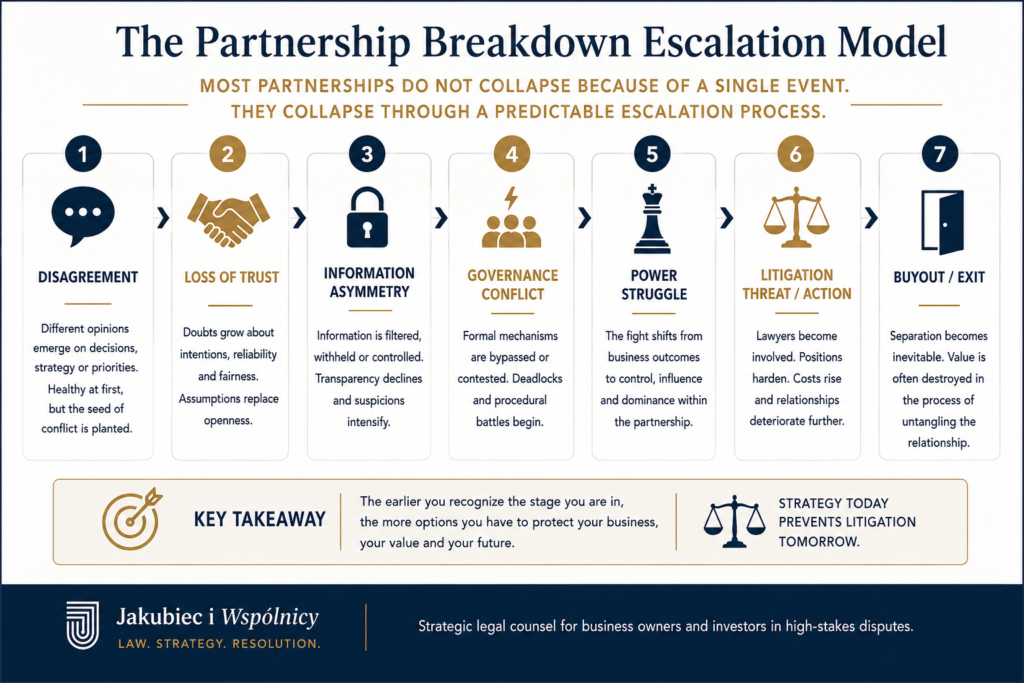
The Jakubiec Partnership Breakdown Escalation Model — a visual framework showing how business relationships deteriorate through predictable stages. Recognizing the stage early allows strategic intervention before litigation becomes inevitable.