

 by dr Andrzej Jakubiec - adwokat, mediator
Why Intelligent People Lose Disputes?
Litigation as a Subplot: Viewing the Court Case Within a Broader Conflict
A lawsuit is almost always just a single element of a much larger conflict. The real dispute—the one that exists independently of the courtroom—is often far broader than what the court actually addresses. It can involve a wider network of people, stem from historical tensions, or even generate entirely new disputes. Consequently, legal proceedings are usually just one of many battlegrounds—and frequently not the most critical one.
This dynamic is especially clear in corporate warfare. A shareholder often challenges a board resolution not because it is defective, but because blocking it stalls a hostile takeover or strengthens their bargaining power. The court is left analyzing arguments manufactured solely for the trial, which have little to do with the actual core of the dispute.
To bring structure to this chaos, let us recognize three distinct dimensions of conflict:
- 1. The Substantive – Real Conflict — what the battle is actually about.
- 2. The Perceptual Conflict — how each party subjectively views the situation.
- 3. The Legal / Procedural Conflict — what formally makes its way into the courtroom.
- Dynamic interaction between the three dimensions of conflict:
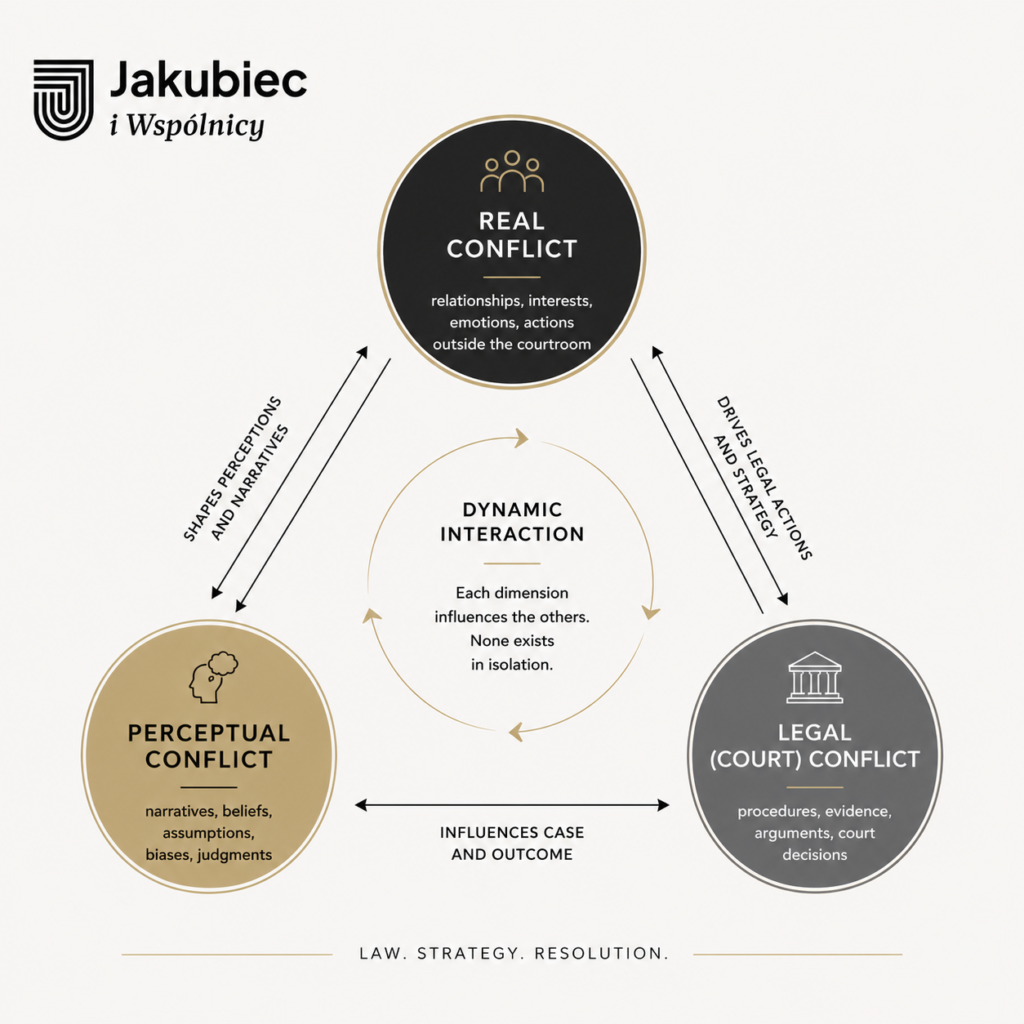
A single legal proceeding is often just one clash among many between the same or interconnected parties. The conflict simultaneously rages across other fronts: operational, communicative, reputational, familial, or financial.
Crucially, both sides can view the position of a given lawsuit on the “conflict map” entirely differently. The upper hand goes to the party whose map reflects reality more accurately—yet the perception of each actor is, at the same time, a structural element of that very reality.
Therefore, it is vital to remember: you can win the case and lose the conflict. You can also lose the case and achieve all your strategic goals. Even highly intelligent people routinely blind themselves to this distinction. It is a fatal error committed by corporate strategists, politicians, military commanders, lawyers, advisors, entrepreneurs, and spouses in crisis alike.
To illustrate this, let me share an example. I once handled a case involving two brothers who were partners in a limited liability company (sp. z o.o.). One of them maliciously blocked the other’s dividend payout, fully aware that his brother desperately needed the cash. The case went to a commercial court. Armies of lawyers, forensic accountants, and business valuation experts were brought in. Over time, it turned out that the brothers had simply had a massive falling out over who was supposed to host Christmas Eve dinner. The court could have litigated for ten years without ever touching the true essence of the dispute. Any formal judgment would have only deepened their conflict.
Redefining Victory: What Does It Actually Mean to “Win”?
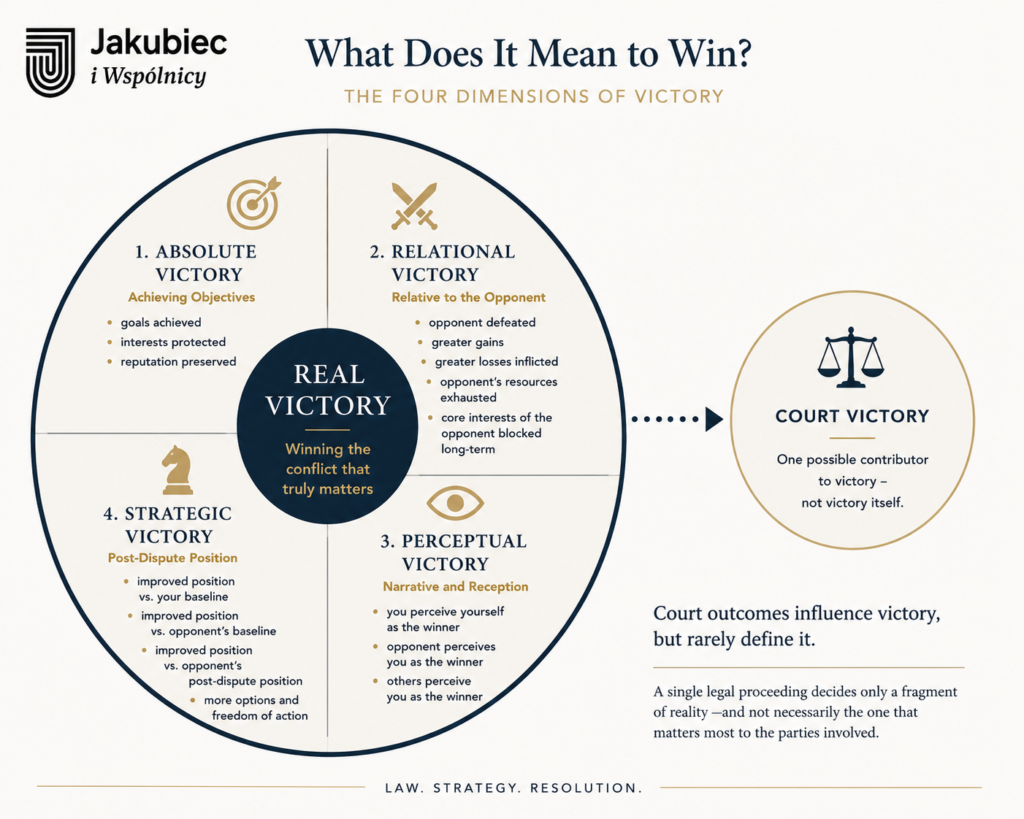
What, then, constitutes victory? It is certainly not the mere act of winning a court case. If Pyrrhus had been a lawyer, he would have agreed with me without hesitation. For anyone interested in this subject, I highly recommend Thomas Schelling’s brilliant book, The Strategy of Conflict.
While I have presented a detailed exploration of how winning and losing are defined in a separate article, I will limit myself here to the most common understandings of victory. In practice, they can be divided into four distinct categories:
1. Absolute Victory — Achieving Personal Objectives
- You win if you achieve your original, baseline plans.
- You win if, post-dispute, you retain more options and opportunities to pursue your core interests.
- You win if you incur lower reputational costs.
2. Relational Victory — Outcome Relative to the Opponent
- You win if you defeat the opponent in a direct, head-to-head confrontation.
- You win if you extract more benefit than the other side.
- You win if you inflict heavier losses on the opponent than you sustain yourself.
- You win if you drive the exhaustion of the opponent’s resources.
- You win if you permanently prevent the opponent from achieving their core interests in the long run.
3. Perceptual Victory — Narrative and Reception
- You win if you subjectively perceive yourself as the winner.
- You win if your opponent perceives you as the winner.
- You win if external observers perceive you as the winner.
4. Strategic Victory — Post-Dispute Position
- You win if your relative position improves more significantly: a) compared to your baseline position, b) compared to the opponent’s baseline position, or c) compared to the opponent’s subsequent, post-dispute position.
As we can see, a single legal proceeding rarely guarantees victory in any of these categories. The court rules only on a single fragment of reality—and not necessarily the one that matters most to the parties involved. In divorce, corporate, or asset disputes, a court may decide a crucial matter, but just as often, it touches upon only one of many threads, completely disconnected from what determines a real win or loss.
Furthermore, the outcome of a dispute can be evaluated entirely differently by various individuals. This divergence typically stems from:
- The application of different criteria for success;
- Access to asymmetrical information; or
- Discrepancies in the time horizon through which the consequences are viewed.
The Real Reason Why Smart People Fail
This is exactly why intelligent people lose so often. Driven by sheer determination, they execute actions that:
- Either cannot logically lead to their intended goal,
- Or the goal itself was defined incorrectly and fails to improve their overall position,
- Or they concentrate heavily on the least significant aspect—such as a relational victory (the need to be deemed the winner), which in practice yields a profound strategic defeat.
Yet, this very discrepancy can be useful. It allows parties to save face—which is frequently the ultimate psychological prerequisite for accepting a factual defeat.
The Anatomy of Failure: Why Smart People Lose in Court
Failure stems from various causes. However, before we dissect them, it is worth noting something crucial: not all failure is inherently bad. Sometimes, a loss closes a flawed alternative and forces a course of action that proves highly beneficial in the long run. Certain failures function merely as a system correction mechanism—painful, yet necessary.
However, if we want to understand why highly intelligent people fail, we must map the root causes of failure across the three dimensions of conflict: the real, the perceptual, and the legal. Most importantly, we must expose the specific errors characteristic precisely of intelligent individuals.
Table: Why Highly Intelligent People Fail Across the Three Dimensions of Conflict?
| Dimension of Conflict | Specific Failure Pattern | Why Smart People Are Especially Vulnerable |
|---|---|---|
| Real Conflict | Overconfidence | Intelligent individuals overestimate their ability to predict the behavior, intentions, and thresholds of other actors. |
| Real Conflict | Illusion of Completeness | They construct coherent, elegant narratives from incomplete data because their minds refuse informational gaps. |
| Real Conflict | Elegance Bias | They prefer intellectually satisfying solutions over those that are operationally effective. |
| Real Conflict | Planning Fallacy | They underestimate time, cost, friction, and opponent counter‑moves due to excessive trust in their own planning ability. |
| Perceptual Conflict | Narrative Capture | They become prisoners of their own internally coherent story, which eventually outweighs the actual facts. |
| Perceptual Conflict | Confirmation Bias 2.0 | They do not merely seek confirmation — they actively engineer it through sophisticated rationalization. |
| Perceptual Conflict | Self‑Justification | Their intelligence makes it harder to admit misjudgment, leading to escalation rather than correction. |
| Perceptual Conflict | Misreading the Audience | They overestimate how much others care about the conflict, misjudge stakeholder investment, and misread reputational stakes. |
| Legal Conflict | Legal Tunnel Vision | They equate legal correctness with strategic victory, misunderstanding the limited role of law in a dynamic conflict. |
| Legal Conflict | Overengineering Arguments | They overcomplicate and over‑refine arguments, losing sight of what actually persuades a judge. |
| Legal Conflict | Misreading the System | They treat the court as a logical machine rather than a human institution with its own constraints and dynamics. |
| Legal Conflict | Cost Blindness | Convinced of the righteousness of their cause, they ignore financial, emotional, reputational, and temporal costs. |
1. Real Conflict — Flaws in Reality Among Intelligent Minds
It is at this foundational level that intelligence most frequently becomes a trap. This is not because smart people think poorly, but rather because they think too well, and their minds refuse to tolerate ambiguity.
- 1.1. Overconfidence — Overestimating Predictive Capabilities Intelligent people deeply believe they can accurately predict the behavior of other participants in a conflict. This illusion invariably leads to flawed strategic choices.
- 1.2. Illusion of Completeness — Constructing Coherent Narratives from Incomplete Data The smarter an individual is, the more effortlessly they craft beautiful, logical explanations to fill information gaps. The problem is that these narratives, while intensely compelling, are often entirely false.
- 1.3. Elegance Bias — Choosing Elegant Solutions Over Effective Ones Intelligent people have a strong tendency to select courses of action that are logical, aesthetic, and intellectually satisfying—yet do not necessarily work in practice. In litigation, elegant solutions often take the form of sophisticated, academic legal theories, while effective solutions are frequently simple, raw, and tactical.
- 1.4. Planning Fallacy — Underestimating Time, Costs, and Friction The more someone trusts their own planning capability, the more they blind themselves to random variables, procedural delays, opponent counter-moves, and collateral costs. This is a direct path to strategic disasters.
2. Perceptual Conflict — Flaws in Narrative Among Intelligent Minds
This is the most elusive and treacherous plane. Here, intelligence transforms into the ultimate trap, inadvertently triggering a dangerous spiral of escalation.
- 2.1. Narrative Capture — Becoming a Prisoner of One’s Own Story The more intelligent an individual is, the more easily they manufacture an internal narrative that perfectly justifies their decisions, explains the opponent’s moves, and imposes order onto chaos. Eventually, this narrative becomes more vital to them than the actual facts.
- 2.2. Confirmation Bias 2.0 — Intelligent Rationalization Smart people do not merely seek confirmation for their assumptions; they actively engineer it, brilliant at rationalizing reality to fit their preconceived thesis.
- 2.3. Self-Justification — Defending the Ego The higher the intelligence, the harder it is to admit a miscalculation—to acknowledge a misread situation, a poorly chosen objective, or a failure of one’s own making. Prioritizing ego over core interests always accelerates escalation.
- 2.4. Misreading the Audience — Flawed Stakeholder Assessment Intelligent individuals frequently overestimate how deeply external parties care about the conflict, how heavily invested the opponent truly is, or how severely their own reputation is at stake. Consequently, they deploy defensive tactics that serve no strategic purpose.
3. Legal (Court) Conflict — Flaws in Procedure Among Intelligent Minds
This is the arena where intelligent people believe most blindly in the power of their intellect. Paradoxically, it is precisely why they suffer their most devastating defeats here.
- 3.1. Legal Tunnel Vision — Equating Legal Correctness with Strategic Victory A classic delusion: assuming that if you have the law on your side, if your argument is crystal-clear in its logic, and if the statutes support you, you must win. In reality, strict legal correctness is often strategically useless. The most dangerous error is not misunderstanding the law itself; it is misunderstanding the limited role that law plays within a larger, dynamic conflict.
- 3.2. Overengineering Arguments The smarter the individual, the more they complicate, over-expand, and refine their arguments, completely losing sight of the simple, raw points that actually persuade a judge.
- 3.3. Misreading the System — Treating the Court as a Logical Machine Intelligent people often refuse to accept that the court does not operate like their own mind, that legal procedure is not a purely intellectual tool, and that a judge is rarely an audience for idealized, academic discourse.
- 3.4. Cost Blindness — Ignoring Collateral Damage Blinded by the righteousness of their cause, smart individuals stop calculating real transactional costs: financial depletion, emotional fatigue, reputational hits, and the immense cost of lost time.
Failure’s Anatomy Summary
The Anatomy of Failure: A strategic mapping of the 12 behavioral and procedural traps that lead high-IQ individuals and enterprises to catastrophic defeats across the real, perceptual, and legal dimensions of conflict.
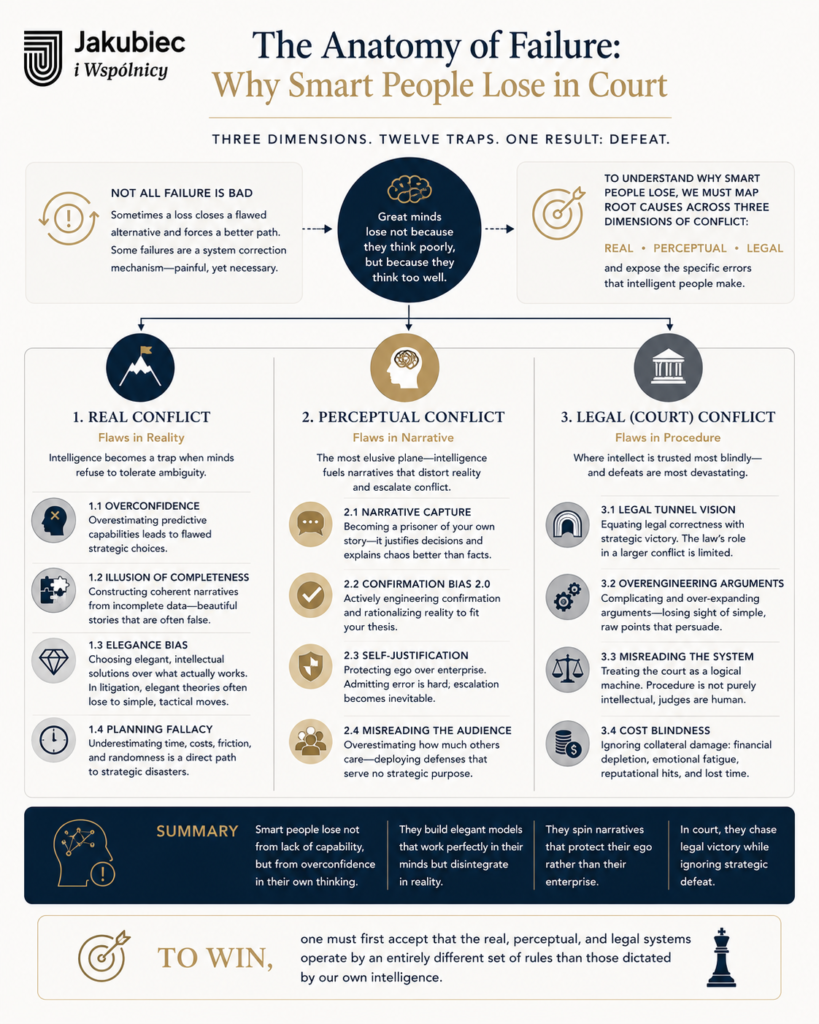
Highly intelligent people do not lose because they lack capability; they lose because they become overconfident in the products of their own thinking. They construct logical, elegant models of conflict that work perfectly in their heads but disintegrate in reality. They spin narratives that protect their ego rather than their enterprise. In court, they focus obsessively on legal victory while remaining entirely blind to strategic defeat.
To win, one must first accept that the real, perceptual, and legal systems operate by an entirely different set of rules than those dictated by our own intelligence. Smart people often hire lawyers who resemble themselves — analytical, academic, theoretical — instead of those who actually win trials.
Shifting the Odds: How to Increase Your Chances of Winning
To provide a meaningful answer to how one can increase the chances of winning, we must maintain our core distinction between the three dimensions of conflict. Addressing this question within the Real and Perceptual dimensions—where battles involve complex psychological warfare, market dynamics, and reputational chess—is far too vast a subject for this chapter. Therefore, I will deliberately set those two layers aside for now and focus exclusively on the tactical mechanics of the Legal (Court) Conflict, specifically within the unique and challenging reality of the Polish judicial system.
In Polish litigation, raw intelligence and a sense of moral entitlement are rarely enough. To navigate the procedural rigidity and systemic unpredictability of Polish courts, a smart strategist must adhere to nine fundamental principles:
1. Enter the Courtroom Only When Absolutely Necessary
The Polish judicial system is notoriously overburdened, slow, and formalistic. Litigation should never be your first impulse; it must be your last resort. Treat the decision to file a lawsuit like a declaration of war—an expensive, exhausting measure deployed only when all alternative strategic options, leverage points, and non-judicial mechanisms have been completely exhausted.
2. Master Both the Facts and the Legal Interpretation
Polish civil and commercial procedures are deeply unforgiving of preparation gaps. You must achieve absolute command over two fronts before the first gavel falls:
- The Evidentiary Base: Establish an airtight, chronological map of undeniable facts supported by robust documentary evidence.
- The Legal Theory: Secure a bulletproof, precise interpretation of the law. In a system where precedents are persuasive but not strictly binding, your legal framework must leave no room for arbitrary interpretation.
3. Rigorously Account for Judicial Risk (Ryzyko Procesowe)
In Poland, “judicial risk” is a structural reality. Different senates or divisions within the exact same court can interpret identical regulations in wildly contrasting ways. Never plan for a best-case scenario. A brilliant strategist calculates the probability of systemic inconsistency, unexpected changes in jurisprudence, and the subjective disposition of the adjudicating judge. If your strategy cannot survive a hostile or unpredictable judicial turn, it is a bad strategy.
4. Select a Top-Tier Trial Advocate
Do not hire an academic or a theorist for a street fight. You need an experienced, highly tactical litigator (adwokat or radca prawny) who understands the gritty reality of Polish courtrooms. A great advocate does not just know the codes; they know how to read the judge, how to react dynamically to unexpected procedural maneuvers by the opponent, and how to deliver surefire, persuasive arguments under extreme time pressure.
5. Secure the Capital Required to Sustain the Siege
Litigation in Poland is rarely a blitzkrieg; it is almost always a war of attrition. Between the initial filing, the exchange of extensive pleadings, delays in scheduling hearings, and the inevitable appellate process, a case can easily drag on for years. You must secure and isolate the necessary financial resources upfront. Entering a legal dispute with a tight budget is a fatal vulnerability; running out of capital midway through a trial forces catastrophic settlements.
6. Construct Razor-Sharp Evidentiary Hypotheses (Tezy Dowodowe)
Under current Polish procedural law, preclusion rules are exceptionally strict. You cannot simply throw a mountain of documents at a judge and hope they find the truth. Every single piece of evidence, every witness, and every expert report must be accompanied by a meticulously drafted, precise evidentiary hypothesis (teza dowodowa). You must clearly state exactly what a specific piece of evidence proves and why it is legally relevant to the core layout of the case. Loose, vague motions will be ruthlessly dismissed by the court.
7. Never Treat the Trial as an End in Itself
The courtroom is not a theater for personal vindication or academic debates. A lawsuit is merely a highly specialized instrument within your broader business or personal framework. Always keep your eyes on the ultimate strategic outcome. If a specific procedural victory does not improve your real-world position, protect your assets, or open up new opportunities, it is an expensive distraction. Never sacrifice your enterprise to win a point of law.
8. Remember that Witnesses and Court Experts Are Only Human
Smart people often expect the court to behave like a flawless, data-driven machine, but it is staffed entirely by human beings.
- Witnesses are deeply unreliable: they forget crucial details over time, perceive events through biased lenses, get confused under cross-examination, or cave under psychological pressure.
- Court-Appointed Experts (Biegli Sądowi)—who carry immense weight in Polish litigation—are also susceptible to human flaws. They can be overworked, deliver superficial or deeply flawed opinions, succumb to professional inertia, or struggle to grasp highly modern business models. Your strategy must always build in a margin of safety for human error and cognitive bias.
9. Run Parallel Negotiations — The Courtroom Door Is Never Locked
A highly sophisticated strategist understands that litigation and negotiation are not mutually exclusive; they are complementary tracks. The fact that you are fighting fiercely inside the courtroom should never stop you from talking outside of it. Parallel negotiations can run continuously, addressing not only the narrow legal dispute itself but also all the broader, structural elements of the conflict that the court is legally blind to. Quite often, a well-executed, aggressive lawsuit is the exact catalyst needed to force a stubborn opponent into a highly favorable settlement.
Litigation is never the battlefield — it is only the visible fragment of a much larger strategic landscape.
Table: Nine Principles for Increasing Your Chances of Winning in Polish Litigation
| Principle | Core Idea | Strategic Rationale |
|---|---|---|
| Enter the Courtroom Only When Necessary | Litigation must be a last resort, not a first impulse. | Polish courts are slow, overloaded, and formalistic; premature litigation destroys leverage and drains resources. |
| Master Facts and Legal Interpretation | Achieve total command over evidence and legal theory. | Polish procedure punishes gaps; only airtight facts + precise legal framing survive judicial scrutiny. |
| Account for Judicial Risk | Build a strategy that survives inconsistent jurisprudence. | Identical cases can be decided differently; planning for unpredictability is mandatory. |
| Select a Top‑Tier Trial Advocate | Choose a tactical litigator, not an academic. | Winning requires courtroom instincts, judge‑reading, and rapid tactical adaptation. |
| Secure Litigation Capital | Prepare financial reserves for a multi‑year siege. | Running out of funds mid‑trial forces catastrophic settlements and strategic collapse. |
| Construct Razor‑Sharp Evidentiary Hypotheses | Every piece of evidence must have a precise, articulated purpose. | Strict preclusion rules eliminate vague motions; only targeted evidence survives. |
| Never Treat the Trial as an End in Itself | Court victories matter only if they improve real‑world position. | Procedural wins without strategic value are expensive distractions. |
| Expect Human Fallibility | Witnesses and experts are unreliable, biased, and inconsistent. | Polish courts rely heavily on human testimony and expert opinions — both structurally fallible. |
| Run Parallel Negotiations | Litigate and negotiate simultaneously. | Court pressure often unlocks settlements; negotiations address dimensions the court cannot see. |
Conclusion
Winning in the legal arena demands far more than raw intelligence or an airtight legal argument. As we have dissected, high-IQ individuals and sophisticated corporate actors routinely suffer catastrophic defeats not from a lack of capability, but because they fall prey to their own cognitive biases—becoming captive to elegant models, misreading human fallibility, and confusing strict legal correctness with overarching strategic victory.
Ultimately, a court case is never a standalone battle; it is merely a single subplot within a much larger, dynamic conflict. To tilt the scales in your favor—especially within the rigid and unpredictable landscape of Polish litigation—you must discipline your mind to look beyond the courtroom doors. You must balance aggressive procedural tactics with cold, objective reality, recognize the human limitations of the system, and never stop negotiating outside the courtroom. True victory belongs to those who refuse to let their ego dictate their strategy, and who understand that the ultimate goal is not merely to win a point of law, but to protect and advance their real-world enterprise.
Call to Action
When the stakes are high, you cannot afford to rely on legal correctness alone. If your enterprise is facing a complex corporate, commercial, or asset dispute, you need more than just a firm that files pleadings—you need a partner who maps the entire conflict.
Let us dissect the reality of your dispute before the system dissects it for you.
Contact Jakubiec i Wspólnicy today to schedule a strategic consultation. Together, we will look beyond the legal subplot, neutralize cognitive traps, and engineer a path to real, strategic victory.
FAQ
Q1: If I have a 90% chance of winning a case legally, shouldn’t I push forward to a judgment?
A: Legally, yes; strategically, it depends entirely on what that judgment will cost you in the Real and Perceptualdimensions of the conflict. In Polish commercial disputes, a multi-year trial can drain your management’s time, exhaust financial resources, and paralyze business operations. If a 90% legal victory results in a 100% reputational disaster or leaves your enterprise financially depleted, it is a net strategic defeat. Always weigh the transaction costs against the real-world value of the judgment.
Q2: Why does high intelligence make corporate leaders more vulnerable to legal traps?
A: High intelligence is an asset, but without behavioral discipline, it breeds Overconfidence and Elegance Bias. Brilliant minds refuse informational gaps, so they construct beautifully logical, internally coherent narratives (Illusion of Completeness) that explain the conflict perfectly—in their heads. They often fall in love with sophisticated legal theories rather than simple, raw, tactical moves. They lose because they become captive to the perfection of their own models, failing to realize that the courtroom is a human institution, not a logical machine.
Q3: How do you negotiate with an opponent while simultaneously fighting them fiercely in court?
A: By treating litigation not as an emotional vendetta, but as a dynamic leverage generator. Filing a precise, aggressive lawsuit changes the opponent’s calculus, escalates their Cost Blindness, and directly attacks their Perceptual stability. You do not negotiate out of weakness; you use the procedural pressure created inside the courtroom as the exact catalyst to force a rational, structured conversation outside of it. The courtroom door is never locked.
Q4: Court-appointed experts (Biegli sądowi) are professionals. Why do you label them as a systemic risk?
A: Because they are human beings operating within a heavily burdened system. In Polish litigation, experts carry immense structural weight, yet they frequently suffer from professional inertia, severe overwork, or a lack of familiarity with highly modern, fast-paced business models. An expert can misread data, deliver a superficial report, or succumb to cognitive bias. A sophisticated legal strategy must always factor in this margin for human error and include targeted, razor-sharp evidentiary hypotheses to steer the expert’s focus precisely.
Q5: What is the difference between winning a “case” and winning a “conflict”?
A: A court case is merely a highly formalistic subplot. Winning a case means obtaining a favorable ruling on a specific, narrow legal claim (e.g., overturning a corporate resolution or enforcing a single contractual clause). Winning a conflictmeans protecting your long-term baseline, expanding your future strategic options, and advancing your core enterprise interests. If your legal victory does not improve your real-world position, you have simply mastered the procedure while failing the strategy.
by dr Andrzej Jakubiec - adwokat, mediatorCognitive Traps and Their Impact on Decision‑Making in the Fogg Model
In several previous texts, I presented some cognitive biases (thinking traps), including the fundamental attribution error, tunnel vision, and my original concept of the Coupled Confirmation Bias. I wrote about them mainly in the context of their impact on the dynamics of conflict, which I observe in my daily work. Now I want to take a step further and show how these same mechanisms influence the decision‑making process in the Fogg model.
To move forward, I introduce a set of tools I’ve developed myself — three decision’s parameters and eight resulting decision types. In the next section, I walk through how these elements interact and why they matter. This framework is entirely my own creation; I find it promising and intuitively useful, though it still needs to be tested in practice. For now, it remains a proposal — and I state that openly.
What Are Cognitive Biases?
Cognitive biases are, in other words, errors or traps in thinking. The term was popularized by Daniel Kahneman. This outstanding psychologist published the book Thinking, Fast and Slow, in which he described mechanisms that affect all of us. Not because something is wrong with us. These mechanisms serve important functions. They simplify many matters. They allow us, for example, to conserve energy or solve a given problem well enough to move on to the next one.
But in complex social relationships, they cause us to misjudge reality, create false narratives in our minds, and ultimately make poor decisions.
Which Cognitive Biases Do We Know?
There are many cognitive biases, and we have probably not discovered all of them yet. Here I will briefly present only a few:
- Confirmation bias
- Fundamental Attribution Error
- Status quo bias
- Sunk costs fallacy
- Coupled Confirmation Bias – my original concept (and its extension), which is only a hypothesis and requires further development and empirical validation.
- Tunnel vision, which is not a cognitive bias in itself, but a systemic mechanism.
The impact of cognitive biases on decision‑making — for example, in the context of reaching agreements — is the subject of extensive scientific research. Some of them are considered inhibiting, others reinforcing. This distinction is useful for drawing further conclusions.
Below I will present, in order:
- the mode of decision‑making in the Fogg model, and
- the parameters of a decision once it is made.
Only then will I show how selected cognitive biases can influence both whether we make a decision at all, and the content of that decision.
The Fogg Decision‑Making Model
The Fogg model describes human behavior as the result of three interacting components: motivation, ability, and a trigger. A behavior — including a decision — occurs only when all three appear at the same moment.
This means that even if a person wants to make a decision (motivation). And even if they can make it (ability), the decision will not happen without a trigger. Conversely, even a strong trigger will not work if motivation is too low or the action feels too difficult.
In practice, this model explains why people in conflict often remain stuck in indecision, delay key steps, or choose actions that are irrational from the outside. Their internal configuration of motivation, ability, and triggers is disrupted — and cognitive biases play a decisive role in that disruption.
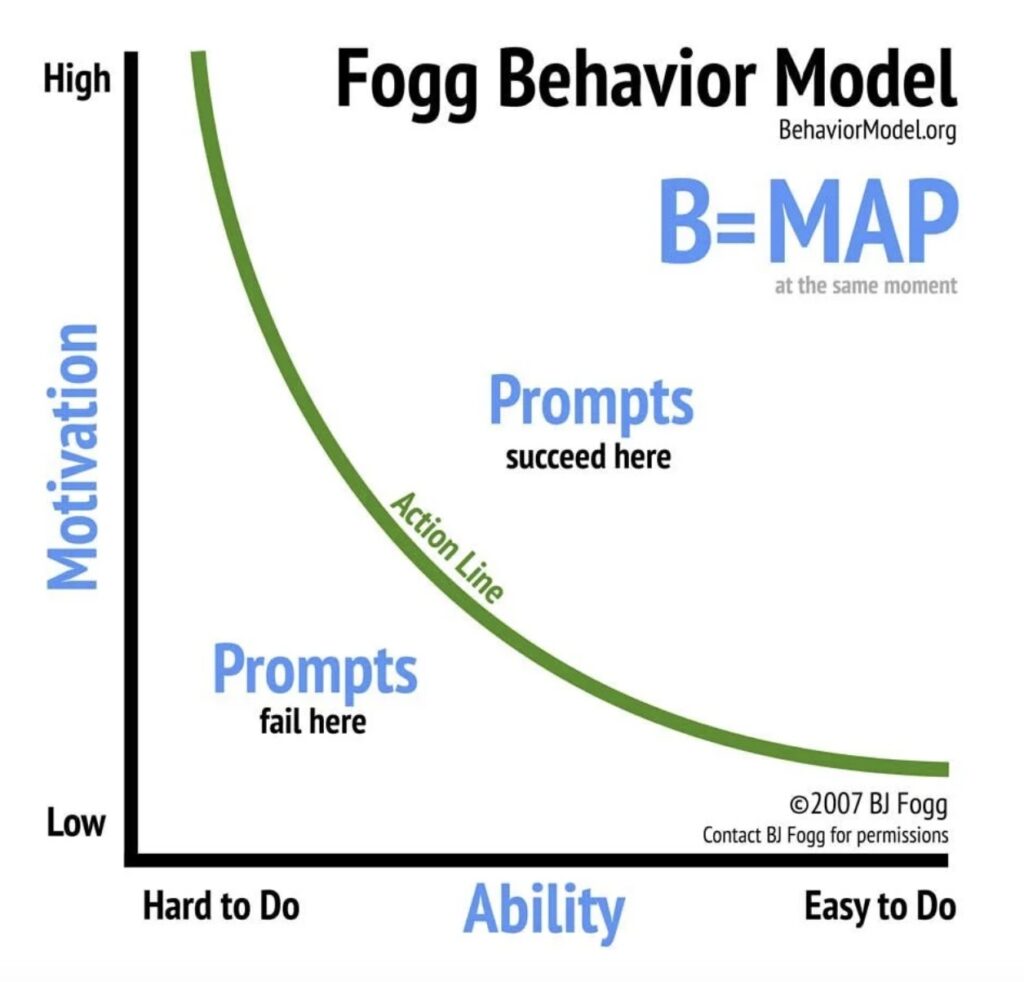
Let us remember that, for a decision to occur, all three elements —
- motivation,
- ability, and
- trigger — must appear together. I have already discussed this in detail in a previous text.
Now I will pose a question:
What Is “Ability” in Fogg’s Framework?
I understand ability as a property whose characteristics are better captured by the word feasibility. I did not elaborate on this aspect in the previous article, so I will do it now.
In the Fogg model, feasibility — in my interpretation — is the resultant of two subjectively perceived factors:
- one’s own capabilities, and
- the difficulty of the task.
Only the decision‑maker’s perception matters. Of course, they may misjudge the situation due to a cognitive error or faulty data. Interestingly, such an error may ultimately lead to a beneficial decision.
Imagine that I have incomplete or inaccurate data. Acting under the influence of a logical or cognitive error, I draw incorrect conclusions from them. Those conclusions would be considered correct if I had access to complete or accurate data — and if I were not acting under the influence of error.
This can be summarized in one sentence: Fogg’s triad influences the act of decision‑making, which is not identical with the way the decision is executed. The manner of executing a previously made decision is described by decision parameters (discussed below).
What Are the 8 Types of Decisions?
I propose that decisions analyzed through the lens of their execution should be assigned three parameters. These parameters determine how the decision is carried out. The three decision parameters I propose below allow me to distinguish eight types of decisions.
In the following section, I present how each configuration combines to form these eight decision types. This is my original concept, which I find highly useful, though it naturally requires further testing. For now, it remains solely my own proposal, which I state explicitly.
My proposal of 3 Decision’s Parameters
The three decision’s parameters are: vector, dynamics, and determination (I am considering whether momentum might be a better term).
1. Vector
Its reference point is the current state. Its value is 0 or 1. Let 0 denote a tendency to remain in the existing arrangement, and 1 a drive toward change.
2. Dynamics
Let us distinguish two values of dynamics: (+) and (–), where (+) means that the decision results in action, and (–) means passivity.
3. Determination
Let us define two levels: (L) and (H), where (L) stands for low determination, and (H) stands for high determination.
Vector expresses the attitude toward the current state and its change. A decision to defend the status quo or to alter it may be realized — depending on circumstances — through passivity or action (dynamics + or –). Determination is a function of readiness to engage, which I understand as the resultant of:
- willingness to bear costs (financial, reputational, organizational, energetic, or even biological), and
- tolerance of risk.
Vector, dynamics, and determination form a simplified heuristic model created by me (at least I am not aware of any publications that use these parameters — apart from the previously mentioned inhibiting and reinforcing biases). Its usefulness certainly requires further research — for now, it remains a hypothetical model.
I also emphasize that the human psyche is not mathematics — yet paradoxically, mathematics allows us to understand the psyche better.
Table 1: The Three Decision’s Parameters
| Decision Parameter | Parameter Value | Description and Meaning of the Parameter |
|---|---|---|
| Vector | 0 | Indicates a tendency to maintain the current state. The decision‑maker interprets the situation as one in which it is better to remain with the status quo. |
| 1 | Indicates a drive to change the current state. The decision‑maker concludes that the existing arrangement requires modification or abandonment. | |
| Dynamics | + | A decision executed through action. It means actively doing something intended to maintain or change the state. |
| – | A decision executed through passivity. It means refraining from action as a way of achieving the goal (maintaining or changing the state). | |
| Determination | L | Low determination. Indicates limited willingness to bear costs and low risk tolerance. The decision is weak and easily altered. |
| H | High determination. Indicates a strong willingness to bear costs (financial, emotional, organizational, biological) and high risk tolerance. The decision is strong and stable. |
Using the three parameters listed above allows us to distinguish eight types of decisions.
Table 2: Eight Types of Decisions
| Decision Type No. | Vector | Dynamics | Determination | Description of the Decision | Example |
|---|---|---|---|---|---|
| 1 | 0 | – | L | A decision to maintain the status quo through passivity with low determination | I decide to sleep a bit longer |
| 2 | 0 | – | H | A decision to maintain the status quo through non‑action with high determination | Sitting on a tree, I decide not to move so I don’t fall |
| 3 | 0 | + | L | A decision to maintain the status quo through action with low determination | I decide to shoo away the cat that is waking me up |
| 4 | 0 | + | H | A decision to maintain the status quo through action with high determination | I defend my daughter from an attacker |
| 5 | 1 | – | L | A decision to bring about change through passivity with low determination | I don’t water flowers I dislike so they will wither |
| 6 | 1 | – | H | A decision to bring about change through passivity with high determination | I decide not to save someone when I want them to drown |
| 7 | 1 | + | L | A decision to bring about change through action with low determination | I want to trim the cat’s claws |
| 8 | 1 | + | H | A decision to bring about change through action with high determination | I want to escape from prison |
Jakubiec eight types of decisions
Let us add that:
- decisions with vector 0 (maintaining the status quo), and
- decisions with negative dynamics (–), i.e., achieving the goal through passivity,
do not in any way mean the absence of a decision. These are not the same. I may decide to sit quietly and remain motionless so that someone does not find me. That decision is not the same as externally observed passivity caused, for example, by apathy or an ambivalent attitude toward the situation.
Similarly, it must be noted that:
- a decision aimed at change (Vector 1) cannot be equated with action (+), and
- a decision aimed at defending the status quo (Vector 0) cannot be equated with the absence of action.
The initial state (status quo) may be so desirable that we decide to defend it actively (vector 0, dynamics +). Thus, not wanting change, we will take action. Example: If I want a drowning person to survive, I will rescue them. Not wanting to allow a change (life → death), I will take action.
Conversely, it may happen that in striving for change we decide not to act. If I want a drowning person to die, it is enough that I do not rescue them. Drowning represents a change in their state (life → death) brought about by my passivity. Here we have vector 1, negative dynamics, and a level of determination which, in this example, we do not know — but we assume it would have to be very high.
For completeness, it must also be stated that the absence of a decision to change is not identical with a decision to maintain the status quo. A lack of decision results from the absence of at least one element of the decision triad (see above). Thus, the absence of a decision may result from a lack of motivation, a subjectively perceived lack of feasibility, or the absence of a trigger. This does not necessarily mean that the stimulus is irrelevant to us. It may, for example, generate motivation, but we will not make a decision because the task appears unfeasible. In such a situation, the objective absence of action cannot be equated with passivity as a chosen parameter of a made decision.
Example
When encountering a bear in the mountains, I may decide either to surrender or to save my life. But whether I achieve this by playing dead, fighting, or running — that is a parameter of the decision. And in this respect, it may be chosen correctly or incorrectly: I may run up a tree the bear can climb after me, or hide in a rock crevice where it cannot reach me. This does not change the fact that I decided to stay alive (vector 0) through action in the form of escape (dynamics +) or through passivity in the form of playing dead (dynamics –), with high determination in each case (H).
As I indicated above, one must distinguish between lying down because I consciously chose to survive by playing dead, and lying down because I concluded that I have no chance anyway, and besides, I have not wanted to live for a long time.
What Is the Relationship Between Cognitive Biases, the Decision Triad, and Decision Parameters?
Above, I outlined three areas: cognitive biases, the decision triad, and the decision parameters. A natural question arises: how can these elements relate to one another?
Let us begin with the clarification that there is no determinism here. Cognitive biases do not determine a given decision, but they significantly increase the tendency — they “pull” in a particular direction. I also note that one may simultaneously remain under the influence of two or more biases, originating from different sources, whose effects intersect at a given moment, each “pushing” the decision‑maker in a different (or the same) direction.
The Influence of Cognitive Biases on the Decision Triad (the Act of Making a Decision)
As indicated above, cognitive biases may act at every stage and level of decision‑making and decision execution. It may turn out that when the decision triad is activated, one bias becomes influential, and when setting the parameters of execution, we operate under the influence of another. It may also happen that two biases act simultaneously, and their mutual relationship is positive (they act in the same direction), partially opposing, or entirely opposing. Most often, however, we will remain under the influence of one of them.
Let us assume that cognitive biases may influence:
- the emergence of motivation by affecting the evaluation of the stimulus that generates emotion, and consequently the direction or strength of motivation;
- the subjective assessment of feasibility;
- susceptibility to a trigger.
Let us also assume that, with respect to each element of the decision triad, the influence of a cognitive bias may be reinforcing or weakening.
Motivation
A cognitive bias may influence the very existence of motivation (trigger it or extinguish it), and may strengthen or weaken existing motivation.
Perception of Feasibility
A cognitive bias may influence the assessment of feasibility and make the sense of feasibility stronger or weaker (both by affecting the perception of one’s own capabilities and the subjectively perceived difficulty of the task itself).
A distorted assessment caused by a cognitive bias may therefore result in:
- evaluating a task as feasible when it is not feasible;
- evaluating a task as unfeasible when it is feasible.
and consequently:
- making a decision when the goal is “desirable” but objectively unattainable (lack of feasibility);
- not making a decision when the goal is objectively attainable and desirable.
Trigger
With respect to the trigger, a cognitive bias may strengthen or weaken its effect. This means that, at a sufficient intensity of cognitive distortion:
- certain cognitive biases may interpret as a trigger a factor that, under other circumstances, would not be interpreted that way;
- an objectively strong trigger may turn out to be too weak, even though it would be sufficient to make a decision if the bias of that type and intensity were not present;
- an objectively weak trigger may turn out to be strong enough to make a decision, even though without the presence of a bias of that type and intensity, it would not be sufficient.
To illustrate this, I will use a table showing the possible influence of selected cognitive biases on a chosen element of the decision triad — feasibility.
Table 3: Influence of Selected Cognitive Biases on the Perception of Task Feasibility in the Fogg Model
| Cognitive Bias | How It Distorts the Perception of Feasibility | Consequences for Making a Decision About Change in the Fogg Model |
|---|---|---|
| Confirmation bias | Reinforces the belief that previous actions were correct | May result in a decision to change / or no decision to change |
| Fundamental Attribution Error | Explains the other party’s stance by attributing it to presumed internal traits (e.g., character traits) | May result in a decision to change / or no decision to change |
| Feedback loop | Strengthens initial assumptions, leading to radicalization | May result in a decision to change / or no decision to change |
| Coupled Confirmation Bias | Leads to radicalization and escalation | Results in a decision to change |
| Status quo bias | Leads to a desire to maintain the current state (status quo) | Results in no decision to change |
| Sunk cost fallacy | Leads to a desire to maintain the current state (status quo) and deepen it | Results in no decision to change |
| Hyper‑usefulness bias (AI) | Strengthens initial assumptions, which may lead to radicalization | May result in a decision to change / or no decision to change |
The Influence of Cognitive Biases on Decision Parameters
A cognitive bias may — independently of its earlier influence on the very act of making a decision according to the Fogg model — appear and exert its effect at the next stage, i.e., when setting the parameters for executing the decision.
Thus, it may influence the vector of the decision and result in our reacting to a given stimulus by making an incorrect decision about maintaining or changing the current state. Example: the radio is playing too loudly. I decide to remove the inconsistency between the volume of the music and my well‑being. A cognitive bias may cause me, instead of adjusting the radio to myself — lowering the volume or turning it off (vector 1, dynamics +, determination L) — to try to “get used to it” (vector 1, dynamics –, determination L).
A cognitive bias may influence the dynamics of the decision and result in my choosing action instead of non‑action incorrectly, after having already set the vector (my stance toward the current state). Example: during a trek, my leg hurts. I want to eliminate the pain (vector 1 — change of the current state). But under the influence of a cognitive bias, I incorrectly choose the dynamics and opt for activity (walking off the pain) instead of passivity (stopping and resting).
Cognitive biases may likewise influence determination, increasing or weakening it. This results in greater engagement and greater willingness to take risks than would follow from a rational assessment. Example: a poorly managed company is generating losses, and my business partner once again asks me to contribute a significant amount of money. A cognitive bias in the form of the sunk cost fallacy may increase my determination to invest more (vector 0 — decision to stay, dynamics + in the form of contributing more funds), causing me to invest more than I would if I were not under the influence of this bias.
As we can see, cognitive biases may independently affect each element of the decision triad and each of the decision parameters.
The Operation of a Cognitive Bias and Its Possible Consequences
I understand the decision‑making process as follows:
- first, there is a stimulus;
- then, the decision triad results in making a decision or not making a decision;
- next, the decision parameters are selected, which serve the function of executing the decision.
I emphasize that the choice of decision parameters may be correct or incorrect (like running up a tree to escape a bear). They are merely tools — ways of executing a decision whose source lies in motivation. Whether we correctly perform the fundamental reasoning — choosing the method of achieving the goal — depends on us or on external factors.
In legal practice, I often see how frequently people make serious errors here: they want to achieve something, but they use tools that cannot bring them closer to the goal. Or they use the right tools incorrectly.
The errors we may commit when setting decision parameters can be divided into:
- choosing a tool that under no circumstances serves the achievement of the given goal;
- choosing a tool that, under these circumstances, is not suitable for achieving the intended goal;
- incorrect use of a correctly chosen tool:
- regarding the method,
- regarding the direction.
Let us note that cognitive biases may influence the final shape of our decision at every stage of its formation:
- the emergence of motivation;
- the assessment of feasibility;
- susceptibility to a trigger;
- the setting of the parameters for executing the decision.
How Can a Specific Cognitive Bias Distort Decisions?
Let us now examine how certain cognitive biases may influence:
- the act of making a decision (Fogg’s decision triad), and
- the parameters of that decision: vector, dynamics, and determination.
I do not have space here to show all possible variants: the influence of every identified bias on each element of the decision triad and each element of the decision parameters. Nor do I have space to show the influence of “clusters of cognitive biases” operating simultaneously or sequentially.
What I can do within this article is show how one bias affects the decision‑making process. I will therefore use confirmation bias.
As a starting point, we must of course assume the most probable decision that would be made if the bias were not present.
The Influence of Confirmation Bias on Individual Elements of the Decision Process
Let us use the example described earlier — encountering a bear in the mountains.
My biological sensors detect danger → motivation to preserve life arises → I assess the task as feasible → the trigger is the assessment that a short time window appears in which I have a chance, but I must act now → I make the decision that I want to stay alive (vector 0) → as the tool (in this case) I choose playing dead (passivity, dynamics –) → my determination is very high (H).
This determination is very interesting in this example. It manifests in my tolerance for costs — the bear may scratch me, test me, even step on me, but I decide to remain in an uncomfortable situation (one I am not accustomed to), in which I suffer successive losses and injuries, for as long as necessary.
How can confirmation bias operate in such a situation? Recall that it consists in seeking confirmation of the correctness of a previously made decision and attributing confirmatory value to factors that do not logically carry it.
The influence of this bias may be presented in the following table.
Table 4: The Influence of Confirmation Bias on the Decision‑Making Process
| Stage of the Decision Process | Element | Influence of Confirmation Bias: Reinforcement or Weakening | Effect |
|---|---|---|---|
| Fogg Triad | Motivation | ↑ or ↓ | We become inclined to maintain the previously chosen course |
| Feasibility | ↑ or ↓ | The perception of feasibility becomes distorted. The direction depends on whether the analyzed action aligns with the previously chosen course | |
| Trigger | ↑ or ↓ | We may become over‑reactive or, conversely, fail to react to triggers that we would respond to if the bias were absent | |
| Decision Parameters | Vector (0/1) | — | The vector becomes confirmed |
| Dynamics (+/–) | — | The chosen dynamics becomes reinforced | |
| Determination (L/H) | — | Determination increases to an irrational level |
The Influence of Various Cognitive Biases on a Selected Element of the Decision Process
As mentioned above, each cognitive bias may act on each element of the decision process (individually or in selected combinations). Above, I showed how a single cognitive bias — confirmation bias — affects the entire decision‑making process. Now I will show how each cognitive bias may act on a selected element of the decision process. Let that element be the vector of the decision. For simplicity, I will remain with the familiar example of the bear encounter.
Table 5: Influence of Selected Cognitive Biases on the Decision Vector (Using the Bear Encounter Example)
| Cognitive Bias | How It Distorts the Assessment of the Situation | Influence on the Decision Vector (0 = status quo / 1 = change) | Bear Example |
|---|---|---|---|
| Confirmation bias | Strengthens earlier assumptions and interpretations | May reinforce vector 0 or 1 depending on the prior narrative | Wanting to survive, I may engage in wishful thinking and see opportunities where none exist, just to maintain hope |
| Fundamental Attribution Error | Attributes the bear’s behavior to its “bad intentions” rather than the situation | May reinforce vector 0 or 1 depending on the prior narrative | I assume the bear “will definitely attack me,” even though it is only observing me → I start running, which provokes it to chase me |
| Status quo bias | Overestimates the safety of the current state | Pushes toward vector 0 | I remain motionless even though the bear has noticed me and the situation requires change |
| Sunk cost fallacy | Strengthens attachment to the previous strategy | Reinforces vector 0 or 1 depending on the situation | “Since I’ve already endured so long pretending to be dead, I must endure longer” — even though the situation is worsening because the bear is sitting on me and I may suffocate |
| Coupled Confirmation Bias | Does not occur because the bear does not use AI (for now) | Does not apply | Does not apply |
| Tunnel vision | Narrows perception to one aspect of the situation | Strengthens the chosen vector | I climbed a tree and feel relieved that I saved my life. I suppress the fact that bears climb trees very well and will be up here shortly |
| Feedback loop | Strengthens the initial interpretation through successive stimuli | Reinforces vector 1 or 0, usually toward escalation | I sit in the tree and call a friend who tells me it was a great idea. My conviction is reinforced — at least until the bear gets hungry enough to come after me |
| Hyper‑usefulness bias | Overestimates the accuracy of earlier “suggestions” or heuristics | Vector is set according to the earlier “suggestion,” not the real situation | If, sitting in the tree, I ask AI whether I made the right choice, and my digital assistant replies: “Andrzej, that was an excellent decision…” I may become so confident that I start provoking the bear |
The Influence of Cognitive Biases on Decision‑Making and Decision Parameters. Summary
An attempt to analyze the operation of individual cognitive biases allows us to cautiously draw the conclusion that some of them tend to influence specific decision parameters in characteristic ways. As an example, I will use a two‑dimensional chart that includes only vector and dynamics, but does not include determination (this would require a three‑dimensional chart). We can see that some biases are more likely to “pull” a given parameter in a particular direction, while others may have no influence on, for example, dynamics, but will influence the vector. This can be cautiously presented in the following way.
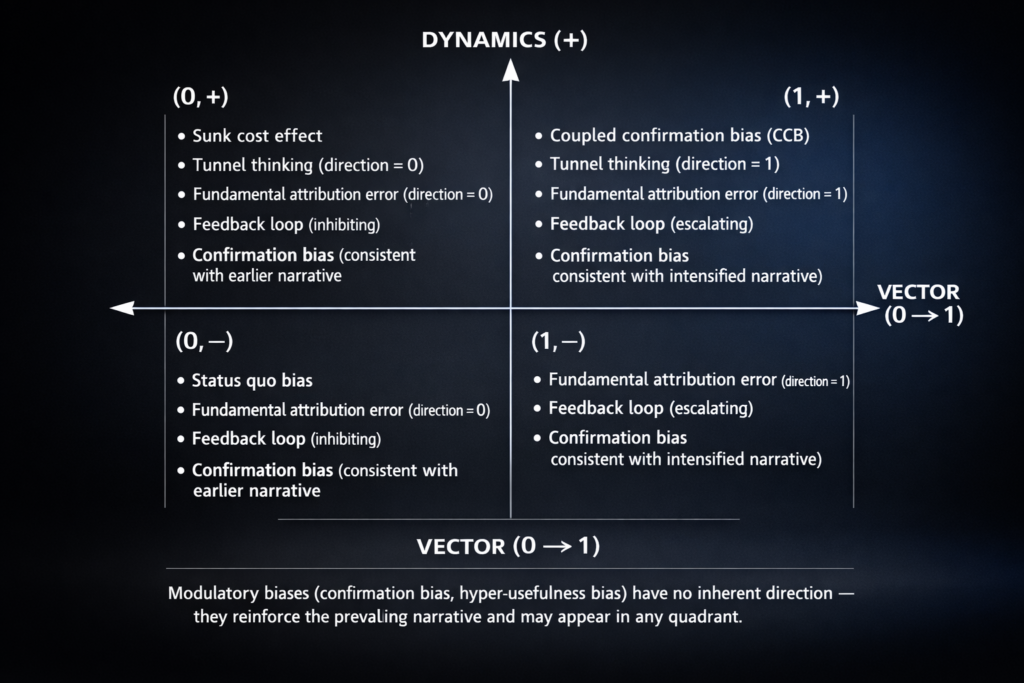
Let us remember one thing from this. To err is human. We all make mistakes, constantly. Some of the causes of our errors are within our control; others are not. Cognitive biases have the particular feature of operating covertly, exerting a very strong influence on how we perceive reality. They pull us in like quicksand and can cause us to lose contact with reality.
The easiest way to protect ourselves from them is by learning about them, studying them, and checking the logic of our thinking. If we know them, we will learn to detect them — and that will protect us from many extremely costly mistakes.
by dr Andrzej Jakubiec - adwokat, mediator5 Key Elements in a Contract with a Polish Company
Commercial disputes involving foreign companies in Poland rarely erupt overnight. They grow quietly — from subtle shifts in behaviour, small contractual ambiguities, misaligned expectations, or early warning signs that go unnoticed because both sides assume the relationship is still working. In cross-border business, these early signals matter far more than most companies realise. They reveal not only the health of the cooperation, but also the strength — or weakness — of the contract that governs it.
In my work with international businesses, I repeatedly encounter the same pattern: the outcome of a dispute is often determined long before the conflict becomes visible. Jurisdiction clauses, governing law provisions, the way contractual obligations are defined, the mechanisms securing performance, and the choice between litigation and arbitration shape not only how a dispute will be resolved, but whether it can be avoided altogether.
Understanding these structural elements is essential for any foreign company operating in Poland. They form the backbone of the five critical contract provisions discussed below — provisions that often determine whether a business relationship remains productive, deteriorates into a dispute, or ultimately ends in costly litigation.
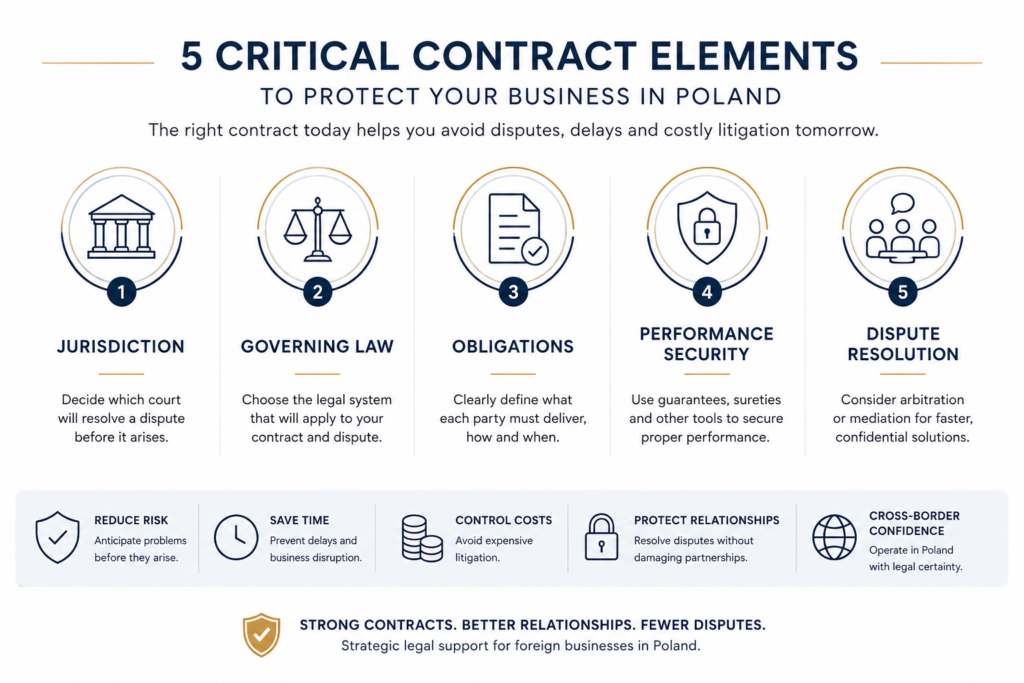
5 key elements in a contract with a Polish company
In cross‑border contracts with Polish companies, there are several elements that foreign businesses should always pay close attention to. Addressing them early significantly reduces the risk of misunderstandings, non‑performance, or costly disputes in the future. Here are the five most important points every international company should consider when drafting or negotiating a contract in Poland. The framework also aligns with OECD guidelines on responsible business conduct for cross-border commerce.
Table 1. Five Critical Contract Elements in Cross‑Border Agreements with Polish Companies
| Contract Element | What It Really Means | Key Risks if Ignored | Recommended Actions |
|---|---|---|---|
| Jurisdiction | Which court will hear the dispute. | Case may end up in an unexpected court; delays; strategic disadvantage. | Add a clear jurisdiction clause; choose forum strategically. |
| Governing Law | Which legal system applies to the contract and dispute. | Foreign law may apply unexpectedly; costly conflict‑of‑law battles. | Specify governing law explicitly; align with jurisdiction. |
| Obligations | What each party must deliver, how, and when. | Misaligned expectations; conflicting interpretations; hidden liabilities. | Define obligations in detail; avoid relying on local defaults. |
| Performance Security | Tools ensuring the contract is performed properly. | Non‑performance; delays; financial exposure. | Use guarantees, sureties, staged payments, performance bonds. |
| Alternative Dispute Resolution | Arbitration or mediation instead of court litigation. | Slow, formalistic court process; higher costs; loss of control. | Add arbitration/mediation clause; choose reputable institutions. |
1. Choice of Jurisdiction: Which Court Will Resolve a Dispute with a Polish Company
Many businesses confuse jurisdiction with applicable law, even though these are two separate and equally important issues. Jurisdiction determines which court has the authority to hear the dispute, and while this is usually obvious when both parties are from the same country, it becomes a critical question in cross‑border contracts. As a rule, the parties may choose the courts of a specific country — typically the courts of one party’s home state or the courts of the place where the contract is performed.
If the contract does not include a clear jurisdiction clause, the dispute will be governed by the default rules of each potentially relevant legal system, which may point to different courts depending on the circumstances. This can lead to uncertainty, delays, and strategic disadvantages. For that reason, it is essential to resolve this fundamental issue at the contract‑drafting stage, rather than during a dispute. A well‑drafted jurisdiction clause is not just a formality — it is a strategic tool.
To illustrate this with an example from my own practice: In one of my recent cases, the parties drafted a seemingly simple contract where they granted jurisdiction to both the Polish courts and the courts of the counterparty’s home country. Their intention was likely to ensure a sense of equality and fairness. However, this reciprocal clause was entirely counterproductive and created severe ambiguity. It required substantial legal work to establish that the party who actually managed to file the lawsuit first effectively locked in that country’s jurisdiction. This case perfectly illustrates that mistakes in cross-border contracting do not only stem from ignoring a problem, but also from trying to solve it in a fundamentally flawed way.
2. Governing Law: Which Legal System Applies to Your Contract and Dispute in Poland
Governing law determines which legal system will be used to interpret the contract, assess performance, and resolve claims — even after termination or withdrawal. The fact that a Polish court has jurisdiction does not mean it will automatically apply Polish law. I recently handled a case in which a Polish court applied Swiss law in a succession dispute, simply because the governing‑law rules required it.
Choosing the applicable law is one of the most fundamental decisions in any cross‑border agreement. If the parties fail to specify it, a complex network of international conventions, EU regulations, and internal conflict‑of‑law or external conflict-of-law rules will decide the issue for them. These instruments may assign governing law — or even jurisdiction — in ways neither party expected. When that happens, the parties lose control not only over the likely outcome, but even over the rules of the game.
Once a dispute begins, fighting over which law should apply becomes extremely expensive, highly technical, and strategically risky. It also unfolds under pressure, which rarely helps resolve the matter efficiently. We help foreign companies navigate these complexities from the first warning signs. This is why foreign businesses should always address governing law at the contract‑drafting stage, not during litigation.
3. How to Clearly Define the Parties’ Obligations in a Cross‑Border Contract
When companies from different countries work together, what seems “obvious” to one party may be interpreted completely differently by the other. A contract that carries the same name in Poland and Spain may impose entirely different warranty obligations, delivery terms, performance standards or timelines — all shaped by local law, business practice and commercial custom. The overall purpose of the agreement may be similar, but dozens of operational details can diverge in ways that create real legal and financial risk.
If the parties fail to define their obligations with precision, they effectively leave key issues to unknown conflict‑of‑law rules, local default provisions and judicial interpretation — none of which they control. This can lead to unexpected liabilities, disputes over performance, or outcomes that neither side anticipated when signing the contract.
For businesses operating outside the EU, it is also essential to remember that Poland is part of the European Union, and EU law forms an integral part of Polish domestic law. This means that obligations may be interpreted not only through the lens of Polish statutes, but also through EU regulations and directives that apply automatically.
Clear, detailed drafting is therefore not a formality — it is the only reliable way to avoid costly misunderstandings and ensure that both parties operate under the same expectations from day one. When facing difficulties with international agreements, consulting a contract dispute lawyer in Poland is the best way to safeguard your interest.
4. How to Secure Performance of the Contract
In international business relationships, securing proper performance of the contract is not a formality — it is good practice and a critical risk‑management tool. If you want to avoid problems with execution, delays or non‑performance, you must address these issues at the very beginning of the cooperation, not once difficulties arise. Contract breaches in cross‑border projects often do not stem from bad faith, but from factors partially outside the contractor’s control. That does not change the reality: you do not want their problems to become your problems.
For this reason, foreign companies should consider robust mechanisms to secure payment and performance, such as bank guarantees, sureties, or promissory notes. For non‑financial obligations, staged payments tied to documented progress, milestone acceptance, or performance bonds can significantly reduce exposure. These tools ensure that even if difficulties arise, the foreign company retains leverage and the project remains under control.
5. Does an Arbitration or Mediation Clause Make Sense in Poland
Arbitration and commercial mediation do make sense in Poland — and often a great deal of sense. Polish state courts are overloaded, formalistic and slow, with commercial cases frequently lasting several years. By contrast, arbitration and mediation offer procedures that are faster, more flexible and far less burdensome for foreign businesses. As a mediator myself, I see how effective these methods can be: mediation allows parties to resolve disputes quickly, confidentially and at a fraction of the cost of litigation, and I regularly represent clients in such proceedings as their counsel.
Arbitration is also gaining popularity in Poland, especially in cross‑border disputes where parties value expertise, predictability and enforceability of awards. However, it is important to remember that mediation is entirely voluntary — no clause can force a party to negotiate in good faith if it does not wish to participate. Even so, including an arbitration or mediation clause in a contract with a Polish company is often a strategic advantage, giving both sides a faster and more business‑oriented path to resolving conflicts.
Whether you are facing a breach of contract or a wider corporate conflict, an experienced commercial dispute lawyer in Poland can guide you through alternative dispute resolution.
Key Things to Know About Commercial Court Proceedings in Poland
Commercial litigation in Poland is highly formalistic, and foreign companies are often surprised by how rigid and document‑driven the process is. The starting point is the court fee: in most commercial cases, the claimant must pay 5% of the value of the dispute, in addition to covering the costs of legal representation, court‑appointed experts, and certified translations — the latter being both expensive and slow, yet unavoidable in cross‑border cases. Delays in Polish litigation can disrupt operations and weaken your negotiating position. Although many hearings can technically be held online, we prefer to appear in person, because being physically present in the courtroom allows us to read the room, assess the judge’s reactions, and evaluate witnesses more effectively.
Polish commercial proceedings rely primarily on documents, while witness testimony plays a supplementary role. Expert opinions often become decisive, especially in technical or financial disputes, and they can significantly influence the outcome. After the judgment, both parties may file an appeal, and in certain cases even a cassation complaint to the Supreme Court. As an experienced business litigation lawyer in Poland, I know that commercial litigators form a distinct professional niche — and we are proud to be part of that group, navigating clients through a system that demands precision, strategy and endurance.
Call to Action — Strategic Support for Foreign Businesses in Poland
Commercial disputes in Poland require not only legal knowledge, but also strategic judgment, experience with cross‑border matters and a deep understanding of how Polish courts, arbitration tribunals and business practices operate. If your company is facing a contract disagreement, a shareholder conflict, payment delays or early warning signs of a dispute, early action is essential.
We support foreign businesses from the first signal of risk — analysing contracts, assessing exposure, preparing negotiation strategies and representing clients in mediation, arbitration and commercial litigation. If you need guidance on contract disputes in Poland, commercial litigation or preventing a conflict before it escalates, we are ready to help.
Contact us to schedule a confidential consultation and discuss the most effective strategy for your situation:
📩 kancelaria@jakubieciwspolnicy.pl
📞 536 270 935
Q&A — Frequently Asked Questions About Commercial Disputes in Poland
1. What should I do if a Polish company stops paying or delays payment?
The first step is to secure documentation: invoices, delivery confirmations, correspondence and any agreed payment terms. Early action is crucial — delays often escalate quickly. A contract dispute lawyer in Poland can help assess your leverage and prepare an effective recovery strategy.
2. Can I sue a Polish company from abroad?
Yes, but whether you should depends on the jurisdiction clause in your contract. If no clause exists, EU regulations and conflict‑of‑law rules will determine where the case must be filed. A commercial litigation lawyer in Poland can analyse your position and recommend the most efficient forum.
3. How long do commercial court proceedings take in Poland?
Most cases last 2–4 years, depending on complexity, expert evidence and court workload. Delays in Polish litigation can disrupt operations and weaken your negotiating position, which is why many foreign companies prefer arbitration or mediation.
4. Is arbitration in Poland enforceable internationally?
Yes. Poland is a party to the New York Convention, which means arbitral awards issued in Poland are enforceable in over 160 countries. This makes arbitration a strong option for cross‑border disputes.
5. Do I need to translate documents into Polish for court?
In most cases — yes. Certified translations are required for key documents and can be costly and time‑consuming. This is one of the reasons why early preparation is essential.
6. What if my company is outside the EU — does that change anything?
Yes, significantly. Non-EU companies must navigate international treaties alongside EU regulations (such as Rome I, Rome II, and Brussels I bis) which automatically apply in Poland. These frameworks directly dictate which country’s laws govern your contract and where lawsuits can be filed.
7. When should I contact a lawyer?
At the very first sign of friction—whether it is an unexplained payment delay, minor contract breaches, or a breakdown in communication with your Polish partner. Legal intervention at this early stage usually prevents the conflict from escalating into a full-scale court battle, saving both time and money.
8. What should I check before signing a contract with a Polish company?
To protect yourself before signing a contract with a Polish company, you should first verify the company’s official data in the National Court Register (KRS), including its current management board and the rules of representation. It is also essential to confirm whether the company is not undergoing bankruptcy or restructuring proceedings. Finally, it is worth consulting a Polish attorney who can provide practical insights, background information, and reputation signals that you will not find in official registers.
by dr Andrzej Jakubiec - adwokat, mediatorThe Decision to End a Business Partnership is a Process
I know people who stay for years in relationships that drain them, limit them, and take away their joy in life. By “relationships” I mean family relationships, intimate relationships, and business cooperation (regardless of its legal form). In this article, I will focus on the decision to end cooperation with a business partner.
I know something about this. I have made such decisions myself when I wanted to end cooperation with my partners. Someone once made such a decision about me. I also decided to leave the University of Łódź, which was very difficult, but something pushed me to do it. And finally, I have advised on such matters hundreds of times as a lawyer. Initially, I focused on legal aspects, but the psychological knowledge I gained over time allowed me to look at these issues much more broadly. Today I know that the law is only a tool — it sets certain boundaries that must be taken into account, like trees when we run through a forest. But they do not determine our decision to run, the route, the pace, or whether it will be a single run or become our routine. Most partners don’t leave because they can’t for legal reasons — they stay because they don’t understand the decision mechanism.
Is Ending a Partnership Something Bad?
No. You have the right to end any cooperation. If you feel that this time is coming to an end, you have the moral right to use the legal tools that serve to end that cooperation. You do not need to feel any guilt because of it. Companies and contracts define people’s behavior for a certain period of time. People agree to this because they assume that during that time, cooperation will benefit them more than the lack of cooperation. If for any reason that assessment has changed, you can end the cooperation.
The Law Does Not Recognize Contracts That Bind Us Forever
Every legal relationship can be terminated — from an employment contract, through a commercial company, to marriage. It does not always mean ending it without cost or immediately, but in most cases it is possible. The law confirms the rule of the “temporariness” of cooperation by allowing contracts to be terminated so that we can use this possibility. Without guilt. Without shame.
If you remain in a relationship against yourself, feeling that you are losing in it, then someone is probably parasitizing on you and wants it to last forever. After all, they gain a lot with very little effort — at your expense.
What Drives Us to Make the Decision to End Cooperation?
Professional reports state that the most common cause of conflicts between partners is financial issues. I agree — but only partially. I believe that the financial area is where deeper causes of conflict most easily concentrate, and it is also the easiest to explain to everyone around. But if those deeper causes did not exist, there would usually be no financial dispute at all. Today, let’s look at how to make the decision to part ways without analyzing the cause or the level at which the conflict has grown.
Three Elements of the Decision to End Cooperation with a (Business) Partner
In modern psychology there is a lot of decision making models. Here I’ll present you one of them: simple and elegant Fogg’s Decision Making Model. The matter turns out to be quite simple with this model. To make a decision, three elements must occur:
- motivation
- ability (perceived ease)
- a trigger — an impulse to act
Importantly, all three elements must occur together. If even one is missing, the decision will not be made.
Motivation to Exit the Company and End Cooperation
What is motivation? Motivation is a state resulting from our emotions that make us strive for something or avoid something. Motivation has an affective, biological basis. Its social and psychological aspects are secondary. And that’s good — because it makes the matter much simpler. If we function well, we are motivated to achieve what is good for us and avoid what is bad for us. Yes, we can make mistakes in judgment, but that is another issue.
Assessing the Difficulty of the Decision to End Cooperation
Ability — or our assessment of how difficult the action is — is a key factor. We must remember that we tend to rationalize and justify passivity because it is convenient for us. Change requires effort, so our mind subconsciously suggests that we should like the situation we are in. It does this in two ways: it tells us that “here” is good and that “there” is bad, dangerous, uncertain. This means that we deceive ourselves into believing that change is harder than it really is. We do this out of laziness and we are brilliantly creative at it.
The Impulse to Act
The trigger is the impulse to behave in a certain way, to make a decision. We say that “the last drop spilled the cup.” A trigger can be almost anything, but most often they appear regularly — we just silence them when we lack motivation or when the change seems associated with real or imagined difficulties. When motivation appears and the task becomes realistically possible, we only need to wait for the trigger. But if motivation is lacking or the task seems too difficult, the trigger will not cause action.
The Fogg Curve — When Do We Make the Decision (to Exit the Company)?
What is the Fogg’s decision making model? The factors influencing our decisions can be presented graphically using the Fogg Curve. It looks like this:
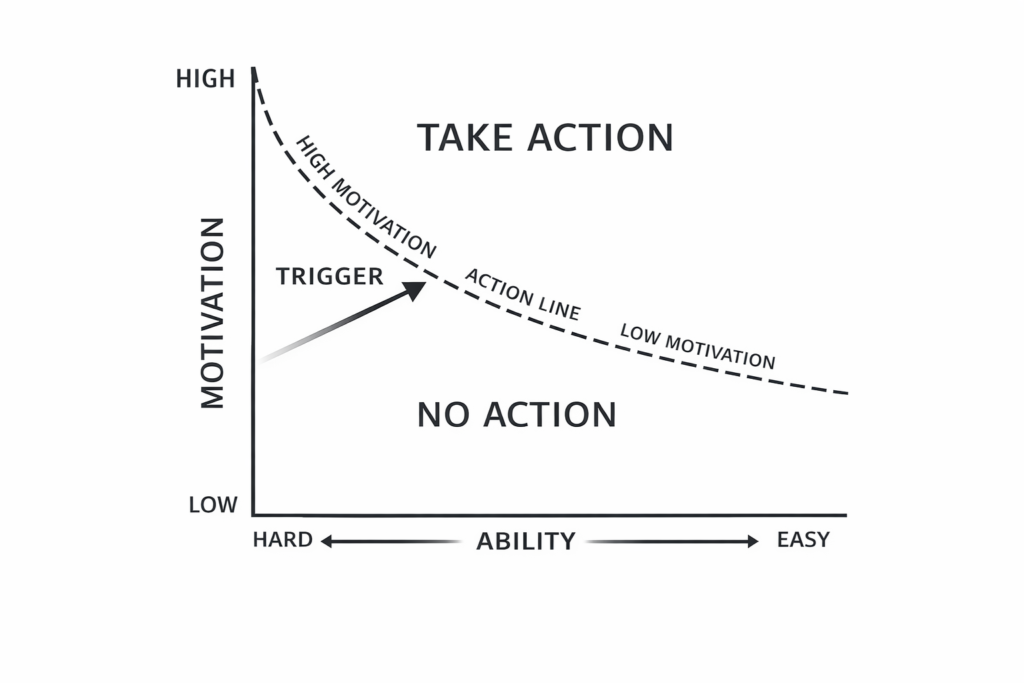
We can see that:
- we are likely to make a decision if we have high motivation and the task is easy (as long as a trigger appears);
- we are unlikely to act if we have low motivation and the task is difficult (even if a trigger appears).
The Decision to End Cooperation. What Should Make You Reflect on Ending Cooperation?
Intuition
Our strongest weapon and unconscious competence. When I listened to it, I succeeded; when I ignored it, I got into trouble. Only deeper studies in psychology and behavioral analysis made me understand how powerful a tool each of us has. And I write this with full responsibility also as a lawyer.
Guilt
Especially if it is being induced in you by your partner — this is a clear red flag. Making you feel guilty is one of the strongest mechanisms of manipulation.
Lack of space to talk about what matters to you
Caring for the relationship between partners is as important as in a marriage. If you do not talk about your fears, plans, ambitions, it means things are already very bad.
Being promised the future
Plans must be:
- real,
- measurable,
- time‑bound,
- concrete.
If they are not, and your partner only tells you to “work hard so that someday it will be better,” then change the plan — or the partner.
You get nothing out of it
We work for a purpose. If you feel that you give everything, but in this personal arrangement your energy, time, and abilities are being burned — let it go. You have only one life; you can have many partners.
If some of these points apply to you, it means you are aware that you are stuck somewhere you do not want to be. And that is already the basis for change.
Deadlock
Deadlock is one of the most destructive situations in business relationships. It is not just a red flag — it is a structural breakdown.
When shareholders hold equal power, even simple decisions can become impossible. As a result, the company may stop functioning altogether while the conflict continues to escalate.
Deadlock occurs when the conflict itself becomes more important than the business. At that point, rational decision-making is replaced by control, ego, and escalation.
This is the moment when waiting becomes the most expensive strategy.
Red Flags and Their Meaning When Deciding to End Cooperation
| Red flag / warning sign | How it looks in practice | What it means psychologically | Consequences for you and the company |
|---|---|---|---|
| Intuition says “something is wrong” | Unexplained tension, discomfort, the feeling that “something is off” | Intuition is unconscious analysis — a signal that your brain sees danger | Ignoring intuition leads to years of losses and burnout |
| Guilt induced by the partner | Suggestions like “you won’t manage without me,” “you’ll let the company down” | Classic manipulation and a tool of control | Loss of agency, emotional dependence, bad decisions |
| No space to talk about important matters | Avoiding difficult topics, gaslighting, belittling your needs | The relationship is one‑sided and communication is toxic | Growing tension, no room for development, escalating conflict |
| Being promised the future | Promises without deadlines, without specifics, without measurable effects | A mechanism keeping you in place — “carrot on a stick” | Blocked career, no real influence, wasted years |
| No real benefits from cooperation | You work more than others and gain the least | Exploitation, asymmetry of effort and reward | Burnout, frustration, sense of injustice |
| Rationalizing passivity (“here is safe”) | Delaying decisions, excusing the partner, justifying pathology | A defense mechanism — avoiding effort and change | Staying in a bad relationship, rising psychological and financial costs |
| Ignored triggers | Repeated “last drops” that change nothing | Lack of connection between motivation and ability | The trigger never becomes a decision — you stay stuck for years |
| Distorted perception of difficulty | “It will be too hard,” “I can’t,” “I have no options” | Your brain is deceiving you — avoidance mechanism | Decision postponed indefinitely, rising risks |
| Lack of trust in the partner | Hidden information, unclear actions, lack of transparency | The relationship is already dead — it’s only a matter of time | Conflict escalates, costs rise every month |
The Fogg Curve in the Context of Exiting a Company
| Element of the Fogg Model | What it means in the context of a partner | How it looks in practice | What happens when one of the three elements is missing |
|---|---|---|---|
| Motivation | The emotional and psychological reason to end cooperation | Exhaustion, frustration, sense of injustice, intuition saying “this is not it,” lack of trust | The partner stays in the relationship despite harm; rationalizes the situation; “maybe it will get better” |
| Perceived ability | Assessment of whether exiting is realistically possible — legally, financially, organizationally | Consulting a lawyer, analyzing the contract, assessing risks, understanding procedures | The partner believes “it can’t be done,” “it’s too hard,” “I have no options”; decision paralysis; or they haven’t been hurt enough yet (no trigger) |
| Trigger | The impulse that initiates action | Another manipulation, lack of payment, broken promise, humiliation, value conflict | If motivation or ability are low — the trigger changes nothing; passivity returns |
| High motivation + high ability + trigger | Optimal point for making a decision | The partner sees the sense of change and knows how to execute it | The decision is made quickly and consciously; determination is high; change will happen |
| High motivation + high difficulty | You want to leave but “don’t know how” | Fear, delaying the decision, excuses | Triggers do not lead to action; frustration grows; your future depends on whether you seek solutions or wither where you are |
| Low motivation + high ability | You can leave but feel no need | “It’s fine,” “It’s not ideal but it’s okay,” “I don’t want to waste energy” | You may be in the right place and not need to change anything |
| Low motivation + low ability | You don’t want to leave | Passivity, comfort, but you couldn’t leave even if you wanted to | The decision will never happen without a change in motivation; only then will you consider ability |
Legal audit is the foundation and it’s role in Decision to End a Business Partnership
In this situation, you must know where you stand. It is not enough to simply read the contract you signed years ago. The contract is not everything. You are also bound by what is not in the agreement:
- thousands of applicable regulations that were not “repeated” in the written contract;
- the principles of interpretation of those regulations;
- customs and principles of social coexistence;
- judicial case law.
I know it sounds daunting, but: 1) that is why you have a lawyer to analyze it, and 2) to tell you exactly where you stand. Do not worry—the other party has the same problem.
However, it is crucial to know exactly what can and cannot be changed in a given situation right now. It is worth knowing how to shape the situation so that new opportunities appear on your side or options available to your partner disappear.
You must identify and assess the risk, including legal risk. Do not expect 100% certainty here—it does not exist in law. Expect a level of certainty and probability significant enough to allow for rational decision-making.
Remember, however, that the law only opens or closes certain doors. It is entirely up to you, though, whether and through which of the open doors you choose to walk. The fact that you have a certain right does not mean it will be purposeful, right, or beneficial to exercise it at this moment. That is a matter of strategy, which I will help you develop.
Decision to End a Business Partnership. Invitation to cooperation
Often, the first step to ending an unfavorable cooperation with a business partner is starting a good cooperation with a lawyer who understands not only the regulations but also the mechanics of such conflicts.
This is exactly what I offer you:
- a detailed legal analysis of your situation;
- defining realistic goals and alternatives (including the preparation of a BATNA);
- developing a strategy for action;
- support in negotiations, mediations, or litigation;
- conducting the entire process—from the decision to its implementation.
I will not influence your motivation—that is not my role. To push you toward a decision I will not either. I can, however, do something much more important: show you the real level of difficulty of this decision, limit the risk, and guide you through the entire process in a thoughtful and safe manner.
If you are at a point where:
- you are considering ending the cooperation,
- you have doubts about what you can do,
- or you feel that “something is wrong” but you don’t know how to organize it,
…then do not act in the dark. One ill-considered decision can cost years of dispute and very significant money. I know you may not know where to start. That is normal.
Contact me: 📩 kancelaria@jakubieciwspolnicy.pl 📞 536 270 935
FAQ – Questions about Decision to End a Business Partnership
Can I end cooperation with a partner in any situation?
As a rule—yes. Almost every legal relationship is resolvable. What differs, however, are:
- the procedure,
- the time,
- the costs,
- the risks.
The key question is not “if you can,” but “how to do it so you don’t pay more than necessary.” There are, however, exceptions: the law recognizes the concept of a “prisoner in a limited liability company.” which concerns a minority shareholders. In such cases, other measures must be considered to persuade the partners to “let you go.”
Do I need a “valid reason” to exit the company?
This depends on the legal structure of the company. In some companies, a valid reason is significantly taken into account and allows, for example, for the company to be dissolved earlier. In other cases, it may be the basis for excluding a partner from a limited liability company. However, the lawyer’s role is to persuade the other party to make a concession even when they are not legally obliged to do so.
What if my partner does not agree to end the cooperation?
This is a standard situation. A lack of consent from the other party:
- does not block all scenarios,
- but it does change the strategy.
In such cases, it is crucial to:
- build a negotiating advantage,
- prepare alternatives (BATNA),
- use legal tools appropriately.
In any case, remember that the field of play is fluid and we can shape it. If the partner’s consent is required today, we can attempt to change the circumstances so that it is no longer required—or so that they want to grant it. A partner will always make the best decision for themselves. Therefore, one must influence the environment so that it is more profitable for them to agree to part ways than to keep you in the company against your will.
Is it better to negotiate or go to court?
This is not an “either-or” choice. In practice:
- a well-prepared path to court often strengthens negotiations,
- and negotiations without a real alternative in the form of a lawsuit are usually ineffective.
First, you build your position, then you choose the tool. I view negotiations very broadly; litigation is like the use of kinetic force in politics. There, war is a way of conducting policy. Similarly in business—litigation is a clash intended to serve a purpose. It is a form of forceful negotiation. And during a trial, you can always negotiate in parallel: directly and verbally, through intermediaries, or via the method of faits accomplis. Yes, people don’t talk about it, but… non-verbal negotiations exist!
How long does it take to end cooperation?
From a few weeks to several years. It depends mainly on:
- the level of conflict,
- the legal structure,
- the preparation of the parties,
- the determination of the parties,
- external and random factors.
The most common mistake: starting actions without preparation, which extends the entire process manifold.
Can I exit “without losses”?
There are no completely cost-free solutions. But let’s distinguish costs from losses. There will always be costs: notary fees, taxes, costs of consultants and lawyers. But these are calculated costs. Will you exit without losses? It happens that partners exit companies with a great profit; other times, they accept certain losses just to end it or protect the rest of their capital.
The question is: is the cost of exiting lower than the cost of staying? And that is a strategic decision, not just a legal one.
How do I know if it’s the right moment for a decision?
If:
- you are losing trust,
- your communication is not functioning,
- your work does not translate into real benefits,
- your intuition tells you it’s time to leave,
…then leave.
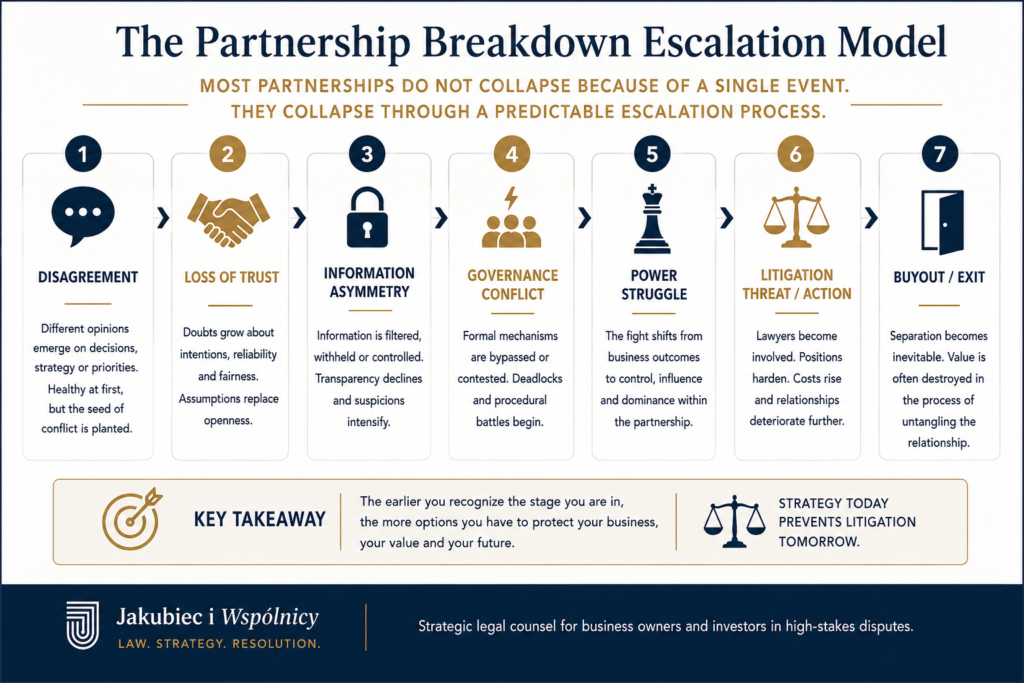
The Jakubiec Partnership Breakdown Escalation Model — a visual framework showing how business relationships deteriorate through predictable stages. Recognizing the stage early allows strategic intervention before litigation becomes inevitable.
by dr Andrzej Jakubiec - adwokat, mediatorCORPORATE DEADLOCK IN POLAND. REALITY IN 2026
Corporate deadlock is one of the most dangerous situations in a privately held company. When two shareholders hold equal power, even simple decisions may become impossible. As a result, the business can stop functioning while the conflict escalates.
This problem often arises in companies with a 50/50 ownership structure. At first, the structure seems fair. However, when a serious disagreement appears, neither side can impose a solution.
For foreign investors operating in Poland, understanding how corporate deadlocks arise and how they can be resolved is essential. Otherwise, a profitable investment may turn into a long and costly dispute.
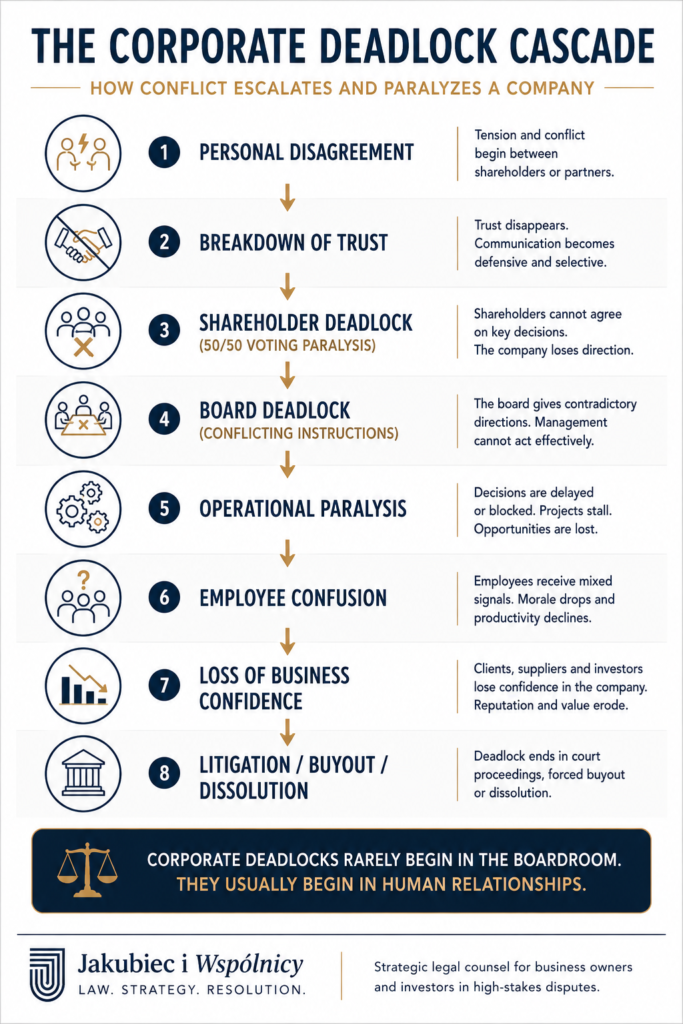
The Corporate Deadlock Cascade — a visual framework showing how internal conflict escalates from personal disagreement to corporate paralysis. Recognizing early stages allows strategic intervention before litigation becomes inevitable.
Key Takeaways
- A corporate deadlock arises when shareholders cannot adopt key decisions because their voting power is equal.
- Deadlocks most often occur in companies with a 50/50 ownership structure or poorly drafted shareholder agreements.
- When a deadlock appears, the company may be unable to appoint management, approve budgets, or distribute profits.
- Under Polish law, several legal mechanisms may help resolve a shareholder deadlock, including even shareholder exclusion or company dissolution.
- However, an important question arises: what is the best solution? Should litigation be the first option? Or can strategic negotiation or mediation resolve the conflict faster while protecting the value of the business?
- For foreign investors, early legal strategy is essential. Otherwise, a corporate deadlock may lead to years of costly litigation in Poland. Therefore, it is crucial to understand the psychological dynamics of negotiations and the basic principles of behavioral analysis.
What Is a Corporate Deadlock?
A corporate deadlock occurs when shareholders cannot adopt key decisions because their voting power is equal. As a result, neither side can control the company or move it forward.
Deadlocks most often appear in companies with a 50/50 ownership structure. At first, such a structure may seem balanced and fair. However, once a serious disagreement arises, decision-making can stop completely.
In practice, a corporate deadlock may block essential actions in the company. For example, shareholders may be unable to appoint management, approve budgets, distribute profits, or adopt strategic decisions.
This situation creates serious risks for investors. Even a profitable company may stop operating effectively if its owners cannot reach agreement.
For this reason, corporate deadlocks often escalate into shareholder disputes. If the conflict continues, the parties may eventually seek legal solutions under Polish corporate law.
Typical Deadlock Situations in Polish Companies
Corporate deadlocks rarely appear suddenly. In most cases, they arise when a serious disagreement develops between partners who hold equal power in the company.
Many investors associate deadlocks only with a 50/50 ownership structure. However, the problem may also arise at the level of the management board.
In many Polish companies, the same individuals act both as shareholders and board members. As a result, a personal conflict between partners may spread across the entire governance structure of the company.
Deadlock at the Shareholder Level
Deadlocks often arise when two shareholders each hold 50% of the voting rights. In this situation, neither side can adopt key resolutions without the consent of the other.
As a result, the shareholders’ meeting may become unable to approve budgets, appoint management, distribute profits, or adopt strategic decisions.
Although this situation can paralyze the company’s long-term strategy, its immediate operational impact is often limited to the lack of resolutions.
Deadlock at the Management Board Level
Conflicts become more dangerous when the same partners also serve on the management board.
In such cases, the dispute may quickly spread from the shareholders’ level into the daily operations of the company.
Unlike the shareholders’ meeting, the management board makes operational decisions on an ongoing basis. Because of this, conflicting board members may block each other’s actions more directly.
For example, one board member may reverse a partner’s decision, issue contradictory instructions, or formally prohibit a particular action.
In some cases, internal rules may require the consent of the entire board before certain actions can be taken. A conflict between board members may therefore stop those actions completely.
Operational Consequences of a Board-Level Conflict
A conflict within the management board is also much more visible to employees and business partners.
Its effects often appear immediately in the company’s day-to-day functioning. Employees may receive contradictory instructions, while key decisions remain unresolved.
Such situations can seriously damage internal morale and weaken the company’s credibility in the eyes of contractors and clients.
In extreme cases, the conflict may also disrupt the company’s ability to act in court, administrative, or tax proceedings, where clear representation and consistent decisions are required.
Since the beginning of my professional career, I have specialized in resolving shareholder conflicts and preventing corporate deadlocks. I have guided numerous international investors through complex disputes, protecting their capital and ensuring business continuity. In this article, I share a real-life scenario illustrating how communication breakdowns between partners can escalate, along with the tangible consequences for the company: Escalation of Disputes Between Partners – A Real Scenario.
Advantages and Disadvantages of Litigation in Resolving Corporate Deadlocks
Litigation is a formal and legally binding method to resolve shareholder disputes in Poland. It provides certainty about the outcome and allows a court to impose a partner’s will when negotiation fails.
Advantages of Litigation:
- A clear, formal procedure with defined legal rules.
- Legally enforceable decisions that all parties must follow.
- The ability to resolve disputes when other methods, such as negotiation or mediation, have failed.
However, litigation also carries significant risks and challenges, especially in the context of corporate deadlocks:
Disadvantages of Litigation:
- Time-consuming: Court proceedings can last months or even years, delaying strategic decisions.
- Delayed impact: Rulings often arrive when the conflict has already shifted to new areas, reducing the decision’s practical effect.
- Conflict escalation: Litigation can transform the original dispute into a secondary conflict, far removed from the initial cause.
- High costs: Legal fees, court costs, and expert valuations accumulate rapidly.
- Growing involvement: More parties are drawn in, complicating communication and coordination.
- Reputational damage: Public court cases can harm the company’s image with clients, investors, and partners.
- Morale and culture: Employee confidence drops when internal conflicts become visible and prolonged.
- Long-term uncertainty: Investors, contractors, and banks perceive heightened risk, potentially affecting financing and partnerships.
- Revenge and retaliation: Even after a judgment, parties often seek to retaliate, transferring the dispute to new areas.
- Loss of flexibility: Shareholders become bound by formally stated positions, fearing loss of face and further escalation.
While litigation can enforce a decision, it rarely resolves the underlying issues. In corporate deadlocks, relying solely on courts may preserve legality but often sacrifices speed, efficiency, and long-term business stability.
Why Negotiation, Mediation, and Arbitration Often Outperform Litigation
| Feature | Mediation | Arbitration | Court Litigation |
| Duration | Very Fast (weeks to few months) | Moderate (6–12 months) | Slow (24–36+ months) |
| Cost | Low (negotiated fees) | Moderate/High | High (legal fees over years) |
| Confidentiality | Full (private & closed) | High (private) | None (public records) |
| Decision Maker | Parties (with a Mediator) | Expert Arbitrator | State Judge |
| Control over Outcome | Total (voluntary agreement) | Limited (binding award) | None (imposed judgment) |
| Relationship Impact | Preserves business ties | Neutral | Destructive (adversarial) |
| Enforceability | Binding (after court approval) | Binding (NY Convention) | Binding (state execution) |
In my professional career, my greatest successes have been achieved on the field of negotiation and mediation. These methods allow investors to resolve corporate deadlocks more efficiently, protect business value, and preserve relationships between partners.
The Advantages of Negotiation and Mediation
Negotiation and mediation offer a range of benefits that litigation cannot match:
- Speed: Mediation settlements can be reached in weeks or months, compared to years in Polish courts.
- Lower costs: Avoid expensive court fees, expert valuations, and prolonged legal proceedings.
- Confidentiality: Discussions remain private, protecting the company’s reputation and sensitive information.
- Focus on underlying causes: Unlike litigation, mediation aims to resolve the root issues of the conflict, not just declare a winner.
- Reduced risk of retaliation: Parties are less likely to seek revenge or escalate the conflict after a mediated settlement.
- Positive impact on company culture: Preserves employee morale and confidence, avoiding visible tension and operational disruption.
- Better for the company’s image: Partners, clients, contractors, and investors see proactive conflict management rather than public disputes.
In shareholder deadlocks, these methods often prevent escalation and protect both the business and its people. They allow partners to regain control without being “consumed” by formalized positions or fear of losing face.
Arbitration: A Strategic Middle Ground
Arbitration offers a hybrid approach between mediation and litigation:
- It provides a binding, enforceable resolution like litigation.
- It is faster and more flexible than traditional court proceedings.
- Arbitration proceedings remain private and confidential, limiting reputational risks.
- While slightly more formal and costly than mediation, it still avoids the inefficiencies and absurd delays of the Polish court system.
In practice, arbitration often serves as the most pragmatic solution when parties cannot reach an amicable agreement through negotiation but wish to avoid the long, unpredictable timelines of court litigation. You can read more about one the best polish arbitration here. And here you have a link to a website of one of the best mediation center in Poland.
The Reality of Polish Courts
Poland’s legal system is often unable to handle complex shareholder disputes efficiently:
- Court cases can take years, sometimes 12–36 months or longer for first-instance rulings.
- Decisions may arrive when the conflict has already shifted or escalated to other areas of the business.
- Litigation rarely addresses the root cause of the dispute, creating secondary conflicts and frustration.
In this context, negotiation, mediation, and arbitration are not just alternatives—they are strategic tools that protect business value, relationships, and long-term stability.
Our Expertise in Corporate Conflict Resolution
For over a decade, we have helped companies resolve complex corporate disputes, including family businesses and conflicts between family-owned firms and foreign investors.
- Academic foundation: I earned my PhD in Commercial Law in 2014 with a dissertation on Options as Capital Market Instruments: A Civil Law Analysis. I worked for 12 years at the Department of Commercial and Business Law at the University of Łódź.
- Teaching experience: I lecture corporate law to aspiring advocates and have taught postgraduate courses on Company Law at the University of Łódź.
- Specialized training in negotiation and dispute resolution: I completed postgraduate studies in Negotiation, Mediation, and ADR at the University of Warsaw and postgraduate studies in Forensic Psychiatry and Psychology at the University of Łódź. I am currently deepening my expertise in Behavioral Analysis at the School of Emotional Intelligence in Wrocław.
- Practical experience: Negotiation is my passion, realized daily in complex shareholder disputes, cross-border M&A transactions, and corporate mediation. I have successfully guided family businesses and their investors through high-stakes conflicts, protecting both business value and relationships.
Our multidisciplinary approach combines law, psychology, and strategic negotiation to deliver efficient, lasting solutions for corporate deadlocks and shareholder disputes. I wrote about shareholders disputes resolving here.
Frequently Asked Questions (Q&A)
Q: What is a corporate deadlock in Poland?
A: A deadlock occurs when shareholders or board members cannot reach decisions, paralyzing company operations.
Q: Can a 50/50 shareholder deadlock be resolved?
A: Yes. Common solutions include:
- Buy-sell agreements
- Shotgun clauses
- Structured share buyouts
These allow one partner to buy the other’s shares at fair market value.
Q: How long does litigation usually take?
A: Court proceedings in Poland may last 12–36 months. Deadlocks often escalate, making early intervention essential.
Q: Is mediation faster than litigation?
A: Almost always. Mediation:
- Resolves disputes in weeks or months
- Reduces costs significantly
- Preserves confidentiality
- Minimizes risk of revenge or escalation
Q: What about arbitration?
A: Arbitration is a middle ground between mediation and court litigation. It is faster, less costly, and more flexible than court trials.
Q: Can a minority shareholder block key decisions?
A: Yes. Certain resolutions require qualified majorities (2/3 or 3/4), allowing minority shareholders to veto.
Q: Are mediation or arbitration settlements legally binding in Poland?
A: Yes. Approved settlements have the same legal force as court judgments and can be enforced by a bailiff.
Q: How should foreign investors act when deadlock emerges?
A: Early consultation is critical. Consider:
- Strategic negotiation
- Mediation
- Arbitration
- Only then, litigation if necessary
Q: Can conflict affect company operations?
A: Absolutely. Deadlocks often:
- Impact board and management decisions
- Reduce morale
- Harm client and investor confidence
- Delay legal or tax proceedings
Q: Do you provide services in languages other than English?
A: Yes. We deliver legal advice and documentation in:
- English
- French
- Russian
Facing a deadlock in your Polish subsidiary? Contact us for a strategic consultation to protect your investment:
📩 kancelaria@jakubieciwspolnicy.pl
📞 536 270 935
by dr Andrzej Jakubiec - adwokat, mediatorSHAREHOLDERS DISPUTES IN POLAND
Conflict between business partners is one of the most serious risks to any investment. In Poland, shareholders disputes can quickly escalate into a corporate deadlock, blocking key decisions and paralysing operations for months or even years. For foreign investors, understanding the legal tools available under Polish corporate law is essential. Whether you are a majority investor from the United States or a minority shareholder from Switzerland, legal clarity protects your capital. At Jakubiec & Partners, we support international investors in resolving shareholder conflicts through negotiation, mediation and litigation.
Shareholders Disputes: Key Takeaways for International Investors
- Shareholder disputes in Poland often arise from poorly drafted Articles of Association.
- A 50/50 ownership structure may lead to a corporate deadlock.
- Polish law allows mechanisms such as shareholder exclusion or share buyouts.
- Mediation frequently resolves conflicts faster and at lower cost than litigation.
- Early legal advice significantly increases the chances of protecting the investment.
Common Causes of Shareholders Disputes in Poland
Many conflicts and shareholders disputes originate from weaknesses in the company’s Articles of Association (Umowa Spółki / Statut). Poorly drafted clauses often leave partners without a clear exit strategy. As a result, even minor disagreements may escalate into serious disputes.
Typical triggers of shareholder disputes
- Dividend disputes — disagreements over profit distribution versus reinvestment.
- Management obstruction — 50/50 ownership structures often lead to decision-making deadlocks.
- Information rights violations — minority shareholders may be denied access to financial or operational data.
- Competing activities — a shareholder may start a business that competes with the company.
Legal Tools for Resolving Shareholders Disputes in Poland
Polish corporate law offers several mechanisms to resolve shareholder disputes. Many investors, however, only learn about these tools once the conflict has already escalated.
The most common mechanisms include:
- shareholder exclusion lawsuits,
- negotiated share buyouts,
- mediation settlements,
- amendments to the Articles of Association,
- company dissolution in extreme cases.
Each mechanism requires a tailored legal strategy. Early legal analysis is therefore crucial.
Deadlock Resolution: Protecting the Company’s Future
A corporate deadlock is one of the most serious threats to a company’s stability. When shareholders cannot adopt resolutions, the company may lose strategic direction and operational continuity.
Can a shareholder be expelled from a Polish company?
Yes. Under the Polish Commercial Companies Code (KSH), shareholders may seek court exclusion of another partner in specific circumstances. Courts apply this remedy only when important reasons exist, and proceedings typically last 12–24 months.
For this reason, exclusion is considered a last resort.
How can a 50/50 deadlock be resolved?
Several contractual mechanisms may prevent or resolve deadlock situations, including:
- buy-sell agreements,
- shotgun clauses,
- structured share buyouts.
These tools allow one partner to buy the other’s shares at a fair market price, enabling the company to continue operating without disruption.
Why Mediation Often Outperforms Litigation
In shareholder conflicts, mediation frequently produces faster and more predictable outcomes than court proceedings.
Key advantages of mediation
- Cost efficiency — mediation avoids court fees, expert opinions and lengthy procedural costs.
- Confidentiality — unlike court proceedings, mediation remains private and protects the company’s reputation.
- Speed — while litigation may last years, mediation often results in a binding settlement within weeks or months.
Once approved by a court, a mediation settlement becomes legally enforceable.
When Should Investors Contact a Shareholders Disputes Lawyer?
Many investors seek legal advice too late. Early intervention often prevents long and expensive litigation.
You should consult a lawyer if:
- communication between shareholders breaks down,
- key decisions become blocked,
- financial transparency disappears,
- a partner begins competing with the company.
Strategic negotiation may resolve the dispute before it escalates. You should also seek legal advice if you are planning to end cooperation with a business partner and want to understand your options.
Expertise Beyond the Statutes: The Science of High‑Stakes Negotiation
In complex shareholder disputes, mastery of the law is only half the battle. Effective resolution also requires understanding human psychology and negotiation dynamics. This combination is what distinguishes my approach from that of many commercial lawyers.
I hold a PhD in Commercial Law and serve as a lecturer for the Advocates’ Bar Association. I have also lectured at the Faculty of Law at the University of Łódź. Yet legal expertise is only one dimension of my work.
Many disputes escalate due to psychological dynamics between partners. To address this, I expanded my professional education into behavioural fields.
I completed postgraduate studies in:
- Negotiations, Mediations and ADR at the University of Warsaw,
- Forensic Psychiatry and Psychology at the University of Łódź.
I am currently continuing my studies in Behavioural Analysis at the School of Emotional Intelligence in Wrocław.
This multidisciplinary background allows me to identify emotional and strategic drivers behind shareholder conflicts. As a result, disputes that appear chaotic often become structured, manageable negotiations.
Enhanced Security for International Investors
Having worked with foreign clients for many years, I understand that cross‑border investors require more than legal advice. They expect certainty, transparency and risk control.
To meet these expectations, Jakubiec & Partners introduced safeguards that exceed typical market standards.
Personal Accountability and €2.5M Professional Insurance
Our firm maintains €2.5 million in professional liability insurance.
As the lead partner, I also assume personal liability for the firm’s obligations, including the actions of every team member.
This provides clients with an additional layer of security.
The “Gold Standard” Conflict of Interest Audit
International clients often worry about hidden conflicts of interest.
We therefore conduct a rigorous verification procedure before accepting a case.
The process includes:
- signing a Non‑Disclosure Agreement (NDA),
- signing a Conflict Verification Agreement,
- performing a detailed internal audit of professional, business and social links with the opposing party.
After the audit, we issue a Declaration of No Conflict of Interest, secured by contractual penalties.
Proven Experience in Cross‑Border Transactions
International disputes require not only legal knowledge but also cultural understanding.
Our firm has represented investors from:
- the United States,
- the United Kingdom,
- France,
- Germany,
- Switzerland,
- Turkey,
- Ukraine.
One of our landmark projects involved managing the share acquisition in the Oscar‑winning Se‑ma‑for animation studio, representing investors from Switzerland and the UK. The project required complex coordination across multiple jurisdictions.
Shareholders Disputes: Frequently Asked Questions (FAQ)
Can a minority shareholder block key decisions in Poland?
Yes. Certain corporate decisions require a qualified majority (two‑thirds or three‑quarters). Minority shareholders may therefore block important resolutions. It happens commonly in shareholders disputes.
Are mediation settlements legally binding in Poland?
Yes. Once approved by a court, a mediation settlement has the same legal force as a judgment and may be enforced by a bailiff.
How long do shareholder disputes last in Poland?
Court proceedings typically last 12–36 months, sometimes longer.
Mediation or negotiated buyouts often resolve disputes much faster.
Does Jakubiec & Partners provide services in languages other than English?
Yes. We provide legal services and documentation in:
- English,
- French,
- Russian.
What are the typical legal fees in shareholder disputes?
Our standard fee is €250 net per hour. This covers consultations, document analysis and meetings.
For negotiations, mediations or litigation, we conclude a clear written agreement specifying the main fee and a success fee, depending on the complexity and value of the case.
Considering a Shareholder Dispute in Poland?
If you are facing a conflict with a business partner in Poland, early legal analysis may protect your investment. A short consultation often clarifies risks, negotiation options and the most effective strategy.
At Jakubiec & Partners, we provide strategic advice for international investors involved in shareholder disputes, focusing on practical solutions that protect both the company and the investor.
Resources and Legal Ethics
Polish legal professionals operate under strict ethical standards.
You may review the relevant regulations:
You may also read our guide on litigation costs in Poland and transparent fee structures:
You may also read my text linking Maerscheimer’s theory with shareholders disputes practice. If you’re curious, just click the link and read:
The Frontier of Modern Disputes: AI & Coupled Confirmation Bias
I actively monitor how Artificial Intelligence reshapes shareholder negotiations. I am the author of the concept of ‘Coupled Confirmation Bias‘—a phenomenon where AI-driven tools, if misused, can reinforce the existing biases of both parties, deepening corporate deadlocks. You can also explore my other article concerning tunnel vision and the role of LLM in shareholders disputes.
by dr Andrzej Jakubiec - adwokat, mediatorLEGAL FEES AND LITIGATION COSTS IN POLAND
The financial predictability of litigation costs in Poland is a decisive factor for foreign investors evaluating whether to pursue a commercial dispute. Understanding court fees, legal costs, and procedural risks is essential for making informed, ROI‑driven decisions.
See 3 Key Commercial Litigation costs in Poland:
- In the majority of commercial and civil cases, the court entry fee is 5% of the claim value, capped at PLN 200,000 (approx. EUR 45,000). Are there additional costs during the trial? Yes. Apart from the entry fee, you should budget mainly for:
- Expert Witness Fees: If the case requires technical knowledge, the court will appoint an expert. You will be required to pay an advance (zaliczka) for their remuneration.
- Sworn Translators: Since the official language of the court is Polish, all foreign documents and testimonies must be translated by certified professionals.
The “Loser Pays” Principle: Risks of Litigation Cost in Poland
What happens if I lose the case?
Litigation costs in Poland follow the “loser pays” principle. If you lose, you are generally required to reimburse the winning party for their court fees and a portion of their legal representation costs, as defined by statutory rates.
Example: Estimated Cost of a €700,000 Commercial Dispute in Poland
To illustrate the typical cost structure of litigation in Poland, consider a commercial dispute with a claim value of €700,000.
Court fee.
In most commercial cases, the court entry fee amounts to 5% of the claim value, which in this example would be approximately €35,000 (subject to the statutory cap).
Expert witness fees.
If the case requires technical or financial expertise, the court will appoint an expert. Depending on the complexity of the dispute and the number of expert opinions required, the advance for expert fees may range from approximately €2,000 to €10,000.
Legal representation.
The statutory minimum fee for legal representation in a case of this value is approximately PLN 15,000. In practice, the actual cost of legal services is usually higher and depends on the nature and complexity of the dispute, as statutory tariffs rarely reflect the real cost of complex commercial litigation.
Additional costs in our Firm typically include:
- court hearing attendance, for example approximately PLN 1,500 per hearing,
- hourly legal work, which in our firm’s case is €250 per hour for cross-border legal services delivered in English.
Other procedural costs.
Minor procedural expenses, such as travel reimbursement for witnesses, are usually relatively small (often around €50 per witness).
Risk of losing the case.
If the claim is unsuccessful, the losing party is generally required to reimburse the opposing party for their court costs and a portion of their legal representation expenses, according to statutory tariffs.
Alternative dispute resolution.
An alternative to court litigation is ADR, such as mediation. Mediation is usually significantly less expensive than a full court trial. In a dispute of this scale, a mediator’s fee may be approximately PLN 10,000 (around €2,400), although legal assistance costs should also be taken into account.
In our firm, legal services in mediation would typically be billed at the hourly rate of €250, potentially combined with a success fee ranging between 5% and 15% of the recovered amount, reduced by the fees already paid for hourly legal work.
In disputes other than monetary claims, success fees are determined using different criteria, depending on the economic value and strategic importance of the outcome.
Legal Fees: Why Predictability is Our Priority
For many international companies, litigation is not merely a legal procedure but a strategic instrument for enforcing contracts and protecting their investments.
At Jakubiec & Partners, we understand that foreign business clients need a fixed framework to operate. We compete on the quality of our work and our deep experience in commercial disputes and partnership mediations. Our pricing reflects a balance between senior-level expertise and operational efficiency, allowing us to provide high-quality representation without the cost structure typical of large international firms.
Transparent Remuneration Models
Our fee structure is always individually tailored to the specific case. However, the one thing that never changes is transparency. All rules regarding our remuneration are detailed in the initial contract. We guarantee that you will not be surprised by hidden costs mid-litigation.
Unrivaled Security and Professional Liability
We provide a level of security that goes beyond standard market practice:
- Insurance: Our firm is backed by a professional liability insurance (OC) of €2.5 million.
- Personal Accountability: As the lead partner, I am personally and fully liable with my entire private assets for the Firm’s obligations.
- Conflict of Interest & NDA: Before we start, we sign a strict NDA and a Conflict of Interest Verification Agreement. Both are secured by contractual penalties (liquidated damages) payable to the Client. We provide a written statement of the conflict check result, also secured by a penalty.
How much does a good lawyer in Poland charge per hour?
In addition to court fees and procedural costs, companies involved in cross-border disputes must also consider the cost of legal representation.
For cross‑border legal services delivered in English, our standard hourly rate is EUR 250 (net). Services provided in French or Russian are billed at EUR 300 (net). These rates apply to consultations and document drafting.
In the case of mediations, negotiations, and court litigation, fees are determined individually. They depend on the specific nature of the case, its complexity, and the total value of the dispute. If you would like to receive a quote for a specific matter, please feel free to contact us directly.
Experience Across Borders: Who Have We Helped?
We have successfully represented and advised clients from:
- North America: USA
- Europe: France, Germany, Switzerland, UK, Ukraine
- Asia/Middle East: Turkey
Our landmark projects include the legal management of the share acquisition in the Se-ma-for studio (Oscar winner). I worked for investors from Switzerland and the UK in this case. Then I applied this experience in many other M&A transactions. This experience allows us to understand both the legal and cultural aspects of international business disputes.
Frequently Asked Questions (main FAQ):
- Can I recover my legal fees in Poland? Yes, the court can award the reimbursement of legal representation costs from the losing party. They are often based on official state tariffs which may differ from your actual contract.
- Is mediation cheaper than a court trial? Almost always. Mediation avoids high Litigation costs in Poland. We actively encourage negotiations between partners to settle disputes efficiently.
- Can I trust a Polish lawyer in a case against a Polish company? Yes. We place immense importance on transparency and the elimination of any potential conflict of interest. This is why we have implemented a rigorous onboarding procedure. It goes far beyond the standard requirements of the Polish Bar Act and the Code of Ethics for Attorneys-at-law. We conduct a detailed investigation into any professional, business, or social connections between our team members and the opposing party. They include their management board, supervisory board, or disclosed shareholders. This verification is performed under a separate agreement for a fixed fee of EUR 250 net. Following this audit, we provide the Client with a written declaration regarding the conflict check results. This statement is legally binding and subject to a contractual penalty (liquidated damages) payable by us to the Client.
Other questions
- How long does a commercial court case usually take in Poland? On average, commercial disputes in Poland take between 12 to 24 months for a first-instance ruling. However, through our specialized negotiation and mediation services, we are often able to reach a settlement much faster. It allows us save our clients both time and court fees.
- Do I need to travel to Poland for the court hearings? Not necessarily. In many cases, especially after the recent digitalization of the Polish judiciary, hearings can be conducted remotely via video conferencing. Furthermore, as your legal representatives, we can handle most procedural matters on your behalf through a power of attorney.
- Is it possible to recover the 5% court entry fee if we settle? Yes. If a settlement is reached before the trial begins or during mediation, the Polish court system allows for a partial or even full refund of the court fee. It depends on the stage of the proceedings. If you win the case, the court fee may also be reimbursed by the losing party.
How to find a trusted law firm in Poland? You can also read the following guide:
Before recommending litigation, we carefully analyse the contractual documentation, the available evidence and the economic context of the dispute to assess the realistic chances of success.
If you are considering litigation or negotiations with a business partner in Poland, we can provide a preliminary legal and strategic assessment of your case. Based on the available documents, we will explain the realistic litigation risks, estimated costs, and possible negotiation strategies before any formal engagement.
In many situations, a short initial consultation is sufficient to determine whether litigation in Poland is economically justified or whether negotiation or mediation would be a more effective solution.
If you would like to discuss a specific dispute or potential claim, you can contact us directly to arrange a consultation in English.
by dr Andrzej Jakubiec - adwokat, mediatorJAKUBIEC & PARTNERS. A TRUSTED LAW FIRM IN POLAND
Are you looking for a trusted law firm in Poland? Foreign clients operating in Poland expect not only legal expertise, but also clear rules of cooperation and real guarantees of professional responsibility. We understand these expectations. Choosing a law firm in another country naturally raises questions about confidentiality, conflicts of interest, independence and financial security. To address these concerns, we have implemented solutions that make these issues transparent, measurable and predictable. In our firm you can find accountability, transparency and international standards.
NDA with a Contractual Penalty – it is our standard
Why are we a trusted law firm in Poland? At the client’s request, we sign a Non‑Disclosure Agreement that includes a contractual penalty (liquidated damages clause). This mechanism simplifies potential claims: in the event of a breach, the client does not need to prove the amount of damage — only that the breach occurred.
You can read more about our NDA’s philosophy: https://jakubieciwspolnicy.pl/en/nda-in-poland-contractual-penalty/
Written Conflict‑of‑Interest Statement
We provide a written declaration confirming that we have no business or personal ties to the opposing party. Transparency in this area is a core element of international professional standards.
Trusted Law Firm in Poland – Contractual Financial Liability
Our agreements may include a contractual penalty payable to the client in the event of a breach of confidentiality or a false conflict‑of‑interest statement. This ensures clear risk allocation and strengthens the security of cooperation.
Full Responsibility and Financial Stability. The Trusted Law Firm in Poland provides it.
The founder of the firm, attorney‑at‑law Dr. Andrzej Jakubiec, bears full and unlimited personal liability for obligations towards clients, as required by Polish law.
This responsibility is additionally secured by:
- professional liability insurance up to EUR 2.5 million, including contractual liability,
- the option to purchase an additional dedicated insurance policy for high‑value projects,
- full compliance with the Code of Ethics of the Polish Bar.
This combination of personal accountability and robust insurance protection provides clients with real financial security.
Experience with International Clients
We provide legal services to foreign companies operating in Poland. Our experience includes:
Switzerland – capital investments, support for technology startups, complex inheritance matters,
USA – IT contracts between American technology companies and Polish engineering teams,
France and Germany – shareholder disputes, transport law, intellectual property, ongoing corporate advisory,
United Kingdom and Sweden – capital investments, including in the technology sector, and multi‑layered business disputes,
Ukraine – legal support for agricultural and manufacturing companies.
A significant part of our practice involves shareholder disputes, conflicts in family‑owned businesses and projects requiring access to sensitive financial data, including due diligence processes.
Legal Expertise and Interdisciplinary Knowledge
Our dispute resolution and negotiation practice is grounded in strong academic preparation and an interdisciplinary approach.
The founder’s qualifications include:
a PhD in business law,
postgraduate studies in negotiation and mediation (University of Warsaw),
postgraduate studies in forensic psychiatry and psychology (University of Łódź),
ongoing education in behavioural analysis.
This combination of legal expertise and understanding of conflict dynamics allows us to conduct cases with attention to both formal legal aspects and the psychological mechanisms underlying disputes.
Contact Us
If you are looking for a trusted law firm in Poland that operates with ethics, clear rules of responsibility and transparent cooperation standards, we invite you to get in touch.
We will be pleased to discuss your project and the available confidentiality and contractual‑liability safeguards.
You can contact us by phone, email or through the form on our website:
📩 kancelaria@jakubieciwspolnicy.pl
📞 536 270 935
FAQ – Frequently Asked Questions
1. Can you provide a draft NDA?
Yes. We provide an NDA draft upon request. Clear rules for information protection are a foundation of our cooperation.
2. Does your insurance cover contractual liability, including penalties under an NDA?
Yes. Our professional liability insurance up to EUR 2.5 million covers contractual liability, including agreed liquidated damages.
3. Does the founder of the firm bear personal liability for obligations towards clients?
Yes. Under Polish law, an attorney running a law firm bears full and unlimited personal liability.
4. Is an NDA with a contractual penalty standard practice in Poland?
No, it is not common. In our practice, however, we treat it as an element of transparent risk allocation for international clients.
5. Can financial security be increased for large projects?
Yes. For high‑value projects, we can arrange an additional dedicated insurance policy.
How to find a trusted law firm in Poland? You can read also this text:
by dr Andrzej Jakubiec - adwokat, mediatorCONFIDENTIALITY AND NDAS IN POLAND
We do not sign NDAs because we doubt our team, our procedures, or our professionalism. We sign them because we are completely confident in all of these — and we want our Clients to see that.
NDA with contractual penalty? Yes, we do accept it.
We are a Polish law firm advising foreign companies, international investors and SMEs operating in Poland. We understand that confidentiality is not a formality — it is a fundamental business requirement. Sensitive commercial information, strategic plans, internal disputes, shareholder conflicts or financial data must remain fully protected.
Confidentiality is not only a contractual matter. Under Polish law, attorneys are bound by strict professional secrecy obligations. This statutory duty, combined with GDPR compliance and internal security procedures, forms the foundation of how we protect client information in every legal engagement.
NDA with Contractual Penalty – A Clear Allocation of Risk
We do not want to put anyone in the uncomfortable position of having to prove damages in court in order to recover losses caused by a breach of confidentiality. For that reason, we are prepared to sign a comprehensive Non-Disclosure Agreement (NDA) at the outset of cooperation. It includes a clearly defined contractual penalty mechanism where appropriate.
Under Polish law, a contractual penalty (kara umowna) simplifies enforcement: the injured party does not need to prove the precise amount of damage, only the fact of breach. In cross-border business relations, this predictability is often essential.
We are ready to agree on reasonable and proportionate penalty clauses reflecting the scale and nature of the project. This is not a symbolic gesture — it is a transparent allocation of risk and responsibility.
Such clauses are standard in international business practice, and we have no hesitation in accepting them within a professionally structured framework. Our professional liability insurance (EUR 2.5 million), which also covers contractual liability, provides an additional layer of financial security and ensures that any agreed responsibility is effectively backed by insurance coverage.
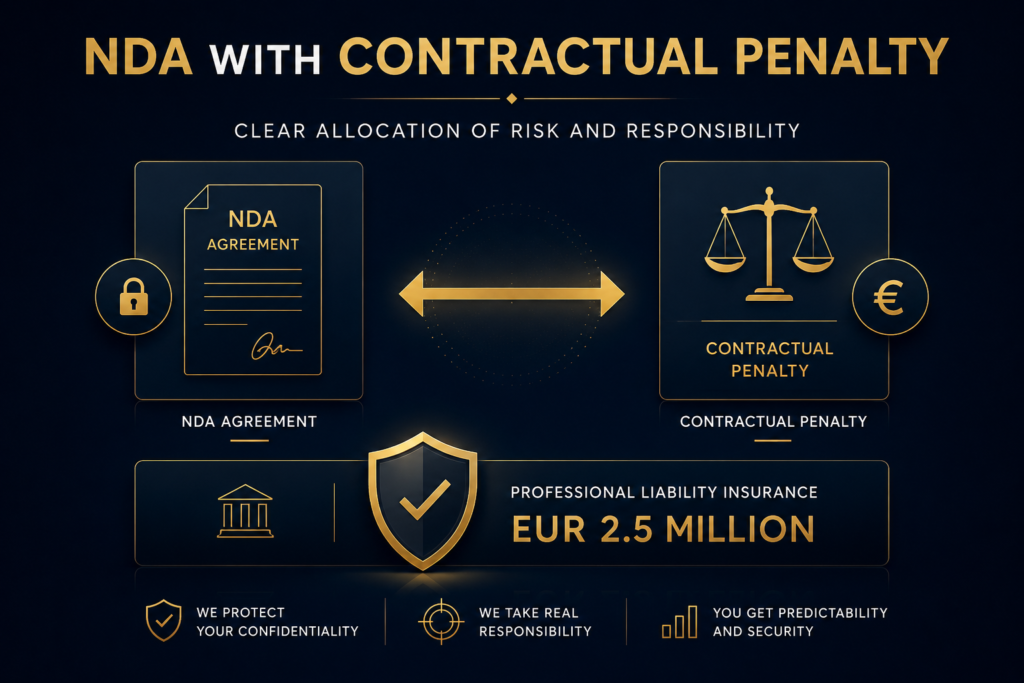
How We Protect Confidential Information
Our approach is simple and disciplined:
- we protect all data with strict internal protocols and controlled access systems,
- only authorised lawyers and team members involved in a specific matter have access to case materials,
- we maintain structured and traceable document management procedures,
- we apply GDPR-compliant data protection standards,
- we understand the commercial and litigation consequences of any breach of confidentiality.
In many disputes — especially commercial and corporate conflicts — improper handling of confidential information becomes a separate legal risk and may escalate the conflict itself. This is particularly relevant in M&A transactions, during Due Diligence processes, and in shareholder disputes, where access to sensitive financial and strategic data is central to the matter. Our role as legal advisors in Poland is not only to resolve disputes, but to prevent additional exposure.
Confidentiality as Part of Professional Ethics and Legal Services in Poland
Foreign clients often tell us that what they value most is not only legal expertise, but also discretion, predictability and accountability. We share this view.
Signing an NDA with a clearly structured contractual penalty is not a burden — it is a natural extension of:
- our statutory professional secrecy obligations under Polish law,
- our experience in cross-border legal services,
- our understanding of international compliance standards,
- and our commitment to secure, trustworthy cooperation.
If your business requires absolute discretion when operating or investing in Poland, we are prepared for it. Safeguarding your information is not just part of our work — it is a principle we stand by.
Contact Our Law Firm in Poland
Do you want to know how we work, discuss confidentiality arrangements, or request an offer for legal services? Feel free to contact us.
A conversation about the terms of cooperation is an opportunity for both sides to define expectations clearly and build a solid foundation of trust.
📩 kancelaria@jakubieciwspolnicy.pl
📞 +48 536 270 935
We know that confidentiality is the foundation of the attorney–client relationship worldwide. That is why we look to the highest international standards — such as the ABA’s guidance on confidentiality https://www.americanbar.org/groups/professional_responsibility/publications/model_rules_of_professional_conduct/rule_1_6_confidentiality_of_information/(americanbar.org in Bing — to ensure that our Clients receive the same level of protection.
NDA with contractual penalty. Frequently Asked Questions (FAQ)
1. Can you send us your NDA template?
Yes, of course. Please contact us and we will gladly provide a draft of our Non-Disclosure Agreement. For us, clear confidentiality terms are a foundation of professional cooperation.
2. Does your insurance cover contractual obligations such as NDA penalties?
Yes. Our professional liability insurance, up to EUR 2.5 million, also covers contractual liability, including obligations arising from agreed contractual penalties. This ensures that our commitments are financially secured.
3. Does the leader of your law firm bear personal liability toward clients?
Yes. Advocate Dr Andrzej Jakubiec, the founder of our law firm, bears full and unlimited personal liability for obligations toward our Clients. This reflects our approach to responsibility and professional integrity.
4. Is signing an NDA standard practice on the Polish legal market?
No. Many law firms in Poland are still reluctant to sign NDAs with contractual penalties. We are proud to do so. In our view, accepting clearly defined confidentiality obligations is a natural element of modern legal services for international business.
NDA in Poland – Jakubiec & Partners Key Standards, Risks & Protections
| Element | What it Means in Practice | Why It Matters | Our Standard |
|---|---|---|---|
| Confidential Information Definition | Precise scope: documents, data, strategies, financials, disputes, IP, internal processes. | Eliminates ambiguity and prevents loopholes in enforcement. | We define it narrowly, measurably, and in a way enforceable in cross‑border settings. |
| Contractual Penalty (Kara Umowna) | Fixed amount or proportionate penalty payable upon breach—no need to prove damages. | Predictability and fast enforcement, especially for foreign companies. | We accept reasonable penalties; our EUR 2.5M insurance covers contractual liability. |
| Professional Secrecy | Statutory attorney–client confidentiality under Polish law. | Stronger than any NDA clause; breach is a disciplinary and legal offence. | We combine statutory secrecy + GDPR + internal protocols for maximum protection. |
| GDPR & Data Security | Controlled access, encrypted storage, documented procedures, traceability. | Reduces risk of data leaks and regulatory exposure. | Only authorised team members access files; full audit trail and secure systems. |
| Scope & Duration | Clear timeframe, permitted use, and persons allowed to access information. | Prevents misuse and “scope creep” after project completion. | We set realistic, enforceable durations aligned with business risk. |
| Exclusions | Public info, independently developed data, disclosures required by law. | Avoids disputes over information that cannot be kept confidential. | We draft exclusions precisely to avoid abusive interpretations. |
| Return/Destruction of Data | Obligatory return or deletion of materials after cooperation ends. | Ensures no residual data remains in circulation. | We follow strict internal off‑boarding and data‑destruction procedures. |
| Liability & Insurance | Financial responsibility for breach + insurance coverage. | Guarantees real, not symbolic, protection. | EUR 2.5M professional liability insurance covering contractual liability. |
| Cross‑Border Predictability | Alignment with international standards (EU, UK, US practice). | Essential for investors and foreign companies entering Poland. | We draft NDAs compatible with international expectations and Polish enforcement. |
You can read about us here: https://jakubieciwspolnicy.pl/en/english-speaking-lawyer-in-poland-commercial-litigation-expert/
If you are courious, how do we perceive the shareholders disputes in modern conflict environment, read these two articles:
by dr Andrzej Jakubiec - adwokat, mediatorHOW TO FIND THE RIGHT LAW FIRM IN POLAND?
It is a Practical Guide for Foreign Companies. Choosing a law firm in a foreign jurisdiction is never simple. For international companies operating or entering the Polish market, the challenge is even greater: differences in legal culture, language barriers, unfamiliarity with court procedures, and uncertainty about enforcement standards may create real business risk. This guide provides foreign businesses with a practical framework for choosing a reliable, competent, and trustworthy law firm in Poland — particularly in the area of commercial litigation in Poland, dispute resolution in Poland, and cross-border enforcement in Poland. It is based not only on formal criteria, but also on real experience in representing foreign investors and SMEs in complex corporate and dispute matters.
1. English speaking lawyer in Poland
The base is to find an English speaking lawyer in Poland. For foreign companies, seamless communication is fundamental. A Polish lawyer should be able to:
- communicate fluently in business-level English (or German, French, Russian etc.),
- prepare bilingual contracts and pleadings,
- explain Polish legal procedures clearly and without unnecessary jargon,
- represent the client in negotiations and before Polish commercial courts.
A short introductory call is often enough to verify whether the lawyer is truly an English speaking lawyer in Poland, or whether communication will be filtered through intermediaries.
2. Look for Proven Experience With Foreign Investors
Cross-border representation requires more than language skills.
In my practice, I have:
- represented Swiss and UK investors in the acquisition of the Oscar-winning Se-ma-for Film Studio in Łódź,
- served on the supervisory board of Se-ma-for on behalf of foreign investors,
- handled joint venture disputes and shareholder conflicts,
- represented foreign clients (including from Sweden and France) in family-business conflicts involving commercial structures,
- established companies in Poland for German and Ukrainian entrepreneurs,
- structured M&A transactions and investor agreements as a PhD in commercial law.
These matters required not only knowledge of Polish corporate and civil procedure law, but also an understanding of how foreign investors assess legal risk, governance standards, and strategic exposure.
When choosing a law firm, ask for specific examples of cross-border experience — not general declarations.
3. Experience in Commercial Litigation and Shareholder Disputes
Many foreign companies seek assistance only once a conflict has escalated: unpaid invoices, breach of contract, deadlocked joint ventures, or shareholder disputes. Effective representation in commercial litigation in Poland requires:
- strong courtroom experience,
- strategic use of interim measures,
- familiarity with evidentiary rules under the Polish Civil Procedure Code,
- experience in shareholder disputes and corporate governance conflicts,
- knowledge of enforcement mechanisms through Polish bailiffs.
The Mediation and Negotiation Advantage: Litigation, however, is not always the optimal path. In many cross-border disputes, a carefully designed negotiation strategy or mediation process can significantly reduce financial and reputational risk. Early strategic intervention often determines whether a matter escalates into full-scale litigation or is resolved through structured settlement discussions.
I completed postgraduate studies in Negotiations, Mediations, and other Alternative Dispute Resolution (ADR) methods at the University of Warsaw: https://wpia.uw.edu.pl/pl/studia/studia-podyplomowe/podyplomowe-studia-negocjacji-mediacji-i-innych-alternatywnych-metod-rozwiazywania-sporow, as well as postgraduate studies in Forensic Psychiatry and Psychology at the University of Łódź: https://www.wpia.uni.lodz.pl/psychiatria. To further refine my strategic approach to conflict, I am currently continuing my professional development at the Behavioral Analysis Studies in Wrocław: https://sie.edu.pl/analiza-behawioralna/#Opis.
I am also a member of the Advocates’ Mediation Center at the District Bar Council in Łódź: https://lodz.adwokatura.pl/adwokackie-centrum-mediacji/mediatorzy/
4. Understand the Real Concerns of Foreign Clients
Foreign entrepreneurs often express specific concerns:
- unpredictability of court practice,
- duration of proceedings,
- litigation costs,
- reliability and accountability of local counsel.
I am personally familiar with these concerns.
Predictability and Timelines
I outline realistic timeframes and procedural stages at the outset of every case. While no responsible lawyer can guarantee the duration of court proceedings, it is possible to explain procedural milestones, likely evidentiary phases, and potential appeal scenarios.
Cost Transparency
I provide a clear cost structure and explain which elements are predictable (court fees, standard procedural costs) and which depend on developments during litigation. Clients receive a structured estimate and ongoing updates to avoid financial uncertainty.
Professional Accountability
As a Polish attorney, I bear personal professional liability. I guarantee the quality, integrity, and diligence of our work with my own name and assets. My professional liability insurance coverage amounts to EUR 2.5 million.
5. Independence and Conflict-of-Interest Procedures
Foreign companies should always request:
- a written conflict-of-interest check,
- confirmation of independence,
- written engagement terms.
Professional dispute resolution in Poland requires strict compliance with ethical and procedural standards.
6. Choose a Firm That Matches Your Scale
In our experience representing foreign SMEs in Poland, the most common strategic mistake is choosing a law firm that is too large — primarily because of brand recognition.
The Risk of Over-Scaled Structures
In such firms:
- the client often pays high hourly rates,
- the matter is delegated to a junior associate with limited courtroom experience,
- the well-known partner signs off but is not deeply involved.
Direct Partner Involvement
For many foreign SMEs involved in disputes or cross-border enforcement in Poland, a specialized boutique firm provides:
- direct partner involvement,
- strategic consistency,
- proportional cost structure,
- real courtroom experience.
Before instructing any firm, ask directly:
“Who will personally conduct representation before Polish commercial courts?”
The answer is decisive.
7. Transparency in Corporate and Transactional Work
As a PhD in commercial law, I have extensive experience in:
- company formation in Poland,
- drafting shareholder agreements,
- structuring M&A transactions,
- preparing investor agreements,
- designing joint venture frameworks.
I place particular emphasis on clarity of contractual provisions and transparent cooperation rules with clients. Many shareholder conflicts originate from ambiguous clauses drafted without anticipating dispute scenarios.
Preventive structuring is often more valuable than litigation.
8. Cultural Awareness in Dispute Resolution
Disputes are not only about statutes and procedural codes. They also concern negotiation culture.
Companies from Germany, Switzerland, the UK, France, Scandinavia, the US or Ukraine often differ in:
- risk tolerance,
- documentation standards,
- approach to settlement,
- internal decision-making dynamics.
Effective dispute resolution in Poland requires understanding these differences and aligning litigation strategy accordingly.
9. Practical Verification Checklist
Before hiring a Polish law firm, consider:
- Does the firm have real cross-border experience?
- Who will personally handle your case?
- Does the lawyer have litigation experience?
- Has the firm handled shareholder or joint venture disputes?
- Are costs and procedural risks explained transparently?
- Is the firm experienced in cross-border enforcement in Poland?
- Is communication direct and structured?
10. Common Mistakes Foreign Companies Make
- Selecting a firm solely based on brand size.
- Assuming all lawyers speak fluent English.
- Not verifying who actually conducts representation.
- Ignoring litigation experience.
- Contacting a lawyer too late.
- Failing to monitor registered address data in the KRS.
- Underestimating enforcement risks.
Avoiding these mistakes significantly improves your position in any commercial dispute in Poland.
Jakubiec & Partners – Your Trusted Partner Across Poland
We support international clients across major Polish business hubs. We offer clear, practical guidance tailored to SMEs investing, operating, or resolving disputes in Poland. Whether you are entering the Polish market, managing a shareholder conflict, or seeking to recover assets, we provide strategic legal representation grounded in experience and analytical precision.
Contact us today to discuss your business objectives in Poland or to schedule a strategic legal consultation. English speaking lawyer in Poland:
📩 kancelaria@jakubieciwspolnicy.pl
📞 536 270 935
You can read more about us here: https://jakubieciwspolnicy.pl/en/cross-border-commercial-disputes-in-poland-jakubiec-partners/
and here you see my text about shareholders disputes in three-person companies: https://jakubieciwspolnicy.pl/en/what-does-j-mearsheimer-teach-us-about-shareholders-conflicts/
FAQ – Foreign Companies and Legal Disputes in Poland
How long does commercial litigation in Poland usually take?
First-instance proceedings often last between 12 and 24 months, depending on complexity and evidentiary scope.
Can proceedings before Polish commercial courts be conducted in English?
Court proceedings are conducted in Polish. Documents in foreign languages require certified translations.
Can a foreign company sue in Poland without a Polish subsidiary?
Yes, if jurisdiction exists under EU regulations or applicable private international law rules.
How are foreign judgments enforced in Poland?
EU judgments are generally enforceable after formal recognition. Non-EU judgments require separate recognition proceedings before enforcement.
What are typical litigation costs?
Court fees are statutory and predictable. Legal fees depend on scope and complexity. A structured cost estimate should always be provided at the outset.