

 by dr Andrzej Jakubiec - adwokat, mediator
The Decision to End a Business Partnership is a Process
I know people who stay for years in relationships that drain them, limit them, and take away their joy in life. By “relationships” I mean family relationships, intimate relationships, and business cooperation (regardless of its legal form). In this article, I will focus on the decision to end cooperation with a business partner.
I know something about this. I have made such decisions myself when I wanted to end cooperation with my partners. Someone once made such a decision about me. I also decided to leave the University of Łódź, which was very difficult, but something pushed me to do it. And finally, I have advised on such matters hundreds of times as a lawyer. Initially, I focused on legal aspects, but the psychological knowledge I gained over time allowed me to look at these issues much more broadly. Today I know that the law is only a tool — it sets certain boundaries that must be taken into account, like trees when we run through a forest. But they do not determine our decision to run, the route, the pace, or whether it will be a single run or become our routine. Most partners don’t leave because they can’t for legal reasons — they stay because they don’t understand the decision mechanism.
Is Ending a Partnership Something Bad?
No. You have the right to end any cooperation. If you feel that this time is coming to an end, you have the moral right to use the legal tools that serve to end that cooperation. You do not need to feel any guilt because of it. Companies and contracts define people’s behavior for a certain period of time. People agree to this because they assume that during that time, cooperation will benefit them more than the lack of cooperation. If for any reason that assessment has changed, you can end the cooperation.
The Law Does Not Recognize Contracts That Bind Us Forever
Every legal relationship can be terminated — from an employment contract, through a commercial company, to marriage. It does not always mean ending it without cost or immediately, but in most cases it is possible. The law confirms the rule of the “temporariness” of cooperation by allowing contracts to be terminated so that we can use this possibility. Without guilt. Without shame.
If you remain in a relationship against yourself, feeling that you are losing in it, then someone is probably parasitizing on you and wants it to last forever. After all, they gain a lot with very little effort — at your expense.
What Drives Us to Make the Decision to End Cooperation?
Professional reports state that the most common cause of conflicts between partners is financial issues. I agree — but only partially. I believe that the financial area is where deeper causes of conflict most easily concentrate, and it is also the easiest to explain to everyone around. But if those deeper causes did not exist, there would usually be no financial dispute at all. Today, let’s look at how to make the decision to part ways without analyzing the cause or the level at which the conflict has grown.
Three Elements of the Decision to End Cooperation with a (Business) Partner
In modern psychology there is a lot of decision making models. Here I’ll present you one of them: simple and elegant Fogg’s Decision Making Model. The matter turns out to be quite simple with this model. To make a decision, three elements must occur:
- motivation
- ability (perceived ease)
- a trigger — an impulse to act
Importantly, all three elements must occur together. If even one is missing, the decision will not be made.
Motivation to Exit the Company and End Cooperation
What is motivation? Motivation is a state resulting from our emotions that make us strive for something or avoid something. Motivation has an affective, biological basis. Its social and psychological aspects are secondary. And that’s good — because it makes the matter much simpler. If we function well, we are motivated to achieve what is good for us and avoid what is bad for us. Yes, we can make mistakes in judgment, but that is another issue.
Assessing the Difficulty of the Decision to End Cooperation
Ability — or our assessment of how difficult the action is — is a key factor. We must remember that we tend to rationalize and justify passivity because it is convenient for us. Change requires effort, so our mind subconsciously suggests that we should like the situation we are in. It does this in two ways: it tells us that “here” is good and that “there” is bad, dangerous, uncertain. This means that we deceive ourselves into believing that change is harder than it really is. We do this out of laziness and we are brilliantly creative at it.
The Impulse to Act
The trigger is the impulse to behave in a certain way, to make a decision. We say that “the last drop spilled the cup.” A trigger can be almost anything, but most often they appear regularly — we just silence them when we lack motivation or when the change seems associated with real or imagined difficulties. When motivation appears and the task becomes realistically possible, we only need to wait for the trigger. But if motivation is lacking or the task seems too difficult, the trigger will not cause action.
The Fogg Curve — When Do We Make the Decision (to Exit the Company)?
What is the Fogg’s decision making model? The factors influencing our decisions can be presented graphically using the Fogg Curve. It looks like this:
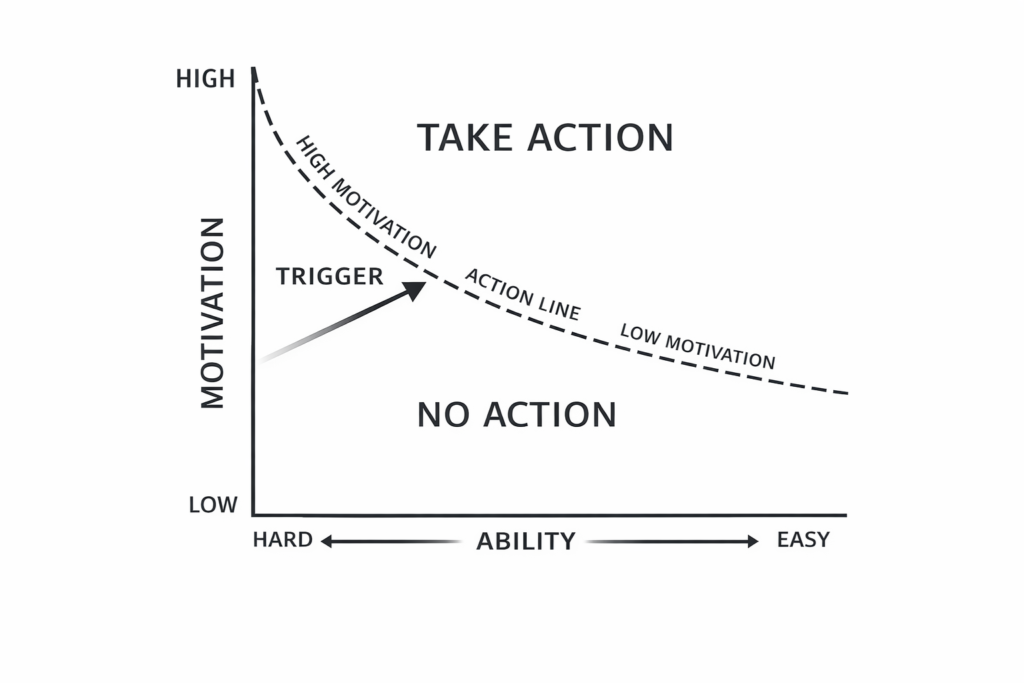
We can see that:
- we are likely to make a decision if we have high motivation and the task is easy (as long as a trigger appears);
- we are unlikely to act if we have low motivation and the task is difficult (even if a trigger appears).
The Decision to End Cooperation. What Should Make You Reflect on Ending Cooperation?
Intuition
Our strongest weapon and unconscious competence. When I listened to it, I succeeded; when I ignored it, I got into trouble. Only deeper studies in psychology and behavioral analysis made me understand how powerful a tool each of us has. And I write this with full responsibility also as a lawyer.
Guilt
Especially if it is being induced in you by your partner — this is a clear red flag. Making you feel guilty is one of the strongest mechanisms of manipulation.
Lack of space to talk about what matters to you
Caring for the relationship between partners is as important as in a marriage. If you do not talk about your fears, plans, ambitions, it means things are already very bad.
Being promised the future
Plans must be:
- real,
- measurable,
- time‑bound,
- concrete.
If they are not, and your partner only tells you to “work hard so that someday it will be better,” then change the plan — or the partner.
You get nothing out of it
We work for a purpose. If you feel that you give everything, but in this personal arrangement your energy, time, and abilities are being burned — let it go. You have only one life; you can have many partners.
If some of these points apply to you, it means you are aware that you are stuck somewhere you do not want to be. And that is already the basis for change.
Deadlock
Deadlock is one of the most destructive situations in business relationships. It is not just a red flag — it is a structural breakdown.
When shareholders hold equal power, even simple decisions can become impossible. As a result, the company may stop functioning altogether while the conflict continues to escalate.
Deadlock occurs when the conflict itself becomes more important than the business. At that point, rational decision-making is replaced by control, ego, and escalation.
This is the moment when waiting becomes the most expensive strategy.
Red Flags and Their Meaning When Deciding to End Cooperation
| Red flag / warning sign | How it looks in practice | What it means psychologically | Consequences for you and the company |
|---|---|---|---|
| Intuition says “something is wrong” | Unexplained tension, discomfort, the feeling that “something is off” | Intuition is unconscious analysis — a signal that your brain sees danger | Ignoring intuition leads to years of losses and burnout |
| Guilt induced by the partner | Suggestions like “you won’t manage without me,” “you’ll let the company down” | Classic manipulation and a tool of control | Loss of agency, emotional dependence, bad decisions |
| No space to talk about important matters | Avoiding difficult topics, gaslighting, belittling your needs | The relationship is one‑sided and communication is toxic | Growing tension, no room for development, escalating conflict |
| Being promised the future | Promises without deadlines, without specifics, without measurable effects | A mechanism keeping you in place — “carrot on a stick” | Blocked career, no real influence, wasted years |
| No real benefits from cooperation | You work more than others and gain the least | Exploitation, asymmetry of effort and reward | Burnout, frustration, sense of injustice |
| Rationalizing passivity (“here is safe”) | Delaying decisions, excusing the partner, justifying pathology | A defense mechanism — avoiding effort and change | Staying in a bad relationship, rising psychological and financial costs |
| Ignored triggers | Repeated “last drops” that change nothing | Lack of connection between motivation and ability | The trigger never becomes a decision — you stay stuck for years |
| Distorted perception of difficulty | “It will be too hard,” “I can’t,” “I have no options” | Your brain is deceiving you — avoidance mechanism | Decision postponed indefinitely, rising risks |
| Lack of trust in the partner | Hidden information, unclear actions, lack of transparency | The relationship is already dead — it’s only a matter of time | Conflict escalates, costs rise every month |
The Fogg Curve in the Context of Exiting a Company
| Element of the Fogg Model | What it means in the context of a partner | How it looks in practice | What happens when one of the three elements is missing |
|---|---|---|---|
| Motivation | The emotional and psychological reason to end cooperation | Exhaustion, frustration, sense of injustice, intuition saying “this is not it,” lack of trust | The partner stays in the relationship despite harm; rationalizes the situation; “maybe it will get better” |
| Perceived ability | Assessment of whether exiting is realistically possible — legally, financially, organizationally | Consulting a lawyer, analyzing the contract, assessing risks, understanding procedures | The partner believes “it can’t be done,” “it’s too hard,” “I have no options”; decision paralysis; or they haven’t been hurt enough yet (no trigger) |
| Trigger | The impulse that initiates action | Another manipulation, lack of payment, broken promise, humiliation, value conflict | If motivation or ability are low — the trigger changes nothing; passivity returns |
| High motivation + high ability + trigger | Optimal point for making a decision | The partner sees the sense of change and knows how to execute it | The decision is made quickly and consciously; determination is high; change will happen |
| High motivation + high difficulty | You want to leave but “don’t know how” | Fear, delaying the decision, excuses | Triggers do not lead to action; frustration grows; your future depends on whether you seek solutions or wither where you are |
| Low motivation + high ability | You can leave but feel no need | “It’s fine,” “It’s not ideal but it’s okay,” “I don’t want to waste energy” | You may be in the right place and not need to change anything |
| Low motivation + low ability | You don’t want to leave | Passivity, comfort, but you couldn’t leave even if you wanted to | The decision will never happen without a change in motivation; only then will you consider ability |
Legal audit is the foundation and it’s role in Decision to End a Business Partnership
In this situation, you must know where you stand. It is not enough to simply read the contract you signed years ago. The contract is not everything. You are also bound by what is not in the agreement:
- thousands of applicable regulations that were not “repeated” in the written contract;
- the principles of interpretation of those regulations;
- customs and principles of social coexistence;
- judicial case law.
I know it sounds daunting, but: 1) that is why you have a lawyer to analyze it, and 2) to tell you exactly where you stand. Do not worry—the other party has the same problem.
However, it is crucial to know exactly what can and cannot be changed in a given situation right now. It is worth knowing how to shape the situation so that new opportunities appear on your side or options available to your partner disappear.
You must identify and assess the risk, including legal risk. Do not expect 100% certainty here—it does not exist in law. Expect a level of certainty and probability significant enough to allow for rational decision-making.
Remember, however, that the law only opens or closes certain doors. It is entirely up to you, though, whether and through which of the open doors you choose to walk. The fact that you have a certain right does not mean it will be purposeful, right, or beneficial to exercise it at this moment. That is a matter of strategy, which I will help you develop.
Decision to End a Business Partnership. Invitation to cooperation
Often, the first step to ending an unfavorable cooperation with a business partner is starting a good cooperation with a lawyer who understands not only the regulations but also the mechanics of such conflicts.
This is exactly what I offer you:
- a detailed legal analysis of your situation;
- defining realistic goals and alternatives (including the preparation of a BATNA);
- developing a strategy for action;
- support in negotiations, mediations, or litigation;
- conducting the entire process—from the decision to its implementation.
I will not influence your motivation—that is not my role. To push you toward a decision I will not either. I can, however, do something much more important: show you the real level of difficulty of this decision, limit the risk, and guide you through the entire process in a thoughtful and safe manner.
If you are at a point where:
- you are considering ending the cooperation,
- you have doubts about what you can do,
- or you feel that “something is wrong” but you don’t know how to organize it,
…then do not act in the dark. One ill-considered decision can cost years of dispute and very significant money. I know you may not know where to start. That is normal.
Contact me: 📩 kancelaria@jakubieciwspolnicy.pl 📞 536 270 935
FAQ – Questions about Decision to End a Business Partnership
Can I end cooperation with a partner in any situation?
As a rule—yes. Almost every legal relationship is resolvable. What differs, however, are:
- the procedure,
- the time,
- the costs,
- the risks.
The key question is not “if you can,” but “how to do it so you don’t pay more than necessary.” There are, however, exceptions: the law recognizes the concept of a “prisoner in a limited liability company.” which concerns a minority shareholders. In such cases, other measures must be considered to persuade the partners to “let you go.”
Do I need a “valid reason” to exit the company?
This depends on the legal structure of the company. In some companies, a valid reason is significantly taken into account and allows, for example, for the company to be dissolved earlier. In other cases, it may be the basis for excluding a partner from a limited liability company. However, the lawyer’s role is to persuade the other party to make a concession even when they are not legally obliged to do so.
What if my partner does not agree to end the cooperation?
This is a standard situation. A lack of consent from the other party:
- does not block all scenarios,
- but it does change the strategy.
In such cases, it is crucial to:
- build a negotiating advantage,
- prepare alternatives (BATNA),
- use legal tools appropriately.
In any case, remember that the field of play is fluid and we can shape it. If the partner’s consent is required today, we can attempt to change the circumstances so that it is no longer required—or so that they want to grant it. A partner will always make the best decision for themselves. Therefore, one must influence the environment so that it is more profitable for them to agree to part ways than to keep you in the company against your will.
Is it better to negotiate or go to court?
This is not an “either-or” choice. In practice:
- a well-prepared path to court often strengthens negotiations,
- and negotiations without a real alternative in the form of a lawsuit are usually ineffective.
First, you build your position, then you choose the tool. I view negotiations very broadly; litigation is like the use of kinetic force in politics. There, war is a way of conducting policy. Similarly in business—litigation is a clash intended to serve a purpose. It is a form of forceful negotiation. And during a trial, you can always negotiate in parallel: directly and verbally, through intermediaries, or via the method of faits accomplis. Yes, people don’t talk about it, but… non-verbal negotiations exist!
How long does it take to end cooperation?
From a few weeks to several years. It depends mainly on:
- the level of conflict,
- the legal structure,
- the preparation of the parties,
- the determination of the parties,
- external and random factors.
The most common mistake: starting actions without preparation, which extends the entire process manifold.
Can I exit “without losses”?
There are no completely cost-free solutions. But let’s distinguish costs from losses. There will always be costs: notary fees, taxes, costs of consultants and lawyers. But these are calculated costs. Will you exit without losses? It happens that partners exit companies with a great profit; other times, they accept certain losses just to end it or protect the rest of their capital.
The question is: is the cost of exiting lower than the cost of staying? And that is a strategic decision, not just a legal one.
How do I know if it’s the right moment for a decision?
If:
- you are losing trust,
- your communication is not functioning,
- your work does not translate into real benefits,
- your intuition tells you it’s time to leave,
…then leave.
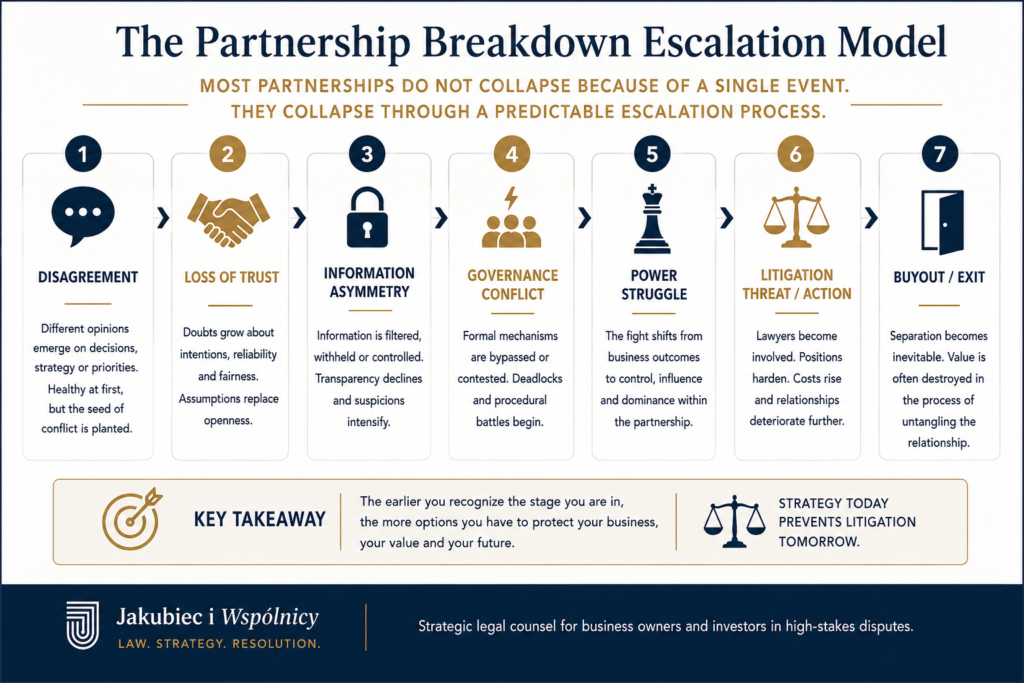
The Jakubiec Partnership Breakdown Escalation Model — a visual framework showing how business relationships deteriorate through predictable stages. Recognizing the stage early allows strategic intervention before litigation becomes inevitable.
by dr Andrzej Jakubiec - adwokat, mediatorAI and Tunnel Vision in Shareholder Disputes
What is the problem?
The Coupled Confirmation Bias is more and more often present in business disputes. I can see it even in my current practice. Sometimes, clients come to me with a ready-made plan. They have already consulted a language model about their company’s situation. They expect me to simply execute it. Conversations with them can be difficult. I feel a strong need to perform my job properly and investigate the situation. Some clients understand this. Others assume it is unnecessary because the case is already “assessed.” A few have even accused me of inflating costs. They claim AI has already done the work and provided a solution.
Confirmation bias clearly influences some clients’ attitudes. I manage to convince a portion of them. Others are surprised when I refuse to cooperate. Some are even outraged. One person accused me—before any substantive talk—that I don’t understand companies or negotiations. My ‘ignorance’ supposedly stemmed from my desire to read the articles of association. I also wanted to discuss the history of the partnership. Welcome to the AI era!
This article expands on thoughts I shared previously.
You can read that text first, but it is not mandatory. This article stands on its own.
Shareholder Disputes: Why Do We Seek Confirmation?
I have observed a natural tendency in shareholder disputes for years. People selectively choose facts that support their version of events. In psychology, this mechanism is called confirmation bias. We ignore information that contradicts our beliefs. Meanwhile, we overvalue evidence that confirms them.
Example: If we believe the Earth is flat, we interpret data to prove it. We ignore inconvenient facts or stretch others. Confirmation bias is not an accusation against anyone. It is a well-researched psychological phenomenon. It is good to be aware of it.
Psychologically, this is a defense mechanism. Its goal is to maintain cognitive consistency and reduce emotional tension. Intellectual anxiety does not serve most of us. We want to eliminate it.
In disputes, every party presents a “favorable” version. They select facts and make convenient assumptions. They weave these assumptions into a factual narrative. This happens at every level: from playground fights to international conflicts. In shareholder disputes, confirmation bias reveals itself with full force.
Until now, clients often came to me with a ready “diagnosis” and “treatment plan.” They sought a lawyer who would accept it as truth.
You can read more here:
Coupled Confirmation Bias in AI Interaction
What is Coupled Confirmation Bias? It is a mechanism where our initial beliefs are reinforced by AI interaction. The pattern looks like this:
- The user formulates a thesis (e.g., a belief about a partner’s dishonesty).
- The AI model generates a response that matches this assumption. It lacks the full history of the partnership. It does not distinguish between facts, assumptions, and interpretations. It wants to be “helpful,” so it usually confirms the user’s thesis.
- The user treats AI as an authority. This authority is strengthened after receiving confirmation.
- A feedback loop forms. It leads to even stronger convictions and a deeper cognitive tunnel.
- New forces arise. AI reinforces beliefs. The user acts decisively, “ennobled” by the confirmation. The conflict escalates.
AI models often state they are not lawyers. However, this has a counterproductive effect. Many users then look for lawyers who will confirm the AI’s conclusions. They use this as the main criterion for evaluating a lawyer’s competence. They will search until they find one.
In practice, AI acts like a “magnifying glass.” It amplifies our starting positions, regardless of their truth. We remove everything from our field of vision that contradicts the original thesis.
You can read more about this problem here: Ben Wang, Jiqun Liu, Cognitively Biased Users Interacting with Algorithmically Biased Results in Whole-Session Search on Debated Topics, https://dl.acm.org/doi/10.1145/3664190.3672520
Why Does AI Naturally Confirm Our Beliefs?
Language models do not “think” independently. Their answers come from the statistical prediction of words based on the prompt’s context. If a question suggests a specific interpretation, the model creates a consistent narrative. The user sees this as objective confirmation.
AI responses are internally consistent. They rarely contradict themselves. However, they are not always externally consistent or grounded in reality. They may lack true legal knowledge (not to be confused with legal regulations). At first glance, they look like expert statements. Only a professional can spot the errors or omissions that invalidate the suggested direction.
We call it hypercustomization. You can read about it: https://journals.sagepub.com/doi/10.1177/23794607251347020
Practical Consequences of Coupled Confirmation Bias for Partners and Negotiations: The Feedback Loop
Coupled confirmation bias can deepen negotiation difficulties. AI confirms one side’s assumptions, making it harder to understand the other side. But what if both partners use AI and coupled confirmation bias affects them both?
Consider what happens when the other party describes their subjective perspective to their own AI model. The model confirms its point of view and reinforces it. The influence on the user’s actions is significant. The second partner observes this with growing suspicion. His reaction will be to prepare for an attack, which may be strictly defensive or pre-emptively offensive. But he wants to be sure that his interpretation is correct. What will he do? He turns to his own chatbot, subjectively describing what he sees. Guess what kind of answer he receives? Yes…
The situation can spiral out of control. It resembles a chess match between two cheaters using computers. This is no longer a normal game.
Every partner subjectively interprets the “opponent’s” behavior. They feed this subjectivity to an AI. The AI confirms the “wickedness” of the other side and suggests radical solutions. When clients come to my office in this spiral, rational arguments often fail to reach them.
We have a clear example of coupled confirmation bias on both sides, which provokes a Feedback Loop! It is a security dilemma on steroids.
Human-AI Confirmation Bias in Scientific Research
My observations are confirmed by scientific research. Studies show that human-AI interactions can reinforce prejudices and false beliefs.
Last year has been published an article: “How human–AI feedback loops alter human perceptual, emotional and social judgements” (Nature Human Behaviour). The authors showed that AI confirming human assumptions strengthens perceptions and social ratings. Here’s the link: https://www.nature.com/articles/s41562-024-02077-2?
I also recommend the paper by Yiran Du: Confirmation Bias in Generative AI Chatbots. It analyzes these mechanisms in AI models and discusses the risks of this coupling: https://arxiv.org/abs/2504.09343?
Another insightful text is Bias in the Loop: How Humans Evaluate AI-Generated Suggestions: The authors found that users accept wrong AI suggestions if they fit prior beliefs. However, effective collaboration depends on who evaluates the AI results and how the review process is organized. You can read it here: https://arxiv.org/pdf/2509.08514
This mechanism is at the forefront of AI research. It is a clear example of how AI affects specific areas of life, such as negotiations.
Summary
Coupled Confirmation Bias is not a new cognitive bias; rather, together with tunnel thinking, it creates a new conflict dynamic in which AI meaningfully influences both the perception and the escalation of the conflict.
Coupled Confirmation Bias proves that AI is not a neutral arbiter. Our subjective biases can be reinforced in a feedback loop. In shareholder disputes, this leads to bad decisions and conflict escalation.
A lawyer’s role has never been just to confirm a client’s ideas. Today, we must go further. We must help some people regain contact with reality.
Everything depends on us. AI offers great possibilities. We can instruct it to be critical of our ideas. It can play devil’s advocate. It can find gaps in our reasoning or suggest alternative explanations. AI is excellent at eliminating the fundamental attribution error in business disputes. I wrote about it here: https://jakubieciwspolnicy.pl/podstawowy-blad-atrybucji-w-pracy-adwokata/
When a client brings AI-generated advice, I don’t get offended. I talk to them. I almost always review the material. Sometimes, a suggested solution is interesting and fresh.
Usually, I gain the client’s trust by explaining how language models work. I show them solutions I can legally defend. Sometimes, a client returns after a few days and says they finally trust me—because the AI eventually agreed with my reasoning. In light of the above, it is a bittersweet success.
If you need a lawyer who handles negotiations and shareholder disputes, feel free to contact me: 📧 kancelaria@jakubieciwspolnicy.pl 📞 +48 536 270 935 I will be happy to help!
by dr Andrzej Jakubiec - adwokat, mediatorWhat Does J. Mearsheimer Teach Us About Shareholders Conflicts?
From the beginning of my work as a business attorney, I observed a striking pattern. In companies with three partners, disputes arose more frequently than in firms with two or four partners. For a long time, I treated this as an interesting curiosity. That changed after I read John Mearsheimer’s The Tragedy of Great Power Politics. Why three-partner companies are statistically more prone to disputes? International political theories offer surprising insights into modern business partnerships. Specifically, Mearsheimer’s theory of offensive realism may explain why three-person structures face inherent instability. By understanding these structural dynamics, entrepreneurs can defuse conflicts before they destroy company value.
International Relations Theory in Business
Is instability of three-partner companies real? Business analysis often draws on theories originally developed to explain great-power politics. John Mearsheimer’s seminal work, The Tragedy of Great Power Politics, presents a clear thesis. He says, that bipolar systems, consisting of two main actors, are significantly more stable than multipolar ones.
In a business context, this translates into the relative durability of companies with only two partners. In such a setup, each partner typically holds a clearly defined role and maintains a strong incentive to reach an agreement to ensure the venture’s survival.
The Third Partner as a Structural Risk Factor
Once a third partner is introduced, the situation becomes strategically complex. Over time, the third individual naturally begins to assess their relative position within the company hierarchy. Neutral events or private conversations may be misinterpreted as signs of a growing alignment between the other two, leading to a breakdown in trust.
As questions arise about the sense of further investing energy, trust, and capital, perceptions begin to shift. This change can radically alter internal loyalty and decision-making dynamics.
Can Mearsheimer’s Theory Explain Shareholder Conflicts?
But can a theory about nuclear powers really apply to a three-person tech startup? The short answer: surprisingly well. The issue is whether they can be used to analyze relationships between business partners. To begin, let us lay out his core arguments. These are:
Mearsheimer’s key arguments about why multipolar arrangements are unstable:
- Anarchy in the system – There is no central authority to enforce agreements or reassure participants. Each actor must rely on itself for security. This creates constant pressure to accumulate advantage and undermines stable trust.
- Offensive capabilities – All major actors possess power that can be used against others. This creates persistent incentives to increase power rather than rely on cooperation.
- Uncertainty about others’ intentions – Actors can never be fully certain about others’ motivations or future plans. As a result, they make worst-case assumptions that drive competitive behavior.
- Survival as the primary goal – Fear of being outcompeted or dominated shapes strategic behavior. Players seek relative advantage even at the cost of short-term cooperation.
- Power maximization behaviour – Actors do not stop seeking power once basic security is achieved. They continue accumulating power to prevent rivals from gaining advantage.
- Security competition becomes self-reinforcing – When one actor increases power, others respond in kind. This dynamic fuels escalation rather than long-term stability.
- Greater opportunities for miscalculation – Multipolar settings create shifting alliances and imbalances. These conditions increase the risk of misjudging intentions or capabilities, triggering conflict.
These assumptions and behavioral imperatives form the core of Mearsheimer’s offensive realism perspective.
Doesn’t this list sound eerily familiar?
When we consider interpersonal dynamics in small, closed settings like commercial partnerships, this list stops being abstract. Competing for relative advantage and mistrusting intentions often feels natural in tightly knit management groups. The same logic appears in global geopolitical systems.
If we consider the theoretical basis for such a conceptual transfer, it cannot be dismissed outright. At minimum, it functions as a legitimate intellectual exercise rather than a formal scientific claim. This framing is a thought experiment, not a strict scientific argument. Still, the parallels are striking and, I hope, clear.
The Security Dilemma at the Micro Level
This internal tension closely resembles the “security dilemma” applied on a micro scale. In this scenario, an increase in one party’s sense of security or influence triggers an instinctive fear in the others. Consequently, a partner may seek to weaken the rest of the group simply to strengthen their own position.
The desire to assume a destructive role—such as an informal judge or arbiter—often emerges. Historical precedents, such as the Roman triumvirates or the history of successor kingdoms following Charlemagne’s empire, confirm that these three-way arrangements are rarely durable.
In my mediation and advisory practice, conflicts in three-partner companies tend to escalate faster and more emotionally than in two-partner structures.
Strategic Consequences for the Company
Conflict escalation in a trio is usually faster and more destructive than in other configurations. As decision-making paralysis begins to erode the organization from within, partners often find themselves fighting each other more fiercely than they compete with the market.
Because you know your partners best, you are able to strike at their most sensitive points. Ultimately, vital energy is diverted into building internal coalitions instead of driving growth.
In real corporate disputes, this dynamic frequently leads to board paralysis, operational stagnation, or costly shareholder litigation.
Instability of three-partner companies. Why Three-Person Structures Are Worth Avoiding?
Companies with three partners are among the least stable business forms because the potential for unequal alliances—typically two versus one—is embedded in the very structure. Instead of creating synergy, the system often devolves into a continuous zero-sum game.
If you are planning a new company, a two-partner model is usually a safer strategic choice. Reading Mearsheimer is essential for any leader who wants to understand and mitigate these structural risks.
Scientific Foundations: Conflict Dynamics in Triads
To fully understand the risks, one must examine the mathematical and psychological frameworks governing three-party interactions.
Offensive Realism in Systems Without a Central Arbiter
A company’s management board often resembles an “anarchic” system. Without a dominant leader to enforce order, each actor must maximize their own power to ensure survival. In a triad, this logic produces a cycle of constant alliance reshuffling.
The Sociology of the Triad (Georg Simmel)
According to Georg Simmel, introducing a third person fundamentally changes group chemistry. Three distinct roles typically emerge: the mediator, the opportunist (tertius gaudens), and the dominator. This structural shift transforms simple cooperation into a complex struggle for influence.
The Physics of Intractable Conflicts
Modern sociophysical models suggest that three-group dynamics are inherently unstable. The human mind is wired to perceive coalition threats more acutely in triads, which often triggers defensive aggression and long-term instability.
Instability of three-partner companies. Key Sources on Three-Party Conflict Dynamics
The following materials provide a foundation for deeper risk analysis in three-partner companies:
- [PL] Jakubiec & Partners – Three Partners: When Conflict Is in the Air An analysis by Dr. Andrzej Jakubiec linking Mearsheimer’s theory with Polish company law.
- [US] John J. Mearsheimer – The Tragedy of Great Power Politics The foundation of offensive realism. Explains why actors in anarchic systems seek dominance.
- A study examining which coalition structures can form in three-player games. It analyzes the conditions under which players form two-player coalitions, a grand coalition, or act independently: https://www.mdpi.com/2073-4336/16/3/30?
- Balanced Weights and Three‑Sided Coalition Formation (MDPI Games) https://www.mdpi.com/2073-4336/1/2/159
- Dynamic Stability of Coalition Formation in Dynamic Games: https://www.sciencedirect.com/science/article/abs/pii/S0167637724000749?via%3Dihub
- Hedonic Games and Coalition Stability: https://en.wikipedia.org/wiki/Hedonic_game?
Most shareholder disputes do not begin with bad intentions, but with structural blind spots that could have been addressed years earlier.
Prior to entering a three-person partnership, ensure your agreement includes provisions to mitigate structural deadlock. I invite you to reach out for a consultation:
📩 kancelaria@jakubieciwspolnicy.pl
📞 536 270 935
by dr Andrzej Jakubiec - adwokat, mediatorUsing AI in Disputes Between Partners
I handle corporate disputes, including conflicts between partners. I am also deeply interested in technology. Using AI to analyze conflicts is now a reality. It is also becoming a fact in disputes between partners. The question is how to use AI optimally in this field. We must also address the traps of using AI in this area. In this post, I want to mention a few of them.
What are partner disputes about?
AI in disputes between partners? Yes, but first, let’s define these disputes. Conflicts between partners are not just about money. Money plays a role, but rarely the leading one. Often, it is just a side issue. Partners sometimes fight each other more fiercely than their competitors. They have many tools and know each other well. This gives them a direct impact on each other’s lives.
What do partners fight about? They fight for power, agency, and vision. Also they seek appreciation and recognition. They also disagree on the pace of change or risk tolerance. Some disputes involve honesty, profit distribution, or hiring family members. Financing—loans versus own funds—is another common issue. In a three-partner setup, unequal coalitions often form. Three-person companies are among the least stable. I wrote more about it here: https://jakubieciwspolnicy.pl/trzech-wspolnikow-czyli-konflikt-wisi-w-powietrzu/
In this text (link up), I have applied an analytical framework developed by J. Mearsheimer in his book The Tragedy of Great Power Politics. In that seminal work, the author explains why international alliances among three states tend to be unstable. In my view, these conclusions can be cautiously extended to relationships between business partners.
How can AI be used in partner disputes?
AI is actually used to resolve disputes. You can read more about here: https://www.reuters.com/legal/legalindustry/artificial-intelligence-dispute-resolution-developments-challenges-perspectives-2025-07-11/ or here in litigation context: https://www.whitecase.com/insight-our-thinking/ai-risks-legal-sector-must-consider-dispute-resolution .
We see, that AI in disputes between partners in business can be used in many ways. New ideas appear constantly. We can group these into three categories:
- Preventive consultation: How to avoid a dispute?
- Interventional: How to resolve an existing dispute?
- Follow-up: How to improve the relationship for the future?
AI can provide general advice on cooperation or focus on a specific case. Both have pros and cons. AI is a great tool, but we must know how to use it.
General advice can offer a new perspective. It might suggest a solution you hadn’t considered. However, many general tips can be clichéd or simplistic. It is difficult to judge if these general “recommendations” apply to your specific case.
You can listen to more about using AI in conflict resolution here: https://www.youtube.com/watch?time_continue=1&v=GO_cZ3NADZI&embeds_referring_euri=https%3A%2F%2Fjakubieciwspolnicy.pl%2F&source_ve_path=MzY4NDIsMjg2NjQsMjM4NTE
AI in Disputes Between Partners and The Coupled Confirmation Bias in AI
AI in partner disputes offers many possibilities. However, asking about a specific case—your company—carries a huge risk. I call this the “Coupled Confirmation Bias”. This is the tendency of AI to confirm our subjective opinions.
How does it work? To get a solution for a specific problem, you must provide data. You need to describe the situation. The problem is that your story is only a slice of reality. A great writer might need four volumes to describe your relationship. You are trying to do it in four sentences.
More importantly, we have a subjective view of reality. We describe it from our perspective. This is natural. We must acknowledge that our view is not the only one.
What does the AI do? Language models are not gods. They are advanced technology learning to talk to us. They do not have a monopoly on wisdom. An AI can give you 92 ways to solve a dispute in 10 seconds. But are they wise?
AI models tend to confirm your views unless they contradict facts. We are very good at telling stories that favor us. We omit “small details.” In this situation, the AI will tell you what you want to hear. It can easily radicalize your attitude. This is the Coupled Confirmation Bias.
AI in Disputes Between Partners. Want to know more?
Our subjective perspective is a natural trap. Research from the Program on Negotiation at Harvard Law School confirms that egocentrism prevents objective assessment. This makes the input data for AI fragmentary.
If you are interested in AI in legal practice, you can also read this report: DRI White Paper on Artificial Intelligence.
Conclusions
Corporate disputes are complex. They involve law, economics, psychology, and negotiation. Usually, each participant sees only part of the puzzle. Their view is fragmentary and subjective. When telling the story, they select facts and add subjective value.
It takes great insight and experience to find what is valuable in such a story. Language models cannot do this yet.
It is worth testing ideas with AI. However, following AI advice blindly in specific cases is a grave mistake. You can fall into a spiral of confirmation. This turns doubts into delusions. We often trust what we don’t understand more than what we know.
Do you need help with partner relations? Are you in a legal dispute? Do you want to minimize the risk of future conflict? Contact us:
Jakubiec & Partners 📩 kancelaria@jakubieciwspolnicy.pl 📞 +48 536 270 935
We are here to help! If you enjoyed this article, you can read my other texts on AI in legal work:
by dr Andrzej Jakubiec - adwokat, mediatorHow to Resolve Disputes Between Partners?
Disputes between partners are a natural part of business. Differences in interest or visions for the company appear sooner or later. Personal tensions or financial crises also affect ownership relations. The key question is not if a conflict will arise. The question is how it will be resolved.
Escalation and Litigation – The Easy Way, But Is It Better?
Mediation between partners is often not the first choice. It requires courage, responsibility, and effort. The simplest path is often the most expensive: escalating the dispute to court. In practice, court cases often focus on “proxy” disputes. These concern formal or technical issues. They rarely address the real source of the conflict.
Why Do Court Proceedings Rarely Solve the Problem?
Litigation always generates high costs. These include money, time, and organizational resources. More importantly, it consumes assets that are hard to rebuild. These are relationships, trust, and the company’s reputation. Even a final court ruling does not remove the cause of conflict. It often leads to further escalation in other areas.
From a business perspective, this path rarely leads to a real solution.
Our Approach to Partner Disputes
The Law Firm of Jakubiec & Partners does not avoid confrontation when necessary. However, in most cases, we focus on real help for our clients. we do not mechanically generate new court proceedings.
We specialize in negotiations and actions that remove the source of the dispute. Our goal is to rebuild the relationship between partners. If that is impossible, we aim for a rational and predictable separation.
Negotiation as a Tool for Mature Conflict Management
Negotiation is not a sign of weakness. On the contrary, it shows maturity and strategic thinking. We often help clients who feel “trapped in a corner.” They often defend positions that do not reflect their true business goals.
A well-led negotiation process allows you to regain control. It limits losses and lets you focus on what matters most: growth and stability.
Mediation Between Partners – Want to Know More?
Mediation between partners is our specialty. We constantly develop our skills and study new sources. We are happy to share them with you.
You can read about alternatives to litigation here: Alternative Dispute Resolution (Harvard). The experts at Harvard University certainly know their field.
For a different perspective, I recommend this Forbes article: Strategic Mediation: Five Pillars for Effective Settlements. It explains how to use mediation in tough business disputes.
You can also read why leading American lawyers prefer mediation for business disputes here: Why Mediation is Preferred for Business Disputes.
If you want to read my previous articles, here are a few links:
- https://jakubieciwspolnicy.pl/wykorzystanie-ai-w-sporach-miedzy-wspolnikami/
- https://jakubieciwspolnicy.pl/wspolnik-mniejszosciowy-i-jego-los/
- https://jakubieciwspolnicy.pl/roznice-miedzy-mediacja-arbitrazem-a-postepowaniem-sadowym/
Would you rather listen than read? Here is a link to my podcast about partner disputes: https://open.spotify.com/episode/4p20ALoBzNcmzQ0W2otf0e
If you want to learn more about how we work and help partners in conflict, please contact our firm.
Jakubiec & Partners 📩 kancelaria@jakubieciwspolnicy.pl 📞 +48 536 270 935
by dr Andrzej Jakubiec - adwokat, mediatorEscalation of Conflict Between Business Partners – a real Scenario
How does a dispute between partners escalate? There are many possibilities of conflict escalation. Today, I want to present one potential scenario. Why? Because I am a lawyer and mediator advising business partners in high-conflict situations. This illustrates the consequences of acting in anger and persistence. I do not want to scare anyone. I want to help you avoid what I have often seen. Why does this matter to me? I believe we must care for Polish business. It is the engine of our economy and our prosperity. In this article, you will learn how the “point of no return” is crossed. You will also learn how to save the company when emotions take over.
Conflict escalation. What are the causes of disputes between partners?
A conflict can escalate regardless of its original cause. Money is rarely the main reason for disputes and conflict escalation. More often, it is about respect or agency. It is about realizing a vision or different risk tolerance. Sometimes it concerns nepotism or financing methods, such as debt aversion. Often, there is no single cause. Partners notice the dispute only when many interests collide.
In my work as a lawyer and mediator, I have seen how conflicts between business partners escalate from minor disagreements into destructive disputes that threaten the entire company. This article is based on those real-life observations.
I discussed the causes of partner disputes in this podcast episode: https://open.spotify.com/episode/4p20ALoBzNcmzQ0W2otf0e?si=TlCfbdvUQ0mCwCCmEtai2A
How does a conflict begin?
Initial differences are often viewed through the lens of the fundamental attribution error. I wrote more about it here: https://jakubieciwspolnicy.pl/podstawowy-blad-atrybucji-w-pracy-adwokata/ and here https://jakubieciwspolnicy.pl/podstawowy-blad-atrybucji-w-sporach-rodzinnych/
In short, people tend to blame negative internal traits for someone’s behavior. We call others “fools” or “greedy” instead of looking at external causes. This is simply easier. It also makes us feel like the “good” and “wise” partner.
This attitude has a dangerous effect. A substantive dispute turns into a conflict of values. One must not yield to “evil” or “greed.” This would be a betrayal of ideals. We trap ourselves in a corner. We lose the flexibility needed for an agreement. The escalation then becomes faster and more violent. Both partners often sit on a powder keg for years.
This is the Moore’s Circle of Conflict. I asked ChatGPT to create this graphic.

How does a dispute explode?
A “proxy” dispute may erupt first. One partner may contest the work of the other partner’s wife. They might complain about her salary or performance to other employees. This creates a heavy atmosphere immediately.
Such news spreads through the company like wildfire. Eventually, the partner and his wife find out. How will they react? She might resign. The partner might defend her publicly or remain silent. It is unlikely they will seek a mediator or business psychologist yet. They usually try to handle it alone.
The partner considers his move…
The partner will think about how to retaliate. Perhaps he will block dividend payments. He might ask ChatGPT for advice on this. The AI might suggest seeing a lawyer.
The other partner is building a house and needs the money. Blocking the funds is framed as “caring for the firm.” In reality, the house construction stopped. The money is needed for a child’s cancer treatment. The partners have not spoken for a long time.
This problem was not the AI tool. The partner only sought confirmation of his own idea. He did not analyze the consequences or alternatives.
Manifestation and escalation of conflict
Eventually, an explosion occurs. Partners shout and trade heavy accusations. It is not a constructive talk. They bring up past incompetence, malice, or dishonesty.
Each partner seeks advice from lawyers. These lawyers often suggest escalatory solutions. They believe in their clients’ rightness. They want what is best for them.
This leads to blocking payments and firing relatives. They dispute the use of trademarks or company cars. The first case goes to court regarding the dividend. A hearing is set for 12 months later.
No one wants to wait that long. A court verdict will not solve the core issue. It will only trigger a desire for revenge. Partners then start pulling employees to their side. They probe key clients about a potential split. Most energy is spent on harming the other side.
The role of advisors in conflict
I compare misused AI models to lawyers who follow client goals without reflection. It is like a patient demanding a heart transplant without an exam. A good advisor should examine the situation first.
Many people seek legal advice only to confirm their assumptions. They do not want an analysis of alternative paths.
What are the effects of conflict escalation?
Escalation brings destruction. Decision paralysis consumes the company. Soon, the first employees leave. They do not give a reason. Partners do not realize that loyalty conflicts destroy morale.
Efficiency and quality drop. Key clients leave for the competition. The bank cancels loans due to lost liquidity. Within a year, the company faces bankruptcy. It collapses like a house of cards. Additionally, tax authorities begin an audit of management contracts.
Could the escalation have been avoided?
Disputes are natural in every relationship. However, you can prevent a dispute from becoming a destructive conflict. This happens when we stop blaming the person and look at the circumstances.
This scenario lacked a dialogue and an understanding of needs. Partners should seek a mediator early. In this example, they should have acted right after the first big fight. Instead, they went to lawyers and demanded war.
We cannot blame the lawyers entirely. Many see professionalism as merely following client orders. I have a different approach. I discuss whether the chosen direction is truly good. This is the moment to save millions of zlotys and years of work.
Recommended Reading
For those interested in conflict structure, I recommend “The Strategy of Conflict” by Thomas Schelling. For dispute resolution, read “The Mediation Process” by Christopher Moore. These books show how hard it is to stop escalation.
If your business relationships are failing, contact us. We help clients avoid the scenarios described above. Many companies end this way. We treat court cases as a last resort. We prioritize dialogue, negotiation, and mediation.
Contact us: 📩 kancelaria@jakubieciwspolnicy.pl 📞 +48 536 270 935
by dr Andrzej Jakubiec - adwokat, mediatorNegotiations Between Partners: How to Resolve Internal Disputes?
Why Partner Negotiations Matter?
Negotiations between partners matter. Partners do not always agree on how to run a business. It is natural that there are differences of opinion regarding strategic decisions, profit sharing, or the role of individual partners. The key is not whether there will be friction, but how we deal with it. Whether we handle it skillfully or allow it to escalate into a conflict that can weaken, destroy the common business, or permanently harm one of the partners.
Risks of Court Disputes in Internal Business Conflicts
Courts as a Last Resort
What to do when a dispute arises? Of course, the “hard” solutions in the Code are a last resort. Involving the court in resolving an internal conflict is often ineffective. It takes time, energy, and costs — and the result is distant and uncertain. Most importantly, a court dispute frequently escalates tension because a court’s role is not to find a solution satisfactory to the parties. But to decide who is right, often in a zero-one way. This can also lead to significant image losses and further tension within the company. Especially in family businesses and closely-held partnerships.
The Power of Negotiation
Why Talk Instead of Litigate
The answer to resolving partner disputes is deceptively simple and often rejected automatically: we have to talk. Conversation and negotiation are not signs of weakness but of courage, maturity, and responsibility. Negotiations show openness to the other party’s interests, potentially generating reciprocity. They allow parties to attempt a joint solutioninstead of adopting a confrontational stance.
Negotiations can be tough and effective at the same time, but they always allow parties to express themselves and present their actual interests, which are usually much deeper than initial positions.
Benefits of Negotiated Agreements
Through negotiation, an agreement worked out jointly by the parties can be reached. Unlike an imposed court verdict — which inherently involves one party feeling “wronged” — negotiations solve the problem collaboratively. This gives each party a sense of ownership and responsibility for implementation, and it avoids revenge attitudes that often occur after court proceedings.
Effective Negotiations: Professional Support and Strategy
Role of Lawyers and Advisors
Negotiations are an art and — contrary to popular belief — do not rely on simple haggling. To negotiate effectively, it is valuable to use the help of a professional — such as a lawyer — who can help prepare for the meeting, support the talks, or even conduct them directly.
Professional advisors can help clarify legal issues, identify strengths and weaknesses in positions, and shape negotiation strategy. Their role is not to impose their views, but to help the parties achieve their goals.
For more detailed methods of avoiding and resolving disputes among partners, see this practical guide on negotiations and conflict management in Polish: https://www.inforlex.pl/dok/tresc,I02.2022.046.183000502,Raport-o-sporach-wspolnikow-Wnioski-z-analizy-tysiaca-orzeczen-sadow-powszechnych.html
Step-by-Step Negotiations between partners framework
Step 1: Prepare Thoroughly for Negotiations
Preparation is critical. It is estimated that at least half of professional negotiation time is spent on preparation. Identify the goals to be achieved, gather information about the other party, and define a strategy that takes into account both interests and possible scenarios.
This may include understanding concepts such as Zone of Possible Agreement (ZOPA) — the range where rational agreement is feasible — and knowing your BATNA (Best Alternative to a Negotiated Agreement). Wikip
Step 2: Find Common Ground
During negotiations, focus on common points and solutions that can satisfy both sides. Use arguments based on facts and figures to support your position and build credibility.
Step 3: Seek a Meaningful Compromise
If negotiations do not go as planned, seek a compromise. Do not concede on all issues, but avoid rigid insistence on every point. Remember that negotiation is a process of exchange, seeking asymmetries where possible and valuable.
Smart concessions — exchanges designed to further your goals while showing flexibility — can build trust and move discussions forward without compromising key interests. MAcceler
Step 4: Communicate Effectively
Communication is key. Listen carefully and ensure you clearly understand your partners’ positions. Clarify anything that is unclear. Pay attention not only to words but also to tone of voice and body language, which affect how messages are received.
Effective communication is essential to disagree without destroying professional relationships, as highlighted by experts in Forbes.
Step 5: Utilize Legal Support During Negotiations
A lawyer can play a crucial role during negotiations. He can help to clarify legal aspects, suggest issues to raise, and propose compromise solutions. A law firm’s support can range from advisory to active facilitation.
Alternatives and Complementary Strategies
When Negotiations Need Extra Help
Sometimes negotiations benefit from neutral third-party involvement — such as mediation or an impartial facilitator — especially if emotions are strong or direct talks stall. Third parties can offer fresh perspectives and help find common ground. Partnership for Transparency
For more on alternative dispute resolution techniques, including mediation vs negotiation, see this comprehensive external resource: 👉 Conflict Resolution Best Practices for Business Partnerships (English) Partnership for
You want to read more? You’re welcome here: https://www.pon.harvard.edu/daily/dispute-resolution/managing-conflict-in-house/
Summary: Negotiations between partners as Conflict Management
Effective negotiations between partners are challenging but essential for reaching compromise and avoiding conflict. Preparation, communication, finding common ground, seeking compromise, and appropriate professional support are the pillars of successful negotiation.
Involving the court should always remain the last resort. A court case is expensive, time-consuming, and uncertain. It decides who is right but rarely deals with the deep-seated causes of conflict. The true motivations and interests that underlie disputes are often inaccessible to a court, but negotiable at the table.
Negotiations between partners: Internal Links to my articles in polish
- Co robić, gdy druga strona nie chce rozmawiać? https://jakubieciwspolnicy.pl/narzucenie-rozwiazania/
- Jakie są przyczyny konfliktów w firmach rodzinnych? https://jakubieciwspolnicy.pl/spory-w-firmach-rodzinnych-jakie-sa-ich-przyczyny/
Talk Before the Conflict Escalates
If you are facing a dispute between partners, early negotiation support can significantly reduce risks and costs. Professional preparation and structured negotiations often allow partners to protect the business, their relationships, and their reputation.
Contact us to discuss your situation confidentially:
📩 Email: kancelaria@jakubieciwspolnicy.pl
📞 Phone: +48 536 270 935
Our law firm supports partners at every stage of negotiations. We prepare the strategy to active participation in talks or leading negotiations on behalf of clients.