

 by dr Andrzej Jakubiec - adwokat, mediator
CORPORATE DEADLOCK IN POLAND. REALITY IN 2026
Corporate deadlock is one of the most dangerous situations in a privately held company. When two shareholders hold equal power, even simple decisions may become impossible. As a result, the business can stop functioning while the conflict escalates.
This problem often arises in companies with a 50/50 ownership structure. At first, the structure seems fair. However, when a serious disagreement appears, neither side can impose a solution.
For foreign investors operating in Poland, understanding how corporate deadlocks arise and how they can be resolved is essential. Otherwise, a profitable investment may turn into a long and costly dispute.
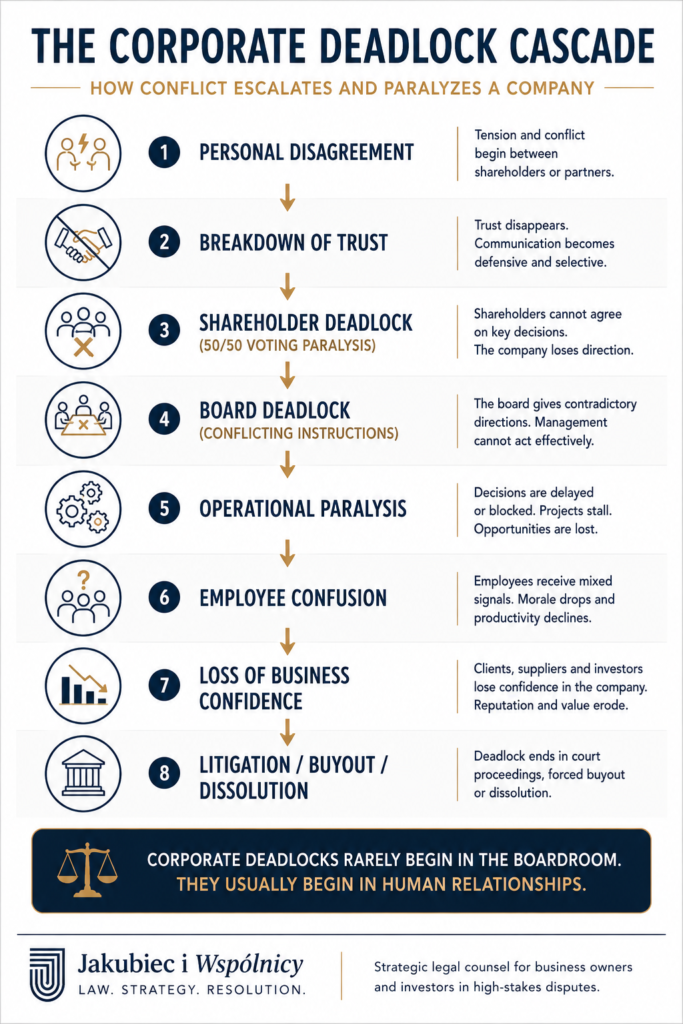
The Corporate Deadlock Cascade — a visual framework showing how internal conflict escalates from personal disagreement to corporate paralysis. Recognizing early stages allows strategic intervention before litigation becomes inevitable.
Key Takeaways
- A corporate deadlock arises when shareholders cannot adopt key decisions because their voting power is equal.
- Deadlocks most often occur in companies with a 50/50 ownership structure or poorly drafted shareholder agreements.
- When a deadlock appears, the company may be unable to appoint management, approve budgets, or distribute profits.
- Under Polish law, several legal mechanisms may help resolve a shareholder deadlock, including even shareholder exclusion or company dissolution.
- However, an important question arises: what is the best solution? Should litigation be the first option? Or can strategic negotiation or mediation resolve the conflict faster while protecting the value of the business?
- For foreign investors, early legal strategy is essential. Otherwise, a corporate deadlock may lead to years of costly litigation in Poland. Therefore, it is crucial to understand the psychological dynamics of negotiations and the basic principles of behavioral analysis.
What Is a Corporate Deadlock?
A corporate deadlock occurs when shareholders cannot adopt key decisions because their voting power is equal. As a result, neither side can control the company or move it forward.
Deadlocks most often appear in companies with a 50/50 ownership structure. At first, such a structure may seem balanced and fair. However, once a serious disagreement arises, decision-making can stop completely.
In practice, a corporate deadlock may block essential actions in the company. For example, shareholders may be unable to appoint management, approve budgets, distribute profits, or adopt strategic decisions.
This situation creates serious risks for investors. Even a profitable company may stop operating effectively if its owners cannot reach agreement.
For this reason, corporate deadlocks often escalate into shareholder disputes. If the conflict continues, the parties may eventually seek legal solutions under Polish corporate law.
Typical Deadlock Situations in Polish Companies
Corporate deadlocks rarely appear suddenly. In most cases, they arise when a serious disagreement develops between partners who hold equal power in the company.
Many investors associate deadlocks only with a 50/50 ownership structure. However, the problem may also arise at the level of the management board.
In many Polish companies, the same individuals act both as shareholders and board members. As a result, a personal conflict between partners may spread across the entire governance structure of the company.
Deadlock at the Shareholder Level
Deadlocks often arise when two shareholders each hold 50% of the voting rights. In this situation, neither side can adopt key resolutions without the consent of the other.
As a result, the shareholders’ meeting may become unable to approve budgets, appoint management, distribute profits, or adopt strategic decisions.
Although this situation can paralyze the company’s long-term strategy, its immediate operational impact is often limited to the lack of resolutions.
Deadlock at the Management Board Level
Conflicts become more dangerous when the same partners also serve on the management board.
In such cases, the dispute may quickly spread from the shareholders’ level into the daily operations of the company.
Unlike the shareholders’ meeting, the management board makes operational decisions on an ongoing basis. Because of this, conflicting board members may block each other’s actions more directly.
For example, one board member may reverse a partner’s decision, issue contradictory instructions, or formally prohibit a particular action.
In some cases, internal rules may require the consent of the entire board before certain actions can be taken. A conflict between board members may therefore stop those actions completely.
Operational Consequences of a Board-Level Conflict
A conflict within the management board is also much more visible to employees and business partners.
Its effects often appear immediately in the company’s day-to-day functioning. Employees may receive contradictory instructions, while key decisions remain unresolved.
Such situations can seriously damage internal morale and weaken the company’s credibility in the eyes of contractors and clients.
In extreme cases, the conflict may also disrupt the company’s ability to act in court, administrative, or tax proceedings, where clear representation and consistent decisions are required.
Since the beginning of my professional career, I have specialized in resolving shareholder conflicts and preventing corporate deadlocks. I have guided numerous international investors through complex disputes, protecting their capital and ensuring business continuity. In this article, I share a real-life scenario illustrating how communication breakdowns between partners can escalate, along with the tangible consequences for the company: Escalation of Disputes Between Partners – A Real Scenario.
Advantages and Disadvantages of Litigation in Resolving Corporate Deadlocks
Litigation is a formal and legally binding method to resolve shareholder disputes in Poland. It provides certainty about the outcome and allows a court to impose a partner’s will when negotiation fails.
Advantages of Litigation:
- A clear, formal procedure with defined legal rules.
- Legally enforceable decisions that all parties must follow.
- The ability to resolve disputes when other methods, such as negotiation or mediation, have failed.
However, litigation also carries significant risks and challenges, especially in the context of corporate deadlocks:
Disadvantages of Litigation:
- Time-consuming: Court proceedings can last months or even years, delaying strategic decisions.
- Delayed impact: Rulings often arrive when the conflict has already shifted to new areas, reducing the decision’s practical effect.
- Conflict escalation: Litigation can transform the original dispute into a secondary conflict, far removed from the initial cause.
- High costs: Legal fees, court costs, and expert valuations accumulate rapidly.
- Growing involvement: More parties are drawn in, complicating communication and coordination.
- Reputational damage: Public court cases can harm the company’s image with clients, investors, and partners.
- Morale and culture: Employee confidence drops when internal conflicts become visible and prolonged.
- Long-term uncertainty: Investors, contractors, and banks perceive heightened risk, potentially affecting financing and partnerships.
- Revenge and retaliation: Even after a judgment, parties often seek to retaliate, transferring the dispute to new areas.
- Loss of flexibility: Shareholders become bound by formally stated positions, fearing loss of face and further escalation.
While litigation can enforce a decision, it rarely resolves the underlying issues. In corporate deadlocks, relying solely on courts may preserve legality but often sacrifices speed, efficiency, and long-term business stability.
Why Negotiation, Mediation, and Arbitration Often Outperform Litigation
| Feature | Mediation | Arbitration | Court Litigation |
| Duration | Very Fast (weeks to few months) | Moderate (6–12 months) | Slow (24–36+ months) |
| Cost | Low (negotiated fees) | Moderate/High | High (legal fees over years) |
| Confidentiality | Full (private & closed) | High (private) | None (public records) |
| Decision Maker | Parties (with a Mediator) | Expert Arbitrator | State Judge |
| Control over Outcome | Total (voluntary agreement) | Limited (binding award) | None (imposed judgment) |
| Relationship Impact | Preserves business ties | Neutral | Destructive (adversarial) |
| Enforceability | Binding (after court approval) | Binding (NY Convention) | Binding (state execution) |
In my professional career, my greatest successes have been achieved on the field of negotiation and mediation. These methods allow investors to resolve corporate deadlocks more efficiently, protect business value, and preserve relationships between partners.
The Advantages of Negotiation and Mediation
Negotiation and mediation offer a range of benefits that litigation cannot match:
- Speed: Mediation settlements can be reached in weeks or months, compared to years in Polish courts.
- Lower costs: Avoid expensive court fees, expert valuations, and prolonged legal proceedings.
- Confidentiality: Discussions remain private, protecting the company’s reputation and sensitive information.
- Focus on underlying causes: Unlike litigation, mediation aims to resolve the root issues of the conflict, not just declare a winner.
- Reduced risk of retaliation: Parties are less likely to seek revenge or escalate the conflict after a mediated settlement.
- Positive impact on company culture: Preserves employee morale and confidence, avoiding visible tension and operational disruption.
- Better for the company’s image: Partners, clients, contractors, and investors see proactive conflict management rather than public disputes.
In shareholder deadlocks, these methods often prevent escalation and protect both the business and its people. They allow partners to regain control without being “consumed” by formalized positions or fear of losing face.
Arbitration: A Strategic Middle Ground
Arbitration offers a hybrid approach between mediation and litigation:
- It provides a binding, enforceable resolution like litigation.
- It is faster and more flexible than traditional court proceedings.
- Arbitration proceedings remain private and confidential, limiting reputational risks.
- While slightly more formal and costly than mediation, it still avoids the inefficiencies and absurd delays of the Polish court system.
In practice, arbitration often serves as the most pragmatic solution when parties cannot reach an amicable agreement through negotiation but wish to avoid the long, unpredictable timelines of court litigation. You can read more about one the best polish arbitration here. And here you have a link to a website of one of the best mediation center in Poland.
The Reality of Polish Courts
Poland’s legal system is often unable to handle complex shareholder disputes efficiently:
- Court cases can take years, sometimes 12–36 months or longer for first-instance rulings.
- Decisions may arrive when the conflict has already shifted or escalated to other areas of the business.
- Litigation rarely addresses the root cause of the dispute, creating secondary conflicts and frustration.
In this context, negotiation, mediation, and arbitration are not just alternatives—they are strategic tools that protect business value, relationships, and long-term stability.
Our Expertise in Corporate Conflict Resolution
For over a decade, we have helped companies resolve complex corporate disputes, including family businesses and conflicts between family-owned firms and foreign investors.
- Academic foundation: I earned my PhD in Commercial Law in 2014 with a dissertation on Options as Capital Market Instruments: A Civil Law Analysis. I worked for 12 years at the Department of Commercial and Business Law at the University of Łódź.
- Teaching experience: I lecture corporate law to aspiring advocates and have taught postgraduate courses on Company Law at the University of Łódź.
- Specialized training in negotiation and dispute resolution: I completed postgraduate studies in Negotiation, Mediation, and ADR at the University of Warsaw and postgraduate studies in Forensic Psychiatry and Psychology at the University of Łódź. I am currently deepening my expertise in Behavioral Analysis at the School of Emotional Intelligence in Wrocław.
- Practical experience: Negotiation is my passion, realized daily in complex shareholder disputes, cross-border M&A transactions, and corporate mediation. I have successfully guided family businesses and their investors through high-stakes conflicts, protecting both business value and relationships.
Our multidisciplinary approach combines law, psychology, and strategic negotiation to deliver efficient, lasting solutions for corporate deadlocks and shareholder disputes. I wrote about shareholders disputes resolving here.
Frequently Asked Questions (Q&A)
Q: What is a corporate deadlock in Poland?
A: A deadlock occurs when shareholders or board members cannot reach decisions, paralyzing company operations.
Q: Can a 50/50 shareholder deadlock be resolved?
A: Yes. Common solutions include:
- Buy-sell agreements
- Shotgun clauses
- Structured share buyouts
These allow one partner to buy the other’s shares at fair market value.
Q: How long does litigation usually take?
A: Court proceedings in Poland may last 12–36 months. Deadlocks often escalate, making early intervention essential.
Q: Is mediation faster than litigation?
A: Almost always. Mediation:
- Resolves disputes in weeks or months
- Reduces costs significantly
- Preserves confidentiality
- Minimizes risk of revenge or escalation
Q: What about arbitration?
A: Arbitration is a middle ground between mediation and court litigation. It is faster, less costly, and more flexible than court trials.
Q: Can a minority shareholder block key decisions?
A: Yes. Certain resolutions require qualified majorities (2/3 or 3/4), allowing minority shareholders to veto.
Q: Are mediation or arbitration settlements legally binding in Poland?
A: Yes. Approved settlements have the same legal force as court judgments and can be enforced by a bailiff.
Q: How should foreign investors act when deadlock emerges?
A: Early consultation is critical. Consider:
- Strategic negotiation
- Mediation
- Arbitration
- Only then, litigation if necessary
Q: Can conflict affect company operations?
A: Absolutely. Deadlocks often:
- Impact board and management decisions
- Reduce morale
- Harm client and investor confidence
- Delay legal or tax proceedings
Q: Do you provide services in languages other than English?
A: Yes. We deliver legal advice and documentation in:
- English
- French
- Russian
Facing a deadlock in your Polish subsidiary? Contact us for a strategic consultation to protect your investment:
📩 kancelaria@jakubieciwspolnicy.pl
📞 536 270 935