

 by dr Andrzej Jakubiec - adwokat, mediator
International Divorce in Poland: A Guide for Expats and Mixed Couples
Navigating a divorce in a foreign country adds layers of legal and emotional complexity. This guide outlines the essential aspects of international divorce in Poland, including jurisdiction, child custody, and asset division. At Jakubiec & Wspólnicy, we combine high-stakes litigation experience with psychological expertise and mediation skills to protect your interests in Łódź and across Poland. We offer legal services in English, French, Russian, and Polish.
Divorce in Poland. Why Jurisdiction and Applicable Law Matter
International cases in Poland carry specific risks that local lawyers often overlook: improper choice of law for assets, jurisdiction traps under Brussels IIb, and the psychological impact of cross-border relocation. We identify these hurdles during your first consultation.
When a marriage involves different nationalities (e.g., a Pole and a foreign citizen), the first question is not “how” to divorce, but “where.” Polish courts often hold jurisdiction when the spouses’ last common habitual residence was located in Poland. The law applicable to assets and alimony depends on your specific matrimonial property regime and international regulations; we assess these factors in detail during your initial consultation.
Divorce in Poland. What Can Go Wrong?
1. Hiring a Lawyer Lacking Dispute Specificity
Choosing a general practice lawyer instead of a specialist in high-conflict international cases can lead to a generic strategy that ignores the unique behavioral drivers of your spouse. Our interdisciplinary background in psychology and behavioral analysis ensures we read between the lines to protect your interests effectively.
2. National Bias and Jurisdictional Disadvantage
Foreigners often fear that Polish courts may subconsciously favor Polish citizens, especially in custody and alimony disputes. We proactively counter this by utilizing international regulations (like Brussels IIb) and presenting evidence in a way that aligns with high European judicial standards.
3. Linguistic Traps in Cross-Party Communication
Subtle nuances in translated evidence or direct communication can be misinterpreted by the court, potentially damaging your credibility. We provide full legal support in English, French, and Russian to ensure every legal and psychological detail is accurately conveyed and understood.
4. Engaging in Surrogate Disputes Instead of Solutions
It is a common mistake to get trapped in emotional “side battles” over minor issues while losing sight of the primary legal and financial goals. Our mediation-first approach identifies these traps early, saving you years of costly litigation and unnecessary emotional exhaustion.
5. Parental Alienation and Lack of Local Reality
Without a deep understanding of the Polish social and legal landscape, foreigners often struggle to identify and counteract early signs of parental alienation. We use our expertise in forensic psychology to secure visitation rights immediately and prevent the permanent breakdown of your relationship with your child.
6. Excessive Alimony Claims and Financial Abuse
A lack of familiarity with local living costs and judicial customs can leave you vulnerable to inflated alimony demands or “financial violence.” We leverage our experience to provide realistic financial benchmarks and defend your assets against groundless or disproportionate claims.
| The Risk (What can go wrong?) | Our Strategic Solution (How we protect you) |
| 1. Lawyer lacking dispute specificity | Interdisciplinary approach: We combine legal hight level with forensic psychology and behavioral analysis to protect you. |
| 2. National bias & jurisdiction traps | International expertise: We ensure that no institution or individual discriminates against you based on your origin or nationality. |
| 3. Linguistic & communication barriers | Multilingual advocacy: Full legal service in English, French, and Russian ensures no detail is lost in translation before the court. |
| 4. Costly surrogate disputes | Mediation-first strategy: We help you stay focused on achieving your pre-defined goals without involving you in costly and unnecessary surrogate disputes. |
| 5. Parental alienation | Immediate protection: We apply local legal mechanisms and psychological insights to secure your parental rights and prevent your relation with your children breakdown. |
| 6. Financial abuse & alimony inflation | Economic reality check: We leverage deep knowledge of local customs and living costs to defend your assets against disproportionate claims. |
The 3 Critical Mistakes Foreigners Make in Polish Courts
| The Mistake | Why it happens | The Strategic Risk (The Cost) |
| 1. Passive Acceptance of “No-Fault” Divorce | Spouses often choose this for a “quick” end to the marriage and to avoid conflict. | Financial Trap: You may unwittingly waive your right to future spousal support (alimony) if your standard of living drops post-divorce. |
| 2. You believe that being right is enough” | You assume that a lawyer is unnecessary and leave the production of evidence entirely to the court. | Loss of Control: Ultimately, you lose the case—not because you lacked the truth, but because you failed to prove your claims, challenge the opponent’s assertions, or seize the strategic opportunities provided by the law.. |
| 3. I’ll wait and see. If it goes wrong, I’ll just appeal | You mistakenly believe the court will do the work for you, always ready to accept new evidence or claims at any time. | Loss of the chance to shape the court’s perception from day one and establish your narrative. By the time you speak up, your version of events may no longer be heard. You lose the case. |
| 4. Informal “Verbal” Custody Plans | Trusting a spouse’s word regarding visitation or relocation out of a desire for peace. | Parental Alienation: Without a court-approved parenting plan, you lack legal enforcement. This often leads to a gradual, permanent breakdown of the bond with your child. |
Comprehensive Legal Support for International Families
Our firm specializes in the “Bundle of Five” critical areas of family law:
- The Divorce Decree: Determining the breakdown of the marriage, including the option of seeking a “ruling of guilt” (orzekanie o winie), which can significantly impact future alimony.
- Child Custody and Residence: Establishing where the children will live and how parental authority will be exercised.
- Visitation Rights (Contacts): Crafting precise schedules that respect the international nature of the family.
- Child and Spousal Alimony: Calculating fair support based on Polish standards and international living costs. Read more on Alimony in Poland (by Atty. Rybarska).
- Division of Assets: Managing cross-border property and financial portfolios. Explore our insights on Property Division.
We also assist with the recognition of foreign divorce decrees by Polish courts, ensuring your legal status is fully updated and valid in Poland.
Divorce in Poland. How to Get Started? (Step-by-Step Guide)
Starting a legal process in a foreign country can feel overwhelming. We have simplified the onboarding process to ensure you feel supported from day one:
- Initial Online Consultation: Schedule a secure video call to discuss the specifics of your case. We analyze jurisdiction and determine if the Polish court is the right venue for you.
- Case Strategy & Analysis: We evaluate potential risks, especially regarding child custody and asset division, integrating our psychological and behavioral expertise.
- The Safety Protocol: Before we exchange any sensitive data, we perform a conflict of interest check and sign a formal NDA with a penalty clause for your peace of mind.
- Formal Representation: Once the agreement is signed, we take over all communications with your spouse’s legal counsel and the court, allowing you to focus on your emotional well-being.
Don’t hesitate to contact us. We will take care about you. Just call us or write:
📩 kancelaria@jakubieciwspolnicy.pl
📞 536 270 935
How Much Does a Divorce in Poland Cost?
Transparency in billing is a core value of our firm. While every case is unique, the costs generally fall into two categories:
1. Court Fees (Statutory)
- Standard Court Fee: The fixed fee for filing a divorce petition is 600 PLN.
- Mediation Fees: If a settlement is reached during court-ordered mediation, part of the filing fee may be refunded. If you start mediations before sending a law suit, the fee is subject to a private contract with the professional mediator.
2. Legal Fees (Professional)
Our fees are determined by the complexity of the case, the number of issues (e.g., fault, children, assets), and the expected duration of the trial.
- Fixed-Fee Model: We prioritize a clear, written agreement so you know the total cost upfront.
- Premium Security: Our fees reflect not only legal representation but also the security of a €2.5 million insurance policy and our interdisciplinary behavioral analysis.
- Our fees reflect the depth of our experience, our interdisciplinary approach, and the additional security we provide. We compete on value, not on price.
Note: During our first consultation, we provide a detailed cost estimate based on your specific situation. We ensure that you understand every line item before any work begins.
The “Jakubiec & Wspólnicy” Advantage: Beyond the Law
International divorces are rarely just about the law; they are about human behavior and complex emotions. Our strategy is not limited to the courtroom. By applying behavioral analysis and forensic psychology, we anticipate the other party’s moves, allowing us to stay two steps ahead in negotiations or litigation.
In high-conflict divorces, the truth is often hidden between the lines of testimony. Our firm uses Behavioral Analysis and Forensic Psychology to expose inconsistencies in the other party’s claims, providing the court with a clear, evidence-based narrative that law-only firms simply cannot produce.
Psychological and Behavioral Expertise
As a founding partner of our firm, I bring unique interdisciplinary backgrounds to your case:
- Forensic Psychiatry & Psychology: We understand the behavioral nuances of high-conflict disputes.
- Behavioral Analysis: Our training allows us to read between the lines of testimony and evidence.
- Negotiation & Mediation: We are certified mediators who prioritize amicable settlements whenever possible to protect children and reduce costs.
Total Security and Transparency
We believe trust is the foundation of the attorney-client relationship. This is why we implement industry-leading safety protocols:
- Conflict of Interest Guarantee: We conduct a rigorous check and provide a written statement with a contractual penalty payable to the client if a conflict is found.
- Strict Confidentiality: We sign a Non-Disclosure Agreement (NDA) with a contractual penalty to ensure your private life stays private.
- Comprehensive Insurance: Our practice is backed by professional liability insurance up to €2.5 million.
- Clear Contracts: Every client receives a detailed written agreement outlining all costs and terms—no hidden fees.
- We operate effectively and in accordance with the highest ethical standards defined by the Bar Association’s Code of Ethics.
Adrianna Rybarska: Choosing the right representative is crucial. See our guide on How to Find a Good Lawyer in Poland.
Divorce in Poland. Mediation vs. Litigation: Our Strategy
We advocate for the “Soft Heart, Iron Fist” approach. If a fair settlement is achievable through mediation, we use our negotiation expertise to secure it. This is particularly vital in preventing Parental Alienation, a topic deeply explored by Attorney Rybarska.
However, if the other party remains unreasonable, we are known for our tenacity in the courtroom. We fight hard to protect your rights, especially in complex cases involving international child relocation or hidden assets. We also stay ahead of modern challenges, such as the Role of AI in Escalating Family Conflicts.
Divorce in Poland. Frequently Asked Questions (FAQ)
1. Can I get a divorce in Poland if I don’t speak Polish?
Yes—we provide full legal representation in English, French, and Russian. We handle all court filings and represent you during hearings to ensure your interests are protected at every stage.
2. Is an online consultation possible?
Absolutely. We regularly conduct consultations via secure video platforms for clients worldwide who have legal interests in Poland.
3. What if my spouse has moved the children to another country?
We have extensive experience in international cases involving children, including proceedings under the Hague Convention. Time is of the essence in these matters.
4. How are assets divided if they are located outside of Poland?
The court must determine which country’s law applies to your matrimonial property regime. We analyze international treaties to ensure your global assets are handled correctly.
5. How can I protect my business assets during a Polish divorce?
In mixed-nationality marriages, asset protection requires a deep dive into international treaties. We provide specialized legal structuring to safeguard your professional and personal wealth
Contact Our International Family Law Team in Łódź
Are you facing a difficult divorce in Poland? Don’t navigate the complex Polish legal system alone. Secure your future with a team that combines legal mastery with psychological insight.
Contact Jakubiec & Wspólnicy for a Confidential Consultation
- Languages: Polish, English, French, Russian.
- Location: Łódź, Poland (Serving clients nationwide and internationally), we operate nationwide across Poland, with a strong presence in Warsaw and Białystok.
- Safety: €2.5M Insurance | Written NDA | Conflict of Interest Guarantee.
Timing Matters: If Your Spouse is Already Preparing
Divorce is often a game of chess where the first move defines the board. If your spouse has already consulted a lawyer or started securing assets, you are already behind. Contact us for a Strategic Risk Assessment before the first hearing.
by dr Andrzej Jakubiec - adwokat, mediatorCORPORATE DEADLOCK IN POLAND. REALITY IN 2026
Corporate deadlock is one of the most dangerous situations in a privately held company. When two shareholders hold equal power, even simple decisions may become impossible. As a result, the business can stop functioning while the conflict escalates.
This problem often arises in companies with a 50/50 ownership structure. At first, the structure seems fair. However, when a serious disagreement appears, neither side can impose a solution.
For foreign investors operating in Poland, understanding how corporate deadlocks arise and how they can be resolved is essential. Otherwise, a profitable investment may turn into a long and costly dispute.
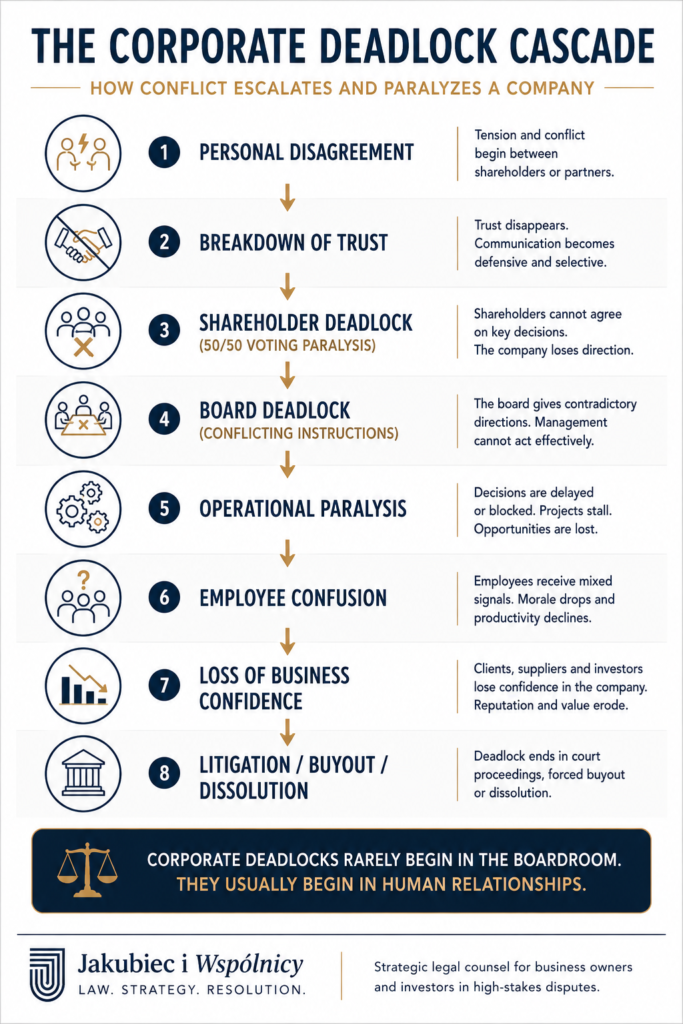
The Corporate Deadlock Cascade — a visual framework showing how internal conflict escalates from personal disagreement to corporate paralysis. Recognizing early stages allows strategic intervention before litigation becomes inevitable.
Key Takeaways
- A corporate deadlock arises when shareholders cannot adopt key decisions because their voting power is equal.
- Deadlocks most often occur in companies with a 50/50 ownership structure or poorly drafted shareholder agreements.
- When a deadlock appears, the company may be unable to appoint management, approve budgets, or distribute profits.
- Under Polish law, several legal mechanisms may help resolve a shareholder deadlock, including even shareholder exclusion or company dissolution.
- However, an important question arises: what is the best solution? Should litigation be the first option? Or can strategic negotiation or mediation resolve the conflict faster while protecting the value of the business?
- For foreign investors, early legal strategy is essential. Otherwise, a corporate deadlock may lead to years of costly litigation in Poland. Therefore, it is crucial to understand the psychological dynamics of negotiations and the basic principles of behavioral analysis.
What Is a Corporate Deadlock?
A corporate deadlock occurs when shareholders cannot adopt key decisions because their voting power is equal. As a result, neither side can control the company or move it forward.
Deadlocks most often appear in companies with a 50/50 ownership structure. At first, such a structure may seem balanced and fair. However, once a serious disagreement arises, decision-making can stop completely.
In practice, a corporate deadlock may block essential actions in the company. For example, shareholders may be unable to appoint management, approve budgets, distribute profits, or adopt strategic decisions.
This situation creates serious risks for investors. Even a profitable company may stop operating effectively if its owners cannot reach agreement.
For this reason, corporate deadlocks often escalate into shareholder disputes. If the conflict continues, the parties may eventually seek legal solutions under Polish corporate law.
Typical Deadlock Situations in Polish Companies
Corporate deadlocks rarely appear suddenly. In most cases, they arise when a serious disagreement develops between partners who hold equal power in the company.
Many investors associate deadlocks only with a 50/50 ownership structure. However, the problem may also arise at the level of the management board.
In many Polish companies, the same individuals act both as shareholders and board members. As a result, a personal conflict between partners may spread across the entire governance structure of the company.
Deadlock at the Shareholder Level
Deadlocks often arise when two shareholders each hold 50% of the voting rights. In this situation, neither side can adopt key resolutions without the consent of the other.
As a result, the shareholders’ meeting may become unable to approve budgets, appoint management, distribute profits, or adopt strategic decisions.
Although this situation can paralyze the company’s long-term strategy, its immediate operational impact is often limited to the lack of resolutions.
Deadlock at the Management Board Level
Conflicts become more dangerous when the same partners also serve on the management board.
In such cases, the dispute may quickly spread from the shareholders’ level into the daily operations of the company.
Unlike the shareholders’ meeting, the management board makes operational decisions on an ongoing basis. Because of this, conflicting board members may block each other’s actions more directly.
For example, one board member may reverse a partner’s decision, issue contradictory instructions, or formally prohibit a particular action.
In some cases, internal rules may require the consent of the entire board before certain actions can be taken. A conflict between board members may therefore stop those actions completely.
Operational Consequences of a Board-Level Conflict
A conflict within the management board is also much more visible to employees and business partners.
Its effects often appear immediately in the company’s day-to-day functioning. Employees may receive contradictory instructions, while key decisions remain unresolved.
Such situations can seriously damage internal morale and weaken the company’s credibility in the eyes of contractors and clients.
In extreme cases, the conflict may also disrupt the company’s ability to act in court, administrative, or tax proceedings, where clear representation and consistent decisions are required.
Since the beginning of my professional career, I have specialized in resolving shareholder conflicts and preventing corporate deadlocks. I have guided numerous international investors through complex disputes, protecting their capital and ensuring business continuity. In this article, I share a real-life scenario illustrating how communication breakdowns between partners can escalate, along with the tangible consequences for the company: Escalation of Disputes Between Partners – A Real Scenario.
Advantages and Disadvantages of Litigation in Resolving Corporate Deadlocks
Litigation is a formal and legally binding method to resolve shareholder disputes in Poland. It provides certainty about the outcome and allows a court to impose a partner’s will when negotiation fails.
Advantages of Litigation:
- A clear, formal procedure with defined legal rules.
- Legally enforceable decisions that all parties must follow.
- The ability to resolve disputes when other methods, such as negotiation or mediation, have failed.
However, litigation also carries significant risks and challenges, especially in the context of corporate deadlocks:
Disadvantages of Litigation:
- Time-consuming: Court proceedings can last months or even years, delaying strategic decisions.
- Delayed impact: Rulings often arrive when the conflict has already shifted to new areas, reducing the decision’s practical effect.
- Conflict escalation: Litigation can transform the original dispute into a secondary conflict, far removed from the initial cause.
- High costs: Legal fees, court costs, and expert valuations accumulate rapidly.
- Growing involvement: More parties are drawn in, complicating communication and coordination.
- Reputational damage: Public court cases can harm the company’s image with clients, investors, and partners.
- Morale and culture: Employee confidence drops when internal conflicts become visible and prolonged.
- Long-term uncertainty: Investors, contractors, and banks perceive heightened risk, potentially affecting financing and partnerships.
- Revenge and retaliation: Even after a judgment, parties often seek to retaliate, transferring the dispute to new areas.
- Loss of flexibility: Shareholders become bound by formally stated positions, fearing loss of face and further escalation.
While litigation can enforce a decision, it rarely resolves the underlying issues. In corporate deadlocks, relying solely on courts may preserve legality but often sacrifices speed, efficiency, and long-term business stability.
Why Negotiation, Mediation, and Arbitration Often Outperform Litigation
| Feature | Mediation | Arbitration | Court Litigation |
| Duration | Very Fast (weeks to few months) | Moderate (6–12 months) | Slow (24–36+ months) |
| Cost | Low (negotiated fees) | Moderate/High | High (legal fees over years) |
| Confidentiality | Full (private & closed) | High (private) | None (public records) |
| Decision Maker | Parties (with a Mediator) | Expert Arbitrator | State Judge |
| Control over Outcome | Total (voluntary agreement) | Limited (binding award) | None (imposed judgment) |
| Relationship Impact | Preserves business ties | Neutral | Destructive (adversarial) |
| Enforceability | Binding (after court approval) | Binding (NY Convention) | Binding (state execution) |
In my professional career, my greatest successes have been achieved on the field of negotiation and mediation. These methods allow investors to resolve corporate deadlocks more efficiently, protect business value, and preserve relationships between partners.
The Advantages of Negotiation and Mediation
Negotiation and mediation offer a range of benefits that litigation cannot match:
- Speed: Mediation settlements can be reached in weeks or months, compared to years in Polish courts.
- Lower costs: Avoid expensive court fees, expert valuations, and prolonged legal proceedings.
- Confidentiality: Discussions remain private, protecting the company’s reputation and sensitive information.
- Focus on underlying causes: Unlike litigation, mediation aims to resolve the root issues of the conflict, not just declare a winner.
- Reduced risk of retaliation: Parties are less likely to seek revenge or escalate the conflict after a mediated settlement.
- Positive impact on company culture: Preserves employee morale and confidence, avoiding visible tension and operational disruption.
- Better for the company’s image: Partners, clients, contractors, and investors see proactive conflict management rather than public disputes.
In shareholder deadlocks, these methods often prevent escalation and protect both the business and its people. They allow partners to regain control without being “consumed” by formalized positions or fear of losing face.
Arbitration: A Strategic Middle Ground
Arbitration offers a hybrid approach between mediation and litigation:
- It provides a binding, enforceable resolution like litigation.
- It is faster and more flexible than traditional court proceedings.
- Arbitration proceedings remain private and confidential, limiting reputational risks.
- While slightly more formal and costly than mediation, it still avoids the inefficiencies and absurd delays of the Polish court system.
In practice, arbitration often serves as the most pragmatic solution when parties cannot reach an amicable agreement through negotiation but wish to avoid the long, unpredictable timelines of court litigation. You can read more about one the best polish arbitration here. And here you have a link to a website of one of the best mediation center in Poland.
The Reality of Polish Courts
Poland’s legal system is often unable to handle complex shareholder disputes efficiently:
- Court cases can take years, sometimes 12–36 months or longer for first-instance rulings.
- Decisions may arrive when the conflict has already shifted or escalated to other areas of the business.
- Litigation rarely addresses the root cause of the dispute, creating secondary conflicts and frustration.
In this context, negotiation, mediation, and arbitration are not just alternatives—they are strategic tools that protect business value, relationships, and long-term stability.
Our Expertise in Corporate Conflict Resolution
For over a decade, we have helped companies resolve complex corporate disputes, including family businesses and conflicts between family-owned firms and foreign investors.
- Academic foundation: I earned my PhD in Commercial Law in 2014 with a dissertation on Options as Capital Market Instruments: A Civil Law Analysis. I worked for 12 years at the Department of Commercial and Business Law at the University of Łódź.
- Teaching experience: I lecture corporate law to aspiring advocates and have taught postgraduate courses on Company Law at the University of Łódź.
- Specialized training in negotiation and dispute resolution: I completed postgraduate studies in Negotiation, Mediation, and ADR at the University of Warsaw and postgraduate studies in Forensic Psychiatry and Psychology at the University of Łódź. I am currently deepening my expertise in Behavioral Analysis at the School of Emotional Intelligence in Wrocław.
- Practical experience: Negotiation is my passion, realized daily in complex shareholder disputes, cross-border M&A transactions, and corporate mediation. I have successfully guided family businesses and their investors through high-stakes conflicts, protecting both business value and relationships.
Our multidisciplinary approach combines law, psychology, and strategic negotiation to deliver efficient, lasting solutions for corporate deadlocks and shareholder disputes. I wrote about shareholders disputes resolving here.
Frequently Asked Questions (Q&A)
Q: What is a corporate deadlock in Poland?
A: A deadlock occurs when shareholders or board members cannot reach decisions, paralyzing company operations.
Q: Can a 50/50 shareholder deadlock be resolved?
A: Yes. Common solutions include:
- Buy-sell agreements
- Shotgun clauses
- Structured share buyouts
These allow one partner to buy the other’s shares at fair market value.
Q: How long does litigation usually take?
A: Court proceedings in Poland may last 12–36 months. Deadlocks often escalate, making early intervention essential.
Q: Is mediation faster than litigation?
A: Almost always. Mediation:
- Resolves disputes in weeks or months
- Reduces costs significantly
- Preserves confidentiality
- Minimizes risk of revenge or escalation
Q: What about arbitration?
A: Arbitration is a middle ground between mediation and court litigation. It is faster, less costly, and more flexible than court trials.
Q: Can a minority shareholder block key decisions?
A: Yes. Certain resolutions require qualified majorities (2/3 or 3/4), allowing minority shareholders to veto.
Q: Are mediation or arbitration settlements legally binding in Poland?
A: Yes. Approved settlements have the same legal force as court judgments and can be enforced by a bailiff.
Q: How should foreign investors act when deadlock emerges?
A: Early consultation is critical. Consider:
- Strategic negotiation
- Mediation
- Arbitration
- Only then, litigation if necessary
Q: Can conflict affect company operations?
A: Absolutely. Deadlocks often:
- Impact board and management decisions
- Reduce morale
- Harm client and investor confidence
- Delay legal or tax proceedings
Q: Do you provide services in languages other than English?
A: Yes. We deliver legal advice and documentation in:
- English
- French
- Russian
Facing a deadlock in your Polish subsidiary? Contact us for a strategic consultation to protect your investment:
📩 kancelaria@jakubieciwspolnicy.pl
📞 536 270 935
by dr Andrzej Jakubiec - adwokat, mediatorSHAREHOLDERS DISPUTES IN POLAND
Conflict between business partners is one of the most serious risks to any investment. In Poland, shareholders disputes can quickly escalate into a corporate deadlock, blocking key decisions and paralysing operations for months or even years. For foreign investors, understanding the legal tools available under Polish corporate law is essential. Whether you are a majority investor from the United States or a minority shareholder from Switzerland, legal clarity protects your capital. At Jakubiec & Partners, we support international investors in resolving shareholder conflicts through negotiation, mediation and litigation.
Shareholders Disputes: Key Takeaways for International Investors
- Shareholder disputes in Poland often arise from poorly drafted Articles of Association.
- A 50/50 ownership structure may lead to a corporate deadlock.
- Polish law allows mechanisms such as shareholder exclusion or share buyouts.
- Mediation frequently resolves conflicts faster and at lower cost than litigation.
- Early legal advice significantly increases the chances of protecting the investment.
Common Causes of Shareholders Disputes in Poland
Many conflicts and shareholders disputes originate from weaknesses in the company’s Articles of Association (Umowa Spółki / Statut). Poorly drafted clauses often leave partners without a clear exit strategy. As a result, even minor disagreements may escalate into serious disputes.
Typical triggers of shareholder disputes
- Dividend disputes — disagreements over profit distribution versus reinvestment.
- Management obstruction — 50/50 ownership structures often lead to decision-making deadlocks.
- Information rights violations — minority shareholders may be denied access to financial or operational data.
- Competing activities — a shareholder may start a business that competes with the company.
Legal Tools for Resolving Shareholders Disputes in Poland
Polish corporate law offers several mechanisms to resolve shareholder disputes. Many investors, however, only learn about these tools once the conflict has already escalated.
The most common mechanisms include:
- shareholder exclusion lawsuits,
- negotiated share buyouts,
- mediation settlements,
- amendments to the Articles of Association,
- company dissolution in extreme cases.
Each mechanism requires a tailored legal strategy. Early legal analysis is therefore crucial.
Deadlock Resolution: Protecting the Company’s Future
A corporate deadlock is one of the most serious threats to a company’s stability. When shareholders cannot adopt resolutions, the company may lose strategic direction and operational continuity.
Can a shareholder be expelled from a Polish company?
Yes. Under the Polish Commercial Companies Code (KSH), shareholders may seek court exclusion of another partner in specific circumstances. Courts apply this remedy only when important reasons exist, and proceedings typically last 12–24 months.
For this reason, exclusion is considered a last resort.
How can a 50/50 deadlock be resolved?
Several contractual mechanisms may prevent or resolve deadlock situations, including:
- buy-sell agreements,
- shotgun clauses,
- structured share buyouts.
These tools allow one partner to buy the other’s shares at a fair market price, enabling the company to continue operating without disruption.
Why Mediation Often Outperforms Litigation
In shareholder conflicts, mediation frequently produces faster and more predictable outcomes than court proceedings.
Key advantages of mediation
- Cost efficiency — mediation avoids court fees, expert opinions and lengthy procedural costs.
- Confidentiality — unlike court proceedings, mediation remains private and protects the company’s reputation.
- Speed — while litigation may last years, mediation often results in a binding settlement within weeks or months.
Once approved by a court, a mediation settlement becomes legally enforceable.
When Should Investors Contact a Shareholders Disputes Lawyer?
Many investors seek legal advice too late. Early intervention often prevents long and expensive litigation.
You should consult a lawyer if:
- communication between shareholders breaks down,
- key decisions become blocked,
- financial transparency disappears,
- a partner begins competing with the company.
Strategic negotiation may resolve the dispute before it escalates. You should also seek legal advice if you are planning to end cooperation with a business partner and want to understand your options.
Expertise Beyond the Statutes: The Science of High‑Stakes Negotiation
In complex shareholder disputes, mastery of the law is only half the battle. Effective resolution also requires understanding human psychology and negotiation dynamics. This combination is what distinguishes my approach from that of many commercial lawyers.
I hold a PhD in Commercial Law and serve as a lecturer for the Advocates’ Bar Association. I have also lectured at the Faculty of Law at the University of Łódź. Yet legal expertise is only one dimension of my work.
Many disputes escalate due to psychological dynamics between partners. To address this, I expanded my professional education into behavioural fields.
I completed postgraduate studies in:
- Negotiations, Mediations and ADR at the University of Warsaw,
- Forensic Psychiatry and Psychology at the University of Łódź.
I am currently continuing my studies in Behavioural Analysis at the School of Emotional Intelligence in Wrocław.
This multidisciplinary background allows me to identify emotional and strategic drivers behind shareholder conflicts. As a result, disputes that appear chaotic often become structured, manageable negotiations.
Enhanced Security for International Investors
Having worked with foreign clients for many years, I understand that cross‑border investors require more than legal advice. They expect certainty, transparency and risk control.
To meet these expectations, Jakubiec & Partners introduced safeguards that exceed typical market standards.
Personal Accountability and €2.5M Professional Insurance
Our firm maintains €2.5 million in professional liability insurance.
As the lead partner, I also assume personal liability for the firm’s obligations, including the actions of every team member.
This provides clients with an additional layer of security.
The “Gold Standard” Conflict of Interest Audit
International clients often worry about hidden conflicts of interest.
We therefore conduct a rigorous verification procedure before accepting a case.
The process includes:
- signing a Non‑Disclosure Agreement (NDA),
- signing a Conflict Verification Agreement,
- performing a detailed internal audit of professional, business and social links with the opposing party.
After the audit, we issue a Declaration of No Conflict of Interest, secured by contractual penalties.
Proven Experience in Cross‑Border Transactions
International disputes require not only legal knowledge but also cultural understanding.
Our firm has represented investors from:
- the United States,
- the United Kingdom,
- France,
- Germany,
- Switzerland,
- Turkey,
- Ukraine.
One of our landmark projects involved managing the share acquisition in the Oscar‑winning Se‑ma‑for animation studio, representing investors from Switzerland and the UK. The project required complex coordination across multiple jurisdictions.
Shareholders Disputes: Frequently Asked Questions (FAQ)
Can a minority shareholder block key decisions in Poland?
Yes. Certain corporate decisions require a qualified majority (two‑thirds or three‑quarters). Minority shareholders may therefore block important resolutions. It happens commonly in shareholders disputes.
Are mediation settlements legally binding in Poland?
Yes. Once approved by a court, a mediation settlement has the same legal force as a judgment and may be enforced by a bailiff.
How long do shareholder disputes last in Poland?
Court proceedings typically last 12–36 months, sometimes longer.
Mediation or negotiated buyouts often resolve disputes much faster.
Does Jakubiec & Partners provide services in languages other than English?
Yes. We provide legal services and documentation in:
- English,
- French,
- Russian.
What are the typical legal fees in shareholder disputes?
Our standard fee is €250 net per hour. This covers consultations, document analysis and meetings.
For negotiations, mediations or litigation, we conclude a clear written agreement specifying the main fee and a success fee, depending on the complexity and value of the case.
Considering a Shareholder Dispute in Poland?
If you are facing a conflict with a business partner in Poland, early legal analysis may protect your investment. A short consultation often clarifies risks, negotiation options and the most effective strategy.
At Jakubiec & Partners, we provide strategic advice for international investors involved in shareholder disputes, focusing on practical solutions that protect both the company and the investor.
Resources and Legal Ethics
Polish legal professionals operate under strict ethical standards.
You may review the relevant regulations:
You may also read our guide on litigation costs in Poland and transparent fee structures:
You may also read my text linking Maerscheimer’s theory with shareholders disputes practice. If you’re curious, just click the link and read:
The Frontier of Modern Disputes: AI & Coupled Confirmation Bias
I actively monitor how Artificial Intelligence reshapes shareholder negotiations. I am the author of the concept of ‘Coupled Confirmation Bias‘—a phenomenon where AI-driven tools, if misused, can reinforce the existing biases of both parties, deepening corporate deadlocks. You can also explore my other article concerning tunnel vision and the role of LLM in shareholders disputes.
by dr Andrzej Jakubiec - adwokat, mediatorLEGAL FEES AND LITIGATION COSTS IN POLAND
The financial predictability of litigation costs in Poland is a decisive factor for foreign investors evaluating whether to pursue a commercial dispute. Understanding court fees, legal costs, and procedural risks is essential for making informed, ROI‑driven decisions.
See 3 Key Commercial Litigation costs in Poland:
- In the majority of commercial and civil cases, the court entry fee is 5% of the claim value, capped at PLN 200,000 (approx. EUR 45,000). Are there additional costs during the trial? Yes. Apart from the entry fee, you should budget mainly for:
- Expert Witness Fees: If the case requires technical knowledge, the court will appoint an expert. You will be required to pay an advance (zaliczka) for their remuneration.
- Sworn Translators: Since the official language of the court is Polish, all foreign documents and testimonies must be translated by certified professionals.
The “Loser Pays” Principle: Risks of Litigation Cost in Poland
What happens if I lose the case?
Litigation costs in Poland follow the “loser pays” principle. If you lose, you are generally required to reimburse the winning party for their court fees and a portion of their legal representation costs, as defined by statutory rates.
Example: Estimated Cost of a €700,000 Commercial Dispute in Poland
To illustrate the typical cost structure of litigation in Poland, consider a commercial dispute with a claim value of €700,000.
Court fee.
In most commercial cases, the court entry fee amounts to 5% of the claim value, which in this example would be approximately €35,000 (subject to the statutory cap).
Expert witness fees.
If the case requires technical or financial expertise, the court will appoint an expert. Depending on the complexity of the dispute and the number of expert opinions required, the advance for expert fees may range from approximately €2,000 to €10,000.
Legal representation.
The statutory minimum fee for legal representation in a case of this value is approximately PLN 15,000. In practice, the actual cost of legal services is usually higher and depends on the nature and complexity of the dispute, as statutory tariffs rarely reflect the real cost of complex commercial litigation.
Additional costs in our Firm typically include:
- court hearing attendance, for example approximately PLN 1,500 per hearing,
- hourly legal work, which in our firm’s case is €250 per hour for cross-border legal services delivered in English.
Other procedural costs.
Minor procedural expenses, such as travel reimbursement for witnesses, are usually relatively small (often around €50 per witness).
Risk of losing the case.
If the claim is unsuccessful, the losing party is generally required to reimburse the opposing party for their court costs and a portion of their legal representation expenses, according to statutory tariffs.
Alternative dispute resolution.
An alternative to court litigation is ADR, such as mediation. Mediation is usually significantly less expensive than a full court trial. In a dispute of this scale, a mediator’s fee may be approximately PLN 10,000 (around €2,400), although legal assistance costs should also be taken into account.
In our firm, legal services in mediation would typically be billed at the hourly rate of €250, potentially combined with a success fee ranging between 5% and 15% of the recovered amount, reduced by the fees already paid for hourly legal work.
In disputes other than monetary claims, success fees are determined using different criteria, depending on the economic value and strategic importance of the outcome.
Legal Fees: Why Predictability is Our Priority
For many international companies, litigation is not merely a legal procedure but a strategic instrument for enforcing contracts and protecting their investments.
At Jakubiec & Partners, we understand that foreign business clients need a fixed framework to operate. We compete on the quality of our work and our deep experience in commercial disputes and partnership mediations. Our pricing reflects a balance between senior-level expertise and operational efficiency, allowing us to provide high-quality representation without the cost structure typical of large international firms.
Transparent Remuneration Models
Our fee structure is always individually tailored to the specific case. However, the one thing that never changes is transparency. All rules regarding our remuneration are detailed in the initial contract. We guarantee that you will not be surprised by hidden costs mid-litigation.
Unrivaled Security and Professional Liability
We provide a level of security that goes beyond standard market practice:
- Insurance: Our firm is backed by a professional liability insurance (OC) of €2.5 million.
- Personal Accountability: As the lead partner, I am personally and fully liable with my entire private assets for the Firm’s obligations.
- Conflict of Interest & NDA: Before we start, we sign a strict NDA and a Conflict of Interest Verification Agreement. Both are secured by contractual penalties (liquidated damages) payable to the Client. We provide a written statement of the conflict check result, also secured by a penalty.
How much does a good lawyer in Poland charge per hour?
In addition to court fees and procedural costs, companies involved in cross-border disputes must also consider the cost of legal representation.
For cross‑border legal services delivered in English, our standard hourly rate is EUR 250 (net). Services provided in French or Russian are billed at EUR 300 (net). These rates apply to consultations and document drafting.
In the case of mediations, negotiations, and court litigation, fees are determined individually. They depend on the specific nature of the case, its complexity, and the total value of the dispute. If you would like to receive a quote for a specific matter, please feel free to contact us directly.
Experience Across Borders: Who Have We Helped?
We have successfully represented and advised clients from:
- North America: USA
- Europe: France, Germany, Switzerland, UK, Ukraine
- Asia/Middle East: Turkey
Our landmark projects include the legal management of the share acquisition in the Se-ma-for studio (Oscar winner). I worked for investors from Switzerland and the UK in this case. Then I applied this experience in many other M&A transactions. This experience allows us to understand both the legal and cultural aspects of international business disputes.
Frequently Asked Questions (main FAQ):
- Can I recover my legal fees in Poland? Yes, the court can award the reimbursement of legal representation costs from the losing party. They are often based on official state tariffs which may differ from your actual contract.
- Is mediation cheaper than a court trial? Almost always. Mediation avoids high Litigation costs in Poland. We actively encourage negotiations between partners to settle disputes efficiently.
- Can I trust a Polish lawyer in a case against a Polish company? Yes. We place immense importance on transparency and the elimination of any potential conflict of interest. This is why we have implemented a rigorous onboarding procedure. It goes far beyond the standard requirements of the Polish Bar Act and the Code of Ethics for Attorneys-at-law. We conduct a detailed investigation into any professional, business, or social connections between our team members and the opposing party. They include their management board, supervisory board, or disclosed shareholders. This verification is performed under a separate agreement for a fixed fee of EUR 250 net. Following this audit, we provide the Client with a written declaration regarding the conflict check results. This statement is legally binding and subject to a contractual penalty (liquidated damages) payable by us to the Client.
Other questions
- How long does a commercial court case usually take in Poland? On average, commercial disputes in Poland take between 12 to 24 months for a first-instance ruling. However, through our specialized negotiation and mediation services, we are often able to reach a settlement much faster. It allows us save our clients both time and court fees.
- Do I need to travel to Poland for the court hearings? Not necessarily. In many cases, especially after the recent digitalization of the Polish judiciary, hearings can be conducted remotely via video conferencing. Furthermore, as your legal representatives, we can handle most procedural matters on your behalf through a power of attorney.
- Is it possible to recover the 5% court entry fee if we settle? Yes. If a settlement is reached before the trial begins or during mediation, the Polish court system allows for a partial or even full refund of the court fee. It depends on the stage of the proceedings. If you win the case, the court fee may also be reimbursed by the losing party.
How to find a trusted law firm in Poland? You can also read the following guide:
Before recommending litigation, we carefully analyse the contractual documentation, the available evidence and the economic context of the dispute to assess the realistic chances of success.
If you are considering litigation or negotiations with a business partner in Poland, we can provide a preliminary legal and strategic assessment of your case. Based on the available documents, we will explain the realistic litigation risks, estimated costs, and possible negotiation strategies before any formal engagement.
In many situations, a short initial consultation is sufficient to determine whether litigation in Poland is economically justified or whether negotiation or mediation would be a more effective solution.
If you would like to discuss a specific dispute or potential claim, you can contact us directly to arrange a consultation in English.
by dr Andrzej Jakubiec - adwokat, mediatorJAKUBIEC & PARTNERS. A TRUSTED LAW FIRM IN POLAND
Are you looking for a trusted law firm in Poland? Foreign clients operating in Poland expect not only legal expertise, but also clear rules of cooperation and real guarantees of professional responsibility. We understand these expectations. Choosing a law firm in another country naturally raises questions about confidentiality, conflicts of interest, independence and financial security. To address these concerns, we have implemented solutions that make these issues transparent, measurable and predictable. In our firm you can find accountability, transparency and international standards.
NDA with a Contractual Penalty – it is our standard
Why are we a trusted law firm in Poland? At the client’s request, we sign a Non‑Disclosure Agreement that includes a contractual penalty (liquidated damages clause). This mechanism simplifies potential claims: in the event of a breach, the client does not need to prove the amount of damage — only that the breach occurred.
You can read more about our NDA’s philosophy: https://jakubieciwspolnicy.pl/en/nda-in-poland-contractual-penalty/
Written Conflict‑of‑Interest Statement
We provide a written declaration confirming that we have no business or personal ties to the opposing party. Transparency in this area is a core element of international professional standards.
Trusted Law Firm in Poland – Contractual Financial Liability
Our agreements may include a contractual penalty payable to the client in the event of a breach of confidentiality or a false conflict‑of‑interest statement. This ensures clear risk allocation and strengthens the security of cooperation.
Full Responsibility and Financial Stability. The Trusted Law Firm in Poland provides it.
The founder of the firm, attorney‑at‑law Dr. Andrzej Jakubiec, bears full and unlimited personal liability for obligations towards clients, as required by Polish law.
This responsibility is additionally secured by:
- professional liability insurance up to EUR 2.5 million, including contractual liability,
- the option to purchase an additional dedicated insurance policy for high‑value projects,
- full compliance with the Code of Ethics of the Polish Bar.
This combination of personal accountability and robust insurance protection provides clients with real financial security.
Experience with International Clients
We provide legal services to foreign companies operating in Poland. Our experience includes:
Switzerland – capital investments, support for technology startups, complex inheritance matters,
USA – IT contracts between American technology companies and Polish engineering teams,
France and Germany – shareholder disputes, transport law, intellectual property, ongoing corporate advisory,
United Kingdom and Sweden – capital investments, including in the technology sector, and multi‑layered business disputes,
Ukraine – legal support for agricultural and manufacturing companies.
A significant part of our practice involves shareholder disputes, conflicts in family‑owned businesses and projects requiring access to sensitive financial data, including due diligence processes.
Legal Expertise and Interdisciplinary Knowledge
Our dispute resolution and negotiation practice is grounded in strong academic preparation and an interdisciplinary approach.
The founder’s qualifications include:
a PhD in business law,
postgraduate studies in negotiation and mediation (University of Warsaw),
postgraduate studies in forensic psychiatry and psychology (University of Łódź),
ongoing education in behavioural analysis.
This combination of legal expertise and understanding of conflict dynamics allows us to conduct cases with attention to both formal legal aspects and the psychological mechanisms underlying disputes.
Contact Us
If you are looking for a trusted law firm in Poland that operates with ethics, clear rules of responsibility and transparent cooperation standards, we invite you to get in touch.
We will be pleased to discuss your project and the available confidentiality and contractual‑liability safeguards.
You can contact us by phone, email or through the form on our website:
📩 kancelaria@jakubieciwspolnicy.pl
📞 536 270 935
FAQ – Frequently Asked Questions
1. Can you provide a draft NDA?
Yes. We provide an NDA draft upon request. Clear rules for information protection are a foundation of our cooperation.
2. Does your insurance cover contractual liability, including penalties under an NDA?
Yes. Our professional liability insurance up to EUR 2.5 million covers contractual liability, including agreed liquidated damages.
3. Does the founder of the firm bear personal liability for obligations towards clients?
Yes. Under Polish law, an attorney running a law firm bears full and unlimited personal liability.
4. Is an NDA with a contractual penalty standard practice in Poland?
No, it is not common. In our practice, however, we treat it as an element of transparent risk allocation for international clients.
5. Can financial security be increased for large projects?
Yes. For high‑value projects, we can arrange an additional dedicated insurance policy.
How to find a trusted law firm in Poland? You can read also this text: