

Holidays Abroad with a Foreign Father: Defeating Parental Alienation
For a foreign father living thousands of miles away, securing international vacation time is far more than just a holiday — it is the frontline defense against parental alienation. In Poland, alienating parents often weaponize fabricated “safety concerns,” refuse to release passports, or manipulate school schedules to block travel, exploiting the slow pace of the courts to gradually erase your presence from your child’s life. Overcoming this requires more than emotional appeals; it demands a precise, strategic legal offensive that cuts through procedural delays, neutralizes bias, and forces the court to act.
Parental alienation is currently the subject of a fierce public debate in Poland. Extreme viewpoints polarize the discourse: ranging from the outright denial of the phenomenon’s existence—dismissing it as a fabrication used by abusive men—to accusations of its instrumental weaponization by fathers seeking to reduce child support payments. One thing is certain—the topic of alienation sparks raw, intense emotions across the country. An entire social movement dedicated to combating this phenomenon is rapidly emerging. Indeed, many researchers directly define it as a form of violence.
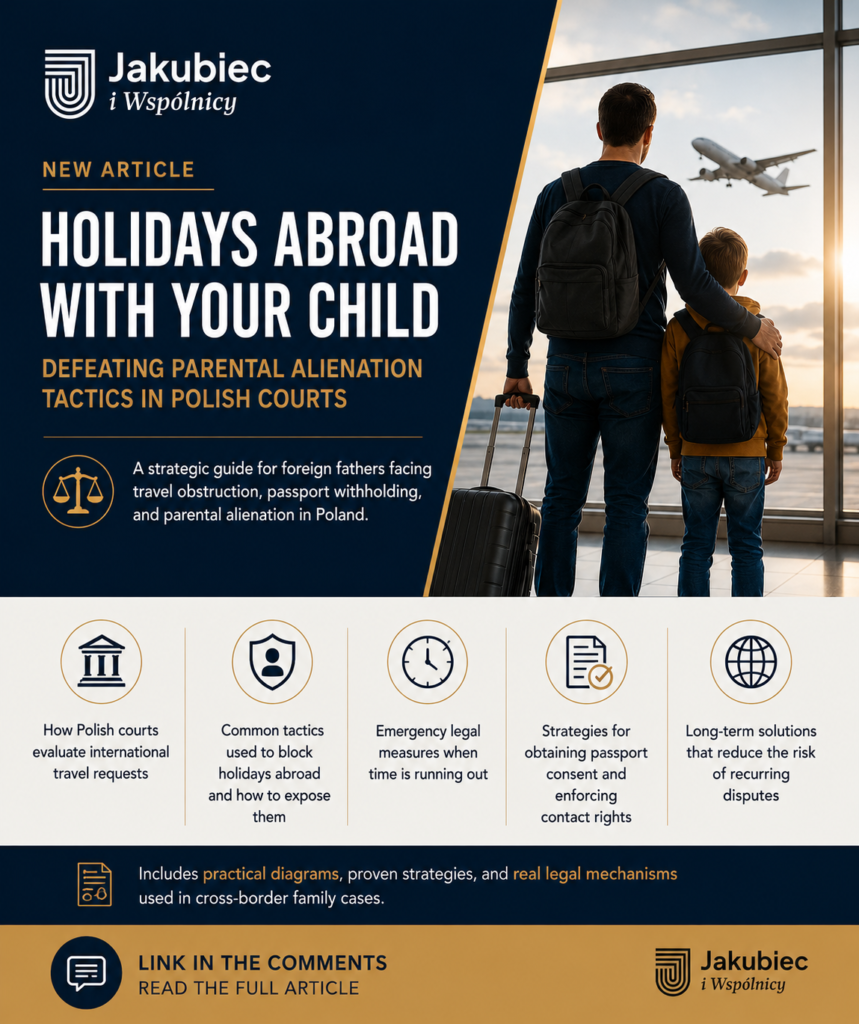
Understanding Parental Alienation in Poland: Why Foreign Fathers Are Especially Vulnerable
In cross‑border custody disputes, parental alienation is rarely an emotional outburst — it is a deliberate manipulation of time, distance, and narrative designed to gradually overwrite a child’s memory. Foreign fathers are uniquely exposed to these tactics because physical separation eliminates spontaneous contact, giving the resident parent in Poland the ability to reshape the father’s image without immediate correction.
This vulnerability is amplified by language barriers, limited access to Polish family‑court procedures, and a system that moves slowly enough for alienation to take root. Alienating parents exploit this information asymmetry to portray the father’s absence as indifference or abandonment, even when the distance is the result of work, visas, or international relocation.
A common example illustrates the pattern: a parent may suddenly claim that the child is “too anxious to fly” or that “international travel is unsafe,” despite years of uneventful trips — a tactic designed not to protect the child, but to block contact and control the narrative.
As I explain in my core guide, Child Custody in Poland – A Guide for Foreign Parents, systemic delays in Polish family courts unintentionally reinforce these tactics by allowing the alienating parent to maintain exclusive control during the most formative months of the child’s perception.
For a non‑resident parent, recognizing this structural disadvantage is essential. International holidays are not merely vacation time — they are critical behavioral checkpoints, the rare moments when your relationship with your child can be rebuilt, reinforced, or, if blocked, quietly dismantled.
The Legal Reality: How Polish Courts View International Travel, Passports, and “Safety Concerns”
When foreign fathers enter a Polish family court, they often encounter a profound clash of expectations. You arrive with a straightforward premise: “I am a loving parent with court‑ordered contact, and I want to take my child on vacation.” But Polish family judges — especially at the District Court level (Sąd Rejonowy) — do not always evaluate international travel only through the lens of parental rights. They evaluate it through the lens of institutional risk management. To navigate this system effectively, you must understand the unspoken psychological blueprint that shapes their decisions.
The Phantom of International Abduction
The dominant, often subconscious fear in Polish family courts is simple: Once a child leaves Polish jurisdiction, they may never return.
This anxiety is especially strong when the destination is outside the EU — places like USA, Canada, Australia, or the Middle East. Judges are aware of the Hague Convention, but they also know its limitations. They fear a scenario where a child “disappears” into a foreign legal system, rendering Polish rulings unenforceable.
As a result, when the resident parent raises vague, fabricated “safety concerns” — “the father might keep the child abroad,” “the child cannot adapt to a foreign environment,” “the trip is too dangerous” — the court’s instinctive reaction is to freeze the status quo. In their internal calculus, denying a vacation feels like the “safe” option, while granting it feels like a potential career‑ending mistake.
You must understand that a judge who grants international travel permission takes on a severe professional and reputational liability. If a parental abduction actually occurs, that judge bears the systemic fallout—after all, they chose to ignore a resident mother who was loudly sounding the alarm. This professional vulnerability inevitably breeds a culture of paralyzing hyper‑caution, protecting the court’s own record at the absolute expense of an innocent foreign father who has zero malicious intent.
The Passport Trap: Article 97 of the Family and Guardianship Code
Under Article 97 of the Polish Family and Guardianship Code, obtaining a passport or crossing an international border is classified as a “substantial matter” (istotna sprawa) requiring the consent of both parents.
This creates a predictable chain reaction:

If the mother refuses to sign the passport application or physically withholds the existing passport, you must petition the court for substitute consent (zastępcza zgoda sądu). This is where many foreign fathers lose momentum. Approaching the court defensively — arguing that the mother is “unfair” or “uncooperative” — only reinforces judicial caution. The court delays, requests more documents, and schedules hearings weeks or months away, effectively destroying your holiday window.
Overcoming Judicial Paralysis
Winning a travel dispute in Poland requires a strategic shift. You cannot rely on the court’s sense of fairness. You must neutralize judicial risk aversion by constructing a framework where the judge does not need to trust you — they only need to trust the process.
This is achieved for example by presenting a high‑security, precision‑engineered travel plan that eliminates ambiguity and reframes the decision as routine rather than risky.
The Strategic Reframe: Transforming Risk Into Certainty
Instead of a vague request for “vacation time,” you present a structured, verifiable protocol:
- Pre‑booked round‑trip flights with fixed, non‑modifiable return dates.
- A detailed day‑by‑day itinerary, including verified addresses, phone numbers, and emergency contacts.
- Proactive legal safeguards, such as offering to file a Mirror Order in your home jurisdiction or agreeing to enforceable financial penalties for any non‑compliance.
- Written commitments to return the child on a specific date, supported by documentation from your employer, school calendars, or immigration requirements.
By shifting the payoff matrix for the judge, you transform what appears to be a high‑risk decision into a legally safe, administratively predictable outcome. At that point, the resident parent’s fear‑based objections lose their persuasive power, and the court can no longer justify blocking the trip.
“I am fully aware that this represents a textbook, ideal scenario—one where you already hold the tickets and count on the court to move with absolute urgency. In practice, real-world logistics can complicate this approach, meaning we must defuse the court’s anxiety through other, equally precise legal safeguards.
Common Alienation Tactics Used to Block Holidays Abroad — and How to Expose Them
Parental alienation in cross‑border cases rarely appears as open defiance. Instead, it unfolds through a series of plausible‑sounding, behaviorally predictable tactics that masquerade as responsible parenting. When international travel approaches, alienating parents in Poland often deploy a coordinated pattern of excuses designed to run out the clock, disrupt logistics, and create just enough confusion for the trip to collapse. These tactics are well‑documented in forensic psychology and appear with striking regularity in Polish family‑court disputes involving foreign fathers.
Below are the four most common maneuvers — and the strategic countermeasures required to expose them.
1. The Sudden Medical Emergency
A child who has been perfectly healthy for weeks suddenly develops a high fever, stomach pain, or a vague psychosomatic symptom 24–48 hours before departure. The timing is never accidental. How to expose it: Immediately request independent, court‑approved medical verification. When the alleged illness evaporates under objective examination, the pattern becomes clear.
2. The Weaponized Anxiety Narrative
The resident parent claims the child is “too anxious to fly,” “terrified of leaving Poland,” or experiencing a sudden psychological crisis. These narratives often appear only when international travel is imminent. How to expose it: Demand a neutral psychological assessment. Courts take professional reports far more seriously than parental assertions, and fabricated anxiety collapses under clinical scrutiny.
3. The Passive‑Aggressive Bureaucratic Block
The passport is “misplaced,” withheld, or allegedly sent for renewal without your knowledge. This tactic exploits the fact that Polish courts often treat such excuses at face value unless confronted with structured evidence. How to expose it: Force all communication into written, timestamped channels. Document every request, reminder, and refusal. A clear paper trail transforms vague excuses into provable obstruction of international travel consent.
4. The Strategic Schedule Overlap
Sudden “mandatory” summer camps, family events, or therapy sessions appear exactly during your court‑ordered holiday window. These conflicts are engineered to create the illusion of competing obligations. How to expose it: Demonstrate the pattern of timing. When these events occur exclusively during your scheduled contact periods, the court can no longer ignore the intentional interference.
Turning Patterns Into Evidence
Polish family courts often struggle to distinguish genuine concerns from manipulative tactics — unless the behavior is presented as a structured, chronological pattern. Your goal is to shift from emotional argument to a cold, objective behavioral audit:
A. Document every interaction;
B. Preserve every message;
C. Track every “coincidence”;
D. Demand independent verification for every alleged crisis.
Once these incidents are mapped out, the pattern becomes undeniable: the child’s “illness,” “anxiety,” or “schedule conflict” appears only when an international departure is approaching. At that point, the court is no longer evaluating excuses — it is evaluating bad‑faith obstruction.
Table: Common Alienation Tactics, How to Detect Them, and How to Counter Them
| Tactic | How to Detect It | How to Counter It |
|---|---|---|
| Sudden Medical Emergency | Symptoms appear only 24–48 hours before departure; no prior medical history; inconsistent or unverifiable explanations from the resident parent. | Demand an independent, court‑approved medical evaluation; document timing; demonstrate recurring patterns across multiple travel attempts. |
| Weaponized Anxiety Narrative | Child suddenly “fears flying” or “cannot leave Poland”; uses adult terminology (“trauma,” “stress,” “instability”); anxiety appears only in the context of international travel. | Request a neutral psychological assessment; present evidence of prior positive travel experiences; highlight inconsistencies in the narrative. |
| Passive‑Aggressive Bureaucratic Block (Passport Withholding) | Passport is “lost,” “at the office,” or “awaiting renewal”; unanswered requests; sudden administrative complications. | Force all communication into written channels; file for interim release of the passport; request substitute judicial consent for passport issuance. |
| Strategic Schedule Overlap | “Mandatory” camps, therapies, or family events appear exactly during your holiday window; no prior notice; conflicts arise only when you plan international travel. | Show the timing pattern; present prior agreements; request fixed, non‑negotiable holiday windows in the parenting plan. |
| Coached Resistance | Child repeats rehearsed phrases; uses legal or adult language; presents a black‑and‑white narrative (“one parent perfect, the other unsafe”); lack of spontaneity. | Do not confront the child; allow evaluators to observe inconsistencies; request OZSS or independent psychologist evaluation. |
| Last‑Minute Logistical Sabotage | Delayed packing, intentional lateness, sudden “technical problems” on the day of departure; child not prepared for travel. | Document every incident; request financial penalties for non‑delivery; include precise handover times in the final order. |
| False Safety Concerns | Claims that the destination is “dangerous” or “unstable” without evidence; concerns appear only when the child travels with the foreign father. | Provide a detailed travel plan, insurance, addresses, and emergency contacts; demonstrate lack of real risk; request standing travel rights in the final order. |
Building a Winning Strategy: Evidence, Expert Opinions, and Procedural Tools That Shift the Court’s Perspective
Winning an international travel dispute in Poland requires moving far beyond the emotional “he‑said, she‑said” dynamic that routinely paralyzes family courts. Polish judges are exhausted by parental conflict and will dismiss unstructured complaints almost instantly. To shift the court’s perspective, your strategy must rely on structural evidence, forensic‑grade psychological assessments, and procedural leverage that fundamentally alters the opposing parent’s incentive structure.
1. The Structural Evidence Matrix
Polish judges do not sift through hundreds of chaotic WhatsApp screenshots. They respond to clarity, chronology, and structure. Your evidence must function as a behavioral audit, not a data dump.
Your matrix should include:
- The Communication Log — A clean, tabulated spreadsheet documenting every travel request, the exact date, and the resident parent’s response (or silence). Judges rely heavily on patterns, and this format makes obstruction unmistakable.
- Logistical Readiness — Timestamped proof of your readiness to travel: flight reservations or payment confirmations, travel insurance, accommodation bookings, and written requests for passport delivery. This demonstrates that you are organized and the obstruction is unilateral.
- The Contrast Record — Evidence of a historically positive relationship (photos, videos, prior trips) contrasted with sudden, unsubstantiated claims of “anxiety” or “fear of flying.” Polish courts react strongly to abrupt behavioral shifts without a developmental cause.
Together, these elements create a structured narrative that courts can process quickly — and trust.
2. Navigating the Forensic Psychological Evaluation (OZSS)
In cross‑border custody disputes, the opinion of the Court Expert Diagnostic Team (OZSS) or court‑appointed psychologists carries enormous weight. Alienating parents often treat this evaluation as their ultimate weapon, coaching the child to repeat rehearsed phrases such as “I am afraid to fly with daddy” or “I don’t want to leave Poland.”
The forensic trap for foreign fathers is simple: If you spend your limited evaluation time attacking the mother, you confirm the expert’s suspicion of conflict alignment.
Court psychologists are trained to detect:
- coaching,
- pathological alignment,
- adult terminology in a child’s speech,
- rigid, one‑sided narratives.
Your strategy must be entirely child‑centric:
- Expose Coaching Indirectly — Do not argue with a coached child. Let them speak. Experienced evaluators immediately recognize rehearsed narratives and developmental inconsistencies.
- Demonstrate Calm Behavioral Continuity — During the observation phase, focus solely on natural interaction: warmth, play, emotional stability. Your calm presence will contrast sharply with the artificial tension engineered by the alienating parent.
Handled correctly, the OZSS evaluation becomes a powerful counterweight to alienation tactics.
3. Procedural Leverage: Altering the Payoff Matrix
Under Polish law — specifically Article 598¹⁵ of the Code of Civil Procedure — courts possess a potent enforcement tool: financial penalties for each violation of a contact order (zagrożenie nakazaniem zapłaty sumy przymusowej).
The mechanism is simple:

Alienating parents continue their behavior because, until now, it has been cost‑free. By proactively petitioning the court for an emergency enforcement order that sets a specific cash penalty for every day a holiday is blocked or a passport is withheld, you fundamentally change the economics of obstruction.
Suddenly:
- delaying becomes expensive,
- refusing becomes risky,
- compliance becomes the rational choice.
This is how you transform psychological obstruction into a financial liability — and force behavioral change.
4. Emergency Measures and Fast-Track Solutions When the Other Parent Refuses Consent or Withholds the Passport
When a planned international vacation is only weeks away, waiting for a standard court ruling in Poland is a death sentence for your holiday plans. Alienating parents understand this perfectly; they exploit the court’s calendar to run out the clock, knowing that a delay is as good as a victory. To defeat this tactical foot-dragging, you must immediately shift from the standard litigation track to the court’s emergency fast-track mechanisms.
In Polish family procedure, your primary weapons are interim injunctions (zabezpieczenie roszczenia), which allow a judge to issue temporary, enforceable orders before the final trial ever takes place.
1. The Interim Travel Injunction (Wniosek o zabezpieczenie)
You cannot afford to wait months for a final verdict on international contact. Simultaneously with your main petition, your lawyer must file an urgent motion for an interim injunction under Article 730 and 755 of the Code of Civil Procedure.
This motion explicitly requests the court to secure your upcoming vacation dates immediately.
- The Evidentiary Threshold: To win an interim injunction, you do not need to fully prove your case yet; you only need to credibilize it (uprawdopodobnienie). By presenting the Structural Evidence Matrix (the communication log showing unilateral obstruction and your pre-booked return flights), you prove that immediate judicial intervention is necessary to prevent irreversible damage to the child-parent bond.
- The Timeline: By law, emergency motions for interim custody or contact security are meant to be processed swiftly, often without a full hearing, giving you a critical window to bypass procedural delays.
2. Fast-Tracking Substitute Passport Consent
If the child lacks a valid passport, or if the resident parent refuses to hand it over, the administrative deadlock is absolute. To break it, your emergency motion must target the root of the blockade through a dual-track procedural request:

Your legal offensive must ask the judge to:
- Grant substitute judicial consent (zastępcza zgoda) for the passport application, which legally replaces the mother’s missing signature at the passport office.
- Issue an interim order compelling the immediate release of the existing physical passport, under a strict, time-sensitive deadline (e.g., 3 days from the delivery of the order).
3. Securing Judicial Execution with Financial Teeth
An emergency order is only as good as its enforcement mechanism. If the court grants your interim travel injunction but fails to attach consequences, the alienating parent may still choose to ignore it on the day of departure, gambling that you cannot react in time.
To neutralize this, your emergency motion must combine the travel permission with a proactive request for threatened financial penalties (zagrożenie nakazaniem zapłaty sumy przymusowej) specifically calibrated for the upcoming holiday.
The Tactical Advantage: You ask the court to rule that if the passport is not delivered by X date, or if the child is not handed over for the flight on Y date, the blocking parent is automatically penalized a substantial, non-negotiable cash amount per day of non-compliance.
When faced with a court order that transforms psychological defiance into a sudden, compounding financial crisis, the alienating parent’s legal counsel will almost always advise them to comply. You shift the reality from a slow-moving bureaucratic debate into a high-stakes financial penalty phase where defiance carries immediate, painful costs.
Long-Term Protection: Court Orders, Parenting Plans, and Preventive Clauses That Secure Future International Travel
Winning an emergency travel injunction solves a immediate crisis, but it does not cure the underlying pathology of parental alienation. If your final court order or parenting plan contains vague, standard language, you condemn yourself to fighting the exact same battle every single summer and winter. Long-term victory requires establishing a permanent structural equilibrium—a legally binding framework that transitions your travel rights from a matter of ongoing dispute to an automated, self-enforcing routine.
To achieve long-term insulation from obstruction, your final court order or parenting plan (Plan Wychowawczy) must bypass the need for parental negotiation entirely, replacing it with algorithmic precision and preventive clauses.
1. Algorithmic Precision in Parenting Plans
The single greatest mistake in international custody agreements is the use of the phrase “to be mutually agreed upon by the parents.” In an alienation dynamic, mutual agreement is a statistical impossibility. Your parenting plan must be engineered so that no communication, negotiation, or consent is required to trigger a vacation.
Your final order must explicitly define:
- Fixed Calendars: Instead of specifying “two weeks in July,” designate exact windows (e.g., “From July 1st at 9:00 AM until July 15th at 6:00 PM in odd-numbered years”).
- Automated Document Release: The order must state that the resident parent is legally obligated to hand over the child’s physical passport and travel documents at least 14 days prior to any international travel, without requiring a separate request.
- The Travel Boundary: Specify that the father possesses a standing, unrestricted right to travel with the child outside the borders of Poland to any country within the EU, the Schengen Zone, or specific non-EU jurisdictions (e.g., the United States), provided a basic itinerary is sent via a designated communication channel.
2. The Permanent Passport Protocol
If the resident parent has a history of withholding documents, leaving the passport in their exclusive possession is a perpetual security risk. Your strategy should aim for a structured, court-mandated custody protocol for the child’s travel documents:

Alternatively, petition the court to allow you to permanently hold the child’s foreign or secondary passport, or mandate that the documents be deposited with a neutral third party (such as a notary or legal counsel) or held in alternating custody. If the child holds dual citizenship (e.g., Polish and American), the court can rule that the foreign passport remains permanently in the foreign father’s custody, effectively neutralizing the administrative blockade.
3. Institutionalizing the Enforcement Penalty
An alienating parent will eventually test the boundaries of a permanent court order. To prevent a relapse into obstruction, the financial penalties discussed in Section 4 must not be temporary—they must be institutionalized directly into the final judgment.
Ensure your final ruling contains a standing threat of execution (związane z zagrożeniem nakazaniem zapłaty):
“For every single instance where the resident parent fails to release the child for international travel, or fails to deliver the required travel documents within the mandated deadline, a standing penalty of [Amount] PLN per day of non-compliance shall be automatically levied, enforceable without the need for a new trial on the merits.”
Shifting from Conflict to Compliance
By embedding these structural guarantees into your long-term legal strategy, you completely rewrite the psychology of the relationship. You strip the alienating parent of their ability to manipulate the calendar, weaponize bureaucracy, or force you into constant litigation. Compliance becomes the only logical, low-risk option for the other parent, finally allowing you to focus on what matters most: rebuilding, reinforcing, and enjoying your unhindered bond with your child.
Executive Summary: Cross‑Border Custody Disputes and International Travel in Poland
International travel disputes involving foreign fathers in Poland sit at the crossroads of high‑conflict family law, cross‑border custody dynamics, and the growing problem of parental alienation. When a resident parent blocks holidays abroad, raises fabricated “safety concerns,” or engages in withholding a child’s passport, distance and bureaucratic inertia can quietly erode the father–child relationship.
Polish judges approach international travel consent not as a question of parental rights, but as an exercise in institutional risk management. This is why foreign fathers seeking Polish family court travel permission must rely on structured, objective tools: a clear evidence matrix, forensic‑grade psychological insight, and fast‑track procedural mechanisms capable of overcoming delay tactics.
Long‑term protection requires transforming international contact rights into a self‑executing, algorithmic routine embedded directly in the final parenting plan. For any foreign father navigating custody in Poland, this shift — from discretionary negotiation to automatic enforcement — is the only reliable safeguard against recurring obstruction.
Take Control Before the System Takes It From You
International travel disputes in Poland are not won by waiting, hoping, or appealing to fairness. They are won by strategy, precision, and speed. If you are facing passport obstruction, fabricated “safety concerns,” or escalating parental alienation, every week of delay strengthens the other parent’s position and weakens your bond with your child.
You do not have to navigate this alone.
My team specializes in cross‑border custody disputes, international travel permissions, and high‑conflict parental alienation cases involving foreign fathers. We represent clients from the United States, the United Kingdom, Australia, the EU, and beyond, and we act quickly, because in these cases time is the most powerful weapon.
Your initial consultation is not a generic conversation — it is a strategic session, during which we analyze your evidence, identify procedural leverage, and outline the fastest path to securing your travel rights.
Your relationship with your child is too important to leave to chance. Take the first step now — before the next holiday window closes.
FAQ: International Travel, Parental Alienation, and Polish Courts
1. What should I do if the other parent refuses to sign the passport application?
File a dual‑track motion:
- petition for substitute consent, and
- interim motion for immediate document release. This breaks the administrative deadlock and forces the court to act before your travel window expires.
2. Can I get emergency permission to travel if the vacation is soon?
Yes. Polish courts can issue interim injunctions (zabezpieczenie) within days, sometimes without a hearing, if you credibilize the urgency.
3. What if the other parent hides the passport?
Request an interim order compelling immediate release of the document under a strict deadline, backed by financial penalties for every day of non‑compliance.
4. How do Polish courts view international travel with a foreign father?
With caution. Judges fear international abduction and often freeze the status quo unless you present a structured, risk‑free travel plan.
5. Can I prevent future obstruction permanently?
Yes — through a precise parenting plan with fixed calendars, automated passport release, and standing financial penalties.
6. What is your fee for handling these cases?
It depends on the complexity and urgency of the matter, but our standard fee for representing a foreign parent in an international travel obstruction case typically ranges between 20,000 PLN and 30,000 PLN and an additional 2,000 PLN per hearing.
7. Can you help even if I live outside Poland?
Yes. We regularly represent clients living in the US, UK, Canada, Australia, and across the EU. Most of the process can be handled remotely.
8. What if the child refuses to travel?
Polish courts distinguish genuine reluctance from coached resistance. Properly handled forensic evaluation (OZSS) can expose manipulation.
9. Do your attorneys attend hearings remotely, or do they physically appear in court?
We make every effort to attend all key court hearings in person. While remote (online) participation is legally permissible in Poland, we are firmly convinced that we can protect your interests far more effectively by being physically present in the courtroom. High-conflict custody and travel disputes require reading the room, reacting instantly to sudden tactical maneuvers, and commanding the judge’s full attention—dynamics that are heavily diluted over a video screen. We travel to courts across Poland to ensure our physical advocacy matches our strategic commitment.
10. How can I get in touch with you to start my case?
You can email us directly at kancelaria@jakubieciwspolnicy.pl—you can expect a direct response within 24 hours. For immediate or urgent matters, you can also reach me directly via WhatsApp at +48 536 270 935. I invite you to schedule your initial strategy consultation so we can thoroughly analyze your situation. While no ethical attorney can promise a guaranteed victory in court, I give you my personal word that we will do absolutely everything in our power to fight for you, protect your rights, and restore your bond with your child.
11. How can I know that I can trust you with such a sensitive case?
We understand that trust is not granted — it must be earned. And we also understand the dilemma: how can you trust a lawyer you have not met yet, especially in a case involving your child, international travel, and parental alienation?
We address this directly, through concrete, verifiable commitments:
- A precise written agreement You receive a clear, detailed contract that defines our obligations, timelines, scope of work, and the exact structure of our fees — with no ambiguity and no hidden clauses.
- A signed NDA with a contractual penalty in your favor We protect your privacy not only ethically, but legally. If we breach confidentiality, you are entitled to a financial penalty.
- A written conflict‑of‑interest declaration — with liability We provide a formal statement confirming that we have no professional, business, or social ties to the other parent. If it ever turned out that we knowingly misrepresented this, we pay you a contractual penalty.
- Professional liability insurance of EUR 2.5 million This is significantly above the industry standard and reflects the complexity and international nature of the cases we handle.
- My personal, unlimited liability with my own assets I made a deliberate decision to assume full, personal responsibility for all obligations of our Firm — with my private assets. I did not have to do this. I chose to do it to show that I stand behind my work not only with words, but with my own money.
Because trust is built through actions — not promises. Read more here.

dr Andrzej Jakubiec - adwokat, mediator
Latest Posts
by dr Andrzej Jakubiec - adwokat, mediatorWhy Intelligent People Lose Disputes?
Litigation as a Subplot: Viewing the Court Case Within a Broader Conflict A lawsuit is almost always just a single element of a much larger conflict....
by dr Andrzej Jakubiec - adwokat, mediatorCognitive Traps and Their Impact on Decision‑Making in the Fogg Model
In several previous texts, I presented some cognitive biases (thinking traps), including the fundamental attribution error, tunnel vision, and my original...
by dr Andrzej Jakubiec - adwokat, mediatorVIP Divorce in Poland: Strategy of Assets and Reputation Protection
A Comprehensive Legal and Behavioral Guide to Strategic Matrimonial Proceedings What exactly is a VIP divorce? Let us clarify at the outset—it is...