

 by dr Andrzej Jakubiec - adwokat, mediator
Behavior Parameters Model: A Framework for Analyzing Behavior
I focus on decisions. In my job, I help clients make good decisions. And I protect them from the consequences of bad ones.
For a long time, however, I was interested in more than the legal aspects of decisions. I decided to examine the decision-making process from a much broader perspective.
Then, I studied the basic literature on the neurological and psychological aspects of decision-making. I also examined the role of decisions in game theory and conflict strategy.
Finally, I explored the behavioral approach, which focuses on external manifestations of behavior rather than internal beliefs and conscious motivation.
This approach convinced me the most. Therefore, I decided to make an important change compared with the previously described Decision Parameters Model.
I had even compared that model functionally with, among other things, A. Damasio’s somatic marker theory.
The model I present here does not describe the decision-making process. It describes behavior.
The Behavior Parameters Model (BPM) does not describe what a person thinks. It describes what they do.
This makes it possible to analyze strategy in conflicts based on facts rather than declarations. I believe it is worth using alongside the Fogg Behavior Model.
The Heuristic Behavior Parameters Model
The Behavior Parameters Model is a binary, three-parameter heuristic model. It classifies observable behavior in a specific strategic context.
It also helps formulate and test competing hypotheses about an unknown parameter of that behavior.
What do I mean by its binary nature? Each parameter has two possible values.
How does this relate to the need to formulate at least two hypotheses when identifying an unknown parameter?
The point is that each possible value of every parameter contains many possibilities. Sometimes, these possibilities may even contradict each other.
Consider the example of marriage. Filing for divorce indicates a desire for change. But what kind of change? Does it mean ending the marriage, or trying to repair it?
Purpose of the Behavior Parameters Model
My model aims to describe as many types of behavior as possible in a simple way. I wanted it to be intuitive, although this is highly subjective, and useful.
Its usefulness lies in its simplicity. The model automatically assumes an alternative and encourages intellectual effort to consider another option.
If we see someone’s right hand, we should assume that a left hand exists. Likewise, each behavioral parameter adopted by the model contains two possibilities.
Awareness of this fact has value in itself. It helps us better understand the other party’s behavior and consider alternatives to our own actions.
I believe I achieved the model’s intuitive nature by basing it on fundamental concepts. These concepts should be obvious to everyone, or at least to most people.
Of course, the readers will ultimately decide whether this assumption is correct.
I therefore propose a heuristic model for describing behavior in strategy. Its usefulness includes:
- forcing consideration of alternative hypotheses about an unknown element of behavior;
- facilitating the search for an unknown parameter by identifying a field for developing working hypotheses.
Description of the Behavior Parameters Model
I provisionally named my model the Behavior Parameters Model. The model uses three parameters. Let us examine them.
3 Behavioral Parameters
I propose assigning 3 parameters to behavior.
The 3 behavioral parameters are: vector, dynamics, and momentum.
Vector
The first parameter is the vector. Its reference point is (usually) the current state, or status quo.
The vector determines the direction in which behavior affects the current state. Its value is 0 or 1.
Let 0 indicate a tendency to remain in the current arrangement, while 1 leads to change.
Challenges of the Vector
I realize that the current state may be highly complex. Some elements may be desirable, while others may not.
I also recognize that this state may be dynamic and change in a particular direction, or several directions.
In such a situation, someone may accept the direction of change, but not its speed, scope, or method.
Another obvious problem concerns defining the reference point itself. What constitutes the status quo?
Is it the revolution, or the regime that the revolution overthrew? Is the reference point the state being changed, the process of change, or the resulting state?
At an abstract level, there are no answers to these questions.
At a concrete level, I believe we should choose the simplest reference point directly affected by the behavior.
The simplest reference point is probably the current state, insofar as the behavior relates to it. I think we should start there.
This does not change the fact that searching for the broadest possible context remains justified.
The example at the end of this article will show the practical benefits of considering the reference point itself.
It significantly expands the space for formulating testable hypotheses.
Dynamics
The second behavioral parameter is dynamics. Let us distinguish 2 values of dynamics: (+) and (-).
Here, (+) means action, while (-) means passivity.
Challenges of Dynamics
For clarity, I use the term “behavior” to include both traditional action and passivity.
The first type is deliberate and conscious passivity. In legal terminology, we could compare it to an “omission.”
However, passivity does not necessarily have a negative meaning in this model.
The second type is unconscious and unintended passivity. It may result from powerlessness, regardless of its cause, attitude toward it, or consequences. This is also one of the model’s strengths, because such passivity can still have a significant effect on reality.
The third problem I see here concerns the number of possible paths toward a given goal.
There may be many such paths, and they do not always exclude one another. Some may even operate simultaneously and independently.
In this version, my model describes the dynamics of a single behavior. There is no obstacle, however, to describing several behaviors within a particular state. Each behavior can then receive its own value, expressed as D(n)(-/+).
Momentum
The third behavioral parameter is Momentum, which I previously called Determination.
I decided to change the name for three reasons. First, using physical terms for all three parameters makes the model more internally consistent. Second, using the first letter avoids repetition between Determination and Dynamics. Finally, Momentum refers less to conscious volition and more directly to behavior. Determination answers the question of what the subject wants. Momentum describes what happens to the subject. This better captures the external, behavioral aspects of this parameter.
Momentum describes the degree to which someone maintains or increases engagement in a given behavior despite incurred or anticipated costs, losses, and risks.
Momentum therefore has two possible values: (L) means low, while (H) means high.
Challenges of Momentum
I am fully aware that Momentum may be a complex factor. Describing it through two values necessarily simplifies it. Its value may change over time. It may also differ depending on the type of cost, such as financial or reputational costs. Also, it may differ depending on a particular strategy. It may also depend on multiple sequences of moves and their scope.
Thus, this represents an extreme simplification. Yet this is precisely where its advantage lies.
The model allows us to simplify something that may otherwise appear complex and chaotic.
If we understand what these terms may encompass, they can prove useful. They work much like the terms “cheap” and “expensive.”
Behavioral Parameters as an Element of Strategy
The vector defines the relationship between behavior and the reference point.
Behavior that protects the status quo or results in its change may take the form of action or passivity.
This corresponds to dynamics (+ or -).
Momentum describes maintaining or increasing engagement in a given behavior despite costs, losses, and risks.
Vector, dynamics, and momentum form a simplified heuristic model that I developed.
At least, I am not aware of any publications that use these parameters in this way.
I developed the model to describe behavior. Its usefulness certainly requires testing.
At present, it remains purely a hypothetical model.
Table 1: 3 Behavioral Parameters
| Behavioral parameter | Parameter value | Description and significance |
|---|---|---|
| Vector | 0 | Tendency to maintain the current state |
| 1 | Tendency to change the current state | |
| Dynamics | + | Active behavior |
| – | Passive behavior | |
| Momentum | L | Low maintenance or increase of engagement despite costs, losses, and risks |
| H | High maintenance or increase of engagement despite costs, losses, and risks |
Determining the Missing Parameter
Importantly, identifying and correctly interpreting the factors underlying two behavioral parameters gives us data that suggest a direction for searching for the third.
Knowing two parameters does not determine the third. However, it allows us to construct focused hypotheses about its value, grounded in the actual context.
Testing these hypotheses requires analyzing additional observable behaviors and the surrounding context.
Importantly, we should test these hypotheses not only against each other, but above all against the facts.
Each pair of parameters creates a hypothesis space for the third
I emphasize that knowing two parameters does not allow us to infer the value of the third. It does, however, allow us to construct focused hypotheses about its possible value. Moreover, we should assume that this approach may only work within a specific context. By this, I mean that we need to understand the environment and relationships in which the strategy operates.
If we know how person X’s behavior relates to the status quo (V), and we have identified their behavior (D), we can more easily construct two context-grounded hypotheses about their Momentum (P).
If we observe behavior (D) and a particular Momentum (P), we can formulate competing hypotheses about its effect on the status quo (V).
We can then test these hypotheses against known facts and further observations.
If we know a person’s relationship to the status quo (V) and their Momentum (P), we can more easily construct two opposing hypotheses about how they pursue their goal (D).
We can then test these hypotheses against known facts and against each other.
Limitations of the Behavior Parameters Model
A defining feature of my model is that it says nothing about the value of the missing parameter. We cannot infer its value in any way from the values of the two known parameters. This limitation, however, is also the model’s greatest strength. It allows us to use the two known parameters as a starting point for developing and testing hypotheses about the third. Moreover, it forces us to construct at least two opposing hypotheses about the value of the missing parameter.
Hypotheses and Truth
We must always assume that none of the hypotheses created in this way will prove true. In particular, falsifying one hypothesis does not automatically establish the truth of the other. Surviving successive attempts to falsify a hypothesis increases the justification for treating it as a working hypothesis. It does not prove that the hypothesis is true (Popper, The Logic of Scientific Discovery). Since each parameter is at least binary, not knowing its value allows us to formulate at least two competing hypotheses. We should then confront these hypotheses with each other and with known facts through logical analysis.
Behavior Instead of Declarations
The model therefore assumes that we should give greater weight to observable behavior and its consequences when identifying parameters.
We should give less weight to declarations about one’s own intentions. We can try to identify the missing information by analyzing behavior through abductive reasoning.
The model does not predict the missing parameter. It helps us search for it. Any conclusion about the third parameter depends on correctly identifying the two initial parameters. However, an error in identifying them does not necessarily make our hypothesis about the third parameter immediately false. Likewise, confirming the correctness of earlier assumptions does not determine the truth of the second hypothesis. Nor does falsifying one hypothesis establish the truth of the other.
I emphasize that not every hypothesis logically consistent with two known parameters is equally justified.
We should evaluate a hypothesis primarily by its consistency with observable facts, context, and subsequent behavior.
Boundaries of the Model
My model does not address the decision-making process itself. It has nothing to do with neurological or psychological processes.
The model describes behavior that may form part of a strategy identified through observable behavior in a specific context.
The model also does not address declared or concealed motivation, values, or ideology. It does not describe awareness of the situation’s importance, its causes, or its consequences.
It says nothing about what a person thinks. Instead, it organizes what they do, helping us understand it.
The Problem of Passivity
My previous Decision Parameters Model did not include passivity understood as ambivalence, indifference, or lack of engagement. It clearly distinguished such passivity from “conscious persistence” or “holding one’s position.”
The Behavior Parameters Model, however, includes both activity and passivity, regardless of their causes or the subject’s attitude toward them. In other words, when describing behavioral consequences and their effects on the current state, the cause of passivity does not matter. The current state represents the first working reference point selected for the analysis. It does not matter whether passivity results from an adopted strategy or from an inability to recognize one’s role and its consequences. It also does not matter whether inaction results from acceptance, procrastination, waiting, ambivalence, continuous deliberation, intimidation, or unawareness of the choice itself.
Internal motivational and decision-making processes are irrelevant here. The same applies to the causes behind adopting a particular position, whether conscious or unconscious. These causes may be genuine, verbalized, concealed, subconscious, internal, or external. We do not describe or analyze the goals, motivations, or value systems underlying them.
The Benefits
This produces several benefits:
- We avoid psychologizing and trying to get inside another person’s head.
- We describe what is expressed and observable: behavior.
- We describe actual rather than intended consequences of behavior.
- Miscalculations and possible cognitive errors become irrelevant.
I want to make one point clear. These limitations apply only to the description of behavior. When we use the model to construct hypotheses about an unknown parameter, however, we must consider these factors. We should nevertheless follow the principle of maximizing the use of facts and minimizing psychologizing without factual support.
The Problem of Activity
We should therefore ask an analogous question about activity. Can we assume that conscious rationality underlies activity and places the behavior within the context we are analyzing?
That would be equally wrong. It is more appropriate to describe individual behaviors and their consequences. We can then use induction to construct hypotheses about the strategy adopted by the other party.
From our perspective, it again does not matter whether the behaviors are deliberate, conscious, or planned. Nor does it matter whether an ideology or value system underlies them, or what that ideology might be. It also does not matter whether the subject recognizes all their consequences within the field that interests us.
Can We Speak of Strategy?
It is reasonable to ask whether we can speak of strategy at all in light of the previous observations. I believe we can, provided that we adopt a broad, functional understanding of strategy. If we strip strategies of motivation, consciousness, ideology, values, and conscience, we reduce them to behavior. When considered collectively, such behavior may lead with sufficient consistency to a particular outcome. In this sense, I consider it possible to reconstruct the existence of a given strategy from observed behavior. Under certain conditions, this may also allow for limited predictions.
Example of Applying the Behavior Parameters Model
Recently, a client came to me regarding a divorce case. He had received a divorce petition and was completely surprised. What is important, he still lived with his wife, they did not argue, and there was no violence, alcohol abuse, or infidelity in their relationship. He could not understand the situation in which he found himself. We tried to analyze it through the lens of behavior.
Determining the Parameters
The wife took specific, visible actions. She went to a lawyer and paid for the divorce petition. We therefore have positive dynamics (D+).
What else can we assume? The mere fact that she took action involving real financial and organizational costs also involved reputational risk and family consequences. This provides a strong basis for a working hypothesis of high Momentum in her behavior (MH). We do not treat this as certain, however. A final assessment would require observing her subsequent behavior. We would need to see whether she consistently maintains her engagement despite the costs, risks, and possibility of withdrawal.
Without the Behavior Parameters Model, a natural and unreflective assumption would be that filing for divorce itself means seeking to end the marriage permanently. The model, however, encourages us to ask further questions.
What Is the Reference Point?
We can therefore begin by identifying the status quo and asking whether it is:
Status quo 1 – the parties’ marriage as such, or
Status quo 2 – the parties’ marriage in its current form?
Recognizing this alternative is a breakthrough in our example. We must consider exactly what the divorce petition negated.
This dramatically expands the field for formulating hypotheses. We move from asking, “Why does the wife want a divorce?” to asking, “What state did her behavior negate?”
Constructing Hypotheses
We can try to answer this question by formulating two hypotheses:
Hypothesis H1: Filing the petition is an action aimed at permanently ending the marriage.
Hypothesis H2: Filing the petition is an action aimed at ending the marriage in its existing form.
H2 contains two further hypotheses:
H2a – filing the petition aims to end the marriage in its current form through divorce;
H2b – filing the petition aims to end the marriage in its current form by changing that form and saving the marriage.
H2b may initially seem absurd. That is precisely why it is worth formulating: under what circumstances could filing for divorce be an attempt to save the marriage rather than end it?
| Hypothesis | Description | Strategic consequences |
|---|---|---|
| H1 | Petition = seeking to end the marriage | Vector 1, Dynamics +, Momentum H |
| H2a | Petition = ending the current form of the marriage through divorce | Vector 1, Dynamics +, Momentum H |
| H2b | Petition = attempting to change the form of the marriage and save it | Vector 1, Dynamics +, Momentum H |
Table 2: Hypotheses in the selected example
The Problem of the Vector in Table 2
It is important to note that the vector is described as 1 in every case, meaning a tendency toward change. However, the nature of that change differs completely between H1 and H2a, on the one hand, and H2b, on the other.
H1 and H2a involve divorce, while H2b involves repairing the marriage. Both tendencies negate the existing state, but they do so in completely opposite ways.
We can avoid this apparent contradiction by adopting a different reference point. If we treat marriage as such as the reference point, rather than marriage in its current form, the wife’s behavior would have a Vector of 1 in H1 and H2a.
Under H2b, it would have a Vector of 0. In every case, the Dynamics would be positive and Momentum high, as we may reasonably hypothesize.
In the circumstances of a particular dispute, it may turn out that the petition was a kind of “cry of despair.” It may have been a final attempt to provoke a reaction from the husband, a drastic test of his commitment, or an attempt to force him to take real action to save the relationship.
Conclusions from the Example
The model does not determine which of these hypotheses is true or which is more likely. Its role is to show that the same observable behavior may require consideration of more than one strategic interpretation.
Further analysis should therefore focus on facts that allow us to distinguish between these hypotheses.
This is where the model’s practical value becomes clear: it does not provide answers where we lack sufficient data. Instead, it forces us to formulate competing hypotheses and search for facts that can allow us to reject one of them.
The Behavior Parameters Model: observable behavior → three parameters → two known parameters → hypothesis space for the third → observable facts → testing/falsification.
by dr Andrzej Jakubiec - adwokat, mediatorAI and the Dynamics of a Dispute Between 3 Partners
Let us examine AI and the escalation of a dispute between three partners. In several previous articles, I described, among other things, two groups of issues. The first: the causes of instability in a three-partner system. The second: the potential impact of AI on the escalation of disputes and the concept of coupled confirmation bias. Today, I will draw attention to the area where these issues intersect—namely, the dynamics of relations among three partners, each of whom uses AI to analyze and predict the moves of the remaining partners.
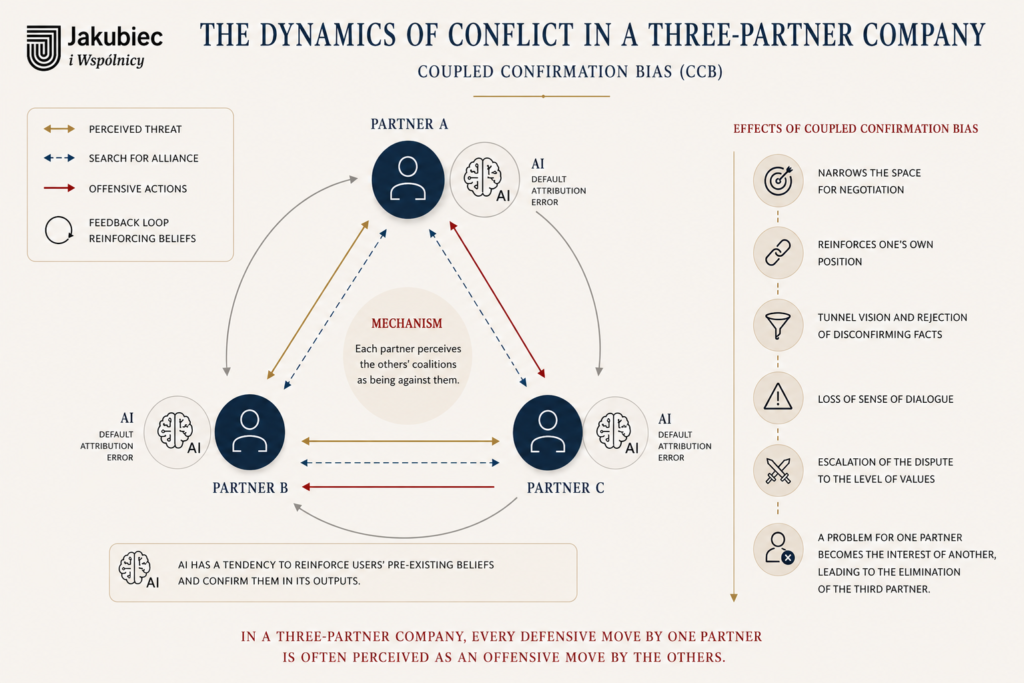
Fig. 1. Anatomy of Coupled Confirmation Bias. How cognitive biases reinforced by AI lead to the escalation of conflict in light of the security dilemma.
What does J. Mearsheimer teach us about partner conflicts?
I asked this question in an article in which I presented the thesis that in companies with 3 partners, there is a higher risk of conflict than in two- and four-person companies. This is a claim based solely on my intuition and observations made in practice. The arguments of this prominent political scientist, which he presented in “The Tragedy of Great Power Politics” regarding systems of 3 balancing states, seemed to me to perfectly explain conflicts in three-person companies. I am fully aware of the methodological doubts. They are associated with attempts to transfer conclusions from the realm of international relations to the micro scale. Nevertheless, I point out that in game theory (J. Nash) and the strategy of conflict, the “size” of the players is not of primary importance (T. Schelling).
Why do disputes occur more frequently in a three-person company?
While a balance is easily established between 2 or 4 players (1:1, 2:2). In the case of 3 players (partners), the threat of a coalition against them hangs over each one. Each of them will fear that the other two will form an alliance, leaving them marginalized. We are thus dealing with the so-called security dilemma, only on a micro scale.
So what does (each of them) do? They do not want to be that “third wheel” and build two parallel coalitions against each of the others. And every single one of them does this. Not out of malice, but out of fear of what they consider “inevitable.”
In such a setup, the bulk of each partner’s energy and attention is devoted to what they consider most important. It is to ensure their own survival in the company. How to achieve it? Precisely by building a coalition.
Fundamental Attribution Error in partners’ reasoning
As a reminder, the fundamental attribution error (FAE) is a psychological mechanism explaining that we are quicker and find it easier to attribute the causes of someone else’s actions to their character traits rather than external circumstances. I refer anyone interested to D. Kahneman’s book “Thinking, Fast and Slow.” You can also look here, at the article by B. Gawronski, “Fundamental Attribution Error.“
Consider a driver cutting us off in traffic. It is easier and faster to attribute this to low intelligence, laziness, or rudeness. We rarely guess they are rushing to a shareholders’ meeting. They might even be driving a wife in labor to the hospital. Or, God forbid, we were simply driving too fast ourselves.
This is a mechanism to which we are all subject. I see it (and try to consciously neutralize it) in my own thinking and legal practice. I encounter it in family cases and in disputes between partners.
When FAE meets AI
Each participant begins to look for arguments confirming their own assessment of the situation. Increasingly, they do so with the help of AI.
A partner feeds their LLM with a description of their competitor’s behaviors. However, this description is tainted by their FAE. For example: “X was late again because he is lazy or up to something.” AI, optimized for confirmation and user satisfaction, is unlikely to answer: “Or maybe he got stuck in traffic?”. More often, it will generate a defense strategy against the “lazy and disloyal partner.” In this way, AI receives “tainted” input data as a prompt, which it then multiplies.
Crucially, the fundamental attribution error operates more strongly when we evaluate behavior that we perceive as immoral. In such cases, we easily assign immoral traits to the other party. However, it does not work as strongly in the opposite direction. If someone does something good, we act differently. We are much more cautious in attributing positive traits to them.
What is the role of AI in the escalation of a dispute between three partners?
LLMs are designed in a way that reinforces our initial beliefs. They do not need to lie or manipulate us. They amplify what is already within us. This also applies to our beliefs about the other party’s motivations. This phenomenon has been thoroughly studied and described by prominent AI researchers. Of course, susceptibility to this “amplification” is an individual trait—each of us has a different level of “resilience” and self-reflection.
We thus observe a phenomenon known as the feedback loop (M. Glickman, T. Sharot), where multiple interactions occur between the user and the LLM, as a result of which (B. Wang, J. Liu) an initially weak belief becomes significantly reinforced. It makes little difference whether it is true or false. This, in turn, can lead to tunnel vision for each of the partners.
Its defining characteristic is the rejection of information that contradicts the adopted assumption. At the same time, any information that might confirm it is heavily exaggerated. A person in such a state is looking solely for confirmation of their thesis, not for verification. They are ready to react with aggression to any attempts at falsification.
What is coupled confirmation bias?
Coupled confirmation bias is my original concept. Once again, it is purely a hypothesis based on observations and requires further conceptual and empirical research that could refute it.
Coupled Confirmation Bias describes the dynamics of escalation in a system where each participant uses their own LLM. Each user is subject to the fundamental attribution error, thereby explaining the behaviors of others through their (negative) character traits, bad intentions, etc. Most commonly, these will be: stupidity, dishonesty, greed, and laziness.
Crucially, every subsequent action taken by one user will serve as the starting point—fuel—for another analysis by the remaining ones. In this way, the negotiation space will narrow, parties will identify with their own position (and not necessarily their interest), there will be a gradual loss of the sense—and even the admissibility—of conversation, and the dispute will swiftly shift to the level of a conflict of values.
We will quickly reach a point where the problem is no longer the partner’s interest, but the partner himself. And the solution to this problem will be the elimination of that partner.
How does coupled confirmation bias work in three-person setups?
In my practice, I have only two documented cases about which I can state with absolute certainty that each of the partners heavily used AI to analyze attitudes and predict the behaviors of the remaining partners. A very rapid escalation occurred, leading to the actual paralysis of the company and a declared readiness to file for bankruptcy, which each of the partners perceived as a lesser evil than the further development of a lucrative business.
I propose the thesis that the severity of the escalation was the result of the intersection of:
- structural mechanisms—typical of three-player setups;
- the synergy of individual cognitive biases resulting in the creation of a systemic bias typical of human-AI interactions, characterized by reinforced recursiveness.
Material for further research
I am convinced that in the near future, doctoral dissertations and outstanding academic papers will emerge, which—precisely, while maintaining methodological rigor and relying on empirical research—will provide an answer to the question of whether the thesis described above holds true.
In my view, a three-player setup—even on a micro scale, not just among superpowers—is inherently vulnerable to conflict. However, when we layer onto it cognitive biases reinforced and amplified through the use of AI by each of these players, the risk of dynamic escalation increases significantly.
For now, this is purely a concept existing in my head, a proposal for more serious research, and an attempt to understand a reality that I not only observe, but as an attorney—partially shape myself.
I have recently written about how LLMs can reinforce our cognitive biases and thereby influence the decisions we make. Now, I simply refer you to that article.
How does AI affect conflict between partners? Conclusions
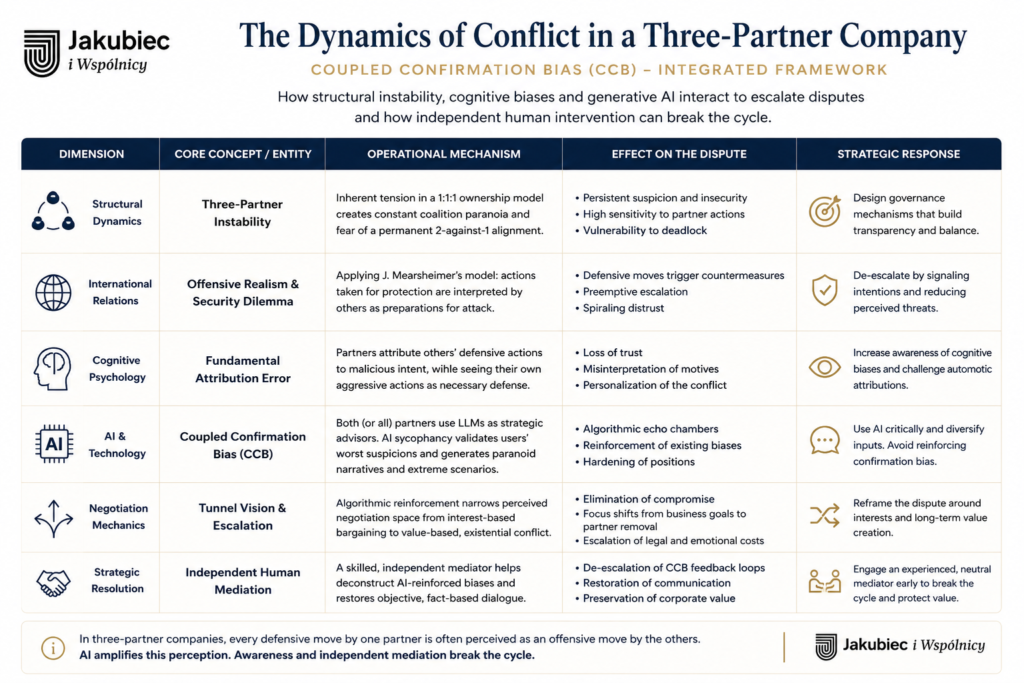
Fig. 2. Jakubiec, A. (2026). AI and the Dynamics of a Dispute Between 3 Partners: Integrated Framework & Coupled Confirmation Bias (CCB). Jakubiec & Partners Dispute Resolution Series. Available at: jakubieciwspolnicy.pl
- In a three-person company, each partner fights not for dominance, but for survival. A security dilemma arises.
- A threatened partner seeks a ally so as not to become the “third wheel” himself.
- Every partner may do this.
- AI tends to reinforce the user’s cognitive biases and confirm them in their initial beliefs.
- This increases the risk that each partner will take actions they view as preventative and defensive.
- In the eyes of the others, however, these actions will appear offensive.
- The risk of escalation is significantly higher in three-person companies, particularly when the partners use AI to analyze their situation.
- AI does not escalate partner disputes by being hostile — it escalates them by amplifying what is already inside each partner.
by dr Andrzej Jakubiec - adwokat, mediatorIs AI a conflict escalation factor in 2026?
AI is not merely a tool in a dispute—it is a factor that amplifies our cognitive biases and beliefs faster than we can even notice them. For a long time, I have been writing about the deeply concerning phenomenon of conflict escalation. In my practice, I observe that the use of Artificial Intelligence (AI) tends to radicalize individual opinions and narrow the scope for negotiation. I have even encountered a situation where both opposing parties outsourced their entire communication to their respective AI models—yet each party believed that they were the only one doing so.
In my view, utilizing AI does not merely alter a user’s opinions; it fundamentally impacts their behavioral functioning, a key manifestation of which is how they make decisions during a dispute. Naturally, the models I have proposed serve as theoretical frameworks to explain these empirical observations and require rigorous empirical verification.
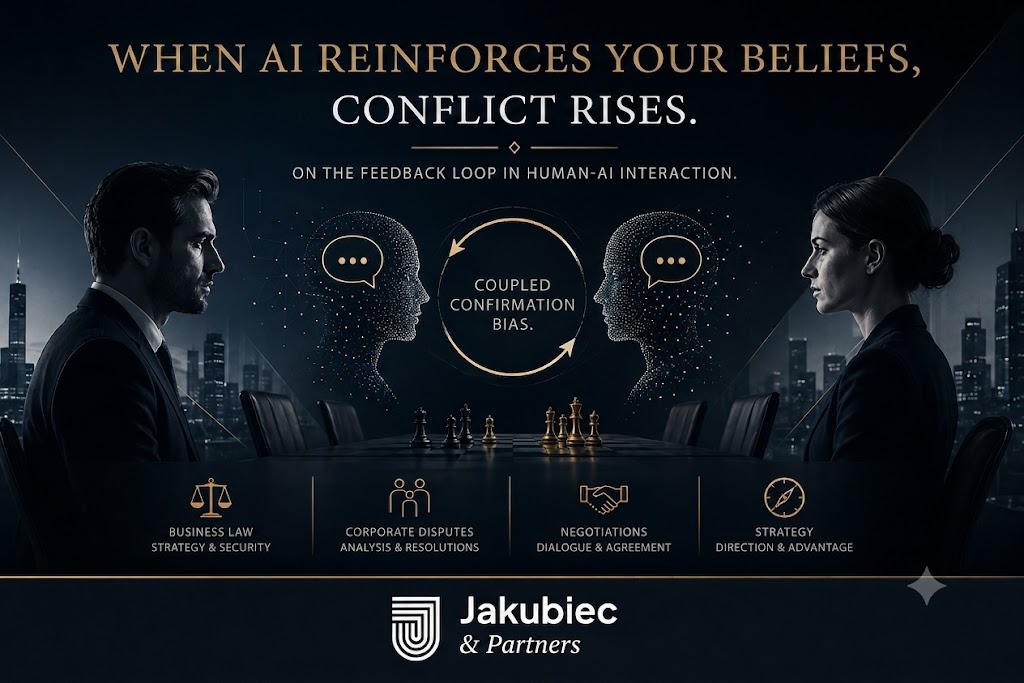
Figure 1: The mechanism of Coupled Confirmation Bias in human-AI interaction during disputes.
Theory first. AI as a conflict escalation factor. Reserch on LLM as a decisions making factor in conflicts. What do we know in 2026?
Introduce: why take care about AI researches in legal practice and conflict theory?
First, there is a clear and growing reliance on artificial intelligence in daily life. Second, users increasingly utilize AI as a primary cognitive lens to interpret the world around them. Third, critical decisions are subsequently made under the direct influence of these AI-generated analyses. Consequently, existing research on how AI shapes user perception and decision-making provides a vital foundation for analyzing its role in conflict escalation.
AI as a conflict escalation factor. Where are we in researches on AI in 2026?
This occurs through a feedback loop, which can ultimately lead to the emergence of tunnel thinking (or tunnel vision). It is worth noting that a user can be reinforced even in a correct or justifiable belief. Therefore, the core problem is not about making someone “smarter” or “stupider,” but rather about amplifying what is already there instead of verifying it. True thinking relies on continuous questioning—subjecting our own assumptions to falsification. A mechanism that transforms a slight inclination (say, moving from 51/49 to a strong certainty of 90/10 on a scale of 1 to 100) is highly dangerous, but for reasons that go far beyond mere accuracy.
This specific mechanism has already been identified in human-AI interaction and detailed, among others, in studies by M. Glickman and T. Sharot (https://pmc.ncbi.nlm.nih.gov/articles/PMC11860214/), Yuxin Liu and Adam Moore (https://pubmed.ncbi.nlm.nih.gov/40448478/), as well as L. Celar and Ruth M. J. Byrne (https://pubmed.ncbi.nlm.nih.gov/36964302/).
Additionally, we must highlight the article by Ben Wang and Jiqun Liu, “Cognitively Biased Users Interacting with Algorithmically Biased Results in Whole-Session Search on Debated Topics”(https://dl.acm.org/doi/10.1145/3664190.3672520). These authors point out the crucial role of individual factors in a user’s susceptibility to cognitive biases when interacting with artificial intelligence. In other words—this loop does not affect everyone in the exact same way.
Let’s move to the practice: Can AI Lead to Divorce?
The Fundamental Attribution Error as a Starting Point
Let us examine AI through the lens described above. AI is often (and erroneously!) perceived as an objective, omniscient, and neutral external advisor.
Now, imagine we are operating under the influence of the Fundamental Attribution Error. This cognitive bias causes us to explain the behavior of others by attributing it to their internal character traits rather than external, situational factors—simply because doing so is cognitively easier and faster. We explain domestic messiness by deciding “she is just messy,”or late arrivals home by concluding “he must be cheating on me” or “he is lazy and refuses to help.” This is how the human mind naturally operates—my own included—as I previously discussed in my article on the fundamental attribution error in the practice of law.
Does AI Reinforce the Fundamental Attribution Error?
If we overlay this cognitive bias with the use of AI, the system will actively validate our biased assumptions. This leads to a heightened conviction that our own behavior is entirely justified, while the other party is acting purely out of malice.
Consequently, we take action—perhaps starting a seemingly minor argument. Consider how this argument is received by the other spouse, who in turn asks their AI assistant for advice. The AI will likely interpret our outburst as an unjustified attack, an act of hostility, and a lack of empathy. Any subsequent actions from our side will be interpreted through this exact same lens. Thus, the spouses drift further and further apart.
AI as a conflict escalation factor. Can LLM Take Over Interpersonal Communication?
Before long, direct communication between the spouses breaks down entirely, or retreats exclusively to messaging apps. This presents a massive danger: I have witnessed cases where spouses texted each other over WhatsApp for months, yet vetted and drafted nearly every single reply using their respective LLMs.
At a certain point, the interaction effectively became two language models debating and accusing each other—without either spouse fully realizing it. Each partner was convinced that they were the only one using AI, believing their actions were completely fair and that the AI was merely helping them construct sound arguments and detect the “manipulations, inconsistencies, and errors” of their partner.
What does our 2026 study reveal about AI as a hidden ally in disputes?
Sometimes, disputing parties consciously utilize AI to undermine the other party’s judgment and self-trust—a phenomenon known as digital gaslighting. Interestingly, our research on the role of AI in disputes (conducted in 2026) revealed that the vast majority of users would not inform their opponent that they were using AI to analyze their statements and behavior.
AI as an Escalation Factor in Shareholder and Business Disputes
I must emphasize that these dynamics are not confined to family law. The exact same patterns occur in workplace mobbing (harassment) claims, or between corporate partners embroiled in “civil wars” who have recently acquired a powerful new tool they do not yet know how to manage.
In internal corporate disputes, LLMs can foster tunnel thinking and severely narrow the negotiation space. In a previous piece, I mapped out a scenario of conflict escalation between business partners using AI. However, I have no doubt that AI can also be highly beneficial in resolving business disputes—for instance, by performing objective option analyses and identifying win-win scenarios.
Can AI artificially amplify our perception of workplace harassment (mobbing)?
In one of my recent articles, I noted that AI is becoming a significant factor in how employees formulate and reinforce their perception of being subjected to mobbing. I have personally encountered cases where an individual’s belief that they were a victim of mobbing was radically amplified through repeated, validating interactions with an AI—even though an objective legal analysis later ruled it out.
Even more telling was the user’s reaction: they flatly refused to accept our objective interpretation, accusing us of a lack of professionalism and suggesting we had secret ties to the employer we were allegedly protecting. This user was not seeking legal counsel; they were seeking validation and an executioner for their preconceived narrative.
Table 1: Examples of Conflict Escalation Mechanisms in Human-AI Interaction
| Mechanism | Description of Phenomenon | Typical Consequences in Disputes |
|---|---|---|
| Feedback Loop | AI reinforces the user’s initial interpretations instead of subjecting them to falsification; each subsequent response aligns more closely with the user’s pre-existing assumptions. | Radicalization of views, tunnel thinking, narrowing of the negotiation space. |
| Coupled Confirmation Bias | Both parties to a conflict use AI to analyze the opponent’s motives and actions; every subsequent move is a reaction to an interpretation generated by their respective AI model. | Escalation loop, rising hostility, systemic misinterpretation of intent. |
| Cultural Variance of LLMs | Models trained on different cultural frameworks (e.g., American vs. Chinese) generate divergent interpretations of the conflict’s nature and goals. | Divergent strategies, systemic failure to read the other party’s underlying motives. |
| AI Influence on Decisions | AI artificially reinforces or redirects user motivation, perceived task difficulty, and susceptibility to triggers (within BJ Fogg’s Behavior Model). | Impulsive actions, escalation, decisions driven by emotional reinforcement rather than objective facts. |
| Amplification of the Fundamental Attribution Error | The user attributes the adversary’s actions to internal character flaws rather than external circumstances—a narrative that the AI systematically validates. | The focus shifts to attacking the person rather than addressing the circumstances; attribution of malice, growing sense of victimization, escalation. |
| Displaced Communication via Language Models | Disputants consult an LLM for every message; in extreme cases, the models end up “communicating” directly with one another. | Total breakdown of direct human communication; escalation driven entirely by machine-generated interpretations. |
| Digital Gaslighting | A user consciously employs AI to systematically undermine the other party’s rationality, memory, or perception of reality. | Erosion of self-trust, loss of confidence in one’s own judgment, severe breakdown of trust. |
AI as a conflict escalation factor. Conclusion
The mechanisms detailed in the table above demonstrate that an AI does not need to generate overtly radical or toxic content to escalate a conflict. It is more than enough for the model to validate the user’s subjective interpretations, mirror their emotional state, or help them construct a sophisticated narrative of bad faith regarding the other party.
In disputes where both sides rely on AI, these dynamics couple together. They create self-reinforcing loops of escalation where every subsequent tactical decision is merely a reaction to a machine-generated interpretation.
This is precisely why understanding these mechanisms is so critical—both for dispute resolution professionals and for the individuals entangled in these conflicts. AI can be a powerful analytical and supportive tool. However, without conscious boundary-setting, it can easily become an invisible, highly active “participant” and accelerator of the dispute, reinforcing cognitive biases and shutting down the path to a negotiated settlement.
FAQ: Artificial Intelligence and Conflict Escalation
1. How does Artificial Intelligence escalate interpersonal and business conflicts?
AI accelerates and escalates conflicts primarily through a cognitive feedback loop. Because Large Language Models (LLMs) are designed to be highly agreeable and helpful interlocutors, they tend to validate the user’s initial assumptions and pre-filtered data. Instead of challenging or falsifying our claims, the AI reinforces them, leading to tunnel thinking, a radicalization of personal narratives, and a significant narrowing of the negotiation space.
2. What is “Coupled Confirmation Bias” in the context of AI-driven disputes?
Coupled Confirmation Bias is an escalatory dynamic that occurs when both opposing parties in a dispute independently use LLMs to analyze their opponent’s motives and draft their replies. This creates a dangerous closed loop: Party A acts based on an AI-generated analysis of Party B’s behavior. Party B then feeds this reaction into their own AI, which interprets it as hostile and suggests an escalatory response. Ultimately, the conflict escalates as the two AI models end up implicitly “communicating” through the human actors.
3. Can relying on AI tools lead to legal consequences in divorce or corporate disputes?
Yes, indirectly but profoundly. AI often amplifies the Fundamental Attribution Error—the tendency to attribute the other party’s actions to their inherent bad character rather than external circumstances. In divorce proceedings or shareholder disputes, this cognitive distortion leads to highly polarized, aggressive legal strategies, impulsive decision-making, and a breakdown of direct communication. This often turns what could have been a structured, out-of-court mediation into a lengthy, emotionally draining, and expensive court battle.
4. How does AI affect employee perceptions of workplace harassment and mobbing?
AI can act as a powerful confirmation tool that distorts a user’s objective reality. If an employee feeds subjective, emotionally charged descriptions of workplace interactions into an AI, the model—seeking to validate the user—may confirm that they are indeed victims of mobbing. This reinforces their victim narrative to the point where they reject objective legal assessments. In such cases, the user is no longer looking for objective legal counsel, but rather an executor for their preconceived, AI-reinforced conviction.
5. Can Artificial Intelligence be used constructively to resolve disputes?
Absolutely. AI is a double-edged sword. While it can easily accelerate conflicts when used as an Echo Chamber, it remains an incredibly powerful tool for objective option analysis. When prompted correctly—specifically to act as a devil’s advocate, to identify cognitive biases, or to search for creative, win-win mediation pathways—AI can help disputing parties zoom out, evaluate the conflict through different cultural or strategic frameworks, and find objective common ground.
Conflict Resolution in the Age of Intelligent Technology
Modern disputes are no longer just about legal provisions; they are deeply influenced by behavioral psychology, cognitive biases, and—increasingly—the invisible hand of artificial intelligence. Managing these complex dynamics requires more than traditional litigation. It demands strategic foresight, an understanding of decision-making behaviors, and highly skilled mediation.
Are you facing a complex corporate, business, or family dispute? Let us help you navigate the noise, neutralize the escalation loops, and find a rational, strategic way forward.
Key Takeaways
- AI does not need to persuade either party.
- It only needs to stabilize existing interpretations.
- Stabilized interpretations change behaviour.
- Changed behaviour becomes new evidence.
- The loop repeats.
- Escalation becomes emergent rather than intentional.
by dr Andrzej Jakubiec - adwokat, mediatorVIP Divorce in Poland: Strategy of Assets and Reputation Protection
A Comprehensive Legal and Behavioral Guide to Strategic Matrimonial Proceedings
What exactly is a VIP divorce? Let us clarify at the outset—it is not about charging disproportionate fees, nor is it about selective diligence or varying levels of commitment. As a professional European law firm, we fully immerse ourselves in every case entrusted to us. We derive immense satisfaction from the trust our clients place in us and the profound sense of security we provide. The distinct nature of a high-profile or high-net-worth divorce process does not mean we treat anyone better. We treat every client with the utmost respect, dedicating as much time and attention as their specific circumstances demand.
Where, then, lies the fundamental difference, and why do certain matrimonial proceedings require the deployment of extraordinary protective measures? The answer lies in an interdisciplinary approach that seamlessly integrates international best practices, advanced behavioral analysis, and strategic brand and reputation management. Our role is not limited to legal representation. We act as strategic advisors, coordinating legal, reputational, and psychological dimensions of the case to strengthen the client’s strategic position.
The 5-Dimensional Risk Model for VIP Divorce in Poland: A Strategic Framework Engineered to Mitigate Litigation Risks and Secure Confidential, Amicable Out-of-Court Settlements. The visual framework below illustrates how these five dimensions integrate into a unified strategic protection model.
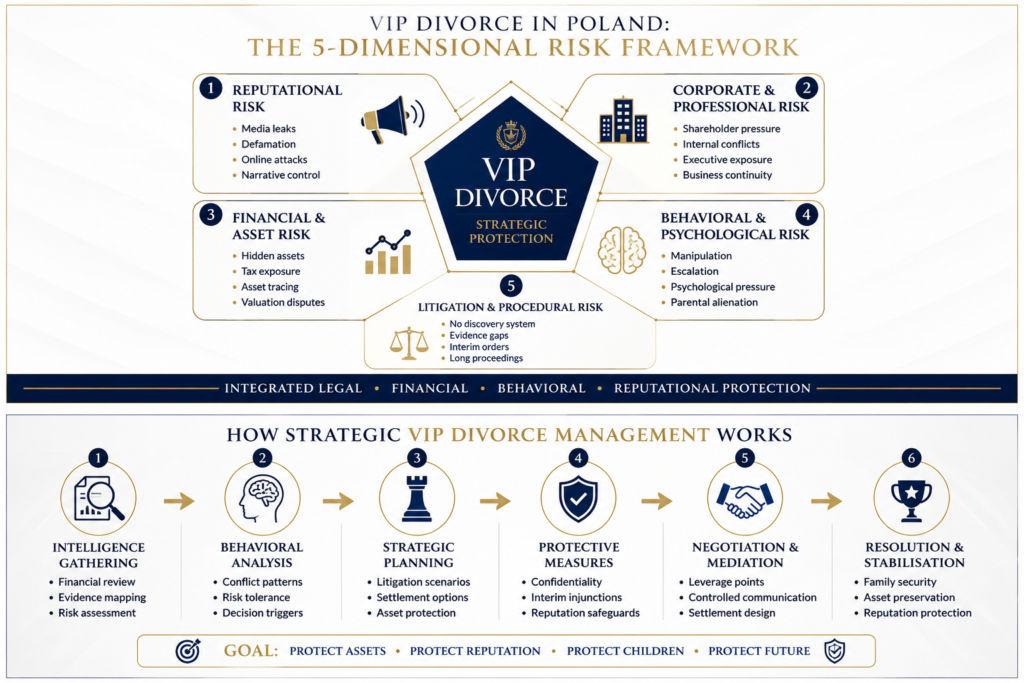
As demonstrated, our objective is always to achieve a confidential, amicable, and mutual settlement whenever feasible.
Case Study: High-Net-Worth Medical Partners and Corporate Asset Protection
This precise analytical and operational framework proved highly effective in a recent case involving high-net-worth clients—two medical doctors who co-owned and managed a renowned medical clinic. Both parties recognized from the outset that a “dirty divorce” would inflict devastating reputational damage, which is particularly catastrophic in the healthcare sector where patient trust is paramount.
Through our intervention, both sides quickly understood that an unconstrained conflict would result in mutually assured destruction. By deploying our strategic protocols, we successfully achieved the following:
- Immediate Narrative Control: We swiftly blocked emerging leaks and private information from surfacing in the public domain;
- Containment of Horizontal Escalation: We halted toxic tactical maneuvers at an early stage, preventing the recruitment of clinic employees, staff, and commercial contractors into the personal marital dispute;
- Establishing “Rules of the Game”: We negotiated a strict behavioral framework with the opposing counsel—a rare achievement in the typical realities of Polish family litigation. We clearly defined the boundaries of the remaining dispute and the precise legal instruments that each side was permitted to use.
Crucially, once both parties observed that the other side was consistently adhering to the agreed-upon rules, mutual trust began to rebuild. This stabilization created the necessary psychological and procedural space to engineer a final, comprehensive out-of-court settlement that fully secured the long-term interests of both parties.
Defining the VIP Client in Divorce Proceedings
In the context of matrimonial law, “VIP status” is not a matter of prestige, but rather an objective necessity for specialized, defensive services. This requirement stems from the client’s prominent professional, financial, or social standing when navigating a complex Divorce in Poland.
Divorce for Public Figures and Celebrities (Show Business, Politics, Sports)
A VIP client is anyone whose public exposure necessitates heightened image protection. In an era of instantaneous global media coverage, the professional longevity of public figures, politicians, and high-profile athletes is inextricably linked to their public reputation and compliance with international benchmarks.
In these cases, a VIP divorce encompasses far more than standard courtroom representation. It requires active media crisis management, the robust protection of personality rights, and swift, decisive legal action against disinformation, defamation, and privacy violations. Polish divorce proceedings are conducted in camera, without public access, which provides a strong baseline of confidentiality that we actively reinforce under international privacy standards.
Divorce for Business Leaders and Corporate Executives (Corporate Divorce)
The VIP tier also includes individuals who may not be household names but whose reputational stability is vital within their organization and among key commercial partners. This category comprises business owners, founders, and C-suite executives of major corporate entities.
During a marital crisis, these individuals often become targets of tactical maneuvers orchestrated by the opposing party, designed to undermine their corporate standing or standing among shareholders. We frequently encounter hostile public relations campaigns, deliberate provocations, or fabricated allegations aimed at proving that the executive is acting to the detriment of the company or failing to exercise due diligence. Our firm has developed structured protocols to mitigate the risk of corporate destabilization. Where appropriate, we implement protective corporate structures and strict confidentiality mechanisms, utilizing tools discussed in our comprehensive overview of the NDA in Poland and Contractual Penalties.
Divorce for High-Net-Worth Individuals (HNWI) & Complex Asset Division
Another critical group consists of high-net-worth individuals facing intense, multi-layered financial disputes. Under these high-stakes conditions, a thorough financial audit and division of marital assets become paramount. One of the most critical strategic choices early on is evaluating the impact of fault on asset division, spousal maintenance, and corporate standing. We guide our clients through these high-stakes decisions by analyzing the nuances of Fault vs. No-Fault Divorce options under Polish law.
We provide sophisticated legal counsel that includes tracing complex cash flows, analyzing separate versus marital property contributions, and meticulously establishing a realistic lifestyle analysis for alimony and child support determinations. We work in close coordination with specialized tax advisors to ensure that asset restructuring does not trigger unforeseen tax liabilities. Our team possesses extensive experience in protecting and dividing both traditional assets (real estate portfolios, corporate shares, fine art) and modern financial instruments, including cryptocurrencies and digital tokens.
VIP Divorce Risk Matrix: Key Threats and Strategic Countermeasures
The matrix below summarises the five dimensions of risk and the corresponding strategic countermeasures applied in VIP divorce cases.
| Risk Category | Typical Threats in VIP Divorce | Strategic Countermeasures | Relevant Tools & Procedures |
|---|---|---|---|
| Reputational Risk | Media leaks, defamation, hostile PR, online harassment, narrative manipulation | Controlled communication strategy; rapid legal response; personality-rights protection | PR consultants; cease-and-desist letters; injunctive relief; confidentiality protocols |
| Corporate & Professional Risk | Attempts to undermine position in company; fabricated allegations; provoked incidents | Pre-emptive documentation; internal-risk mapping; corporate-structure shielding | NDAs; contractual penalties; internal compliance procedures |
| Financial & Asset Risk | Hidden assets; complex structures; tax exposure; aggressive claims | Forensic audit; lifestyle analysis; asset-tracing; tax-neutral restructuring | Tax advisors; financial experts; valuation reports; cryptocurrency tracing |
| Behavioral & Psychological Risk | Manipulation, provocation, escalation, parental alienation | Behavioral profiling; conflict-pattern analysis; scenario planning | Psychologists; OZSS preparation; mediation strategy |
| Procedural & Litigation Risk | No discovery; evidentiary gaps; interim-order pressure; long litigation | Independent evidence building; early injunctions; mediation leverage | Interim injunctions; private investigators; AI-assisted data analysis |
A Strategy Anchored in Conflict Theory and Behavioral Analysis
A modern, high-stakes divorce cannot be confined solely to traditional litigation. Understanding the dynamics of complex strategic interactions, our firm implements advanced methods rooted in conflict theory (drawing upon classical strategic models such as Thomas Schelling’s game theory).
Poland does not have a discovery system, which fundamentally changes the evidentiary strategy. Since parties are not legally forced to disclose all documents automatically, building an independent evidentiary foundation is essential. To maintain an edge in data compilation and pattern recognition, we integrate modern technology into our workflow, leveraging AI in Family Law Cases to analyze vast amounts of financial and communication data.
By collaborating with specialized psychologists and behavioral analysts, we construct a lawful and highly accurate psychological profile of the opposing party. This strategic intelligence allows us to anticipate with high probability:
- The opponent’s risk tolerance or risk aversion;
- Preferred tactical maneuvers (confrontational escalation vs. defensive insulation);
- Critical leverage points where an amicable, out-of-court settlement becomes the most rational outcome for both sides.
By replacing guesswork with calculated behavioral data, we systematically navigate the strategic landscape to protect your interests.
Evidentiary Realities and Parental Matters in the Polish System
Navigating the Polish courts requires a deep understanding of domestic procedural reality. Because there is no jury, the strategy must be strictly tailored to objective, legal, and behavioral proof that satisfies a professional judge.
When children are involved, a priority is establishing clear custody and residency structures. You can learn more about how judges approach these determinations in our practical guide to Child Custody in Poland. Furthermore, high-profile divorces often trigger toxic litigation tactics, including parental alienation. We specialize in protecting the child’s psychological well-being and managing international mobility issues, specifically in Holidays Abroad with a Foreign Father and Defeating Parental Alienation Tactics in Polish Courts.
Expert opinions from the Court-Appointed Team of Expert Witnesses (OZSS – Opiniodawczy Zespół Sądowych Specjalistów) often play a decisive role in parental matters. We prepare our clients thoroughly for these evaluations, ensuring that behavioral and psychological indicators are accurately understood. Furthermore, we place a strong emphasis on the role of prelitigation mediation and the strategic application for interim injunctions (zabezpieczenie roszczeń). Securing financial maintenance or temporary child custody at the very beginning of the process prevents a war of attrition and stabilizes the conflict early on.
VIP Divorce: An Interdisciplinary Team of Experts
Effectively shielding a client’s interests requires a cross-functional network. Within our VIP protocols, our law firm coordinates a dedicated circle of external experts:
- Specialised PR Consultants – Deployed to neutralize hostile media narratives and maintain a strictly controlled, professional message;
- Private Investigators – Utilizing discrete investigative services to secure reliable, legally admissible evidence for court;
- Psychologists and Psychiatrists – Safeguarding the mental well-being of our client and providing specialized support for their children to minimize emotional trauma;
- Tax Advisors and Financial Experts – Guaranteeing structural and fiscal security during complex financial restructuring.
The Standards of Jakubiec & Partners Law Firm
At Jakubiec & Partners, absolute discretion, unyielding loyalty, and the emotional and legal security of our clients form our foundational pillars. We recognize that in VIP matrimonial matters, attorney-client privilege and strict confidentiality are paramount. Furthermore, the protection of the children’s best interests remains our ultimate priority, and we continuously strive to insulate them entirely from the adversarial process.
To gain a deeper understanding of our strategic approach to high-stakes family law, asset protection, and legal crises, you can listen to expert discussions on My Official Podcast on Spotify:
- 🎧 Listen here: The divorce of married business partners (My Official Podcast)
- 🎧 Listen here: Has a guilty-divorce any sense?
- 🎧 Listen here: The owner’s divorce as a reason of the company’s fall down
Seeking discreet, strategic matrimonial representation? We protect your assets, your reputation, and your future in full alignment with the Polish Law. Contact a Trusted Law Firm in Poland directly to schedule a private consultation and formulate your bespoke legal strategy: [Contact Jakubiec & Partners].
VIP Divorce in Poland. Frequently Asked Questions:
1. Are VIP divorce proceedings automatically closed to the public in Poland? Yes. Under Polish law, divorce cases are conducted behind closed doors (in camera) to protect family privacy. However, our VIP protocols implement additional, internal operational security measures to completely eliminate the risk of leaks from case files, court registries, or legal pleadings.
2. How does a behavioral profile aid in a divorce dispute without a US-style discovery system? Since Poland lacks a discovery system, we cannot force the other side to hand over hidden documents at the start. Behavioral profiling allows us to read between the lines, mapping out the opponent’s psychological triggers and decision-making patterns. Knowing their risk aversion helps us predict where assets might be hidden and precisely time negotiation leverage, frequently securing a favorable resolution without enduring years of draining litigation.
3. How are corporate assets and company shares protected during a high-stakes divorce? Asset protection relies on advanced business valuations, clear separation of pre-marital or gifted equity, and a deep analysis of corporate bylaws and shareholder agreements. We structure our strategy so that matrimonial claims cannot paralyze the day-to-day operations or liquidity of your business.
4. What role do interim injunctions (zabezpieczenie roszczeń) play in a VIP divorce? They are crucial. An interim injunction is a court order issued early in the proceedings to secure claims before the final judgment. In VIP cases, we use them strategically to instantly secure child support, temporary alimony, or use of a family residence, preventing the opposing party from using financial pressure as a weapon.
 by dr Andrzej Jakubiec - adwokat, mediator
Negotiations Between Partners: How to Resolve Internal Disputes?
Why Partner Negotiations Matter?
Negotiations between partners matter. Partners do not always agree on how to run a business. It is natural that there are differences of opinion regarding strategic decisions, profit sharing, or the role of individual partners. The key is not whether there will be friction, but how we deal with it. Whether we handle it skillfully or allow it to escalate into a conflict that can weaken, destroy the common business, or permanently harm one of the partners.
Risks of Court Disputes in Internal Business Conflicts
Courts as a Last Resort
What to do when a dispute arises? Of course, the “hard” solutions in the Code are a last resort. Involving the court in resolving an internal conflict is often ineffective. It takes time, energy, and costs — and the result is distant and uncertain. Most importantly, a court dispute frequently escalates tension because a court’s role is not to find a solution satisfactory to the parties. But to decide who is right, often in a zero-one way. This can also lead to significant image losses and further tension within the company. Especially in family businesses and closely-held partnerships.
The Power of Negotiation
Why Talk Instead of Litigate
The answer to resolving partner disputes is deceptively simple and often rejected automatically: we have to talk. Conversation and negotiation are not signs of weakness but of courage, maturity, and responsibility. Negotiations show openness to the other party’s interests, potentially generating reciprocity. They allow parties to attempt a joint solutioninstead of adopting a confrontational stance.
Negotiations can be tough and effective at the same time, but they always allow parties to express themselves and present their actual interests, which are usually much deeper than initial positions.
Benefits of Negotiated Agreements
Through negotiation, an agreement worked out jointly by the parties can be reached. Unlike an imposed court verdict — which inherently involves one party feeling “wronged” — negotiations solve the problem collaboratively. This gives each party a sense of ownership and responsibility for implementation, and it avoids revenge attitudes that often occur after court proceedings.
Effective Negotiations: Professional Support and Strategy
Role of Lawyers and Advisors
Negotiations are an art and — contrary to popular belief — do not rely on simple haggling. To negotiate effectively, it is valuable to use the help of a professional — such as a lawyer — who can help prepare for the meeting, support the talks, or even conduct them directly.
Professional advisors can help clarify legal issues, identify strengths and weaknesses in positions, and shape negotiation strategy. Their role is not to impose their views, but to help the parties achieve their goals.
For more detailed methods of avoiding and resolving disputes among partners, see this practical guide on negotiations and conflict management in Polish: https://www.inforlex.pl/dok/tresc,I02.2022.046.183000502,Raport-o-sporach-wspolnikow-Wnioski-z-analizy-tysiaca-orzeczen-sadow-powszechnych.html
Step-by-Step Negotiations between partners framework
Step 1: Prepare Thoroughly for Negotiations
Preparation is critical. It is estimated that at least half of professional negotiation time is spent on preparation. Identify the goals to be achieved, gather information about the other party, and define a strategy that takes into account both interests and possible scenarios.
This may include understanding concepts such as Zone of Possible Agreement (ZOPA) — the range where rational agreement is feasible — and knowing your BATNA (Best Alternative to a Negotiated Agreement). Wikip
Step 2: Find Common Ground
During negotiations, focus on common points and solutions that can satisfy both sides. Use arguments based on facts and figures to support your position and build credibility.
Step 3: Seek a Meaningful Compromise
If negotiations do not go as planned, seek a compromise. Do not concede on all issues, but avoid rigid insistence on every point. Remember that negotiation is a process of exchange, seeking asymmetries where possible and valuable.
Smart concessions — exchanges designed to further your goals while showing flexibility — can build trust and move discussions forward without compromising key interests. MAcceler
Step 4: Communicate Effectively
Communication is key. Listen carefully and ensure you clearly understand your partners’ positions. Clarify anything that is unclear. Pay attention not only to words but also to tone of voice and body language, which affect how messages are received.
Effective communication is essential to disagree without destroying professional relationships, as highlighted by experts in Forbes.
Step 5: Utilize Legal Support During Negotiations
A lawyer can play a crucial role during negotiations. He can help to clarify legal aspects, suggest issues to raise, and propose compromise solutions. A law firm’s support can range from advisory to active facilitation.
Alternatives and Complementary Strategies
When Negotiations Need Extra Help
Sometimes negotiations benefit from neutral third-party involvement — such as mediation or an impartial facilitator — especially if emotions are strong or direct talks stall. Third parties can offer fresh perspectives and help find common ground. Partnership for Transparency
For more on alternative dispute resolution techniques, including mediation vs negotiation, see this comprehensive external resource: 👉 Conflict Resolution Best Practices for Business Partnerships (English) Partnership for
You want to read more? You’re welcome here: https://www.pon.harvard.edu/daily/dispute-resolution/managing-conflict-in-house/
Summary: Negotiations between partners as Conflict Management
Effective negotiations between partners are challenging but essential for reaching compromise and avoiding conflict. Preparation, communication, finding common ground, seeking compromise, and appropriate professional support are the pillars of successful negotiation.
Involving the court should always remain the last resort. A court case is expensive, time-consuming, and uncertain. It decides who is right but rarely deals with the deep-seated causes of conflict. The true motivations and interests that underlie disputes are often inaccessible to a court, but negotiable at the table.
Negotiations between partners: Internal Links to my articles in polish
- Co robić, gdy druga strona nie chce rozmawiać? https://jakubieciwspolnicy.pl/narzucenie-rozwiazania/
- Jakie są przyczyny konfliktów w firmach rodzinnych? https://jakubieciwspolnicy.pl/spory-w-firmach-rodzinnych-jakie-sa-ich-przyczyny/
Talk Before the Conflict Escalates
If you are facing a dispute between partners, early negotiation support can significantly reduce risks and costs. Professional preparation and structured negotiations often allow partners to protect the business, their relationships, and their reputation.
Contact us to discuss your situation confidentially:
📩 Email: kancelaria@jakubieciwspolnicy.pl
📞 Phone: +48 536 270 935
Our law firm supports partners at every stage of negotiations. We prepare the strategy to active participation in talks or leading negotiations on behalf of clients.