

 by dr Andrzej Jakubiec - adwokat, mediator
JAKUBIEC & PARTNERS. A TRUSTED LAW FIRM IN POLAND
Are you looking for a trusted law firm in Poland? Foreign clients operating in Poland expect not only legal expertise, but also clear rules of cooperation and real guarantees of professional responsibility. We understand these expectations. Choosing a law firm in another country naturally raises questions about confidentiality, conflicts of interest, independence and financial security. To address these concerns, we have implemented solutions that make these issues transparent, measurable and predictable. In our firm you can find accountability, transparency and international standards.
NDA with a Contractual Penalty – it is our standard
Why are we a trusted law firm in Poland? At the client’s request, we sign a Non‑Disclosure Agreement that includes a contractual penalty (liquidated damages clause). This mechanism simplifies potential claims: in the event of a breach, the client does not need to prove the amount of damage — only that the breach occurred.
You can read more about our NDA’s philosophy: https://jakubieciwspolnicy.pl/en/nda-in-poland-contractual-penalty/
Written Conflict‑of‑Interest Statement
We provide a written declaration confirming that we have no business or personal ties to the opposing party. Transparency in this area is a core element of international professional standards.
Trusted Law Firm in Poland – Contractual Financial Liability
Our agreements may include a contractual penalty payable to the client in the event of a breach of confidentiality or a false conflict‑of‑interest statement. This ensures clear risk allocation and strengthens the security of cooperation.
Full Responsibility and Financial Stability. The Trusted Law Firm in Poland provides it.
The founder of the firm, attorney‑at‑law Dr. Andrzej Jakubiec, bears full and unlimited personal liability for obligations towards clients, as required by Polish law.
This responsibility is additionally secured by:
- professional liability insurance up to EUR 2.5 million, including contractual liability,
- the option to purchase an additional dedicated insurance policy for high‑value projects,
- full compliance with the Code of Ethics of the Polish Bar.
This combination of personal accountability and robust insurance protection provides clients with real financial security.
Experience with International Clients
We provide legal services to foreign companies operating in Poland. Our experience includes:
Switzerland – capital investments, support for technology startups, complex inheritance matters,
USA – IT contracts between American technology companies and Polish engineering teams,
France and Germany – shareholder disputes, transport law, intellectual property, ongoing corporate advisory,
United Kingdom and Sweden – capital investments, including in the technology sector, and multi‑layered business disputes,
Ukraine – legal support for agricultural and manufacturing companies.
A significant part of our practice involves shareholder disputes, conflicts in family‑owned businesses and projects requiring access to sensitive financial data, including due diligence processes.
Legal Expertise and Interdisciplinary Knowledge
Our dispute resolution and negotiation practice is grounded in strong academic preparation and an interdisciplinary approach.
The founder’s qualifications include:
a PhD in business law,
postgraduate studies in negotiation and mediation (University of Warsaw),
postgraduate studies in forensic psychiatry and psychology (University of Łódź),
ongoing education in behavioural analysis.
This combination of legal expertise and understanding of conflict dynamics allows us to conduct cases with attention to both formal legal aspects and the psychological mechanisms underlying disputes.
Contact Us
If you are looking for a trusted law firm in Poland that operates with ethics, clear rules of responsibility and transparent cooperation standards, we invite you to get in touch.
We will be pleased to discuss your project and the available confidentiality and contractual‑liability safeguards.
You can contact us by phone, email or through the form on our website:
📩 kancelaria@jakubieciwspolnicy.pl
📞 536 270 935
FAQ – Frequently Asked Questions
1. Can you provide a draft NDA?
Yes. We provide an NDA draft upon request. Clear rules for information protection are a foundation of our cooperation.
2. Does your insurance cover contractual liability, including penalties under an NDA?
Yes. Our professional liability insurance up to EUR 2.5 million covers contractual liability, including agreed liquidated damages.
3. Does the founder of the firm bear personal liability for obligations towards clients?
Yes. Under Polish law, an attorney running a law firm bears full and unlimited personal liability.
4. Is an NDA with a contractual penalty standard practice in Poland?
No, it is not common. In our practice, however, we treat it as an element of transparent risk allocation for international clients.
5. Can financial security be increased for large projects?
Yes. For high‑value projects, we can arrange an additional dedicated insurance policy.
How to find a trusted law firm in Poland? You can read also this text:
by dr Andrzej Jakubiec - adwokat, mediatorCONFIDENTIALITY AND NDAS IN POLAND
We do not sign NDAs because we doubt our team, our procedures, or our professionalism. We sign them because we are completely confident in all of these — and we want our Clients to see that.
NDA with contractual penalty? Yes, we do accept it.
We are a Polish law firm advising foreign companies, international investors and SMEs operating in Poland. We understand that confidentiality is not a formality — it is a fundamental business requirement. Sensitive commercial information, strategic plans, internal disputes, shareholder conflicts or financial data must remain fully protected.
Confidentiality is not only a contractual matter. Under Polish law, attorneys are bound by strict professional secrecy obligations. This statutory duty, combined with GDPR compliance and internal security procedures, forms the foundation of how we protect client information in every legal engagement.
NDA with Contractual Penalty – A Clear Allocation of Risk
We do not want to put anyone in the uncomfortable position of having to prove damages in court in order to recover losses caused by a breach of confidentiality. For that reason, we are prepared to sign a comprehensive Non-Disclosure Agreement (NDA) at the outset of cooperation. It includes a clearly defined contractual penalty mechanism where appropriate.
Under Polish law, a contractual penalty (kara umowna) simplifies enforcement: the injured party does not need to prove the precise amount of damage, only the fact of breach. In cross-border business relations, this predictability is often essential.
We are ready to agree on reasonable and proportionate penalty clauses reflecting the scale and nature of the project. This is not a symbolic gesture — it is a transparent allocation of risk and responsibility.
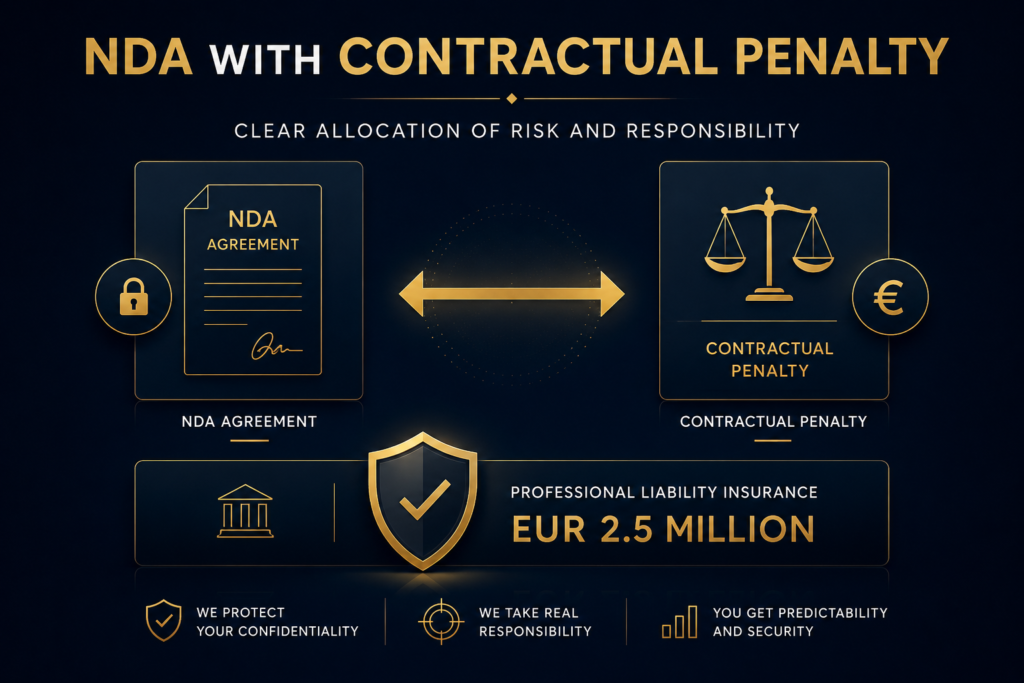
Such clauses are standard in international business practice, and we have no hesitation in accepting them within a professionally structured framework. Our professional liability insurance (EUR 2.5 million), which also covers contractual liability, provides an additional layer of financial security and ensures that any agreed responsibility is effectively backed by insurance coverage.
How We Protect Confidential Information
Our approach is simple and disciplined:
- we protect all data with strict internal protocols and controlled access systems,
- only authorised lawyers and team members involved in a specific matter have access to case materials,
- we maintain structured and traceable document management procedures,
- we apply GDPR-compliant data protection standards,
- we understand the commercial and litigation consequences of any breach of confidentiality.
In many disputes — especially commercial and corporate conflicts — improper handling of confidential information becomes a separate legal risk and may escalate the conflict itself. This is particularly relevant in M&A transactions, during Due Diligence processes, and in shareholder disputes, where access to sensitive financial and strategic data is central to the matter. Our role as legal advisors in Poland is not only to resolve disputes, but to prevent additional exposure.
Confidentiality as Part of Professional Ethics and Legal Services in Poland
Foreign clients often tell us that what they value most is not only legal expertise, but also discretion, predictability and accountability. We share this view.
Signing an NDA with a clearly structured contractual penalty is not a burden — it is a natural extension of:
- our statutory professional secrecy obligations under Polish law,
- our experience in cross-border legal services,
- our understanding of international compliance standards,
- and our commitment to secure, trustworthy cooperation.
If your business requires absolute discretion when operating or investing in Poland, we are prepared for it. Safeguarding your information is not just part of our work — it is a principle we stand by.
Contact Our Law Firm in Poland
Do you want to know how we work, discuss confidentiality arrangements, or request an offer for legal services? Feel free to contact us.
A conversation about the terms of cooperation is an opportunity for both sides to define expectations clearly and build a solid foundation of trust.
📩 kancelaria@jakubieciwspolnicy.pl
📞 +48 536 270 935
We know that confidentiality is the foundation of the attorney–client relationship worldwide. That is why we look to the highest international standards — such as the ABA’s guidance on confidentiality https://www.americanbar.org/groups/professional_responsibility/publications/model_rules_of_professional_conduct/rule_1_6_confidentiality_of_information/(americanbar.org in Bing — to ensure that our Clients receive the same level of protection.
NDA with contractual penalty. Frequently Asked Questions (FAQ)
1. Can you send us your NDA template?
Yes, of course. Please contact us and we will gladly provide a draft of our Non-Disclosure Agreement. For us, clear confidentiality terms are a foundation of professional cooperation.
2. Does your insurance cover contractual obligations such as NDA penalties?
Yes. Our professional liability insurance, up to EUR 2.5 million, also covers contractual liability, including obligations arising from agreed contractual penalties. This ensures that our commitments are financially secured.
3. Does the leader of your law firm bear personal liability toward clients?
Yes. Advocate Dr Andrzej Jakubiec, the founder of our law firm, bears full and unlimited personal liability for obligations toward our Clients. This reflects our approach to responsibility and professional integrity.
4. Is signing an NDA standard practice on the Polish legal market?
No. Many law firms in Poland are still reluctant to sign NDAs with contractual penalties. We are proud to do so. In our view, accepting clearly defined confidentiality obligations is a natural element of modern legal services for international business.
NDA in Poland – Jakubiec & Partners Key Standards, Risks & Protections
| Element | What it Means in Practice | Why It Matters | Our Standard |
|---|---|---|---|
| Confidential Information Definition | Precise scope: documents, data, strategies, financials, disputes, IP, internal processes. | Eliminates ambiguity and prevents loopholes in enforcement. | We define it narrowly, measurably, and in a way enforceable in cross‑border settings. |
| Contractual Penalty (Kara Umowna) | Fixed amount or proportionate penalty payable upon breach—no need to prove damages. | Predictability and fast enforcement, especially for foreign companies. | We accept reasonable penalties; our EUR 2.5M insurance covers contractual liability. |
| Professional Secrecy | Statutory attorney–client confidentiality under Polish law. | Stronger than any NDA clause; breach is a disciplinary and legal offence. | We combine statutory secrecy + GDPR + internal protocols for maximum protection. |
| GDPR & Data Security | Controlled access, encrypted storage, documented procedures, traceability. | Reduces risk of data leaks and regulatory exposure. | Only authorised team members access files; full audit trail and secure systems. |
| Scope & Duration | Clear timeframe, permitted use, and persons allowed to access information. | Prevents misuse and “scope creep” after project completion. | We set realistic, enforceable durations aligned with business risk. |
| Exclusions | Public info, independently developed data, disclosures required by law. | Avoids disputes over information that cannot be kept confidential. | We draft exclusions precisely to avoid abusive interpretations. |
| Return/Destruction of Data | Obligatory return or deletion of materials after cooperation ends. | Ensures no residual data remains in circulation. | We follow strict internal off‑boarding and data‑destruction procedures. |
| Liability & Insurance | Financial responsibility for breach + insurance coverage. | Guarantees real, not symbolic, protection. | EUR 2.5M professional liability insurance covering contractual liability. |
| Cross‑Border Predictability | Alignment with international standards (EU, UK, US practice). | Essential for investors and foreign companies entering Poland. | We draft NDAs compatible with international expectations and Polish enforcement. |
You can read about us here: https://jakubieciwspolnicy.pl/en/english-speaking-lawyer-in-poland-commercial-litigation-expert/
If you are courious, how do we perceive the shareholders disputes in modern conflict environment, read these two articles:
by dr Andrzej Jakubiec - adwokat, mediatorHOW TO FIND THE RIGHT LAW FIRM IN POLAND?
It is a Practical Guide for Foreign Companies. Choosing a law firm in a foreign jurisdiction is never simple. For international companies operating or entering the Polish market, the challenge is even greater: differences in legal culture, language barriers, unfamiliarity with court procedures, and uncertainty about enforcement standards may create real business risk. This guide provides foreign businesses with a practical framework for choosing a reliable, competent, and trustworthy law firm in Poland — particularly in the area of commercial litigation in Poland, dispute resolution in Poland, and cross-border enforcement in Poland. It is based not only on formal criteria, but also on real experience in representing foreign investors and SMEs in complex corporate and dispute matters.
1. English speaking lawyer in Poland
The base is to find an English speaking lawyer in Poland. For foreign companies, seamless communication is fundamental. A Polish lawyer should be able to:
- communicate fluently in business-level English (or German, French, Russian etc.),
- prepare bilingual contracts and pleadings,
- explain Polish legal procedures clearly and without unnecessary jargon,
- represent the client in negotiations and before Polish commercial courts.
A short introductory call is often enough to verify whether the lawyer is truly an English speaking lawyer in Poland, or whether communication will be filtered through intermediaries.
2. Look for Proven Experience With Foreign Investors
Cross-border representation requires more than language skills.
In my practice, I have:
- represented Swiss and UK investors in the acquisition of the Oscar-winning Se-ma-for Film Studio in Łódź,
- served on the supervisory board of Se-ma-for on behalf of foreign investors,
- handled joint venture disputes and shareholder conflicts,
- represented foreign clients (including from Sweden and France) in family-business conflicts involving commercial structures,
- established companies in Poland for German and Ukrainian entrepreneurs,
- structured M&A transactions and investor agreements as a PhD in commercial law.
These matters required not only knowledge of Polish corporate and civil procedure law, but also an understanding of how foreign investors assess legal risk, governance standards, and strategic exposure.
When choosing a law firm, ask for specific examples of cross-border experience — not general declarations.
3. Experience in Commercial Litigation and Shareholder Disputes
Many foreign companies seek assistance only once a conflict has escalated: unpaid invoices, breach of contract, deadlocked joint ventures, or shareholder disputes. Effective representation in commercial litigation in Poland requires:
- strong courtroom experience,
- strategic use of interim measures,
- familiarity with evidentiary rules under the Polish Civil Procedure Code,
- experience in shareholder disputes and corporate governance conflicts,
- knowledge of enforcement mechanisms through Polish bailiffs.
The Mediation and Negotiation Advantage: Litigation, however, is not always the optimal path. In many cross-border disputes, a carefully designed negotiation strategy or mediation process can significantly reduce financial and reputational risk. Early strategic intervention often determines whether a matter escalates into full-scale litigation or is resolved through structured settlement discussions.
I completed postgraduate studies in Negotiations, Mediations, and other Alternative Dispute Resolution (ADR) methods at the University of Warsaw: https://wpia.uw.edu.pl/pl/studia/studia-podyplomowe/podyplomowe-studia-negocjacji-mediacji-i-innych-alternatywnych-metod-rozwiazywania-sporow, as well as postgraduate studies in Forensic Psychiatry and Psychology at the University of Łódź: https://www.wpia.uni.lodz.pl/psychiatria. To further refine my strategic approach to conflict, I am currently continuing my professional development at the Behavioral Analysis Studies in Wrocław: https://sie.edu.pl/analiza-behawioralna/#Opis.
I am also a member of the Advocates’ Mediation Center at the District Bar Council in Łódź: https://lodz.adwokatura.pl/adwokackie-centrum-mediacji/mediatorzy/
4. Understand the Real Concerns of Foreign Clients
Foreign entrepreneurs often express specific concerns:
- unpredictability of court practice,
- duration of proceedings,
- litigation costs,
- reliability and accountability of local counsel.
I am personally familiar with these concerns.
Predictability and Timelines
I outline realistic timeframes and procedural stages at the outset of every case. While no responsible lawyer can guarantee the duration of court proceedings, it is possible to explain procedural milestones, likely evidentiary phases, and potential appeal scenarios.
Cost Transparency
I provide a clear cost structure and explain which elements are predictable (court fees, standard procedural costs) and which depend on developments during litigation. Clients receive a structured estimate and ongoing updates to avoid financial uncertainty.
Professional Accountability
As a Polish attorney, I bear personal professional liability. I guarantee the quality, integrity, and diligence of our work with my own name and assets. My professional liability insurance coverage amounts to EUR 2.5 million.
5. Independence and Conflict-of-Interest Procedures
Foreign companies should always request:
- a written conflict-of-interest check,
- confirmation of independence,
- written engagement terms.
Professional dispute resolution in Poland requires strict compliance with ethical and procedural standards.
6. Choose a Firm That Matches Your Scale
In our experience representing foreign SMEs in Poland, the most common strategic mistake is choosing a law firm that is too large — primarily because of brand recognition.
The Risk of Over-Scaled Structures
In such firms:
- the client often pays high hourly rates,
- the matter is delegated to a junior associate with limited courtroom experience,
- the well-known partner signs off but is not deeply involved.
Direct Partner Involvement
For many foreign SMEs involved in disputes or cross-border enforcement in Poland, a specialized boutique firm provides:
- direct partner involvement,
- strategic consistency,
- proportional cost structure,
- real courtroom experience.
Before instructing any firm, ask directly:
“Who will personally conduct representation before Polish commercial courts?”
The answer is decisive.
7. Transparency in Corporate and Transactional Work
As a PhD in commercial law, I have extensive experience in:
- company formation in Poland,
- drafting shareholder agreements,
- structuring M&A transactions,
- preparing investor agreements,
- designing joint venture frameworks.
I place particular emphasis on clarity of contractual provisions and transparent cooperation rules with clients. Many shareholder conflicts originate from ambiguous clauses drafted without anticipating dispute scenarios.
Preventive structuring is often more valuable than litigation.
8. Cultural Awareness in Dispute Resolution
Disputes are not only about statutes and procedural codes. They also concern negotiation culture.
Companies from Germany, Switzerland, the UK, France, Scandinavia, the US or Ukraine often differ in:
- risk tolerance,
- documentation standards,
- approach to settlement,
- internal decision-making dynamics.
Effective dispute resolution in Poland requires understanding these differences and aligning litigation strategy accordingly.
9. Practical Verification Checklist
Before hiring a Polish law firm, consider:
- Does the firm have real cross-border experience?
- Who will personally handle your case?
- Does the lawyer have litigation experience?
- Has the firm handled shareholder or joint venture disputes?
- Are costs and procedural risks explained transparently?
- Is the firm experienced in cross-border enforcement in Poland?
- Is communication direct and structured?
10. Common Mistakes Foreign Companies Make
- Selecting a firm solely based on brand size.
- Assuming all lawyers speak fluent English.
- Not verifying who actually conducts representation.
- Ignoring litigation experience.
- Contacting a lawyer too late.
- Failing to monitor registered address data in the KRS.
- Underestimating enforcement risks.
Avoiding these mistakes significantly improves your position in any commercial dispute in Poland.
Jakubiec & Partners – Your Trusted Partner Across Poland
We support international clients across major Polish business hubs. We offer clear, practical guidance tailored to SMEs investing, operating, or resolving disputes in Poland. Whether you are entering the Polish market, managing a shareholder conflict, or seeking to recover assets, we provide strategic legal representation grounded in experience and analytical precision.
Contact us today to discuss your business objectives in Poland or to schedule a strategic legal consultation. English speaking lawyer in Poland:
📩 kancelaria@jakubieciwspolnicy.pl
📞 536 270 935
You can read more about us here: https://jakubieciwspolnicy.pl/en/cross-border-commercial-disputes-in-poland-jakubiec-partners/
and here you see my text about shareholders disputes in three-person companies: https://jakubieciwspolnicy.pl/en/what-does-j-mearsheimer-teach-us-about-shareholders-conflicts/
FAQ – Foreign Companies and Legal Disputes in Poland
How long does commercial litigation in Poland usually take?
First-instance proceedings often last between 12 and 24 months, depending on complexity and evidentiary scope.
Can proceedings before Polish commercial courts be conducted in English?
Court proceedings are conducted in Polish. Documents in foreign languages require certified translations.
Can a foreign company sue in Poland without a Polish subsidiary?
Yes, if jurisdiction exists under EU regulations or applicable private international law rules.
How are foreign judgments enforced in Poland?
EU judgments are generally enforceable after formal recognition. Non-EU judgments require separate recognition proceedings before enforcement.
What are typical litigation costs?
Court fees are statutory and predictable. Legal fees depend on scope and complexity. A structured cost estimate should always be provided at the outset.
by dr Andrzej Jakubiec - adwokat, mediatorLEGAL SUPPORT FOR FOREIGN SMES OPERATING IN POLAND
We are english‑speaking lawyers in Poland. Jakubiec & Partners is a Polish law firm specializing in cross-border commercial disputes and strategic legal advisory for international SMEs operating in Poland. Based in Łódź, with a strong presence in Warsaw and representation capabilities throughout Poland, we advise and represent foreign entrepreneurs who require not only legal compliance, but also strategic clarity in a complex regulatory and negotiation environment. For 17 years, our founder has worked with approximately 60 foreign companies from, among others, the United Kingdom, Germany, Switzerland, France, and Turkey. We support international SMEs both in day-to-day corporate matters and in high-stakes commercial disputes before Polish courts and arbitration tribunals.
Who we help?
We support international SMEs that operate in Poland or are involved in commercial disputes with Polish counterparties.
Commercial Disputes and Strategic Legal Advisory in Poland
Our Practice Focuses On:
- Cross-border commercial disputes in Poland
- Strategic negotiation structuring in complex cross-border business conflicts
- Corporate advisory for foreign investors
- Commercial litigation, mediation, and asset recovery in Poland
- Risk mitigation and dispute prevention strategies
Business Entry, Operations & Growth
We assist foreign entrepreneurs in navigating the complexities of Polish business law, ensuring secure and compliant operations from day one.
Our services include:
Company Formation & Market Entry: Establishing subsidiaries, branches, and representative offices aligned with your long-term strategic objectives.
Corporate & Shareholder Matters: Advising on shareholder disputes, joint ventures, corporate governance issues, and internal restructuring.
Mergers, Acquisitions & Joint Investments: Legal support in negotiations concerning the acquisition of commercial companies, joint ventures, and strategic partnerships.
Commercial Real Estate: Legal due diligence, negotiation, and oversight of property acquisitions and commercial lease agreements.
Employment & Compliance: Drafting employment contracts, advising on HR policies, and ensuring compliance with Polish labor regulations.
We regularly advise foreign clients in payment disputes (claims for receivables), corporate conflicts, and strategic governance matters.
Cross-Border Disputes & Strategic Negotiations
For international companies facing disputes with Polish contractors, suppliers, shareholders, or business partners, we provide a structured and analytically grounded approach. Our firm has extensive experience in complex business negotiations, particularly in:
- Shareholder conflicts and disputes within joint ventures
- Deadlocks in strategic investment projects
- High-value commercial disagreements
Our founder previously served on the Supervisory Board of the Oscar-winning animation studio Se-ma-for Sp. z o.o.: https://en.wikipedia.org/wiki/Se-ma-for, representing a Swiss / British investor. This role required navigating sensitive cross-border corporate dynamics and investor protection issues.
In addition to a PhD in Commercial Law and postgraduate studies in Negotiation and Mediation (University of Warsaw): https://wpia.uw.edu.pl/pl/studia/studia-podyplomowe/podyplomowe-studia-negocjacji-mediacji-i-innych-alternatywnych-metod-rozwiazywania-sporow as well as Forensic Psychiatry and Psychology (University of Łódź), our founder completed the Cycle de Droit Comparé at Université Robert Schuman in Strasbourg: https://pl.wikipedia.org/wiki/Université_de_Strasbourg_III. He is currently undertaking advanced studies in behavioral analysis in Wrocław: https://sie.edu.pl/analiza-behawioralna/#Opis, focused on business and organizational conflict, further strengthening our analytical framework for understanding conflict dynamics.
Dr. Jakubiec is also a Certified Mediator. He is officially registered on the List of Permanent Mediators maintained by the President of the District Court in Łódź (official registry link).
What do we apply?
- Strategic negotiation structuring and conflict de-escalation techniques
- Analysis of counterpart’s behavioral patterns
- Litigation strategy aligned with business objectives
This interdisciplinary approach enables us to effectively manage negotiation stalemates and dispute escalation. We provide a long-term strategic perspective rather than focusing on a purely procedural one.
Our founder regularly publishes on negotiation dynamics, AI in disputes, and behavioral aspects of commercial conflict.
Furthermore, Dr. Jakubiec is the architect of the Coupled Confirmation Bias (CCB) framework. He developed this concept to explain the phenomenon of rapid dispute escalation observed in his practice. Particularly in scenarios where both parties utilize AI to interpret the counterparty’s intentions and design their own strategic moves. You can explore his in-depth analysis of CCB here: The Coupled Confirmation Bias
and CCB Part 2
Litigation, Arbitration & Asset Recovery in Poland
When litigation becomes necessary, we provide rigorous representation before Polish courts and arbitration tribunals.
Commercial Litigation in Poland: Representation in payment claims, contractual disputes, shareholder conflicts, and corporate litigation.
Mediation & Alternative Dispute Resolution (ADR): Strategic mediation support aimed at preserving business value while resolving disputes efficiently.
Securing Transactions & Risk Mitigation: Preventing disputes before they arise through carefully structured contracts and enforcement planning.
Asset Tracing & Recovery in Poland: Identifying, securing, and recovering debtor assets within the Polish jurisdiction.
Enforcement Proceedings: Efficient navigation of enforcement mechanisms under Polish law to ensure successful recovery of claims.
Why International SMEs Choose Us in Poland?
Strategic Approach: Deep understanding of Polish enforcement mechanisms and procedural strategy.
Conflict Resolution: Experience in complex negotiation stalemates, particularly in shareholder and joint venture disputes.
Multilingual Communication Without Intermediaries: Direct legal support in English and French, with additional assistance in Russian.
Global Perspective: Cross-border experience gained through long-term cooperation with foreign investors and international SMEs.
Jakubiec & Partners – Your Trusted Partner Across Poland
We support international clients across major Polish business hubs. We offer clear, practical guidance tailored to SMEs investing, operating, or resolving disputes in Poland. Whether you are entering the Polish market, managing a shareholder conflict, or seeking to recover assets, we provide strategic legal representation grounded in experience and analytical precision.
Contact us today to discuss your business objectives in Poland or to schedule a strategic legal consultation:
📩 kancelaria@jakubieciwspolnicy.pl
📞 536 270 935
FAQ
1. Can a foreign company pursue a commercial claim against a Polish contractor?
Yes. Foreign SMEs can file commercial claims in Poland, and Polish courts regularly handle disputes involving international parties. We represent foreign companies throughout the entire process, from pre‑litigation strategy to enforcement.
2. How long does commercial litigation in Poland typically take?
Most commercial cases take between 8 and 18 months in the first instance, depending on complexity and the court’s workload. Well‑prepared filings and strategic case management can significantly shorten the timeline.
3. Can a foreign judgment be enforced in Poland?
Yes. Judgments from EU countries are enforceable under EU regulations, while judgments from non‑EU jurisdictions may require recognition by a Polish court. We handle both recognition and enforcement proceedings.
4. What documents are needed to start a dispute in Poland?
Typically: the contract, correspondence with the Polish counterparty, invoices, proof of delivery or performance, and any settlement attempts. We assist clients in preparing a complete evidentiary package.
5. Do you provide legal support directly in English or French?
Yes. We offer direct legal support in English and French, without intermediaries. We also provide assistance in Russian through a lawyer with a background in Russian philology.
6. Are out‑of‑court dispute resolution methods effective in Poland?
Yes. Our firm has extensive experience in resolving disputes through mediation and structured negotiation. We also represent clients in arbitration proceedings. These methods help avoid the natural risks of court litigation, reduce procedural costs, and typically lead to significantly faster outcomes.
by dr Andrzej Jakubiec - adwokat, mediatorSTUDY: AI AS A HIDDEN ALLY IN DISPUTES?
Below is a report from a study conducted in January 2026. We gathered information on how people use AI to analyze their disputes. The results proved to be very interesting.
AI’s Role in Disputes Report (January 2026): Hidden Advisor or Error Generator? What did we do?
We conducted a survey completed by 87 participants. This group included our clients, lawyers, mediators, and business leaders. It also involved psychologists and people from the fields of science and art. Consequently, this is not a nationally representative sample. However, it represents a group with high awareness of conflict essence. These individuals can critically evaluate their own reasoning.
I designed the survey myself. After its distribution, some participants provided technical feedback on the questions. I appreciate these comments. Therefore, I will include them in future studies. I certainly plan to conduct more research soon.
What was the focus of the AI survey?
The questions concerned general AI usage. We also focused on analyzing family, work, and business situations. This includes the stage before a formal dispute arises.
Furthermore, we asked about analyzing the other party’s intentions. This element is highly susceptible to the fundamental attribution error. When combined with AI hyper-alignment, it generates a so-called feedback loop. This is a confirmation trap that leads to tunnel vision.
Next, I asked about using AI to determine one’s own actions. I deliberately did not specify if this meant the first move or a reaction. However, the most important question concerned transparency. I asked if participants would inform the other side about using AI. Surprisingly, the respondents showed remarkable consistency here. The conclusions from this remain an open question.
The final two questions concerned trust in AI. Although they were similar, the results were intriguing. Trust in AI does not match the assessment of its objectivity. It seems we know AI is not objective, yet we tend to trust it.
How did the participants respond?
Below are the “raw” questions and answers.
Do you use AI LLM models?
(Blue – yes, red – no)
87 answers

Do you use AI’s LLM to analyze family, employment or business?

Which of these relationships do you use AI to analyze? Family, work, business, or other?

Do you use AI’s LLM to analyze the other party’s intentions?
(blue – yes, red – no)

Do you use AI to design your own moves in an dispute?
(blue – yes, red – no)

Would you inform the other side of the dispute that you are using AI to analyze and predict their behavior or prepare your own moves?

Do you trust artificial intelligence analyses?
(blue – yes, red – no, yellow – partly)

Is AI objective?

Analysis of the Responses
The vast majority of participants use AI. Certainly, they do so to varying degrees. Their topics of interest are also not the same. Nevertheless, the widespread use of language models is a fact.
Specifically, 43% of respondents use AI to analyze family or business situations. In my opinion, this is a high number. Interestingly, business analysis was the most common. Family situations were the least frequent. Meanwhile, 29% of people pointed to other areas. Here is a link to an article on AI in family disputes: [Link]
A significant majority (81%) did not try to determine the other party’s intentions via AI. Is this a high number? On the contrary, almost 20% of people do try. This means every fifth person is vulnerable to the AI feedback loop. AI tends to “agree” with the user, reinforcing their original bias.
Furthermore, 25% of respondents use AI to plan their moves in a dispute. This discrepancy with the previous question is interesting. Perhaps 5% of us use AI for planning without analyzing the other side’s intentions. It is unclear if these are the same participants. This might result from ignoring psychological aspects or simply focusing on the “matter” of the case.
Significantly, 80% of us would not inform the other side about using AI. Why is that? Do we consider it unfair, like “technological doping”? Perhaps we view it as a superstition and feel slightly ashamed. Or maybe we believe we have a technological advantage and want to keep this powerful weapon secret.
Do we trust AI?
The last two questions yielded astonishing results. While 75% of us use AI, 67% believe it is not objective. Why then do we use it? Perhaps to reinforce our own beliefs. After all, it feels good when technology says: “That’s a great idea, Andrzej!”. We might simply pretend not to see the lack of objectivity. Alternatively, we may feel that AI is biased, but it is “on our side.” This correlates with the fact that most respondents partially trust AI.
Conclusions
AI has become a common tool. It shapes our attitudes in many areas of life. Certainly, its influence is felt in the disputes we handle. Interestingly, we also see it in the analysis of the situation’s structure. This can lead to a desire to change the status quo. Consequently, it may even trigger the dispute itself.
My previous publications on AI in disputes
Below are links to articles regarding AI’s impact on dispute dynamics. I presented my original concept of Coupled Confirmation Bias (CCB) there. These texts include references to the latest research in prestigious journals. They cover psychology, technology, and the role of AI in creating tunnel vision.
I recommend a key article by Yiran Du: Confirmation Bias in Generative AI Chatbots. It analyzes confirmation bias mechanisms in AI models. You can read about the risks of this coupling here: https://arxiv.org/abs/2504.09343?
I applied this research to situations where both parties use AI. One party’s actions, determined by their AI, become the input for the other party’s AI. This prompts a specific, often escalated response. This escalation seems particularly dangerous.
For those interested, here is the link to the English version of my article on CCB: https://jakubieciwspolnicy.pl/en/coupled-confirmation-bias-2/ and the main text in polish: https://jakubieciwspolnicy.pl/sprzezony-blad-konfirmacji/
Invitation to Cooperation
If you are a party to a dispute, you may need strategic advice. I and my team deal with more than just the law. We conduct negotiations based on psychology, economics, and behavioral analysis.
If you have experiences with AI in disputes, please contact us. We would love to hear your story. It might serve as valuable material for our research. We ensure full anonymity.
Email: kancelaria@jakubieciwspolnicy.pl
Phone: 536 270 935
 by dr Andrzej Jakubiec - adwokat, mediator
WHEN DISPUTANTS USE DIFFERENT AI MODELS
I recently introduced the concept of Coupled Confirmation Bias (CCB). Now, we must examine how different LLMs affect dispute dynamics. I distinguish between two main groups: American and Chinese AI models. This is a simplification used to present a specific problem. This distinction is not based on technology. Language models carry tendencies rooted deeply in the cultures of their creators.
Cultural AI Models: Types of Language Models
Let us assume two basic cultural AI models: American and Chinese. This division describes communication styles, not technology. Language is strictly tied to culture. Language models aim to build and maintain relationships with users. They do this by predicting the next word. However, this process is not neutral. It is influenced by the cultural values of the developers. It also depends on the user’s chosen language. Finally, it reflects the user’s native way of thinking.
American language models operate within a different conceptual grid. This stems from natural semantic differences. They also lead conversations differently. Interaction in Western and Eastern cultures has different goals. American culture values individualism, competition, and being right. Chinese culture prizes harmony, collectivism, and politeness.
A central example is the approach to “saving face.” Models with different conversational styles impact how users perceive a dispute. An LLM is not just a “word machine.” It is a carrier of values. American AI may promote an adversarial system. Chinese AI may promote a consensus-based approach.
Mutual Perception and Different Language Models
In CCB, each party filters the other’s actions through their own cultural model. The AI model reinforces this filter. This creates a spiral of mutual errors.
Imagine one party uses an American LLM and the other a Chinese one. Their worldviews will differ. Their language, questions, and goals will also differ. Every language has specific patterns and taboos. Some things are obvious; others must remain unsaid. These are low-context (American) and high-context (Chinese) cultures.
In some cultures, assertiveness and confrontation are values. In others, harmony and hierarchy are more important than being right. Cultural models reinforce the attitudes deemed desirable in those societies.
Users from different cultures will describe the same event differently. Furthermore, AI consultations may produce opposite results. This overlaps with the fundamental attribution error and confirmation bias. We must also consider AI hyper-utility. This is the tendency of models to be “too helpful.” They provide answers that reinforce the user’s false assumptions. Shared cognitive space may quickly disappear.
The Critical Point
In CCB, the critical point occurs when interpretations diverge completely. Every reaction from one side is seen as an escalation by the other. Shared cognitive space vanishes faster than in traditional conflicts.
The critical point is a specific moment. One party maintains a mature, relational strategy. They try not to be provoked. Eventually, this strategy is seen as losing face. The other party may escalate repeatedly. They violate the need for harmony and politeness. This leads to an unintended, uncontrolled explosion. Passive behavior is finally viewed as total failure. A 180-degree turn in strategy follows.
This critical point may differ from the “ping-pong” effect described earlier. We can visualize ping-pong as a corridor. There, “pleasantries” bounce from side to side, gaining momentum. In this model, it looks more like a triangle. Its height grows with the escalations of one party. Eventually, the triangle is torn apart by the pressure.
Cultural AI Models: Literature
For more on these issues, read “The Geography of Thought” by R. Nisbett. See also “Babel” by G. Dorren and “The Age of Unpeace” by M. Leonard. These books were my starting point for cultural differences in conflicts. Of course, nothing replaces T. Schelling’s “The Strategy of Conflict.” It is one of the most important books ever written.
Evidence that models adopt cultural values can be found here: “Cultural Alignment in Large Language Models” (Johnson et al., 2023/2024): https://globalaicultures.github.io/pdf/14_cultural_alignment_in_large_la.pdf
Studies also confirm that Chinese models avoid open conflict more than American ones: https://arxiv.org/abs/2402.10946. See “CultureLLM: Incorporating Cultural Differences into Large Language Models.” Similar conclusions appear in “Values-aligned AI: Comparing Western and Chinese LLMs on Moral Dilemmas” (Liu et al., 2024): https://arxiv.org/html/2506.01495v5
If you want to read more about Coupled Confirmation Bias (CCB), see my previous articles: