

 by dr Andrzej Jakubiec - adwokat, mediator
The Decision to End a Business Partnership is a Process
I know people who stay for years in relationships that drain them, limit them, and take away their joy in life. By “relationships” I mean family relationships, intimate relationships, and business cooperation (regardless of its legal form). In this article, I will focus on the decision to end cooperation with a business partner.
I know something about this. I have made such decisions myself when I wanted to end cooperation with my partners. Someone once made such a decision about me. I also decided to leave the University of Łódź, which was very difficult, but something pushed me to do it. And finally, I have advised on such matters hundreds of times as a lawyer. Initially, I focused on legal aspects, but the psychological knowledge I gained over time allowed me to look at these issues much more broadly. Today I know that the law is only a tool — it sets certain boundaries that must be taken into account, like trees when we run through a forest. But they do not determine our decision to run, the route, the pace, or whether it will be a single run or become our routine. Most partners don’t leave because they can’t for legal reasons — they stay because they don’t understand the decision mechanism.
Is Ending a Partnership Something Bad?
No. You have the right to end any cooperation. If you feel that this time is coming to an end, you have the moral right to use the legal tools that serve to end that cooperation. You do not need to feel any guilt because of it. Companies and contracts define people’s behavior for a certain period of time. People agree to this because they assume that during that time, cooperation will benefit them more than the lack of cooperation. If for any reason that assessment has changed, you can end the cooperation.
The Law Does Not Recognize Contracts That Bind Us Forever
Every legal relationship can be terminated — from an employment contract, through a commercial company, to marriage. It does not always mean ending it without cost or immediately, but in most cases it is possible. The law confirms the rule of the “temporariness” of cooperation by allowing contracts to be terminated so that we can use this possibility. Without guilt. Without shame.
If you remain in a relationship against yourself, feeling that you are losing in it, then someone is probably parasitizing on you and wants it to last forever. After all, they gain a lot with very little effort — at your expense.
What Drives Us to Make the Decision to End Cooperation?
Professional reports state that the most common cause of conflicts between partners is financial issues. I agree — but only partially. I believe that the financial area is where deeper causes of conflict most easily concentrate, and it is also the easiest to explain to everyone around. But if those deeper causes did not exist, there would usually be no financial dispute at all. Today, let’s look at how to make the decision to part ways without analyzing the cause or the level at which the conflict has grown.
Three Elements of the Decision to End Cooperation with a (Business) Partner
In modern psychology there is a lot of decision making models. Here I’ll present you one of them: simple and elegant Fogg’s Decision Making Model. The matter turns out to be quite simple with this model. To make a decision, three elements must occur:
- motivation
- ability (perceived ease)
- a trigger — an impulse to act
Importantly, all three elements must occur together. If even one is missing, the decision will not be made.
Motivation to Exit the Company and End Cooperation
What is motivation? Motivation is a state resulting from our emotions that make us strive for something or avoid something. Motivation has an affective, biological basis. Its social and psychological aspects are secondary. And that’s good — because it makes the matter much simpler. If we function well, we are motivated to achieve what is good for us and avoid what is bad for us. Yes, we can make mistakes in judgment, but that is another issue.
Assessing the Difficulty of the Decision to End Cooperation
Ability — or our assessment of how difficult the action is — is a key factor. We must remember that we tend to rationalize and justify passivity because it is convenient for us. Change requires effort, so our mind subconsciously suggests that we should like the situation we are in. It does this in two ways: it tells us that “here” is good and that “there” is bad, dangerous, uncertain. This means that we deceive ourselves into believing that change is harder than it really is. We do this out of laziness and we are brilliantly creative at it.
The Impulse to Act
The trigger is the impulse to behave in a certain way, to make a decision. We say that “the last drop spilled the cup.” A trigger can be almost anything, but most often they appear regularly — we just silence them when we lack motivation or when the change seems associated with real or imagined difficulties. When motivation appears and the task becomes realistically possible, we only need to wait for the trigger. But if motivation is lacking or the task seems too difficult, the trigger will not cause action.
The Fogg Curve — When Do We Make the Decision (to Exit the Company)?
What is the Fogg’s decision making model? The factors influencing our decisions can be presented graphically using the Fogg Curve. It looks like this:
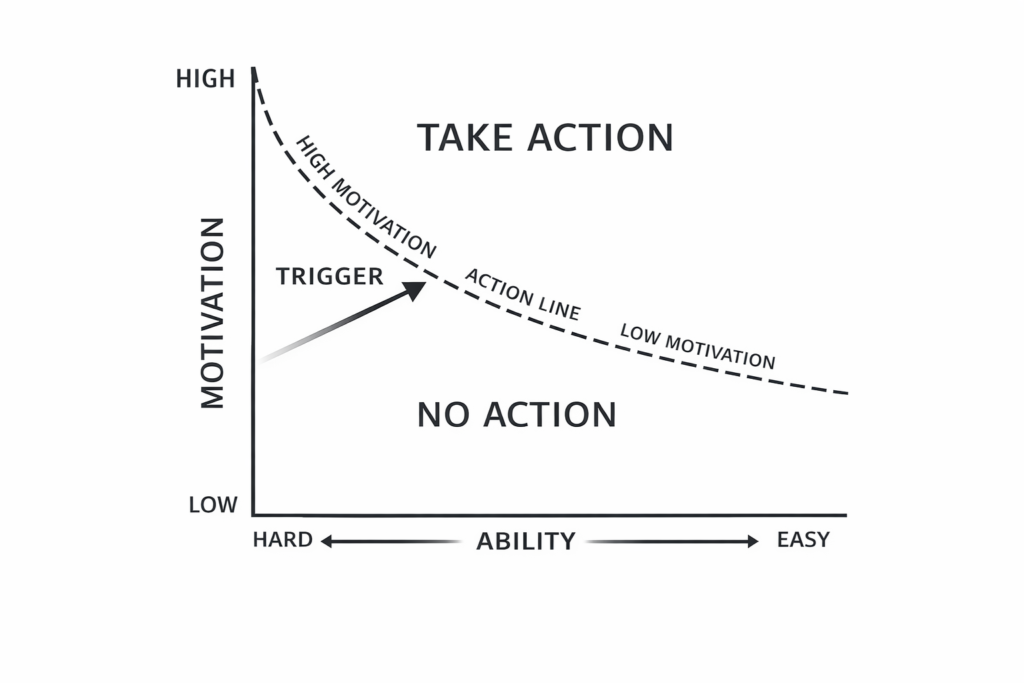
We can see that:
- we are likely to make a decision if we have high motivation and the task is easy (as long as a trigger appears);
- we are unlikely to act if we have low motivation and the task is difficult (even if a trigger appears).
The Decision to End Cooperation. What Should Make You Reflect on Ending Cooperation?
Intuition
Our strongest weapon and unconscious competence. When I listened to it, I succeeded; when I ignored it, I got into trouble. Only deeper studies in psychology and behavioral analysis made me understand how powerful a tool each of us has. And I write this with full responsibility also as a lawyer.
Guilt
Especially if it is being induced in you by your partner — this is a clear red flag. Making you feel guilty is one of the strongest mechanisms of manipulation.
Lack of space to talk about what matters to you
Caring for the relationship between partners is as important as in a marriage. If you do not talk about your fears, plans, ambitions, it means things are already very bad.
Being promised the future
Plans must be:
- real,
- measurable,
- time‑bound,
- concrete.
If they are not, and your partner only tells you to “work hard so that someday it will be better,” then change the plan — or the partner.
You get nothing out of it
We work for a purpose. If you feel that you give everything, but in this personal arrangement your energy, time, and abilities are being burned — let it go. You have only one life; you can have many partners.
If some of these points apply to you, it means you are aware that you are stuck somewhere you do not want to be. And that is already the basis for change.
Deadlock
Deadlock is one of the most destructive situations in business relationships. It is not just a red flag — it is a structural breakdown.
When shareholders hold equal power, even simple decisions can become impossible. As a result, the company may stop functioning altogether while the conflict continues to escalate.
Deadlock occurs when the conflict itself becomes more important than the business. At that point, rational decision-making is replaced by control, ego, and escalation.
This is the moment when waiting becomes the most expensive strategy.
Red Flags and Their Meaning When Deciding to End Cooperation
| Red flag / warning sign | How it looks in practice | What it means psychologically | Consequences for you and the company |
|---|---|---|---|
| Intuition says “something is wrong” | Unexplained tension, discomfort, the feeling that “something is off” | Intuition is unconscious analysis — a signal that your brain sees danger | Ignoring intuition leads to years of losses and burnout |
| Guilt induced by the partner | Suggestions like “you won’t manage without me,” “you’ll let the company down” | Classic manipulation and a tool of control | Loss of agency, emotional dependence, bad decisions |
| No space to talk about important matters | Avoiding difficult topics, gaslighting, belittling your needs | The relationship is one‑sided and communication is toxic | Growing tension, no room for development, escalating conflict |
| Being promised the future | Promises without deadlines, without specifics, without measurable effects | A mechanism keeping you in place — “carrot on a stick” | Blocked career, no real influence, wasted years |
| No real benefits from cooperation | You work more than others and gain the least | Exploitation, asymmetry of effort and reward | Burnout, frustration, sense of injustice |
| Rationalizing passivity (“here is safe”) | Delaying decisions, excusing the partner, justifying pathology | A defense mechanism — avoiding effort and change | Staying in a bad relationship, rising psychological and financial costs |
| Ignored triggers | Repeated “last drops” that change nothing | Lack of connection between motivation and ability | The trigger never becomes a decision — you stay stuck for years |
| Distorted perception of difficulty | “It will be too hard,” “I can’t,” “I have no options” | Your brain is deceiving you — avoidance mechanism | Decision postponed indefinitely, rising risks |
| Lack of trust in the partner | Hidden information, unclear actions, lack of transparency | The relationship is already dead — it’s only a matter of time | Conflict escalates, costs rise every month |
The Fogg Curve in the Context of Exiting a Company
| Element of the Fogg Model | What it means in the context of a partner | How it looks in practice | What happens when one of the three elements is missing |
|---|---|---|---|
| Motivation | The emotional and psychological reason to end cooperation | Exhaustion, frustration, sense of injustice, intuition saying “this is not it,” lack of trust | The partner stays in the relationship despite harm; rationalizes the situation; “maybe it will get better” |
| Perceived ability | Assessment of whether exiting is realistically possible — legally, financially, organizationally | Consulting a lawyer, analyzing the contract, assessing risks, understanding procedures | The partner believes “it can’t be done,” “it’s too hard,” “I have no options”; decision paralysis; or they haven’t been hurt enough yet (no trigger) |
| Trigger | The impulse that initiates action | Another manipulation, lack of payment, broken promise, humiliation, value conflict | If motivation or ability are low — the trigger changes nothing; passivity returns |
| High motivation + high ability + trigger | Optimal point for making a decision | The partner sees the sense of change and knows how to execute it | The decision is made quickly and consciously; determination is high; change will happen |
| High motivation + high difficulty | You want to leave but “don’t know how” | Fear, delaying the decision, excuses | Triggers do not lead to action; frustration grows; your future depends on whether you seek solutions or wither where you are |
| Low motivation + high ability | You can leave but feel no need | “It’s fine,” “It’s not ideal but it’s okay,” “I don’t want to waste energy” | You may be in the right place and not need to change anything |
| Low motivation + low ability | You don’t want to leave | Passivity, comfort, but you couldn’t leave even if you wanted to | The decision will never happen without a change in motivation; only then will you consider ability |
Legal audit is the foundation and it’s role in Decision to End a Business Partnership
In this situation, you must know where you stand. It is not enough to simply read the contract you signed years ago. The contract is not everything. You are also bound by what is not in the agreement:
- thousands of applicable regulations that were not “repeated” in the written contract;
- the principles of interpretation of those regulations;
- customs and principles of social coexistence;
- judicial case law.
I know it sounds daunting, but: 1) that is why you have a lawyer to analyze it, and 2) to tell you exactly where you stand. Do not worry—the other party has the same problem.
However, it is crucial to know exactly what can and cannot be changed in a given situation right now. It is worth knowing how to shape the situation so that new opportunities appear on your side or options available to your partner disappear.
You must identify and assess the risk, including legal risk. Do not expect 100% certainty here—it does not exist in law. Expect a level of certainty and probability significant enough to allow for rational decision-making.
Remember, however, that the law only opens or closes certain doors. It is entirely up to you, though, whether and through which of the open doors you choose to walk. The fact that you have a certain right does not mean it will be purposeful, right, or beneficial to exercise it at this moment. That is a matter of strategy, which I will help you develop.
Decision to End a Business Partnership. Invitation to cooperation
Often, the first step to ending an unfavorable cooperation with a business partner is starting a good cooperation with a lawyer who understands not only the regulations but also the mechanics of such conflicts.
This is exactly what I offer you:
- a detailed legal analysis of your situation;
- defining realistic goals and alternatives (including the preparation of a BATNA);
- developing a strategy for action;
- support in negotiations, mediations, or litigation;
- conducting the entire process—from the decision to its implementation.
I will not influence your motivation—that is not my role. To push you toward a decision I will not either. I can, however, do something much more important: show you the real level of difficulty of this decision, limit the risk, and guide you through the entire process in a thoughtful and safe manner.
If you are at a point where:
- you are considering ending the cooperation,
- you have doubts about what you can do,
- or you feel that “something is wrong” but you don’t know how to organize it,
…then do not act in the dark. One ill-considered decision can cost years of dispute and very significant money. I know you may not know where to start. That is normal.
Contact me: 📩 kancelaria@jakubieciwspolnicy.pl 📞 536 270 935
FAQ – Questions about Decision to End a Business Partnership
Can I end cooperation with a partner in any situation?
As a rule—yes. Almost every legal relationship is resolvable. What differs, however, are:
- the procedure,
- the time,
- the costs,
- the risks.
The key question is not “if you can,” but “how to do it so you don’t pay more than necessary.” There are, however, exceptions: the law recognizes the concept of a “prisoner in a limited liability company.” which concerns a minority shareholders. In such cases, other measures must be considered to persuade the partners to “let you go.”
Do I need a “valid reason” to exit the company?
This depends on the legal structure of the company. In some companies, a valid reason is significantly taken into account and allows, for example, for the company to be dissolved earlier. In other cases, it may be the basis for excluding a partner from a limited liability company. However, the lawyer’s role is to persuade the other party to make a concession even when they are not legally obliged to do so.
What if my partner does not agree to end the cooperation?
This is a standard situation. A lack of consent from the other party:
- does not block all scenarios,
- but it does change the strategy.
In such cases, it is crucial to:
- build a negotiating advantage,
- prepare alternatives (BATNA),
- use legal tools appropriately.
In any case, remember that the field of play is fluid and we can shape it. If the partner’s consent is required today, we can attempt to change the circumstances so that it is no longer required—or so that they want to grant it. A partner will always make the best decision for themselves. Therefore, one must influence the environment so that it is more profitable for them to agree to part ways than to keep you in the company against your will.
Is it better to negotiate or go to court?
This is not an “either-or” choice. In practice:
- a well-prepared path to court often strengthens negotiations,
- and negotiations without a real alternative in the form of a lawsuit are usually ineffective.
First, you build your position, then you choose the tool. I view negotiations very broadly; litigation is like the use of kinetic force in politics. There, war is a way of conducting policy. Similarly in business—litigation is a clash intended to serve a purpose. It is a form of forceful negotiation. And during a trial, you can always negotiate in parallel: directly and verbally, through intermediaries, or via the method of faits accomplis. Yes, people don’t talk about it, but… non-verbal negotiations exist!
How long does it take to end cooperation?
From a few weeks to several years. It depends mainly on:
- the level of conflict,
- the legal structure,
- the preparation of the parties,
- the determination of the parties,
- external and random factors.
The most common mistake: starting actions without preparation, which extends the entire process manifold.
Can I exit “without losses”?
There are no completely cost-free solutions. But let’s distinguish costs from losses. There will always be costs: notary fees, taxes, costs of consultants and lawyers. But these are calculated costs. Will you exit without losses? It happens that partners exit companies with a great profit; other times, they accept certain losses just to end it or protect the rest of their capital.
The question is: is the cost of exiting lower than the cost of staying? And that is a strategic decision, not just a legal one.
How do I know if it’s the right moment for a decision?
If:
- you are losing trust,
- your communication is not functioning,
- your work does not translate into real benefits,
- your intuition tells you it’s time to leave,
…then leave.
by dr Andrzej Jakubiec - adwokat, mediatorThe Decision to End a Business Partnership is a Process
I know people who stay for years in relationships that drain them, limit them, and take away their joy in life. By “relationships” I mean family relationships, intimate relationships, and business cooperation (regardless of its legal form). In this article, I will focus on the decision to end cooperation with a business partner.
I know something about this. I have made such decisions myself when I wanted to end cooperation with my partners. Someone once made such a decision about me. I also decided to leave the University of Łódź, which was very difficult, but something pushed me to do it. And finally, I have advised on such matters hundreds of times as a lawyer. Initially, I focused on legal aspects, but the psychological knowledge I gained over time allowed me to look at these issues much more broadly. Today I know that the law is only a tool — it sets certain boundaries that must be taken into account, like trees when we run through a forest. But they do not determine our decision to run, the route, the pace, or whether it will be a single run or become our routine. Most partners don’t leave because they can’t for legal reasons — they stay because they don’t understand the decision mechanism.
Is Ending a Partnership Something Bad?
No. You have the right to end any cooperation. If you feel that this time is coming to an end, you have the moral right to use the legal tools that serve to end that cooperation. You do not need to feel any guilt because of it. Companies and contracts define people’s behavior for a certain period of time. People agree to this because they assume that during that time, cooperation will benefit them more than the lack of cooperation. If for any reason that assessment has changed, you can end the cooperation.
The Law Does Not Recognize Contracts That Bind Us Forever
Every legal relationship can be terminated — from an employment contract, through a commercial company, to marriage. It does not always mean ending it without cost or immediately, but in most cases it is possible. The law confirms the rule of the “temporariness” of cooperation by allowing contracts to be terminated so that we can use this possibility. Without guilt. Without shame.
If you remain in a relationship against yourself, feeling that you are losing in it, then someone is probably parasitizing on you and wants it to last forever. After all, they gain a lot with very little effort — at your expense.
What Drives Us to Make the Decision to End Cooperation?
Professional reports state that the most common cause of conflicts between partners is financial issues. I agree — but only partially. I believe that the financial area is where deeper causes of conflict most easily concentrate, and it is also the easiest to explain to everyone around. But if those deeper causes did not exist, there would usually be no financial dispute at all. Today, let’s look at how to make the decision to part ways without analyzing the cause or the level at which the conflict has grown.
Three Elements of the Decision to End Cooperation with a (Business) Partner
In modern psychology there is a lot of decision making models. Here I’ll present you one of them: simple and elegant Fogg’s Decision Making Model. The matter turns out to be quite simple with this model. To make a decision, three elements must occur:
- motivation
- ability (perceived ease)
- a trigger — an impulse to act
Importantly, all three elements must occur together. If even one is missing, the decision will not be made.
Motivation to Exit the Company and End Cooperation
What is motivation? Motivation is a state resulting from our emotions that make us strive for something or avoid something. Motivation has an affective, biological basis. Its social and psychological aspects are secondary. And that’s good — because it makes the matter much simpler. If we function well, we are motivated to achieve what is good for us and avoid what is bad for us. Yes, we can make mistakes in judgment, but that is another issue.
Assessing the Difficulty of the Decision to End Cooperation
Ability — or our assessment of how difficult the action is — is a key factor. We must remember that we tend to rationalize and justify passivity because it is convenient for us. Change requires effort, so our mind subconsciously suggests that we should like the situation we are in. It does this in two ways: it tells us that “here” is good and that “there” is bad, dangerous, uncertain. This means that we deceive ourselves into believing that change is harder than it really is. We do this out of laziness and we are brilliantly creative at it.
The Impulse to Act
The trigger is the impulse to behave in a certain way, to make a decision. We say that “the last drop spilled the cup.” A trigger can be almost anything, but most often they appear regularly — we just silence them when we lack motivation or when the change seems associated with real or imagined difficulties. When motivation appears and the task becomes realistically possible, we only need to wait for the trigger. But if motivation is lacking or the task seems too difficult, the trigger will not cause action.
The Fogg Curve — When Do We Make the Decision (to Exit the Company)?
What is the Fogg’s decision making model? The factors influencing our decisions can be presented graphically using the Fogg Curve. It looks like this:
We can see that:
- we are likely to make a decision if we have high motivation and the task is easy (as long as a trigger appears);
- we are unlikely to act if we have low motivation and the task is difficult (even if a trigger appears).
The Decision to End Cooperation. What Should Make You Reflect on Ending Cooperation?
Intuition
Our strongest weapon and unconscious competence. When I listened to it, I succeeded; when I ignored it, I got into trouble. Only deeper studies in psychology and behavioral analysis made me understand how powerful a tool each of us has. And I write this with full responsibility also as a lawyer.
Guilt
Especially if it is being induced in you by your partner — this is a clear red flag. Making you feel guilty is one of the strongest mechanisms of manipulation.
Lack of space to talk about what matters to you
Caring for the relationship between partners is as important as in a marriage. If you do not talk about your fears, plans, ambitions, it means things are already very bad.
Being promised the future
Plans must be:
- real,
- measurable,
- time‑bound,
- concrete.
If they are not, and your partner only tells you to “work hard so that someday it will be better,” then change the plan — or the partner.
You get nothing out of it
We work for a purpose. If you feel that you give everything, but in this personal arrangement your energy, time, and abilities are being burned — let it go. You have only one life; you can have many partners.
If some of these points apply to you, it means you are aware that you are stuck somewhere you do not want to be. And that is already the basis for change.
Deadlock
Deadlock is one of the most destructive situations in business relationships. It is not just a red flag — it is a structural breakdown.
When shareholders hold equal power, even simple decisions can become impossible. As a result, the company may stop functioning altogether while the conflict continues to escalate.
Deadlock occurs when the conflict itself becomes more important than the business. At that point, rational decision-making is replaced by control, ego, and escalation.
This is the moment when waiting becomes the most expensive strategy.
Red Flags and Their Meaning When Deciding to End Cooperation
| Red flag / warning sign | How it looks in practice | What it means psychologically | Consequences for you and the company |
|---|---|---|---|
| Intuition says “something is wrong” | Unexplained tension, discomfort, the feeling that “something is off” | Intuition is unconscious analysis — a signal that your brain sees danger | Ignoring intuition leads to years of losses and burnout |
| Guilt induced by the partner | Suggestions like “you won’t manage without me,” “you’ll let the company down” | Classic manipulation and a tool of control | Loss of agency, emotional dependence, bad decisions |
| No space to talk about important matters | Avoiding difficult topics, gaslighting, belittling your needs | The relationship is one‑sided and communication is toxic | Growing tension, no room for development, escalating conflict |
| Being promised the future | Promises without deadlines, without specifics, without measurable effects | A mechanism keeping you in place — “carrot on a stick” | Blocked career, no real influence, wasted years |
| No real benefits from cooperation | You work more than others and gain the least | Exploitation, asymmetry of effort and reward | Burnout, frustration, sense of injustice |
| Rationalizing passivity (“here is safe”) | Delaying decisions, excusing the partner, justifying pathology | A defense mechanism — avoiding effort and change | Staying in a bad relationship, rising psychological and financial costs |
| Ignored triggers | Repeated “last drops” that change nothing | Lack of connection between motivation and ability | The trigger never becomes a decision — you stay stuck for years |
| Distorted perception of difficulty | “It will be too hard,” “I can’t,” “I have no options” | Your brain is deceiving you — avoidance mechanism | Decision postponed indefinitely, rising risks |
| Lack of trust in the partner | Hidden information, unclear actions, lack of transparency | The relationship is already dead — it’s only a matter of time | Conflict escalates, costs rise every month |
The Fogg Curve in the Context of Exiting a Company
| Element of the Fogg Model | What it means in the context of a partner | How it looks in practice | What happens when one of the three elements is missing |
|---|---|---|---|
| Motivation | The emotional and psychological reason to end cooperation | Exhaustion, frustration, sense of injustice, intuition saying “this is not it,” lack of trust | The partner stays in the relationship despite harm; rationalizes the situation; “maybe it will get better” |
| Perceived ability | Assessment of whether exiting is realistically possible — legally, financially, organizationally | Consulting a lawyer, analyzing the contract, assessing risks, understanding procedures | The partner believes “it can’t be done,” “it’s too hard,” “I have no options”; decision paralysis; or they haven’t been hurt enough yet (no trigger) |
| Trigger | The impulse that initiates action | Another manipulation, lack of payment, broken promise, humiliation, value conflict | If motivation or ability are low — the trigger changes nothing; passivity returns |
| High motivation + high ability + trigger | Optimal point for making a decision | The partner sees the sense of change and knows how to execute it | The decision is made quickly and consciously; determination is high; change will happen |
| High motivation + high difficulty | You want to leave but “don’t know how” | Fear, delaying the decision, excuses | Triggers do not lead to action; frustration grows; your future depends on whether you seek solutions or wither where you are |
| Low motivation + high ability | You can leave but feel no need | “It’s fine,” “It’s not ideal but it’s okay,” “I don’t want to waste energy” | You may be in the right place and not need to change anything |
| Low motivation + low ability | You don’t want to leave | Passivity, comfort, but you couldn’t leave even if you wanted to | The decision will never happen without a change in motivation; only then will you consider ability |
Legal audit is the foundation and it’s role in Decision to End a Business Partnership
In this situation, you must know where you stand. It is not enough to simply read the contract you signed years ago. The contract is not everything. You are also bound by what is not in the agreement:
- thousands of applicable regulations that were not “repeated” in the written contract;
- the principles of interpretation of those regulations;
- customs and principles of social coexistence;
- judicial case law.
I know it sounds daunting, but: 1) that is why you have a lawyer to analyze it, and 2) to tell you exactly where you stand. Do not worry—the other party has the same problem.
However, it is crucial to know exactly what can and cannot be changed in a given situation right now. It is worth knowing how to shape the situation so that new opportunities appear on your side or options available to your partner disappear.
You must identify and assess the risk, including legal risk. Do not expect 100% certainty here—it does not exist in law. Expect a level of certainty and probability significant enough to allow for rational decision-making.
Remember, however, that the law only opens or closes certain doors. It is entirely up to you, though, whether and through which of the open doors you choose to walk. The fact that you have a certain right does not mean it will be purposeful, right, or beneficial to exercise it at this moment. That is a matter of strategy, which I will help you develop.
Decision to End a Business Partnership. Invitation to cooperation
Often, the first step to ending an unfavorable cooperation with a business partner is starting a good cooperation with a lawyer who understands not only the regulations but also the mechanics of such conflicts.
This is exactly what I offer you:
- a detailed legal analysis of your situation;
- defining realistic goals and alternatives (including the preparation of a BATNA);
- developing a strategy for action;
- support in negotiations, mediations, or litigation;
- conducting the entire process—from the decision to its implementation.
I will not influence your motivation—that is not my role. To push you toward a decision I will not either. I can, however, do something much more important: show you the real level of difficulty of this decision, limit the risk, and guide you through the entire process in a thoughtful and safe manner.
If you are at a point where:
- you are considering ending the cooperation,
- you have doubts about what you can do,
- or you feel that “something is wrong” but you don’t know how to organize it,
…then do not act in the dark. One ill-considered decision can cost years of dispute and very significant money. I know you may not know where to start. That is normal.
Contact me: 📩 kancelaria@jakubieciwspolnicy.pl 📞 536 270 935
FAQ – Questions about Decision to End a Business Partnership
Can I end cooperation with a partner in any situation?
As a rule—yes. Almost every legal relationship is resolvable. What differs, however, are:
- the procedure,
- the time,
- the costs,
- the risks.
The key question is not “if you can,” but “how to do it so you don’t pay more than necessary.” There are, however, exceptions: the law recognizes the concept of a “prisoner in a limited liability company.” which concerns a minority shareholders. In such cases, other measures must be considered to persuade the partners to “let you go.”
Do I need a “valid reason” to exit the company?
This depends on the legal structure of the company. In some companies, a valid reason is significantly taken into account and allows, for example, for the company to be dissolved earlier. In other cases, it may be the basis for excluding a partner from a limited liability company. However, the lawyer’s role is to persuade the other party to make a concession even when they are not legally obliged to do so.
What if my partner does not agree to end the cooperation?
This is a standard situation. A lack of consent from the other party:
- does not block all scenarios,
- but it does change the strategy.
In such cases, it is crucial to:
- build a negotiating advantage,
- prepare alternatives (BATNA),
- use legal tools appropriately.
In any case, remember that the field of play is fluid and we can shape it. If the partner’s consent is required today, we can attempt to change the circumstances so that it is no longer required—or so that they want to grant it. A partner will always make the best decision for themselves. Therefore, one must influence the environment so that it is more profitable for them to agree to part ways than to keep you in the company against your will.
Is it better to negotiate or go to court?
This is not an “either-or” choice. In practice:
- a well-prepared path to court often strengthens negotiations,
- and negotiations without a real alternative in the form of a lawsuit are usually ineffective.
First, you build your position, then you choose the tool. I view negotiations very broadly; litigation is like the use of kinetic force in politics. There, war is a way of conducting policy. Similarly in business—litigation is a clash intended to serve a purpose. It is a form of forceful negotiation. And during a trial, you can always negotiate in parallel: directly and verbally, through intermediaries, or via the method of faits accomplis. Yes, people don’t talk about it, but… non-verbal negotiations exist!
How long does it take to end cooperation?
From a few weeks to several years. It depends mainly on:
- the level of conflict,
- the legal structure,
- the preparation of the parties,
- the determination of the parties,
- external and random factors.
The most common mistake: starting actions without preparation, which extends the entire process manifold.
Can I exit “without losses”?
There are no completely cost-free solutions. But let’s distinguish costs from losses. There will always be costs: notary fees, taxes, costs of consultants and lawyers. But these are calculated costs. Will you exit without losses? It happens that partners exit companies with a great profit; other times, they accept certain losses just to end it or protect the rest of their capital.
The question is: is the cost of exiting lower than the cost of staying? And that is a strategic decision, not just a legal one.
How do I know if it’s the right moment for a decision?
If:
- you are losing trust,
- your communication is not functioning,
- your work does not translate into real benefits,
- your intuition tells you it’s time to leave,
…then leave.
by dr Andrzej Jakubiec - adwokat, mediatorThe Decision to End a Business Partnership is a Process
I know people who stay for years in relationships that drain them, limit them, and take away their joy in life. By “relationships” I mean family relationships, intimate relationships, and business cooperation (regardless of its legal form). In this article, I will focus on the decision to end cooperation with a business partner.
I know something about this. I have made such decisions myself when I wanted to end cooperation with my partners. Someone once made such a decision about me. I also decided to leave the University of Łódź, which was very difficult, but something pushed me to do it. And finally, I have advised on such matters hundreds of times as a lawyer. Initially, I focused on legal aspects, but the psychological knowledge I gained over time allowed me to look at these issues much more broadly. Today I know that the law is only a tool — it sets certain boundaries that must be taken into account, like trees when we run through a forest. But they do not determine our decision to run, the route, the pace, or whether it will be a single run or become our routine. Most partners don’t leave because they can’t for legal reasons — they stay because they don’t understand the decision mechanism.
Is Ending a Partnership Something Bad?
No. You have the right to end any cooperation. If you feel that this time is coming to an end, you have the moral right to use the legal tools that serve to end that cooperation. You do not need to feel any guilt because of it. Companies and contracts define people’s behavior for a certain period of time. People agree to this because they assume that during that time, cooperation will benefit them more than the lack of cooperation. If for any reason that assessment has changed, you can end the cooperation.
The Law Does Not Recognize Contracts That Bind Us Forever
Every legal relationship can be terminated — from an employment contract, through a commercial company, to marriage. It does not always mean ending it without cost or immediately, but in most cases it is possible. The law confirms the rule of the “temporariness” of cooperation by allowing contracts to be terminated so that we can use this possibility. Without guilt. Without shame.
If you remain in a relationship against yourself, feeling that you are losing in it, then someone is probably parasitizing on you and wants it to last forever. After all, they gain a lot with very little effort — at your expense.
What Drives Us to Make the Decision to End Cooperation?
Professional reports state that the most common cause of conflicts between partners is financial issues. I agree — but only partially. I believe that the financial area is where deeper causes of conflict most easily concentrate, and it is also the easiest to explain to everyone around. But if those deeper causes did not exist, there would usually be no financial dispute at all. Today, let’s look at how to make the decision to part ways without analyzing the cause or the level at which the conflict has grown.
Three Elements of the Decision to End Cooperation with a (Business) Partner
In modern psychology there is a lot of decision making models. Here I’ll present you one of them: simple and elegant Fogg’s Decision Making Model. The matter turns out to be quite simple with this model. To make a decision, three elements must occur:
- motivation
- ability (perceived ease)
- a trigger — an impulse to act
Importantly, all three elements must occur together. If even one is missing, the decision will not be made.
Motivation to Exit the Company and End Cooperation
What is motivation? Motivation is a state resulting from our emotions that make us strive for something or avoid something. Motivation has an affective, biological basis. Its social and psychological aspects are secondary. And that’s good — because it makes the matter much simpler. If we function well, we are motivated to achieve what is good for us and avoid what is bad for us. Yes, we can make mistakes in judgment, but that is another issue.
Assessing the Difficulty of the Decision to End Cooperation
Ability — or our assessment of how difficult the action is — is a key factor. We must remember that we tend to rationalize and justify passivity because it is convenient for us. Change requires effort, so our mind subconsciously suggests that we should like the situation we are in. It does this in two ways: it tells us that “here” is good and that “there” is bad, dangerous, uncertain. This means that we deceive ourselves into believing that change is harder than it really is. We do this out of laziness and we are brilliantly creative at it.
The Impulse to Act
The trigger is the impulse to behave in a certain way, to make a decision. We say that “the last drop spilled the cup.” A trigger can be almost anything, but most often they appear regularly — we just silence them when we lack motivation or when the change seems associated with real or imagined difficulties. When motivation appears and the task becomes realistically possible, we only need to wait for the trigger. But if motivation is lacking or the task seems too difficult, the trigger will not cause action.
The Fogg Curve — When Do We Make the Decision (to Exit the Company)?
What is the Fogg’s decision making model? The factors influencing our decisions can be presented graphically using the Fogg Curve. It looks like this:
We can see that:
- we are likely to make a decision if we have high motivation and the task is easy (as long as a trigger appears);
- we are unlikely to act if we have low motivation and the task is difficult (even if a trigger appears).
The Decision to End Cooperation. What Should Make You Reflect on Ending Cooperation?
Intuition
Our strongest weapon and unconscious competence. When I listened to it, I succeeded; when I ignored it, I got into trouble. Only deeper studies in psychology and behavioral analysis made me understand how powerful a tool each of us has. And I write this with full responsibility also as a lawyer.
Guilt
Especially if it is being induced in you by your partner — this is a clear red flag. Making you feel guilty is one of the strongest mechanisms of manipulation.
Lack of space to talk about what matters to you
Caring for the relationship between partners is as important as in a marriage. If you do not talk about your fears, plans, ambitions, it means things are already very bad.
Being promised the future
Plans must be:
- real,
- measurable,
- time‑bound,
- concrete.
If they are not, and your partner only tells you to “work hard so that someday it will be better,” then change the plan — or the partner.
You get nothing out of it
We work for a purpose. If you feel that you give everything, but in this personal arrangement your energy, time, and abilities are being burned — let it go. You have only one life; you can have many partners.
If some of these points apply to you, it means you are aware that you are stuck somewhere you do not want to be. And that is already the basis for change.
Deadlock
Deadlock is one of the most destructive situations in business relationships. It is not just a red flag — it is a structural breakdown.
When shareholders hold equal power, even simple decisions can become impossible. As a result, the company may stop functioning altogether while the conflict continues to escalate.
Deadlock occurs when the conflict itself becomes more important than the business. At that point, rational decision-making is replaced by control, ego, and escalation.
This is the moment when waiting becomes the most expensive strategy.
Red Flags and Their Meaning When Deciding to End Cooperation
| Red flag / warning sign | How it looks in practice | What it means psychologically | Consequences for you and the company |
|---|---|---|---|
| Intuition says “something is wrong” | Unexplained tension, discomfort, the feeling that “something is off” | Intuition is unconscious analysis — a signal that your brain sees danger | Ignoring intuition leads to years of losses and burnout |
| Guilt induced by the partner | Suggestions like “you won’t manage without me,” “you’ll let the company down” | Classic manipulation and a tool of control | Loss of agency, emotional dependence, bad decisions |
| No space to talk about important matters | Avoiding difficult topics, gaslighting, belittling your needs | The relationship is one‑sided and communication is toxic | Growing tension, no room for development, escalating conflict |
| Being promised the future | Promises without deadlines, without specifics, without measurable effects | A mechanism keeping you in place — “carrot on a stick” | Blocked career, no real influence, wasted years |
| No real benefits from cooperation | You work more than others and gain the least | Exploitation, asymmetry of effort and reward | Burnout, frustration, sense of injustice |
| Rationalizing passivity (“here is safe”) | Delaying decisions, excusing the partner, justifying pathology | A defense mechanism — avoiding effort and change | Staying in a bad relationship, rising psychological and financial costs |
| Ignored triggers | Repeated “last drops” that change nothing | Lack of connection between motivation and ability | The trigger never becomes a decision — you stay stuck for years |
| Distorted perception of difficulty | “It will be too hard,” “I can’t,” “I have no options” | Your brain is deceiving you — avoidance mechanism | Decision postponed indefinitely, rising risks |
| Lack of trust in the partner | Hidden information, unclear actions, lack of transparency | The relationship is already dead — it’s only a matter of time | Conflict escalates, costs rise every month |
The Fogg Curve in the Context of Exiting a Company
| Element of the Fogg Model | What it means in the context of a partner | How it looks in practice | What happens when one of the three elements is missing |
|---|---|---|---|
| Motivation | The emotional and psychological reason to end cooperation | Exhaustion, frustration, sense of injustice, intuition saying “this is not it,” lack of trust | The partner stays in the relationship despite harm; rationalizes the situation; “maybe it will get better” |
| Perceived ability | Assessment of whether exiting is realistically possible — legally, financially, organizationally | Consulting a lawyer, analyzing the contract, assessing risks, understanding procedures | The partner believes “it can’t be done,” “it’s too hard,” “I have no options”; decision paralysis; or they haven’t been hurt enough yet (no trigger) |
| Trigger | The impulse that initiates action | Another manipulation, lack of payment, broken promise, humiliation, value conflict | If motivation or ability are low — the trigger changes nothing; passivity returns |
| High motivation + high ability + trigger | Optimal point for making a decision | The partner sees the sense of change and knows how to execute it | The decision is made quickly and consciously; determination is high; change will happen |
| High motivation + high difficulty | You want to leave but “don’t know how” | Fear, delaying the decision, excuses | Triggers do not lead to action; frustration grows; your future depends on whether you seek solutions or wither where you are |
| Low motivation + high ability | You can leave but feel no need | “It’s fine,” “It’s not ideal but it’s okay,” “I don’t want to waste energy” | You may be in the right place and not need to change anything |
| Low motivation + low ability | You don’t want to leave | Passivity, comfort, but you couldn’t leave even if you wanted to | The decision will never happen without a change in motivation; only then will you consider ability |
Legal audit is the foundation and it’s role in Decision to End a Business Partnership
In this situation, you must know where you stand. It is not enough to simply read the contract you signed years ago. The contract is not everything. You are also bound by what is not in the agreement:
- thousands of applicable regulations that were not “repeated” in the written contract;
- the principles of interpretation of those regulations;
- customs and principles of social coexistence;
- judicial case law.
I know it sounds daunting, but: 1) that is why you have a lawyer to analyze it, and 2) to tell you exactly where you stand. Do not worry—the other party has the same problem.
However, it is crucial to know exactly what can and cannot be changed in a given situation right now. It is worth knowing how to shape the situation so that new opportunities appear on your side or options available to your partner disappear.
You must identify and assess the risk, including legal risk. Do not expect 100% certainty here—it does not exist in law. Expect a level of certainty and probability significant enough to allow for rational decision-making.
Remember, however, that the law only opens or closes certain doors. It is entirely up to you, though, whether and through which of the open doors you choose to walk. The fact that you have a certain right does not mean it will be purposeful, right, or beneficial to exercise it at this moment. That is a matter of strategy, which I will help you develop.
Decision to End a Business Partnership. Invitation to cooperation
Often, the first step to ending an unfavorable cooperation with a business partner is starting a good cooperation with a lawyer who understands not only the regulations but also the mechanics of such conflicts.
This is exactly what I offer you:
- a detailed legal analysis of your situation;
- defining realistic goals and alternatives (including the preparation of a BATNA);
- developing a strategy for action;
- support in negotiations, mediations, or litigation;
- conducting the entire process—from the decision to its implementation.
I will not influence your motivation—that is not my role. To push you toward a decision I will not either. I can, however, do something much more important: show you the real level of difficulty of this decision, limit the risk, and guide you through the entire process in a thoughtful and safe manner.
If you are at a point where:
- you are considering ending the cooperation,
- you have doubts about what you can do,
- or you feel that “something is wrong” but you don’t know how to organize it,
…then do not act in the dark. One ill-considered decision can cost years of dispute and very significant money. I know you may not know where to start. That is normal.
Contact me: 📩 kancelaria@jakubieciwspolnicy.pl 📞 536 270 935
FAQ – Questions about Decision to End a Business Partnership
Can I end cooperation with a partner in any situation?
As a rule—yes. Almost every legal relationship is resolvable. What differs, however, are:
- the procedure,
- the time,
- the costs,
- the risks.
The key question is not “if you can,” but “how to do it so you don’t pay more than necessary.” There are, however, exceptions: the law recognizes the concept of a “prisoner in a limited liability company.” which concerns a minority shareholders. In such cases, other measures must be considered to persuade the partners to “let you go.”
Do I need a “valid reason” to exit the company?
This depends on the legal structure of the company. In some companies, a valid reason is significantly taken into account and allows, for example, for the company to be dissolved earlier. In other cases, it may be the basis for excluding a partner from a limited liability company. However, the lawyer’s role is to persuade the other party to make a concession even when they are not legally obliged to do so.
What if my partner does not agree to end the cooperation?
This is a standard situation. A lack of consent from the other party:
- does not block all scenarios,
- but it does change the strategy.
In such cases, it is crucial to:
- build a negotiating advantage,
- prepare alternatives (BATNA),
- use legal tools appropriately.
In any case, remember that the field of play is fluid and we can shape it. If the partner’s consent is required today, we can attempt to change the circumstances so that it is no longer required—or so that they want to grant it. A partner will always make the best decision for themselves. Therefore, one must influence the environment so that it is more profitable for them to agree to part ways than to keep you in the company against your will.
Is it better to negotiate or go to court?
This is not an “either-or” choice. In practice:
- a well-prepared path to court often strengthens negotiations,
- and negotiations without a real alternative in the form of a lawsuit are usually ineffective.
First, you build your position, then you choose the tool. I view negotiations very broadly; litigation is like the use of kinetic force in politics. There, war is a way of conducting policy. Similarly in business—litigation is a clash intended to serve a purpose. It is a form of forceful negotiation. And during a trial, you can always negotiate in parallel: directly and verbally, through intermediaries, or via the method of faits accomplis. Yes, people don’t talk about it, but… non-verbal negotiations exist!
How long does it take to end cooperation?
From a few weeks to several years. It depends mainly on:
- the level of conflict,
- the legal structure,
- the preparation of the parties,
- the determination of the parties,
- external and random factors.
The most common mistake: starting actions without preparation, which extends the entire process manifold.
Can I exit “without losses”?
There are no completely cost-free solutions. But let’s distinguish costs from losses. There will always be costs: notary fees, taxes, costs of consultants and lawyers. But these are calculated costs. Will you exit without losses? It happens that partners exit companies with a great profit; other times, they accept certain losses just to end it or protect the rest of their capital.
The question is: is the cost of exiting lower than the cost of staying? And that is a strategic decision, not just a legal one.
How do I know if it’s the right moment for a decision?
If:
- you are losing trust,
- your communication is not functioning,
- your work does not translate into real benefits,
- your intuition tells you it’s time to leave,
…then leave.
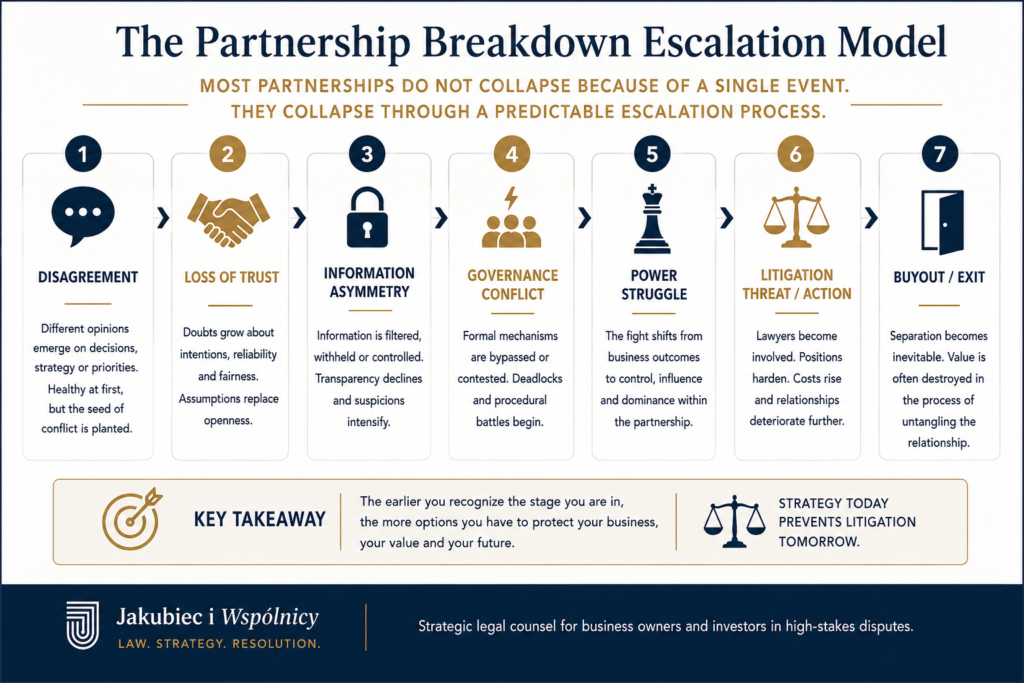
The Jakubiec Partnership Breakdown Escalation Model — a visual framework showing how business relationships deteriorate through predictable stages. Recognizing the stage early allows strategic intervention before litigation becomes inevitable.
by dr Andrzej Jakubiec - adwokat, mediatorCORPORATE DEADLOCK IN POLAND. REALITY IN 2026
Corporate deadlock is one of the most dangerous situations in a privately held company. When two shareholders hold equal power, even simple decisions may become impossible. As a result, the business can stop functioning while the conflict escalates.
This problem often arises in companies with a 50/50 ownership structure. At first, the structure seems fair. However, when a serious disagreement appears, neither side can impose a solution.
For foreign investors operating in Poland, understanding how corporate deadlocks arise and how they can be resolved is essential. Otherwise, a profitable investment may turn into a long and costly dispute.
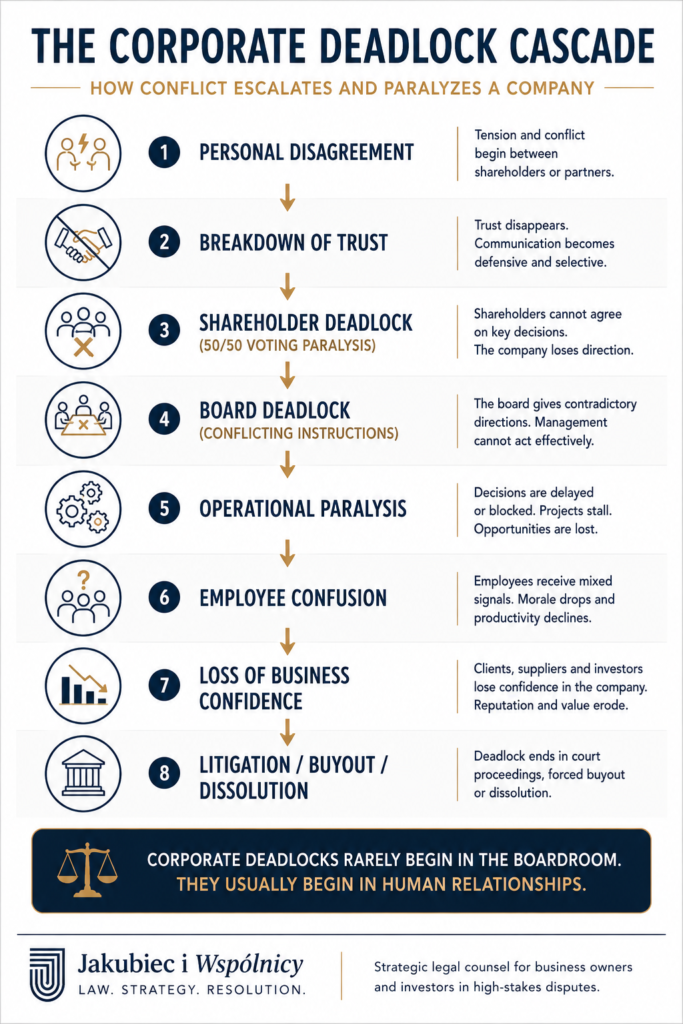
The Corporate Deadlock Cascade — a visual framework showing how internal conflict escalates from personal disagreement to corporate paralysis. Recognizing early stages allows strategic intervention before litigation becomes inevitable.
Key Takeaways
- A corporate deadlock arises when shareholders cannot adopt key decisions because their voting power is equal.
- Deadlocks most often occur in companies with a 50/50 ownership structure or poorly drafted shareholder agreements.
- When a deadlock appears, the company may be unable to appoint management, approve budgets, or distribute profits.
- Under Polish law, several legal mechanisms may help resolve a shareholder deadlock, including even shareholder exclusion or company dissolution.
- However, an important question arises: what is the best solution? Should litigation be the first option? Or can strategic negotiation or mediation resolve the conflict faster while protecting the value of the business?
- For foreign investors, early legal strategy is essential. Otherwise, a corporate deadlock may lead to years of costly litigation in Poland. Therefore, it is crucial to understand the psychological dynamics of negotiations and the basic principles of behavioral analysis.
What Is a Corporate Deadlock?
A corporate deadlock occurs when shareholders cannot adopt key decisions because their voting power is equal. As a result, neither side can control the company or move it forward.
Deadlocks most often appear in companies with a 50/50 ownership structure. At first, such a structure may seem balanced and fair. However, once a serious disagreement arises, decision-making can stop completely.
In practice, a corporate deadlock may block essential actions in the company. For example, shareholders may be unable to appoint management, approve budgets, distribute profits, or adopt strategic decisions.
This situation creates serious risks for investors. Even a profitable company may stop operating effectively if its owners cannot reach agreement.
For this reason, corporate deadlocks often escalate into shareholder disputes. If the conflict continues, the parties may eventually seek legal solutions under Polish corporate law.
Typical Deadlock Situations in Polish Companies
Corporate deadlocks rarely appear suddenly. In most cases, they arise when a serious disagreement develops between partners who hold equal power in the company.
Many investors associate deadlocks only with a 50/50 ownership structure. However, the problem may also arise at the level of the management board.
In many Polish companies, the same individuals act both as shareholders and board members. As a result, a personal conflict between partners may spread across the entire governance structure of the company.
Deadlock at the Shareholder Level
Deadlocks often arise when two shareholders each hold 50% of the voting rights. In this situation, neither side can adopt key resolutions without the consent of the other.
As a result, the shareholders’ meeting may become unable to approve budgets, appoint management, distribute profits, or adopt strategic decisions.
Although this situation can paralyze the company’s long-term strategy, its immediate operational impact is often limited to the lack of resolutions.
Deadlock at the Management Board Level
Conflicts become more dangerous when the same partners also serve on the management board.
In such cases, the dispute may quickly spread from the shareholders’ level into the daily operations of the company.
Unlike the shareholders’ meeting, the management board makes operational decisions on an ongoing basis. Because of this, conflicting board members may block each other’s actions more directly.
For example, one board member may reverse a partner’s decision, issue contradictory instructions, or formally prohibit a particular action.
In some cases, internal rules may require the consent of the entire board before certain actions can be taken. A conflict between board members may therefore stop those actions completely.
Operational Consequences of a Board-Level Conflict
A conflict within the management board is also much more visible to employees and business partners.
Its effects often appear immediately in the company’s day-to-day functioning. Employees may receive contradictory instructions, while key decisions remain unresolved.
Such situations can seriously damage internal morale and weaken the company’s credibility in the eyes of contractors and clients.
In extreme cases, the conflict may also disrupt the company’s ability to act in court, administrative, or tax proceedings, where clear representation and consistent decisions are required.
Since the beginning of my professional career, I have specialized in resolving shareholder conflicts and preventing corporate deadlocks. I have guided numerous international investors through complex disputes, protecting their capital and ensuring business continuity. In this article, I share a real-life scenario illustrating how communication breakdowns between partners can escalate, along with the tangible consequences for the company: Escalation of Disputes Between Partners – A Real Scenario.
Advantages and Disadvantages of Litigation in Resolving Corporate Deadlocks
Litigation is a formal and legally binding method to resolve shareholder disputes in Poland. It provides certainty about the outcome and allows a court to impose a partner’s will when negotiation fails.
Advantages of Litigation:
- A clear, formal procedure with defined legal rules.
- Legally enforceable decisions that all parties must follow.
- The ability to resolve disputes when other methods, such as negotiation or mediation, have failed.
However, litigation also carries significant risks and challenges, especially in the context of corporate deadlocks:
Disadvantages of Litigation:
- Time-consuming: Court proceedings can last months or even years, delaying strategic decisions.
- Delayed impact: Rulings often arrive when the conflict has already shifted to new areas, reducing the decision’s practical effect.
- Conflict escalation: Litigation can transform the original dispute into a secondary conflict, far removed from the initial cause.
- High costs: Legal fees, court costs, and expert valuations accumulate rapidly.
- Growing involvement: More parties are drawn in, complicating communication and coordination.
- Reputational damage: Public court cases can harm the company’s image with clients, investors, and partners.
- Morale and culture: Employee confidence drops when internal conflicts become visible and prolonged.
- Long-term uncertainty: Investors, contractors, and banks perceive heightened risk, potentially affecting financing and partnerships.
- Revenge and retaliation: Even after a judgment, parties often seek to retaliate, transferring the dispute to new areas.
- Loss of flexibility: Shareholders become bound by formally stated positions, fearing loss of face and further escalation.
While litigation can enforce a decision, it rarely resolves the underlying issues. In corporate deadlocks, relying solely on courts may preserve legality but often sacrifices speed, efficiency, and long-term business stability.
Why Negotiation, Mediation, and Arbitration Often Outperform Litigation
| Feature | Mediation | Arbitration | Court Litigation |
| Duration | Very Fast (weeks to few months) | Moderate (6–12 months) | Slow (24–36+ months) |
| Cost | Low (negotiated fees) | Moderate/High | High (legal fees over years) |
| Confidentiality | Full (private & closed) | High (private) | None (public records) |
| Decision Maker | Parties (with a Mediator) | Expert Arbitrator | State Judge |
| Control over Outcome | Total (voluntary agreement) | Limited (binding award) | None (imposed judgment) |
| Relationship Impact | Preserves business ties | Neutral | Destructive (adversarial) |
| Enforceability | Binding (after court approval) | Binding (NY Convention) | Binding (state execution) |
In my professional career, my greatest successes have been achieved on the field of negotiation and mediation. These methods allow investors to resolve corporate deadlocks more efficiently, protect business value, and preserve relationships between partners.
The Advantages of Negotiation and Mediation
Negotiation and mediation offer a range of benefits that litigation cannot match:
- Speed: Mediation settlements can be reached in weeks or months, compared to years in Polish courts.
- Lower costs: Avoid expensive court fees, expert valuations, and prolonged legal proceedings.
- Confidentiality: Discussions remain private, protecting the company’s reputation and sensitive information.
- Focus on underlying causes: Unlike litigation, mediation aims to resolve the root issues of the conflict, not just declare a winner.
- Reduced risk of retaliation: Parties are less likely to seek revenge or escalate the conflict after a mediated settlement.
- Positive impact on company culture: Preserves employee morale and confidence, avoiding visible tension and operational disruption.
- Better for the company’s image: Partners, clients, contractors, and investors see proactive conflict management rather than public disputes.
In shareholder deadlocks, these methods often prevent escalation and protect both the business and its people. They allow partners to regain control without being “consumed” by formalized positions or fear of losing face.
Arbitration: A Strategic Middle Ground
Arbitration offers a hybrid approach between mediation and litigation:
- It provides a binding, enforceable resolution like litigation.
- It is faster and more flexible than traditional court proceedings.
- Arbitration proceedings remain private and confidential, limiting reputational risks.
- While slightly more formal and costly than mediation, it still avoids the inefficiencies and absurd delays of the Polish court system.
In practice, arbitration often serves as the most pragmatic solution when parties cannot reach an amicable agreement through negotiation but wish to avoid the long, unpredictable timelines of court litigation. You can read more about one the best polish arbitration here. And here you have a link to a website of one of the best mediation center in Poland.
The Reality of Polish Courts
Poland’s legal system is often unable to handle complex shareholder disputes efficiently:
- Court cases can take years, sometimes 12–36 months or longer for first-instance rulings.
- Decisions may arrive when the conflict has already shifted or escalated to other areas of the business.
- Litigation rarely addresses the root cause of the dispute, creating secondary conflicts and frustration.
In this context, negotiation, mediation, and arbitration are not just alternatives—they are strategic tools that protect business value, relationships, and long-term stability.
Our Expertise in Corporate Conflict Resolution
For over a decade, we have helped companies resolve complex corporate disputes, including family businesses and conflicts between family-owned firms and foreign investors.
- Academic foundation: I earned my PhD in Commercial Law in 2014 with a dissertation on Options as Capital Market Instruments: A Civil Law Analysis. I worked for 12 years at the Department of Commercial and Business Law at the University of Łódź.
- Teaching experience: I lecture corporate law to aspiring advocates and have taught postgraduate courses on Company Law at the University of Łódź.
- Specialized training in negotiation and dispute resolution: I completed postgraduate studies in Negotiation, Mediation, and ADR at the University of Warsaw and postgraduate studies in Forensic Psychiatry and Psychology at the University of Łódź. I am currently deepening my expertise in Behavioral Analysis at the School of Emotional Intelligence in Wrocław.
- Practical experience: Negotiation is my passion, realized daily in complex shareholder disputes, cross-border M&A transactions, and corporate mediation. I have successfully guided family businesses and their investors through high-stakes conflicts, protecting both business value and relationships.
Our multidisciplinary approach combines law, psychology, and strategic negotiation to deliver efficient, lasting solutions for corporate deadlocks and shareholder disputes. I wrote about shareholders disputes resolving here.
Frequently Asked Questions (Q&A)
Q: What is a corporate deadlock in Poland?
A: A deadlock occurs when shareholders or board members cannot reach decisions, paralyzing company operations.
Q: Can a 50/50 shareholder deadlock be resolved?
A: Yes. Common solutions include:
- Buy-sell agreements
- Shotgun clauses
- Structured share buyouts
These allow one partner to buy the other’s shares at fair market value.
Q: How long does litigation usually take?
A: Court proceedings in Poland may last 12–36 months. Deadlocks often escalate, making early intervention essential.
Q: Is mediation faster than litigation?
A: Almost always. Mediation:
- Resolves disputes in weeks or months
- Reduces costs significantly
- Preserves confidentiality
- Minimizes risk of revenge or escalation
Q: What about arbitration?
A: Arbitration is a middle ground between mediation and court litigation. It is faster, less costly, and more flexible than court trials.
Q: Can a minority shareholder block key decisions?
A: Yes. Certain resolutions require qualified majorities (2/3 or 3/4), allowing minority shareholders to veto.
Q: Are mediation or arbitration settlements legally binding in Poland?
A: Yes. Approved settlements have the same legal force as court judgments and can be enforced by a bailiff.
Q: How should foreign investors act when deadlock emerges?
A: Early consultation is critical. Consider:
- Strategic negotiation
- Mediation
- Arbitration
- Only then, litigation if necessary
Q: Can conflict affect company operations?
A: Absolutely. Deadlocks often:
- Impact board and management decisions
- Reduce morale
- Harm client and investor confidence
- Delay legal or tax proceedings
Q: Do you provide services in languages other than English?
A: Yes. We deliver legal advice and documentation in:
- English
- French
- Russian
Facing a deadlock in your Polish subsidiary? Contact us for a strategic consultation to protect your investment:
📩 kancelaria@jakubieciwspolnicy.pl
📞 536 270 935