

5 Key Elements in a Contract with a Polish Company
Commercial disputes involving foreign companies in Poland rarely erupt overnight. They grow quietly — from subtle shifts in behaviour, small contractual ambiguities, misaligned expectations, or early warning signs that go unnoticed because both sides assume the relationship is still working. In cross-border business, these early signals matter far more than most companies realise. They reveal not only the health of the cooperation, but also the strength — or weakness — of the contract that governs it.
In my work with international businesses, I repeatedly encounter the same pattern: the outcome of a dispute is often determined long before the conflict becomes visible. Jurisdiction clauses, governing law provisions, the way contractual obligations are defined, the mechanisms securing performance, and the choice between litigation and arbitration shape not only how a dispute will be resolved, but whether it can be avoided altogether.
Understanding these structural elements is essential for any foreign company operating in Poland. They form the backbone of the five critical contract provisions discussed below — provisions that often determine whether a business relationship remains productive, deteriorates into a dispute, or ultimately ends in costly litigation.
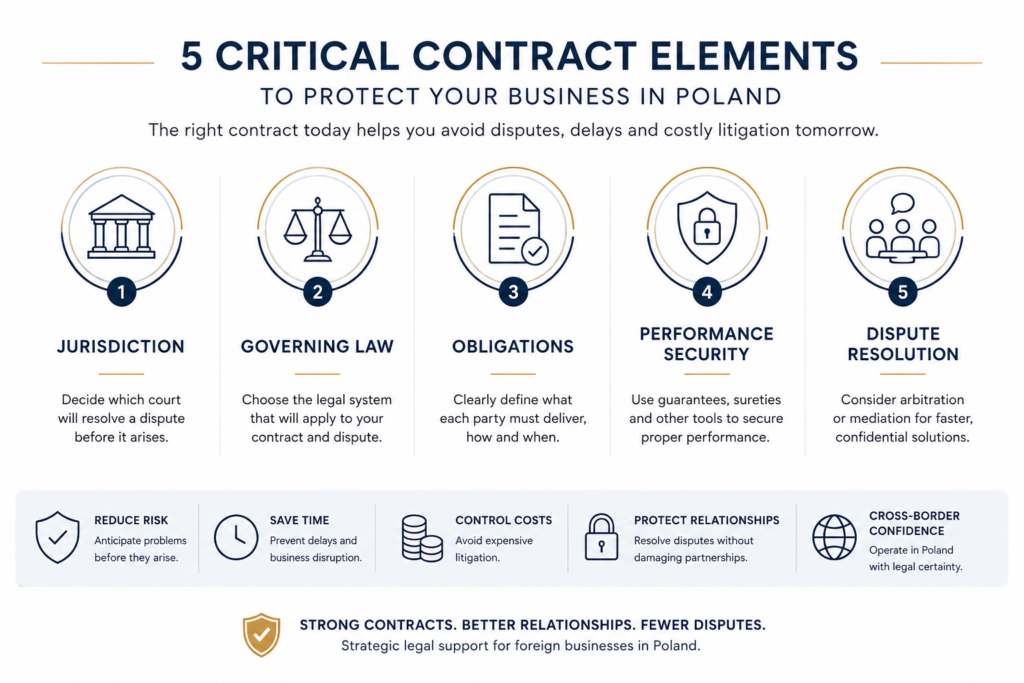
5 key elements in a contract with a Polish company
In cross‑border contracts with Polish companies, there are several elements that foreign businesses should always pay close attention to. Addressing them early significantly reduces the risk of misunderstandings, non‑performance, or costly disputes in the future. Here are the five most important points every international company should consider when drafting or negotiating a contract in Poland. The framework also aligns with OECD guidelines on responsible business conduct for cross-border commerce.
Table 1. Five Critical Contract Elements in Cross‑Border Agreements with Polish Companies
| Contract Element | What It Really Means | Key Risks if Ignored | Recommended Actions |
|---|---|---|---|
| Jurisdiction | Which court will hear the dispute. | Case may end up in an unexpected court; delays; strategic disadvantage. | Add a clear jurisdiction clause; choose forum strategically. |
| Governing Law | Which legal system applies to the contract and dispute. | Foreign law may apply unexpectedly; costly conflict‑of‑law battles. | Specify governing law explicitly; align with jurisdiction. |
| Obligations | What each party must deliver, how, and when. | Misaligned expectations; conflicting interpretations; hidden liabilities. | Define obligations in detail; avoid relying on local defaults. |
| Performance Security | Tools ensuring the contract is performed properly. | Non‑performance; delays; financial exposure. | Use guarantees, sureties, staged payments, performance bonds. |
| Alternative Dispute Resolution | Arbitration or mediation instead of court litigation. | Slow, formalistic court process; higher costs; loss of control. | Add arbitration/mediation clause; choose reputable institutions. |
1. Choice of Jurisdiction: Which Court Will Resolve a Dispute with a Polish Company
Many businesses confuse jurisdiction with applicable law, even though these are two separate and equally important issues. Jurisdiction determines which court has the authority to hear the dispute, and while this is usually obvious when both parties are from the same country, it becomes a critical question in cross‑border contracts. As a rule, the parties may choose the courts of a specific country — typically the courts of one party’s home state or the courts of the place where the contract is performed.
If the contract does not include a clear jurisdiction clause, the dispute will be governed by the default rules of each potentially relevant legal system, which may point to different courts depending on the circumstances. This can lead to uncertainty, delays, and strategic disadvantages. For that reason, it is essential to resolve this fundamental issue at the contract‑drafting stage, rather than during a dispute. A well‑drafted jurisdiction clause is not just a formality — it is a strategic tool.
To illustrate this with an example from my own practice: In one of my recent cases, the parties drafted a seemingly simple contract where they granted jurisdiction to both the Polish courts and the courts of the counterparty’s home country. Their intention was likely to ensure a sense of equality and fairness. However, this reciprocal clause was entirely counterproductive and created severe ambiguity. It required substantial legal work to establish that the party who actually managed to file the lawsuit first effectively locked in that country’s jurisdiction. This case perfectly illustrates that mistakes in cross-border contracting do not only stem from ignoring a problem, but also from trying to solve it in a fundamentally flawed way.
2. Governing Law: Which Legal System Applies to Your Contract and Dispute in Poland
Governing law determines which legal system will be used to interpret the contract, assess performance, and resolve claims — even after termination or withdrawal. The fact that a Polish court has jurisdiction does not mean it will automatically apply Polish law. I recently handled a case in which a Polish court applied Swiss law in a succession dispute, simply because the governing‑law rules required it.
Choosing the applicable law is one of the most fundamental decisions in any cross‑border agreement. If the parties fail to specify it, a complex network of international conventions, EU regulations, and internal conflict‑of‑law or external conflict-of-law rules will decide the issue for them. These instruments may assign governing law — or even jurisdiction — in ways neither party expected. When that happens, the parties lose control not only over the likely outcome, but even over the rules of the game.
Once a dispute begins, fighting over which law should apply becomes extremely expensive, highly technical, and strategically risky. It also unfolds under pressure, which rarely helps resolve the matter efficiently. We help foreign companies navigate these complexities from the first warning signs. This is why foreign businesses should always address governing law at the contract‑drafting stage, not during litigation.
3. How to Clearly Define the Parties’ Obligations in a Cross‑Border Contract
When companies from different countries work together, what seems “obvious” to one party may be interpreted completely differently by the other. A contract that carries the same name in Poland and Spain may impose entirely different warranty obligations, delivery terms, performance standards or timelines — all shaped by local law, business practice and commercial custom. The overall purpose of the agreement may be similar, but dozens of operational details can diverge in ways that create real legal and financial risk.
If the parties fail to define their obligations with precision, they effectively leave key issues to unknown conflict‑of‑law rules, local default provisions and judicial interpretation — none of which they control. This can lead to unexpected liabilities, disputes over performance, or outcomes that neither side anticipated when signing the contract.
For businesses operating outside the EU, it is also essential to remember that Poland is part of the European Union, and EU law forms an integral part of Polish domestic law. This means that obligations may be interpreted not only through the lens of Polish statutes, but also through EU regulations and directives that apply automatically.
Clear, detailed drafting is therefore not a formality — it is the only reliable way to avoid costly misunderstandings and ensure that both parties operate under the same expectations from day one. When facing difficulties with international agreements, consulting a contract dispute lawyer in Poland is the best way to safeguard your interest.
4. How to Secure Performance of the Contract
In international business relationships, securing proper performance of the contract is not a formality — it is good practice and a critical risk‑management tool. If you want to avoid problems with execution, delays or non‑performance, you must address these issues at the very beginning of the cooperation, not once difficulties arise. Contract breaches in cross‑border projects often do not stem from bad faith, but from factors partially outside the contractor’s control. That does not change the reality: you do not want their problems to become your problems.
For this reason, foreign companies should consider robust mechanisms to secure payment and performance, such as bank guarantees, sureties, or promissory notes. For non‑financial obligations, staged payments tied to documented progress, milestone acceptance, or performance bonds can significantly reduce exposure. These tools ensure that even if difficulties arise, the foreign company retains leverage and the project remains under control.
5. Does an Arbitration or Mediation Clause Make Sense in Poland
Arbitration and commercial mediation do make sense in Poland — and often a great deal of sense. Polish state courts are overloaded, formalistic and slow, with commercial cases frequently lasting several years. By contrast, arbitration and mediation offer procedures that are faster, more flexible and far less burdensome for foreign businesses. As a mediator myself, I see how effective these methods can be: mediation allows parties to resolve disputes quickly, confidentially and at a fraction of the cost of litigation, and I regularly represent clients in such proceedings as their counsel.
Arbitration is also gaining popularity in Poland, especially in cross‑border disputes where parties value expertise, predictability and enforceability of awards. However, it is important to remember that mediation is entirely voluntary — no clause can force a party to negotiate in good faith if it does not wish to participate. Even so, including an arbitration or mediation clause in a contract with a Polish company is often a strategic advantage, giving both sides a faster and more business‑oriented path to resolving conflicts.
Whether you are facing a breach of contract or a wider corporate conflict, an experienced commercial dispute lawyer in Poland can guide you through alternative dispute resolution.
Key Things to Know About Commercial Court Proceedings in Poland
Commercial litigation in Poland is highly formalistic, and foreign companies are often surprised by how rigid and document‑driven the process is. The starting point is the court fee: in most commercial cases, the claimant must pay 5% of the value of the dispute, in addition to covering the costs of legal representation, court‑appointed experts, and certified translations — the latter being both expensive and slow, yet unavoidable in cross‑border cases. Delays in Polish litigation can disrupt operations and weaken your negotiating position. Although many hearings can technically be held online, we prefer to appear in person, because being physically present in the courtroom allows us to read the room, assess the judge’s reactions, and evaluate witnesses more effectively.
Polish commercial proceedings rely primarily on documents, while witness testimony plays a supplementary role. Expert opinions often become decisive, especially in technical or financial disputes, and they can significantly influence the outcome. After the judgment, both parties may file an appeal, and in certain cases even a cassation complaint to the Supreme Court. As an experienced business litigation lawyer in Poland, I know that commercial litigators form a distinct professional niche — and we are proud to be part of that group, navigating clients through a system that demands precision, strategy and endurance.
Call to Action — Strategic Support for Foreign Businesses in Poland
Commercial disputes in Poland require not only legal knowledge, but also strategic judgment, experience with cross‑border matters and a deep understanding of how Polish courts, arbitration tribunals and business practices operate. If your company is facing a contract disagreement, a shareholder conflict, payment delays or early warning signs of a dispute, early action is essential.
We support foreign businesses from the first signal of risk — analysing contracts, assessing exposure, preparing negotiation strategies and representing clients in mediation, arbitration and commercial litigation. If you need guidance on contract disputes in Poland, commercial litigation or preventing a conflict before it escalates, we are ready to help.
Contact us to schedule a confidential consultation and discuss the most effective strategy for your situation:
📩 kancelaria@jakubieciwspolnicy.pl
📞 536 270 935
Q&A — Frequently Asked Questions About Commercial Disputes in Poland
1. What should I do if a Polish company stops paying or delays payment?
The first step is to secure documentation: invoices, delivery confirmations, correspondence and any agreed payment terms. Early action is crucial — delays often escalate quickly. A contract dispute lawyer in Poland can help assess your leverage and prepare an effective recovery strategy.
2. Can I sue a Polish company from abroad?
Yes, but whether you should depends on the jurisdiction clause in your contract. If no clause exists, EU regulations and conflict‑of‑law rules will determine where the case must be filed. A commercial litigation lawyer in Poland can analyse your position and recommend the most efficient forum.
3. How long do commercial court proceedings take in Poland?
Most cases last 2–4 years, depending on complexity, expert evidence and court workload. Delays in Polish litigation can disrupt operations and weaken your negotiating position, which is why many foreign companies prefer arbitration or mediation.
4. Is arbitration in Poland enforceable internationally?
Yes. Poland is a party to the New York Convention, which means arbitral awards issued in Poland are enforceable in over 160 countries. This makes arbitration a strong option for cross‑border disputes.
5. Do I need to translate documents into Polish for court?
In most cases — yes. Certified translations are required for key documents and can be costly and time‑consuming. This is one of the reasons why early preparation is essential.
6. What if my company is outside the EU — does that change anything?
Yes, significantly. Non-EU companies must navigate international treaties alongside EU regulations (such as Rome I, Rome II, and Brussels I bis) which automatically apply in Poland. These frameworks directly dictate which country’s laws govern your contract and where lawsuits can be filed.
7. When should I contact a lawyer?
At the very first sign of friction—whether it is an unexplained payment delay, minor contract breaches, or a breakdown in communication with your Polish partner. Legal intervention at this early stage usually prevents the conflict from escalating into a full-scale court battle, saving both time and money.
8. What should I check before signing a contract with a Polish company?
To protect yourself before signing a contract with a Polish company, you should first verify the company’s official data in the National Court Register (KRS), including its current management board and the rules of representation. It is also essential to confirm whether the company is not undergoing bankruptcy or restructuring proceedings. Finally, it is worth consulting a Polish attorney who can provide practical insights, background information, and reputation signals that you will not find in official registers.

dr Andrzej Jakubiec - adwokat, mediator
Latest Posts
by dr Andrzej Jakubiec - adwokat, mediatorWhy Intelligent People Lose Disputes?
Litigation as a Subplot: Viewing the Court Case Within a Broader Conflict A lawsuit is almost always just a single element of a much larger conflict....
by dr Andrzej Jakubiec - adwokat, mediatorCognitive Traps and Their Impact on Decision‑Making in the Fogg Model
In several previous texts, I presented some cognitive biases (thinking traps), including the fundamental attribution error, tunnel vision, and my original...
by dr Andrzej Jakubiec - adwokat, mediatorVIP Divorce in Poland: Strategy of Assets and Reputation Protection
A Comprehensive Legal and Behavioral Guide to Strategic Matrimonial Proceedings What exactly is a VIP divorce? Let us clarify at the outset—it is...