

 by dr Andrzej Jakubiec - adwokat, mediator
Why Intelligent People Lose Disputes?
Litigation as a Subplot: Viewing the Court Case Within a Broader Conflict
A lawsuit is almost always just a single element of a much larger conflict. The real dispute—the one that exists independently of the courtroom—is often far broader than what the court actually addresses. It can involve a wider network of people, stem from historical tensions, or even generate entirely new disputes. Consequently, legal proceedings are usually just one of many battlegrounds—and frequently not the most critical one.
This dynamic is especially clear in corporate warfare. A shareholder often challenges a board resolution not because it is defective, but because blocking it stalls a hostile takeover or strengthens their bargaining power. The court is left analyzing arguments manufactured solely for the trial, which have little to do with the actual core of the dispute.
To bring structure to this chaos, let us recognize three distinct dimensions of conflict:
- 1. The Substantive – Real Conflict — what the battle is actually about.
- 2. The Perceptual Conflict — how each party subjectively views the situation.
- 3. The Legal / Procedural Conflict — what formally makes its way into the courtroom.
- Dynamic interaction between the three dimensions of conflict:
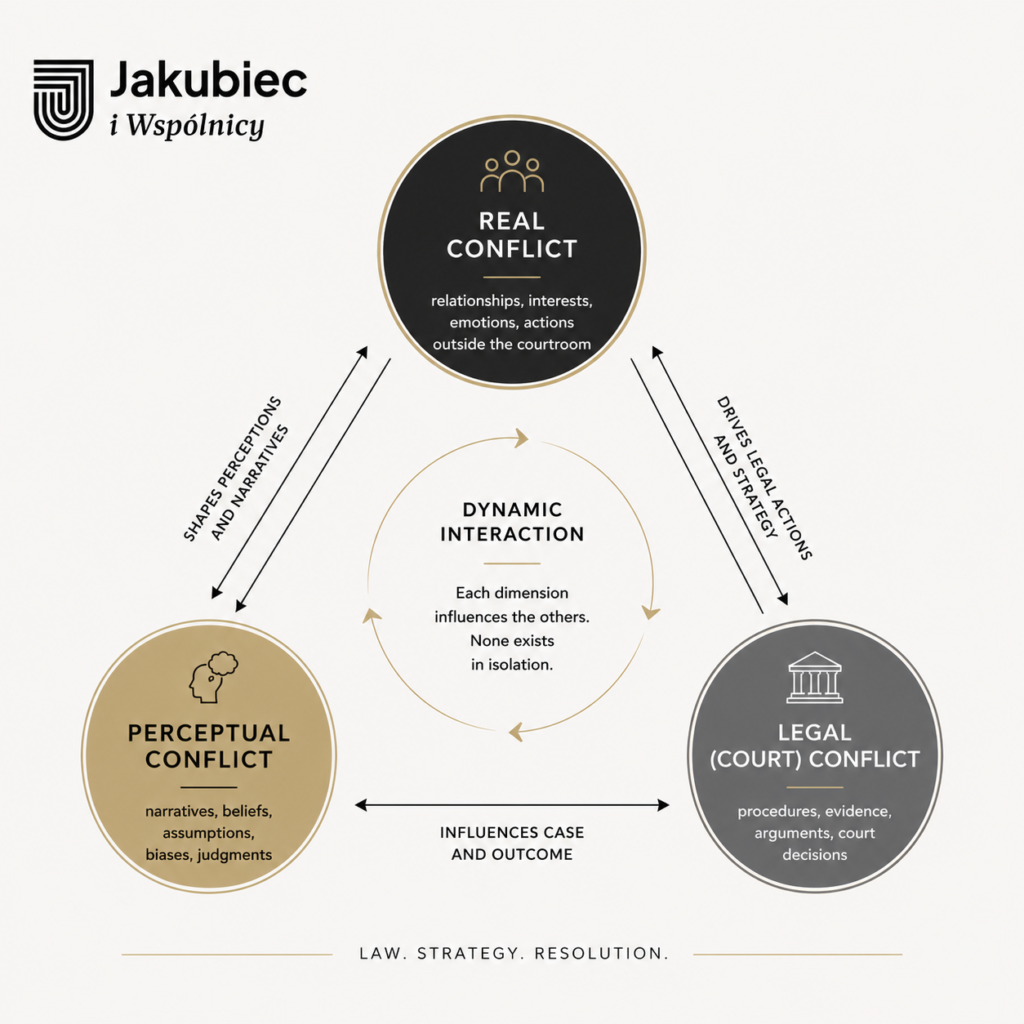
A single legal proceeding is often just one clash among many between the same or interconnected parties. The conflict simultaneously rages across other fronts: operational, communicative, reputational, familial, or financial.
Crucially, both sides can view the position of a given lawsuit on the “conflict map” entirely differently. The upper hand goes to the party whose map reflects reality more accurately—yet the perception of each actor is, at the same time, a structural element of that very reality.
Therefore, it is vital to remember: you can win the case and lose the conflict. You can also lose the case and achieve all your strategic goals. Even highly intelligent people routinely blind themselves to this distinction. It is a fatal error committed by corporate strategists, politicians, military commanders, lawyers, advisors, entrepreneurs, and spouses in crisis alike.
To illustrate this, let me share an example. I once handled a case involving two brothers who were partners in a limited liability company (sp. z o.o.). One of them maliciously blocked the other’s dividend payout, fully aware that his brother desperately needed the cash. The case went to a commercial court. Armies of lawyers, forensic accountants, and business valuation experts were brought in. Over time, it turned out that the brothers had simply had a massive falling out over who was supposed to host Christmas Eve dinner. The court could have litigated for ten years without ever touching the true essence of the dispute. Any formal judgment would have only deepened their conflict.
Redefining Victory: What Does It Actually Mean to “Win”?
What, then, constitutes victory? It is certainly not the mere act of winning a court case. If Pyrrhus had been a lawyer, he would have agreed with me without hesitation. For anyone interested in this subject, I highly recommend Thomas Schelling’s brilliant book, The Strategy of Conflict.
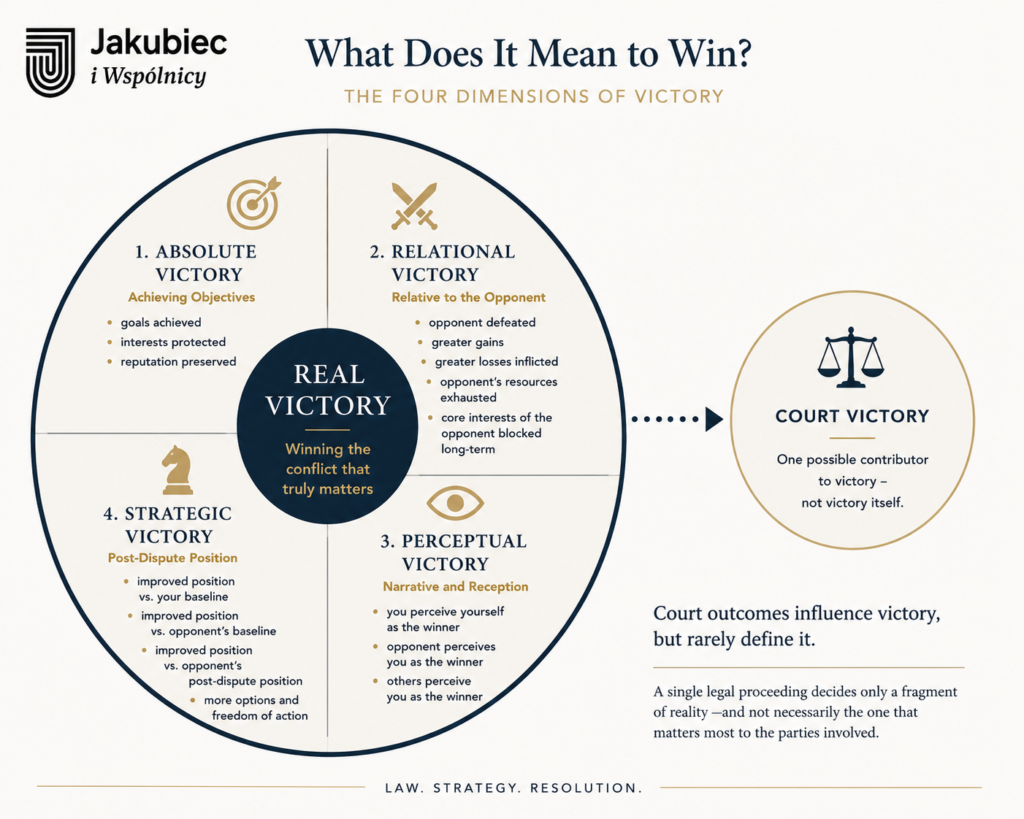
While I have presented a detailed exploration of how winning and losing are defined in a separate article, I will limit myself here to the most common understandings of victory. In practice, they can be divided into four distinct categories:
1. Absolute Victory — Achieving Personal Objectives
- You win if you achieve your original, baseline plans.
- You win if, post-dispute, you retain more options and opportunities to pursue your core interests.
- You win if you incur lower reputational costs.
2. Relational Victory — Outcome Relative to the Opponent
- You win if you defeat the opponent in a direct, head-to-head confrontation.
- You win if you extract more benefit than the other side.
- You win if you inflict heavier losses on the opponent than you sustain yourself.
- You win if you drive the exhaustion of the opponent’s resources.
- You win if you permanently prevent the opponent from achieving their core interests in the long run.
3. Perceptual Victory — Narrative and Reception
- You win if you subjectively perceive yourself as the winner.
- You win if your opponent perceives you as the winner.
- You win if external observers perceive you as the winner.
4. Strategic Victory — Post-Dispute Position
- You win if your relative position improves more significantly: a) compared to your baseline position, b) compared to the opponent’s baseline position, or c) compared to the opponent’s subsequent, post-dispute position.
As we can see, a single legal proceeding rarely guarantees victory in any of these categories. The court rules only on a single fragment of reality—and not necessarily the one that matters most to the parties involved. In divorce, corporate, or asset disputes, a court may decide a crucial matter, but just as often, it touches upon only one of many threads, completely disconnected from what determines a real win or loss.
Furthermore, the outcome of a dispute can be evaluated entirely differently by various individuals. This divergence typically stems from:
- The application of different criteria for success;
- Access to asymmetrical information; or
- Discrepancies in the time horizon through which the consequences are viewed.
The Real Reason Why Smart People Fail
This is exactly why intelligent people lose so often. Driven by sheer determination, they execute actions that:
- Either cannot logically lead to their intended goal,
- Or the goal itself was defined incorrectly and fails to improve their overall position,
- Or they concentrate heavily on the least significant aspect—such as a relational victory (the need to be deemed the winner), which in practice yields a profound strategic defeat.
Yet, this very discrepancy can be useful. It allows parties to save face—which is frequently the ultimate psychological prerequisite for accepting a factual defeat.
The Anatomy of Failure: Why Smart People Lose in Court
Failure stems from various causes. However, before we dissect them, it is worth noting something crucial: not all failure is inherently bad. Sometimes, a loss closes a flawed alternative and forces a course of action that proves highly beneficial in the long run. Certain failures function merely as a system correction mechanism—painful, yet necessary.
However, if we want to understand why highly intelligent people fail, we must map the root causes of failure across the three dimensions of conflict: the real, the perceptual, and the legal. Most importantly, we must expose the specific errors characteristic precisely of intelligent individuals.
Table: Why Highly Intelligent People Fail Across the Three Dimensions of Conflict?
| Dimension of Conflict | Specific Failure Pattern | Why Smart People Are Especially Vulnerable |
|---|---|---|
| Real Conflict | Overconfidence | Intelligent individuals overestimate their ability to predict the behavior, intentions, and thresholds of other actors. |
| Real Conflict | Illusion of Completeness | They construct coherent, elegant narratives from incomplete data because their minds refuse informational gaps. |
| Real Conflict | Elegance Bias | They prefer intellectually satisfying solutions over those that are operationally effective. |
| Real Conflict | Planning Fallacy | They underestimate time, cost, friction, and opponent counter‑moves due to excessive trust in their own planning ability. |
| Perceptual Conflict | Narrative Capture | They become prisoners of their own internally coherent story, which eventually outweighs the actual facts. |
| Perceptual Conflict | Confirmation Bias 2.0 | They do not merely seek confirmation — they actively engineer it through sophisticated rationalization. |
| Perceptual Conflict | Self‑Justification | Their intelligence makes it harder to admit misjudgment, leading to escalation rather than correction. |
| Perceptual Conflict | Misreading the Audience | They overestimate how much others care about the conflict, misjudge stakeholder investment, and misread reputational stakes. |
| Legal Conflict | Legal Tunnel Vision | They equate legal correctness with strategic victory, misunderstanding the limited role of law in a dynamic conflict. |
| Legal Conflict | Overengineering Arguments | They overcomplicate and over‑refine arguments, losing sight of what actually persuades a judge. |
| Legal Conflict | Misreading the System | They treat the court as a logical machine rather than a human institution with its own constraints and dynamics. |
| Legal Conflict | Cost Blindness | Convinced of the righteousness of their cause, they ignore financial, emotional, reputational, and temporal costs. |
1. Real Conflict — Flaws in Reality Among Intelligent Minds
It is at this foundational level that intelligence most frequently becomes a trap. This is not because smart people think poorly, but rather because they think too well, and their minds refuse to tolerate ambiguity.
- 1.1. Overconfidence — Overestimating Predictive Capabilities Intelligent people deeply believe they can accurately predict the behavior of other participants in a conflict. This illusion invariably leads to flawed strategic choices.
- 1.2. Illusion of Completeness — Constructing Coherent Narratives from Incomplete Data The smarter an individual is, the more effortlessly they craft beautiful, logical explanations to fill information gaps. The problem is that these narratives, while intensely compelling, are often entirely false.
- 1.3. Elegance Bias — Choosing Elegant Solutions Over Effective Ones Intelligent people have a strong tendency to select courses of action that are logical, aesthetic, and intellectually satisfying—yet do not necessarily work in practice. In litigation, elegant solutions often take the form of sophisticated, academic legal theories, while effective solutions are frequently simple, raw, and tactical.
- 1.4. Planning Fallacy — Underestimating Time, Costs, and Friction The more someone trusts their own planning capability, the more they blind themselves to random variables, procedural delays, opponent counter-moves, and collateral costs. This is a direct path to strategic disasters.
2. Perceptual Conflict — Flaws in Narrative Among Intelligent Minds
This is the most elusive and treacherous plane. Here, intelligence transforms into the ultimate trap, inadvertently triggering a dangerous spiral of escalation.
- 2.1. Narrative Capture — Becoming a Prisoner of One’s Own Story The more intelligent an individual is, the more easily they manufacture an internal narrative that perfectly justifies their decisions, explains the opponent’s moves, and imposes order onto chaos. Eventually, this narrative becomes more vital to them than the actual facts.
- 2.2. Confirmation Bias 2.0 — Intelligent Rationalization Smart people do not merely seek confirmation for their assumptions; they actively engineer it, brilliant at rationalizing reality to fit their preconceived thesis.
- 2.3. Self-Justification — Defending the Ego The higher the intelligence, the harder it is to admit a miscalculation—to acknowledge a misread situation, a poorly chosen objective, or a failure of one’s own making. Prioritizing ego over core interests always accelerates escalation.
- 2.4. Misreading the Audience — Flawed Stakeholder Assessment Intelligent individuals frequently overestimate how deeply external parties care about the conflict, how heavily invested the opponent truly is, or how severely their own reputation is at stake. Consequently, they deploy defensive tactics that serve no strategic purpose.
3. Legal (Court) Conflict — Flaws in Procedure Among Intelligent Minds
This is the arena where intelligent people believe most blindly in the power of their intellect. Paradoxically, it is precisely why they suffer their most devastating defeats here.
- 3.1. Legal Tunnel Vision — Equating Legal Correctness with Strategic Victory A classic delusion: assuming that if you have the law on your side, if your argument is crystal-clear in its logic, and if the statutes support you, you must win. In reality, strict legal correctness is often strategically useless. The most dangerous error is not misunderstanding the law itself; it is misunderstanding the limited role that law plays within a larger, dynamic conflict.
- 3.2. Overengineering Arguments The smarter the individual, the more they complicate, over-expand, and refine their arguments, completely losing sight of the simple, raw points that actually persuade a judge.
- 3.3. Misreading the System — Treating the Court as a Logical Machine Intelligent people often refuse to accept that the court does not operate like their own mind, that legal procedure is not a purely intellectual tool, and that a judge is rarely an audience for idealized, academic discourse.
- 3.4. Cost Blindness — Ignoring Collateral Damage Blinded by the righteousness of their cause, smart individuals stop calculating real transactional costs: financial depletion, emotional fatigue, reputational hits, and the immense cost of lost time.
Failure’s Anatomy Summary
The Anatomy of Failure: A strategic mapping of the 12 behavioral and procedural traps that lead high-IQ individuals and enterprises to catastrophic defeats across the real, perceptual, and legal dimensions of conflict.
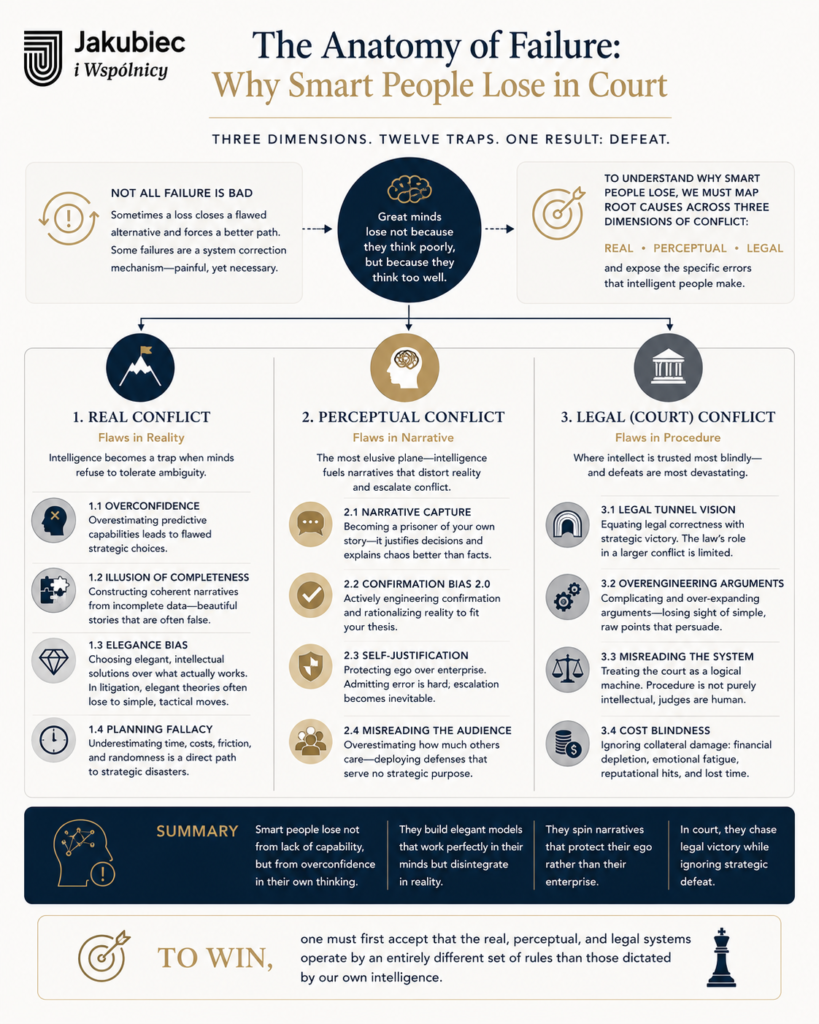
Highly intelligent people do not lose because they lack capability; they lose because they become overconfident in the products of their own thinking. They construct logical, elegant models of conflict that work perfectly in their heads but disintegrate in reality. They spin narratives that protect their ego rather than their enterprise. In court, they focus obsessively on legal victory while remaining entirely blind to strategic defeat.
To win, one must first accept that the real, perceptual, and legal systems operate by an entirely different set of rules than those dictated by our own intelligence. Smart people often hire lawyers who resemble themselves — analytical, academic, theoretical — instead of those who actually win trials.
Shifting the Odds: How to Increase Your Chances of Winning
To provide a meaningful answer to how one can increase the chances of winning, we must maintain our core distinction between the three dimensions of conflict. Addressing this question within the Real and Perceptual dimensions—where battles involve complex psychological warfare, market dynamics, and reputational chess—is far too vast a subject for this chapter. Therefore, I will deliberately set those two layers aside for now and focus exclusively on the tactical mechanics of the Legal (Court) Conflict, specifically within the unique and challenging reality of the Polish judicial system.
In Polish litigation, raw intelligence and a sense of moral entitlement are rarely enough. To navigate the procedural rigidity and systemic unpredictability of Polish courts, a smart strategist must adhere to nine fundamental principles:
1. Enter the Courtroom Only When Absolutely Necessary
The Polish judicial system is notoriously overburdened, slow, and formalistic. Litigation should never be your first impulse; it must be your last resort. Treat the decision to file a lawsuit like a declaration of war—an expensive, exhausting measure deployed only when all alternative strategic options, leverage points, and non-judicial mechanisms have been completely exhausted.
2. Master Both the Facts and the Legal Interpretation
Polish civil and commercial procedures are deeply unforgiving of preparation gaps. You must achieve absolute command over two fronts before the first gavel falls:
- The Evidentiary Base: Establish an airtight, chronological map of undeniable facts supported by robust documentary evidence.
- The Legal Theory: Secure a bulletproof, precise interpretation of the law. In a system where precedents are persuasive but not strictly binding, your legal framework must leave no room for arbitrary interpretation.
3. Rigorously Account for Judicial Risk (Ryzyko Procesowe)
In Poland, “judicial risk” is a structural reality. Different senates or divisions within the exact same court can interpret identical regulations in wildly contrasting ways. Never plan for a best-case scenario. A brilliant strategist calculates the probability of systemic inconsistency, unexpected changes in jurisprudence, and the subjective disposition of the adjudicating judge. If your strategy cannot survive a hostile or unpredictable judicial turn, it is a bad strategy.
4. Select a Top-Tier Trial Advocate
Do not hire an academic or a theorist for a street fight. You need an experienced, highly tactical litigator (adwokat or radca prawny) who understands the gritty reality of Polish courtrooms. A great advocate does not just know the codes; they know how to read the judge, how to react dynamically to unexpected procedural maneuvers by the opponent, and how to deliver surefire, persuasive arguments under extreme time pressure.
5. Secure the Capital Required to Sustain the Siege
Litigation in Poland is rarely a blitzkrieg; it is almost always a war of attrition. Between the initial filing, the exchange of extensive pleadings, delays in scheduling hearings, and the inevitable appellate process, a case can easily drag on for years. You must secure and isolate the necessary financial resources upfront. Entering a legal dispute with a tight budget is a fatal vulnerability; running out of capital midway through a trial forces catastrophic settlements.
6. Construct Razor-Sharp Evidentiary Hypotheses (Tezy Dowodowe)
Under current Polish procedural law, preclusion rules are exceptionally strict. You cannot simply throw a mountain of documents at a judge and hope they find the truth. Every single piece of evidence, every witness, and every expert report must be accompanied by a meticulously drafted, precise evidentiary hypothesis (teza dowodowa). You must clearly state exactly what a specific piece of evidence proves and why it is legally relevant to the core layout of the case. Loose, vague motions will be ruthlessly dismissed by the court.
7. Never Treat the Trial as an End in Itself
The courtroom is not a theater for personal vindication or academic debates. A lawsuit is merely a highly specialized instrument within your broader business or personal framework. Always keep your eyes on the ultimate strategic outcome. If a specific procedural victory does not improve your real-world position, protect your assets, or open up new opportunities, it is an expensive distraction. Never sacrifice your enterprise to win a point of law.
8. Remember that Witnesses and Court Experts Are Only Human
Smart people often expect the court to behave like a flawless, data-driven machine, but it is staffed entirely by human beings.
- Witnesses are deeply unreliable: they forget crucial details over time, perceive events through biased lenses, get confused under cross-examination, or cave under psychological pressure.
- Court-Appointed Experts (Biegli Sądowi)—who carry immense weight in Polish litigation—are also susceptible to human flaws. They can be overworked, deliver superficial or deeply flawed opinions, succumb to professional inertia, or struggle to grasp highly modern business models. Your strategy must always build in a margin of safety for human error and cognitive bias.
9. Run Parallel Negotiations — The Courtroom Door Is Never Locked
A highly sophisticated strategist understands that litigation and negotiation are not mutually exclusive; they are complementary tracks. The fact that you are fighting fiercely inside the courtroom should never stop you from talking outside of it. Parallel negotiations can run continuously, addressing not only the narrow legal dispute itself but also all the broader, structural elements of the conflict that the court is legally blind to. Quite often, a well-executed, aggressive lawsuit is the exact catalyst needed to force a stubborn opponent into a highly favorable settlement.
Litigation is never the battlefield — it is only the visible fragment of a much larger strategic landscape.
Table: Nine Principles for Increasing Your Chances of Winning in Polish Litigation
| Principle | Core Idea | Strategic Rationale |
|---|---|---|
| Enter the Courtroom Only When Necessary | Litigation must be a last resort, not a first impulse. | Polish courts are slow, overloaded, and formalistic; premature litigation destroys leverage and drains resources. |
| Master Facts and Legal Interpretation | Achieve total command over evidence and legal theory. | Polish procedure punishes gaps; only airtight facts + precise legal framing survive judicial scrutiny. |
| Account for Judicial Risk | Build a strategy that survives inconsistent jurisprudence. | Identical cases can be decided differently; planning for unpredictability is mandatory. |
| Select a Top‑Tier Trial Advocate | Choose a tactical litigator, not an academic. | Winning requires courtroom instincts, judge‑reading, and rapid tactical adaptation. |
| Secure Litigation Capital | Prepare financial reserves for a multi‑year siege. | Running out of funds mid‑trial forces catastrophic settlements and strategic collapse. |
| Construct Razor‑Sharp Evidentiary Hypotheses | Every piece of evidence must have a precise, articulated purpose. | Strict preclusion rules eliminate vague motions; only targeted evidence survives. |
| Never Treat the Trial as an End in Itself | Court victories matter only if they improve real‑world position. | Procedural wins without strategic value are expensive distractions. |
| Expect Human Fallibility | Witnesses and experts are unreliable, biased, and inconsistent. | Polish courts rely heavily on human testimony and expert opinions — both structurally fallible. |
| Run Parallel Negotiations | Litigate and negotiate simultaneously. | Court pressure often unlocks settlements; negotiations address dimensions the court cannot see. |
Conclusion
Winning in the legal arena demands far more than raw intelligence or an airtight legal argument. As we have dissected, high-IQ individuals and sophisticated corporate actors routinely suffer catastrophic defeats not from a lack of capability, but because they fall prey to their own cognitive biases—becoming captive to elegant models, misreading human fallibility, and confusing strict legal correctness with overarching strategic victory.
Ultimately, a court case is never a standalone battle; it is merely a single subplot within a much larger, dynamic conflict. To tilt the scales in your favor—especially within the rigid and unpredictable landscape of Polish litigation—you must discipline your mind to look beyond the courtroom doors. You must balance aggressive procedural tactics with cold, objective reality, recognize the human limitations of the system, and never stop negotiating outside the courtroom. True victory belongs to those who refuse to let their ego dictate their strategy, and who understand that the ultimate goal is not merely to win a point of law, but to protect and advance their real-world enterprise.
Call to Action
When the stakes are high, you cannot afford to rely on legal correctness alone. If your enterprise is facing a complex corporate, commercial, or asset dispute, you need more than just a firm that files pleadings—you need a partner who maps the entire conflict.
Let us dissect the reality of your dispute before the system dissects it for you.
Contact Jakubiec i Wspólnicy today to schedule a strategic consultation. Together, we will look beyond the legal subplot, neutralize cognitive traps, and engineer a path to real, strategic victory.
FAQ
Q1: If I have a 90% chance of winning a case legally, shouldn’t I push forward to a judgment?
A: Legally, yes; strategically, it depends entirely on what that judgment will cost you in the Real and Perceptualdimensions of the conflict. In Polish commercial disputes, a multi-year trial can drain your management’s time, exhaust financial resources, and paralyze business operations. If a 90% legal victory results in a 100% reputational disaster or leaves your enterprise financially depleted, it is a net strategic defeat. Always weigh the transaction costs against the real-world value of the judgment.
Q2: Why does high intelligence make corporate leaders more vulnerable to legal traps?
A: High intelligence is an asset, but without behavioral discipline, it breeds Overconfidence and Elegance Bias. Brilliant minds refuse informational gaps, so they construct beautifully logical, internally coherent narratives (Illusion of Completeness) that explain the conflict perfectly—in their heads. They often fall in love with sophisticated legal theories rather than simple, raw, tactical moves. They lose because they become captive to the perfection of their own models, failing to realize that the courtroom is a human institution, not a logical machine.
Q3: How do you negotiate with an opponent while simultaneously fighting them fiercely in court?
A: By treating litigation not as an emotional vendetta, but as a dynamic leverage generator. Filing a precise, aggressive lawsuit changes the opponent’s calculus, escalates their Cost Blindness, and directly attacks their Perceptual stability. You do not negotiate out of weakness; you use the procedural pressure created inside the courtroom as the exact catalyst to force a rational, structured conversation outside of it. The courtroom door is never locked.
Q4: Court-appointed experts (Biegli sądowi) are professionals. Why do you label them as a systemic risk?
A: Because they are human beings operating within a heavily burdened system. In Polish litigation, experts carry immense structural weight, yet they frequently suffer from professional inertia, severe overwork, or a lack of familiarity with highly modern, fast-paced business models. An expert can misread data, deliver a superficial report, or succumb to cognitive bias. A sophisticated legal strategy must always factor in this margin for human error and include targeted, razor-sharp evidentiary hypotheses to steer the expert’s focus precisely.
Q5: What is the difference between winning a “case” and winning a “conflict”?
A: A court case is merely a highly formalistic subplot. Winning a case means obtaining a favorable ruling on a specific, narrow legal claim (e.g., overturning a corporate resolution or enforcing a single contractual clause). Winning a conflictmeans protecting your long-term baseline, expanding your future strategic options, and advancing your core enterprise interests. If your legal victory does not improve your real-world position, you have simply mastered the procedure while failing the strategy.