

 by dr Andrzej Jakubiec - adwokat, mediator
Cognitive Traps and Their Impact on Decision‑Making in the Fogg Model
In several previous texts, I presented some cognitive biases (thinking traps), including the fundamental attribution error, tunnel vision, and my original concept of the Coupled Confirmation Bias. I wrote about them mainly in the context of their impact on the dynamics of conflict, which I observe in my daily work. Now I want to take a step further and show how these same mechanisms influence the decision‑making process in the Fogg model.
To move forward, I introduce a set of tools I’ve developed myself — three decision’s parameters and eight resulting decision types. In the next section, I walk through how these elements interact and why they matter. This framework is entirely my own creation; I find it promising and intuitively useful, though it still needs to be tested in practice. For now, it remains a proposal — and I state that openly.
What Are Cognitive Biases?
Cognitive biases are, in other words, errors or traps in thinking. The term was popularized by Daniel Kahneman. This outstanding psychologist published the book Thinking, Fast and Slow, in which he described mechanisms that affect all of us. Not because something is wrong with us. These mechanisms serve important functions. They simplify many matters. They allow us, for example, to conserve energy or solve a given problem well enough to move on to the next one.
But in complex social relationships, they cause us to misjudge reality, create false narratives in our minds, and ultimately make poor decisions.
Which Cognitive Biases Do We Know?
There are many cognitive biases, and we have probably not discovered all of them yet. Here I will briefly present only a few:
- Confirmation bias
- Fundamental Attribution Error
- Status quo bias
- Sunk costs fallacy
- Coupled Confirmation Bias – my original concept (and its extension), which is only a hypothesis and requires further development and empirical validation.
- Tunnel vision, which is not a cognitive bias in itself, but a systemic mechanism.
The impact of cognitive biases on decision‑making — for example, in the context of reaching agreements — is the subject of extensive scientific research. Some of them are considered inhibiting, others reinforcing. This distinction is useful for drawing further conclusions.
Below I will present, in order:
- the mode of decision‑making in the Fogg model, and
- the parameters of a decision once it is made.
Only then will I show how selected cognitive biases can influence both whether we make a decision at all, and the content of that decision.
The Fogg Decision‑Making Model
The Fogg model describes human behavior as the result of three interacting components: motivation, ability, and a trigger. A behavior — including a decision — occurs only when all three appear at the same moment.
This means that even if a person wants to make a decision (motivation). And even if they can make it (ability), the decision will not happen without a trigger. Conversely, even a strong trigger will not work if motivation is too low or the action feels too difficult.
In practice, this model explains why people in conflict often remain stuck in indecision, delay key steps, or choose actions that are irrational from the outside. Their internal configuration of motivation, ability, and triggers is disrupted — and cognitive biases play a decisive role in that disruption.
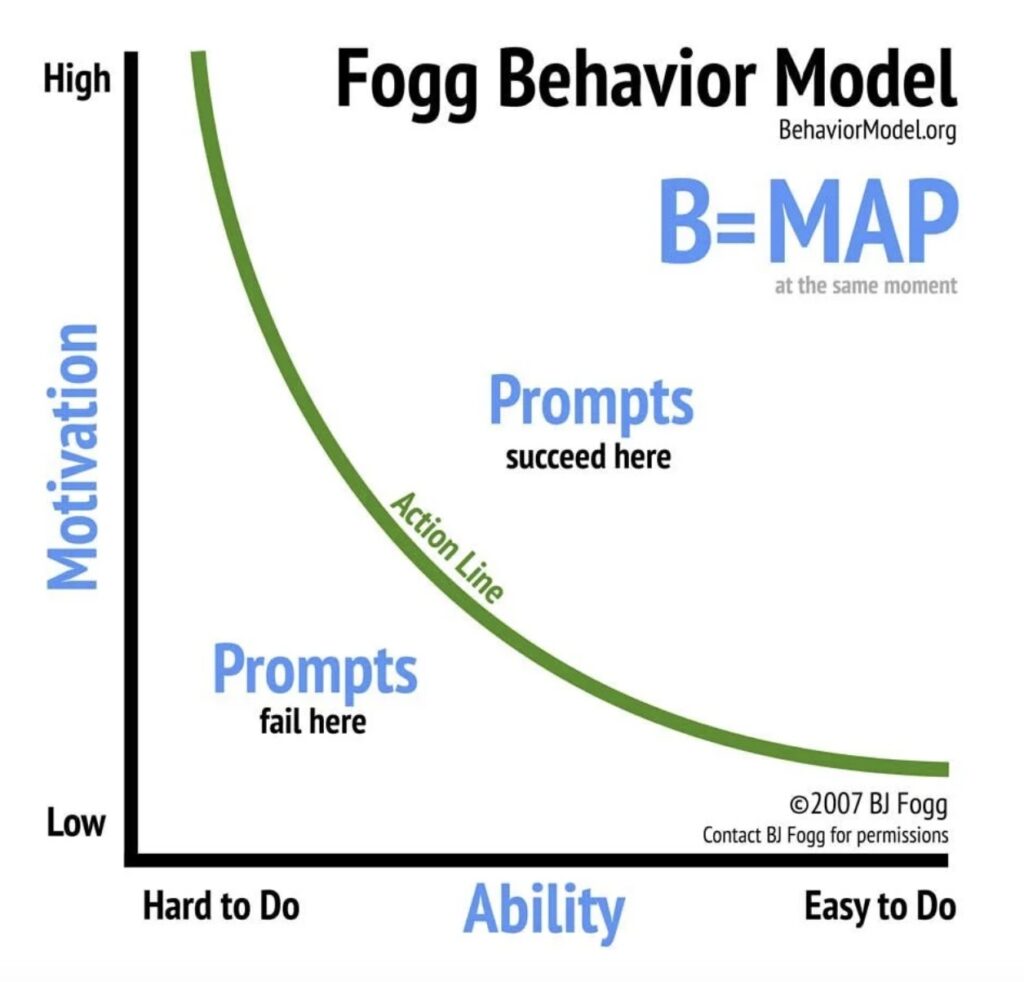
Let us remember that, for a decision to occur, all three elements —
- motivation,
- ability, and
- trigger — must appear together. I have already discussed this in detail in a previous text.
Now I will pose a question:
What Is “Ability” in Fogg’s Framework?
I understand ability as a property whose characteristics are better captured by the word feasibility. I did not elaborate on this aspect in the previous article, so I will do it now.
In the Fogg model, feasibility — in my interpretation — is the resultant of two subjectively perceived factors:
- one’s own capabilities, and
- the difficulty of the task.
Only the decision‑maker’s perception matters. Of course, they may misjudge the situation due to a cognitive error or faulty data. Interestingly, such an error may ultimately lead to a beneficial decision.
Imagine that I have incomplete or inaccurate data. Acting under the influence of a logical or cognitive error, I draw incorrect conclusions from them. Those conclusions would be considered correct if I had access to complete or accurate data — and if I were not acting under the influence of error.
This can be summarized in one sentence: Fogg’s triad influences the act of decision‑making, which is not identical with the way the decision is executed. The manner of executing a previously made decision is described by decision parameters (discussed below).
What Are the 8 Types of Decisions?
I propose that decisions analyzed through the lens of their execution should be assigned three parameters. These parameters determine how the decision is carried out. The three decision parameters I propose below allow me to distinguish eight types of decisions.
In the following section, I present how each configuration combines to form these eight decision types. This is my original concept, which I find highly useful, though it naturally requires further testing. For now, it remains solely my own proposal, which I state explicitly.
My proposal of 3 Decision’s Parameters
The three decision’s parameters are: vector, dynamics, and determination (I am considering whether momentum might be a better term).
1. Vector
Its reference point is the current state. Its value is 0 or 1. Let 0 denote a tendency to remain in the existing arrangement, and 1 a drive toward change.
2. Dynamics
Let us distinguish two values of dynamics: (+) and (–), where (+) means that the decision results in action, and (–) means passivity.
3. Determination
Let us define two levels: (L) and (H), where (L) stands for low determination, and (H) stands for high determination.
Vector expresses the attitude toward the current state and its change. A decision to defend the status quo or to alter it may be realized — depending on circumstances — through passivity or action (dynamics + or –). Determination is a function of readiness to engage, which I understand as the resultant of:
- willingness to bear costs (financial, reputational, organizational, energetic, or even biological), and
- tolerance of risk.
Vector, dynamics, and determination form a simplified heuristic model created by me (at least I am not aware of any publications that use these parameters — apart from the previously mentioned inhibiting and reinforcing biases). Its usefulness certainly requires further research — for now, it remains a hypothetical model.
I also emphasize that the human psyche is not mathematics — yet paradoxically, mathematics allows us to understand the psyche better.
Table 1: The Three Decision’s Parameters
| Decision Parameter | Parameter Value | Description and Meaning of the Parameter |
|---|---|---|
| Vector | 0 | Indicates a tendency to maintain the current state. The decision‑maker interprets the situation as one in which it is better to remain with the status quo. |
| 1 | Indicates a drive to change the current state. The decision‑maker concludes that the existing arrangement requires modification or abandonment. | |
| Dynamics | + | A decision executed through action. It means actively doing something intended to maintain or change the state. |
| – | A decision executed through passivity. It means refraining from action as a way of achieving the goal (maintaining or changing the state). | |
| Determination | L | Low determination. Indicates limited willingness to bear costs and low risk tolerance. The decision is weak and easily altered. |
| H | High determination. Indicates a strong willingness to bear costs (financial, emotional, organizational, biological) and high risk tolerance. The decision is strong and stable. |
Using the three parameters listed above allows us to distinguish eight types of decisions.
Table 2: Eight Types of Decisions
| Decision Type No. | Vector | Dynamics | Determination | Description of the Decision | Example |
|---|---|---|---|---|---|
| 1 | 0 | – | L | A decision to maintain the status quo through passivity with low determination | I decide to sleep a bit longer |
| 2 | 0 | – | H | A decision to maintain the status quo through non‑action with high determination | Sitting on a tree, I decide not to move so I don’t fall |
| 3 | 0 | + | L | A decision to maintain the status quo through action with low determination | I decide to shoo away the cat that is waking me up |
| 4 | 0 | + | H | A decision to maintain the status quo through action with high determination | I defend my daughter from an attacker |
| 5 | 1 | – | L | A decision to bring about change through passivity with low determination | I don’t water flowers I dislike so they will wither |
| 6 | 1 | – | H | A decision to bring about change through passivity with high determination | I decide not to save someone when I want them to drown |
| 7 | 1 | + | L | A decision to bring about change through action with low determination | I want to trim the cat’s claws |
| 8 | 1 | + | H | A decision to bring about change through action with high determination | I want to escape from prison |
Jakubiec eight types of decisions
Let us add that:
- decisions with vector 0 (maintaining the status quo), and
- decisions with negative dynamics (–), i.e., achieving the goal through passivity,
do not in any way mean the absence of a decision. These are not the same. I may decide to sit quietly and remain motionless so that someone does not find me. That decision is not the same as externally observed passivity caused, for example, by apathy or an ambivalent attitude toward the situation.
Similarly, it must be noted that:
- a decision aimed at change (Vector 1) cannot be equated with action (+), and
- a decision aimed at defending the status quo (Vector 0) cannot be equated with the absence of action.
The initial state (status quo) may be so desirable that we decide to defend it actively (vector 0, dynamics +). Thus, not wanting change, we will take action. Example: If I want a drowning person to survive, I will rescue them. Not wanting to allow a change (life → death), I will take action.
Conversely, it may happen that in striving for change we decide not to act. If I want a drowning person to die, it is enough that I do not rescue them. Drowning represents a change in their state (life → death) brought about by my passivity. Here we have vector 1, negative dynamics, and a level of determination which, in this example, we do not know — but we assume it would have to be very high.
For completeness, it must also be stated that the absence of a decision to change is not identical with a decision to maintain the status quo. A lack of decision results from the absence of at least one element of the decision triad (see above). Thus, the absence of a decision may result from a lack of motivation, a subjectively perceived lack of feasibility, or the absence of a trigger. This does not necessarily mean that the stimulus is irrelevant to us. It may, for example, generate motivation, but we will not make a decision because the task appears unfeasible. In such a situation, the objective absence of action cannot be equated with passivity as a chosen parameter of a made decision.
Example
When encountering a bear in the mountains, I may decide either to surrender or to save my life. But whether I achieve this by playing dead, fighting, or running — that is a parameter of the decision. And in this respect, it may be chosen correctly or incorrectly: I may run up a tree the bear can climb after me, or hide in a rock crevice where it cannot reach me. This does not change the fact that I decided to stay alive (vector 0) through action in the form of escape (dynamics +) or through passivity in the form of playing dead (dynamics –), with high determination in each case (H).
As I indicated above, one must distinguish between lying down because I consciously chose to survive by playing dead, and lying down because I concluded that I have no chance anyway, and besides, I have not wanted to live for a long time.
What Is the Relationship Between Cognitive Biases, the Decision Triad, and Decision Parameters?
Above, I outlined three areas: cognitive biases, the decision triad, and the decision parameters. A natural question arises: how can these elements relate to one another?
Let us begin with the clarification that there is no determinism here. Cognitive biases do not determine a given decision, but they significantly increase the tendency — they “pull” in a particular direction. I also note that one may simultaneously remain under the influence of two or more biases, originating from different sources, whose effects intersect at a given moment, each “pushing” the decision‑maker in a different (or the same) direction.
The Influence of Cognitive Biases on the Decision Triad (the Act of Making a Decision)
As indicated above, cognitive biases may act at every stage and level of decision‑making and decision execution. It may turn out that when the decision triad is activated, one bias becomes influential, and when setting the parameters of execution, we operate under the influence of another. It may also happen that two biases act simultaneously, and their mutual relationship is positive (they act in the same direction), partially opposing, or entirely opposing. Most often, however, we will remain under the influence of one of them.
Let us assume that cognitive biases may influence:
- the emergence of motivation by affecting the evaluation of the stimulus that generates emotion, and consequently the direction or strength of motivation;
- the subjective assessment of feasibility;
- susceptibility to a trigger.
Let us also assume that, with respect to each element of the decision triad, the influence of a cognitive bias may be reinforcing or weakening.
Motivation
A cognitive bias may influence the very existence of motivation (trigger it or extinguish it), and may strengthen or weaken existing motivation.
Perception of Feasibility
A cognitive bias may influence the assessment of feasibility and make the sense of feasibility stronger or weaker (both by affecting the perception of one’s own capabilities and the subjectively perceived difficulty of the task itself).
A distorted assessment caused by a cognitive bias may therefore result in:
- evaluating a task as feasible when it is not feasible;
- evaluating a task as unfeasible when it is feasible.
and consequently:
- making a decision when the goal is “desirable” but objectively unattainable (lack of feasibility);
- not making a decision when the goal is objectively attainable and desirable.
Trigger
With respect to the trigger, a cognitive bias may strengthen or weaken its effect. This means that, at a sufficient intensity of cognitive distortion:
- certain cognitive biases may interpret as a trigger a factor that, under other circumstances, would not be interpreted that way;
- an objectively strong trigger may turn out to be too weak, even though it would be sufficient to make a decision if the bias of that type and intensity were not present;
- an objectively weak trigger may turn out to be strong enough to make a decision, even though without the presence of a bias of that type and intensity, it would not be sufficient.
To illustrate this, I will use a table showing the possible influence of selected cognitive biases on a chosen element of the decision triad — feasibility.
Table 3: Influence of Selected Cognitive Biases on the Perception of Task Feasibility in the Fogg Model
| Cognitive Bias | How It Distorts the Perception of Feasibility | Consequences for Making a Decision About Change in the Fogg Model |
|---|---|---|
| Confirmation bias | Reinforces the belief that previous actions were correct | May result in a decision to change / or no decision to change |
| Fundamental Attribution Error | Explains the other party’s stance by attributing it to presumed internal traits (e.g., character traits) | May result in a decision to change / or no decision to change |
| Feedback loop | Strengthens initial assumptions, leading to radicalization | May result in a decision to change / or no decision to change |
| Coupled Confirmation Bias | Leads to radicalization and escalation | Results in a decision to change |
| Status quo bias | Leads to a desire to maintain the current state (status quo) | Results in no decision to change |
| Sunk cost fallacy | Leads to a desire to maintain the current state (status quo) and deepen it | Results in no decision to change |
| Hyper‑usefulness bias (AI) | Strengthens initial assumptions, which may lead to radicalization | May result in a decision to change / or no decision to change |
The Influence of Cognitive Biases on Decision Parameters
A cognitive bias may — independently of its earlier influence on the very act of making a decision according to the Fogg model — appear and exert its effect at the next stage, i.e., when setting the parameters for executing the decision.
Thus, it may influence the vector of the decision and result in our reacting to a given stimulus by making an incorrect decision about maintaining or changing the current state. Example: the radio is playing too loudly. I decide to remove the inconsistency between the volume of the music and my well‑being. A cognitive bias may cause me, instead of adjusting the radio to myself — lowering the volume or turning it off (vector 1, dynamics +, determination L) — to try to “get used to it” (vector 1, dynamics –, determination L).
A cognitive bias may influence the dynamics of the decision and result in my choosing action instead of non‑action incorrectly, after having already set the vector (my stance toward the current state). Example: during a trek, my leg hurts. I want to eliminate the pain (vector 1 — change of the current state). But under the influence of a cognitive bias, I incorrectly choose the dynamics and opt for activity (walking off the pain) instead of passivity (stopping and resting).
Cognitive biases may likewise influence determination, increasing or weakening it. This results in greater engagement and greater willingness to take risks than would follow from a rational assessment. Example: a poorly managed company is generating losses, and my business partner once again asks me to contribute a significant amount of money. A cognitive bias in the form of the sunk cost fallacy may increase my determination to invest more (vector 0 — decision to stay, dynamics + in the form of contributing more funds), causing me to invest more than I would if I were not under the influence of this bias.
As we can see, cognitive biases may independently affect each element of the decision triad and each of the decision parameters.
The Operation of a Cognitive Bias and Its Possible Consequences
I understand the decision‑making process as follows:
- first, there is a stimulus;
- then, the decision triad results in making a decision or not making a decision;
- next, the decision parameters are selected, which serve the function of executing the decision.
I emphasize that the choice of decision parameters may be correct or incorrect (like running up a tree to escape a bear). They are merely tools — ways of executing a decision whose source lies in motivation. Whether we correctly perform the fundamental reasoning — choosing the method of achieving the goal — depends on us or on external factors.
In legal practice, I often see how frequently people make serious errors here: they want to achieve something, but they use tools that cannot bring them closer to the goal. Or they use the right tools incorrectly.
The errors we may commit when setting decision parameters can be divided into:
- choosing a tool that under no circumstances serves the achievement of the given goal;
- choosing a tool that, under these circumstances, is not suitable for achieving the intended goal;
- incorrect use of a correctly chosen tool:
- regarding the method,
- regarding the direction.
Let us note that cognitive biases may influence the final shape of our decision at every stage of its formation:
- the emergence of motivation;
- the assessment of feasibility;
- susceptibility to a trigger;
- the setting of the parameters for executing the decision.
How Can a Specific Cognitive Bias Distort Decisions?
Let us now examine how certain cognitive biases may influence:
- the act of making a decision (Fogg’s decision triad), and
- the parameters of that decision: vector, dynamics, and determination.
I do not have space here to show all possible variants: the influence of every identified bias on each element of the decision triad and each element of the decision parameters. Nor do I have space to show the influence of “clusters of cognitive biases” operating simultaneously or sequentially.
What I can do within this article is show how one bias affects the decision‑making process. I will therefore use confirmation bias.
As a starting point, we must of course assume the most probable decision that would be made if the bias were not present.
The Influence of Confirmation Bias on Individual Elements of the Decision Process
Let us use the example described earlier — encountering a bear in the mountains.
My biological sensors detect danger → motivation to preserve life arises → I assess the task as feasible → the trigger is the assessment that a short time window appears in which I have a chance, but I must act now → I make the decision that I want to stay alive (vector 0) → as the tool (in this case) I choose playing dead (passivity, dynamics –) → my determination is very high (H).
This determination is very interesting in this example. It manifests in my tolerance for costs — the bear may scratch me, test me, even step on me, but I decide to remain in an uncomfortable situation (one I am not accustomed to), in which I suffer successive losses and injuries, for as long as necessary.
How can confirmation bias operate in such a situation? Recall that it consists in seeking confirmation of the correctness of a previously made decision and attributing confirmatory value to factors that do not logically carry it.
The influence of this bias may be presented in the following table.
Table 4: The Influence of Confirmation Bias on the Decision‑Making Process
| Stage of the Decision Process | Element | Influence of Confirmation Bias: Reinforcement or Weakening | Effect |
|---|---|---|---|
| Fogg Triad | Motivation | ↑ or ↓ | We become inclined to maintain the previously chosen course |
| Feasibility | ↑ or ↓ | The perception of feasibility becomes distorted. The direction depends on whether the analyzed action aligns with the previously chosen course | |
| Trigger | ↑ or ↓ | We may become over‑reactive or, conversely, fail to react to triggers that we would respond to if the bias were absent | |
| Decision Parameters | Vector (0/1) | — | The vector becomes confirmed |
| Dynamics (+/–) | — | The chosen dynamics becomes reinforced | |
| Determination (L/H) | — | Determination increases to an irrational level |
The Influence of Various Cognitive Biases on a Selected Element of the Decision Process
As mentioned above, each cognitive bias may act on each element of the decision process (individually or in selected combinations). Above, I showed how a single cognitive bias — confirmation bias — affects the entire decision‑making process. Now I will show how each cognitive bias may act on a selected element of the decision process. Let that element be the vector of the decision. For simplicity, I will remain with the familiar example of the bear encounter.
Table 5: Influence of Selected Cognitive Biases on the Decision Vector (Using the Bear Encounter Example)
| Cognitive Bias | How It Distorts the Assessment of the Situation | Influence on the Decision Vector (0 = status quo / 1 = change) | Bear Example |
|---|---|---|---|
| Confirmation bias | Strengthens earlier assumptions and interpretations | May reinforce vector 0 or 1 depending on the prior narrative | Wanting to survive, I may engage in wishful thinking and see opportunities where none exist, just to maintain hope |
| Fundamental Attribution Error | Attributes the bear’s behavior to its “bad intentions” rather than the situation | May reinforce vector 0 or 1 depending on the prior narrative | I assume the bear “will definitely attack me,” even though it is only observing me → I start running, which provokes it to chase me |
| Status quo bias | Overestimates the safety of the current state | Pushes toward vector 0 | I remain motionless even though the bear has noticed me and the situation requires change |
| Sunk cost fallacy | Strengthens attachment to the previous strategy | Reinforces vector 0 or 1 depending on the situation | “Since I’ve already endured so long pretending to be dead, I must endure longer” — even though the situation is worsening because the bear is sitting on me and I may suffocate |
| Coupled Confirmation Bias | Does not occur because the bear does not use AI (for now) | Does not apply | Does not apply |
| Tunnel vision | Narrows perception to one aspect of the situation | Strengthens the chosen vector | I climbed a tree and feel relieved that I saved my life. I suppress the fact that bears climb trees very well and will be up here shortly |
| Feedback loop | Strengthens the initial interpretation through successive stimuli | Reinforces vector 1 or 0, usually toward escalation | I sit in the tree and call a friend who tells me it was a great idea. My conviction is reinforced — at least until the bear gets hungry enough to come after me |
| Hyper‑usefulness bias | Overestimates the accuracy of earlier “suggestions” or heuristics | Vector is set according to the earlier “suggestion,” not the real situation | If, sitting in the tree, I ask AI whether I made the right choice, and my digital assistant replies: “Andrzej, that was an excellent decision…” I may become so confident that I start provoking the bear |
The Influence of Cognitive Biases on Decision‑Making and Decision Parameters. Summary
An attempt to analyze the operation of individual cognitive biases allows us to cautiously draw the conclusion that some of them tend to influence specific decision parameters in characteristic ways. As an example, I will use a two‑dimensional chart that includes only vector and dynamics, but does not include determination (this would require a three‑dimensional chart). We can see that some biases are more likely to “pull” a given parameter in a particular direction, while others may have no influence on, for example, dynamics, but will influence the vector. This can be cautiously presented in the following way.
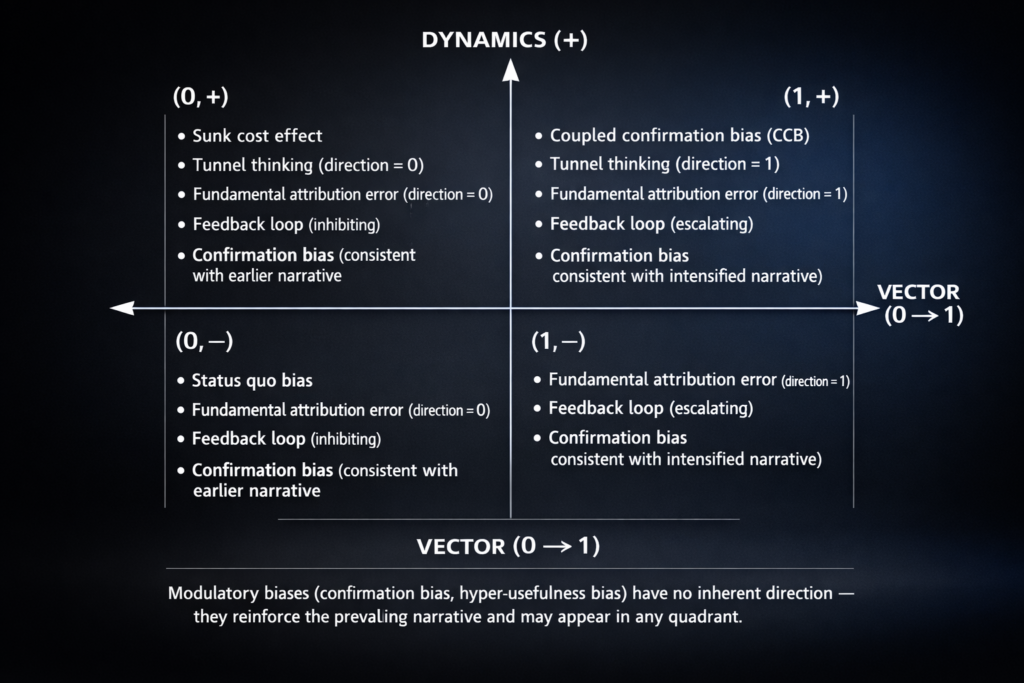
Let us remember one thing from this. To err is human. We all make mistakes, constantly. Some of the causes of our errors are within our control; others are not. Cognitive biases have the particular feature of operating covertly, exerting a very strong influence on how we perceive reality. They pull us in like quicksand and can cause us to lose contact with reality.
The easiest way to protect ourselves from them is by learning about them, studying them, and checking the logic of our thinking. If we know them, we will learn to detect them — and that will protect us from many extremely costly mistakes.
by dr Andrzej Jakubiec - adwokat, mediatorVIP Divorce in Poland: Strategy of Assets and Reputation Protection
A Comprehensive Legal and Behavioral Guide to Strategic Matrimonial Proceedings
What exactly is a VIP divorce? Let us clarify at the outset—it is not about charging disproportionate fees, nor is it about selective diligence or varying levels of commitment. As a professional European law firm, we fully immerse ourselves in every case entrusted to us. We derive immense satisfaction from the trust our clients place in us and the profound sense of security we provide. The distinct nature of a high-profile or high-net-worth divorce process does not mean we treat anyone better. We treat every client with the utmost respect, dedicating as much time and attention as their specific circumstances demand.
Where, then, lies the fundamental difference, and why do certain matrimonial proceedings require the deployment of extraordinary protective measures? The answer lies in an interdisciplinary approach that seamlessly integrates international best practices, advanced behavioral analysis, and strategic brand and reputation management. Our role is not limited to legal representation. We act as strategic advisors, coordinating legal, reputational, and psychological dimensions of the case to strengthen the client’s strategic position.
The 5-Dimensional Risk Model for VIP Divorce in Poland: A Strategic Framework Engineered to Mitigate Litigation Risks and Secure Confidential, Amicable Out-of-Court Settlements. The visual framework below illustrates how these five dimensions integrate into a unified strategic protection model.
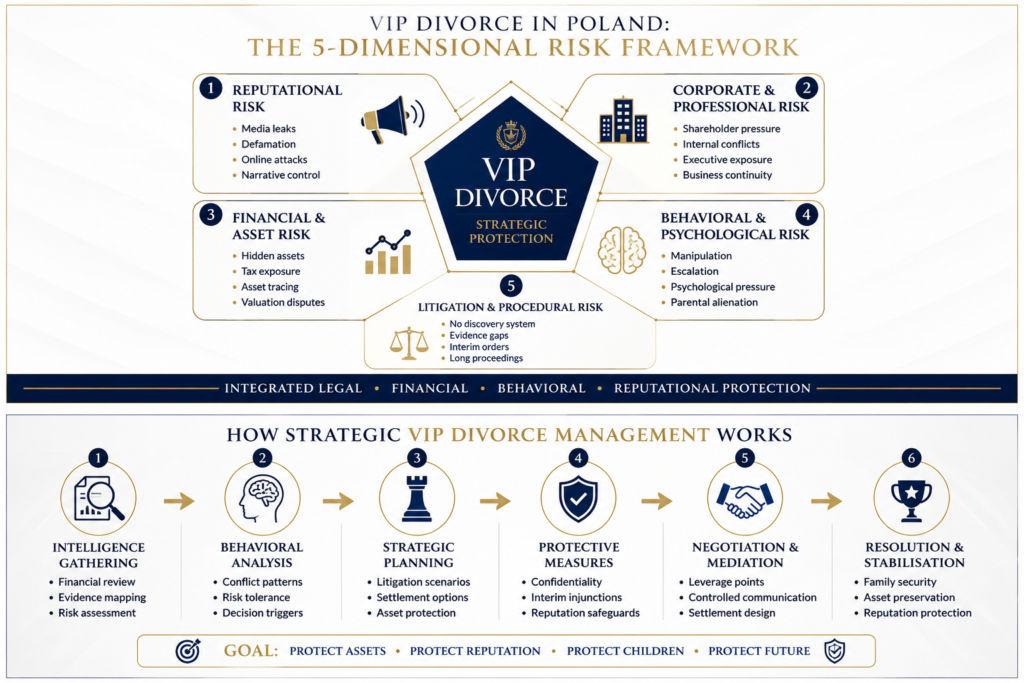
As demonstrated, our objective is always to achieve a confidential, amicable, and mutual settlement whenever feasible.
Case Study: High-Net-Worth Medical Partners and Corporate Asset Protection
This precise analytical and operational framework proved highly effective in a recent case involving high-net-worth clients—two medical doctors who co-owned and managed a renowned medical clinic. Both parties recognized from the outset that a “dirty divorce” would inflict devastating reputational damage, which is particularly catastrophic in the healthcare sector where patient trust is paramount.
Through our intervention, both sides quickly understood that an unconstrained conflict would result in mutually assured destruction. By deploying our strategic protocols, we successfully achieved the following:
- Immediate Narrative Control: We swiftly blocked emerging leaks and private information from surfacing in the public domain;
- Containment of Horizontal Escalation: We halted toxic tactical maneuvers at an early stage, preventing the recruitment of clinic employees, staff, and commercial contractors into the personal marital dispute;
- Establishing “Rules of the Game”: We negotiated a strict behavioral framework with the opposing counsel—a rare achievement in the typical realities of Polish family litigation. We clearly defined the boundaries of the remaining dispute and the precise legal instruments that each side was permitted to use.
Crucially, once both parties observed that the other side was consistently adhering to the agreed-upon rules, mutual trust began to rebuild. This stabilization created the necessary psychological and procedural space to engineer a final, comprehensive out-of-court settlement that fully secured the long-term interests of both parties.
Defining the VIP Client in Divorce Proceedings
In the context of matrimonial law, “VIP status” is not a matter of prestige, but rather an objective necessity for specialized, defensive services. This requirement stems from the client’s prominent professional, financial, or social standing when navigating a complex Divorce in Poland.
Divorce for Public Figures and Celebrities (Show Business, Politics, Sports)
A VIP client is anyone whose public exposure necessitates heightened image protection. In an era of instantaneous global media coverage, the professional longevity of public figures, politicians, and high-profile athletes is inextricably linked to their public reputation and compliance with international benchmarks.
In these cases, a VIP divorce encompasses far more than standard courtroom representation. It requires active media crisis management, the robust protection of personality rights, and swift, decisive legal action against disinformation, defamation, and privacy violations. Polish divorce proceedings are conducted in camera, without public access, which provides a strong baseline of confidentiality that we actively reinforce under international privacy standards.
Divorce for Business Leaders and Corporate Executives (Corporate Divorce)
The VIP tier also includes individuals who may not be household names but whose reputational stability is vital within their organization and among key commercial partners. This category comprises business owners, founders, and C-suite executives of major corporate entities.
During a marital crisis, these individuals often become targets of tactical maneuvers orchestrated by the opposing party, designed to undermine their corporate standing or standing among shareholders. We frequently encounter hostile public relations campaigns, deliberate provocations, or fabricated allegations aimed at proving that the executive is acting to the detriment of the company or failing to exercise due diligence. Our firm has developed structured protocols to mitigate the risk of corporate destabilization. Where appropriate, we implement protective corporate structures and strict confidentiality mechanisms, utilizing tools discussed in our comprehensive overview of the NDA in Poland and Contractual Penalties.
Divorce for High-Net-Worth Individuals (HNWI) & Complex Asset Division
Another critical group consists of high-net-worth individuals facing intense, multi-layered financial disputes. Under these high-stakes conditions, a thorough financial audit and division of marital assets become paramount. One of the most critical strategic choices early on is evaluating the impact of fault on asset division, spousal maintenance, and corporate standing. We guide our clients through these high-stakes decisions by analyzing the nuances of Fault vs. No-Fault Divorce options under Polish law.
We provide sophisticated legal counsel that includes tracing complex cash flows, analyzing separate versus marital property contributions, and meticulously establishing a realistic lifestyle analysis for alimony and child support determinations. We work in close coordination with specialized tax advisors to ensure that asset restructuring does not trigger unforeseen tax liabilities. Our team possesses extensive experience in protecting and dividing both traditional assets (real estate portfolios, corporate shares, fine art) and modern financial instruments, including cryptocurrencies and digital tokens.
VIP Divorce Risk Matrix: Key Threats and Strategic Countermeasures
The matrix below summarises the five dimensions of risk and the corresponding strategic countermeasures applied in VIP divorce cases.
| Risk Category | Typical Threats in VIP Divorce | Strategic Countermeasures | Relevant Tools & Procedures |
|---|---|---|---|
| Reputational Risk | Media leaks, defamation, hostile PR, online harassment, narrative manipulation | Controlled communication strategy; rapid legal response; personality-rights protection | PR consultants; cease-and-desist letters; injunctive relief; confidentiality protocols |
| Corporate & Professional Risk | Attempts to undermine position in company; fabricated allegations; provoked incidents | Pre-emptive documentation; internal-risk mapping; corporate-structure shielding | NDAs; contractual penalties; internal compliance procedures |
| Financial & Asset Risk | Hidden assets; complex structures; tax exposure; aggressive claims | Forensic audit; lifestyle analysis; asset-tracing; tax-neutral restructuring | Tax advisors; financial experts; valuation reports; cryptocurrency tracing |
| Behavioral & Psychological Risk | Manipulation, provocation, escalation, parental alienation | Behavioral profiling; conflict-pattern analysis; scenario planning | Psychologists; OZSS preparation; mediation strategy |
| Procedural & Litigation Risk | No discovery; evidentiary gaps; interim-order pressure; long litigation | Independent evidence building; early injunctions; mediation leverage | Interim injunctions; private investigators; AI-assisted data analysis |
A Strategy Anchored in Conflict Theory and Behavioral Analysis
A modern, high-stakes divorce cannot be confined solely to traditional litigation. Understanding the dynamics of complex strategic interactions, our firm implements advanced methods rooted in conflict theory (drawing upon classical strategic models such as Thomas Schelling’s game theory).
Poland does not have a discovery system, which fundamentally changes the evidentiary strategy. Since parties are not legally forced to disclose all documents automatically, building an independent evidentiary foundation is essential. To maintain an edge in data compilation and pattern recognition, we integrate modern technology into our workflow, leveraging AI in Family Law Cases to analyze vast amounts of financial and communication data.
By collaborating with specialized psychologists and behavioral analysts, we construct a lawful and highly accurate psychological profile of the opposing party. This strategic intelligence allows us to anticipate with high probability:
- The opponent’s risk tolerance or risk aversion;
- Preferred tactical maneuvers (confrontational escalation vs. defensive insulation);
- Critical leverage points where an amicable, out-of-court settlement becomes the most rational outcome for both sides.
By replacing guesswork with calculated behavioral data, we systematically navigate the strategic landscape to protect your interests.
Evidentiary Realities and Parental Matters in the Polish System
Navigating the Polish courts requires a deep understanding of domestic procedural reality. Because there is no jury, the strategy must be strictly tailored to objective, legal, and behavioral proof that satisfies a professional judge.
When children are involved, a priority is establishing clear custody and residency structures. You can learn more about how judges approach these determinations in our practical guide to Child Custody in Poland. Furthermore, high-profile divorces often trigger toxic litigation tactics, including parental alienation. We specialize in protecting the child’s psychological well-being and managing international mobility issues, specifically in Holidays Abroad with a Foreign Father and Defeating Parental Alienation Tactics in Polish Courts.
Expert opinions from the Court-Appointed Team of Expert Witnesses (OZSS – Opiniodawczy Zespół Sądowych Specjalistów) often play a decisive role in parental matters. We prepare our clients thoroughly for these evaluations, ensuring that behavioral and psychological indicators are accurately understood. Furthermore, we place a strong emphasis on the role of prelitigation mediation and the strategic application for interim injunctions (zabezpieczenie roszczeń). Securing financial maintenance or temporary child custody at the very beginning of the process prevents a war of attrition and stabilizes the conflict early on.
VIP Divorce: An Interdisciplinary Team of Experts
Effectively shielding a client’s interests requires a cross-functional network. Within our VIP protocols, our law firm coordinates a dedicated circle of external experts:
- Specialised PR Consultants – Deployed to neutralize hostile media narratives and maintain a strictly controlled, professional message;
- Private Investigators – Utilizing discrete investigative services to secure reliable, legally admissible evidence for court;
- Psychologists and Psychiatrists – Safeguarding the mental well-being of our client and providing specialized support for their children to minimize emotional trauma;
- Tax Advisors and Financial Experts – Guaranteeing structural and fiscal security during complex financial restructuring.
The Standards of Jakubiec & Partners Law Firm
At Jakubiec & Partners, absolute discretion, unyielding loyalty, and the emotional and legal security of our clients form our foundational pillars. We recognize that in VIP matrimonial matters, attorney-client privilege and strict confidentiality are paramount. Furthermore, the protection of the children’s best interests remains our ultimate priority, and we continuously strive to insulate them entirely from the adversarial process.
To gain a deeper understanding of our strategic approach to high-stakes family law, asset protection, and legal crises, you can listen to expert discussions on My Official Podcast on Spotify:
- 🎧 Listen here: The divorce of married business partners (My Official Podcast)
- 🎧 Listen here: Has a guilty-divorce any sense?
- 🎧 Listen here: The owner’s divorce as a reason of the company’s fall down
Seeking discreet, strategic matrimonial representation? We protect your assets, your reputation, and your future in full alignment with the Polish Law. Contact a Trusted Law Firm in Poland directly to schedule a private consultation and formulate your bespoke legal strategy: [Contact Jakubiec & Partners].
VIP Divorce in Poland. Frequently Asked Questions:
1. Are VIP divorce proceedings automatically closed to the public in Poland? Yes. Under Polish law, divorce cases are conducted behind closed doors (in camera) to protect family privacy. However, our VIP protocols implement additional, internal operational security measures to completely eliminate the risk of leaks from case files, court registries, or legal pleadings.
2. How does a behavioral profile aid in a divorce dispute without a US-style discovery system? Since Poland lacks a discovery system, we cannot force the other side to hand over hidden documents at the start. Behavioral profiling allows us to read between the lines, mapping out the opponent’s psychological triggers and decision-making patterns. Knowing their risk aversion helps us predict where assets might be hidden and precisely time negotiation leverage, frequently securing a favorable resolution without enduring years of draining litigation.
3. How are corporate assets and company shares protected during a high-stakes divorce? Asset protection relies on advanced business valuations, clear separation of pre-marital or gifted equity, and a deep analysis of corporate bylaws and shareholder agreements. We structure our strategy so that matrimonial claims cannot paralyze the day-to-day operations or liquidity of your business.
4. What role do interim injunctions (zabezpieczenie roszczeń) play in a VIP divorce? They are crucial. An interim injunction is a court order issued early in the proceedings to secure claims before the final judgment. In VIP cases, we use them strategically to instantly secure child support, temporary alimony, or use of a family residence, preventing the opposing party from using financial pressure as a weapon.