

 by dr Andrzej Jakubiec - adwokat, mediator
The Decision to End a Business Partnership is a Process
I know people who stay for years in relationships that drain them, limit them, and take away their joy in life. By “relationships” I mean family relationships, intimate relationships, and business cooperation (regardless of its legal form). In this article, I will focus on the decision to end cooperation with a business partner.
I know something about this. I have made such decisions myself when I wanted to end cooperation with my partners. Someone once made such a decision about me. I also decided to leave the University of Łódź, which was very difficult, but something pushed me to do it. And finally, I have advised on such matters hundreds of times as a lawyer. Initially, I focused on legal aspects, but the psychological knowledge I gained over time allowed me to look at these issues much more broadly. Today I know that the law is only a tool — it sets certain boundaries that must be taken into account, like trees when we run through a forest. But they do not determine our decision to run, the route, the pace, or whether it will be a single run or become our routine. Most partners don’t leave because they can’t for legal reasons — they stay because they don’t understand the decision mechanism.
Is Ending a Partnership Something Bad?
No. You have the right to end any cooperation. If you feel that this time is coming to an end, you have the moral right to use the legal tools that serve to end that cooperation. You do not need to feel any guilt because of it. Companies and contracts define people’s behavior for a certain period of time. People agree to this because they assume that during that time, cooperation will benefit them more than the lack of cooperation. If for any reason that assessment has changed, you can end the cooperation.
The Law Does Not Recognize Contracts That Bind Us Forever
Every legal relationship can be terminated — from an employment contract, through a commercial company, to marriage. It does not always mean ending it without cost or immediately, but in most cases it is possible. The law confirms the rule of the “temporariness” of cooperation by allowing contracts to be terminated so that we can use this possibility. Without guilt. Without shame.
If you remain in a relationship against yourself, feeling that you are losing in it, then someone is probably parasitizing on you and wants it to last forever. After all, they gain a lot with very little effort — at your expense.
What Drives Us to Make the Decision to End Cooperation?
Professional reports state that the most common cause of conflicts between partners is financial issues. I agree — but only partially. I believe that the financial area is where deeper causes of conflict most easily concentrate, and it is also the easiest to explain to everyone around. But if those deeper causes did not exist, there would usually be no financial dispute at all. Today, let’s look at how to make the decision to part ways without analyzing the cause or the level at which the conflict has grown.
Three Elements of the Decision to End Cooperation with a (Business) Partner
In modern psychology there is a lot of decision making models. Here I’ll present you one of them: simple and elegant Fogg’s Decision Making Model. The matter turns out to be quite simple with this model. To make a decision, three elements must occur:
- motivation
- ability (perceived ease)
- a trigger — an impulse to act
Importantly, all three elements must occur together. If even one is missing, the decision will not be made.
Motivation to Exit the Company and End Cooperation
What is motivation? Motivation is a state resulting from our emotions that make us strive for something or avoid something. Motivation has an affective, biological basis. Its social and psychological aspects are secondary. And that’s good — because it makes the matter much simpler. If we function well, we are motivated to achieve what is good for us and avoid what is bad for us. Yes, we can make mistakes in judgment, but that is another issue.
Assessing the Difficulty of the Decision to End Cooperation
Ability — or our assessment of how difficult the action is — is a key factor. We must remember that we tend to rationalize and justify passivity because it is convenient for us. Change requires effort, so our mind subconsciously suggests that we should like the situation we are in. It does this in two ways: it tells us that “here” is good and that “there” is bad, dangerous, uncertain. This means that we deceive ourselves into believing that change is harder than it really is. We do this out of laziness and we are brilliantly creative at it.
The Impulse to Act
The trigger is the impulse to behave in a certain way, to make a decision. We say that “the last drop spilled the cup.” A trigger can be almost anything, but most often they appear regularly — we just silence them when we lack motivation or when the change seems associated with real or imagined difficulties. When motivation appears and the task becomes realistically possible, we only need to wait for the trigger. But if motivation is lacking or the task seems too difficult, the trigger will not cause action.
The Fogg Curve — When Do We Make the Decision (to Exit the Company)?
What is the Fogg’s decision making model? The factors influencing our decisions can be presented graphically using the Fogg Curve. It looks like this:
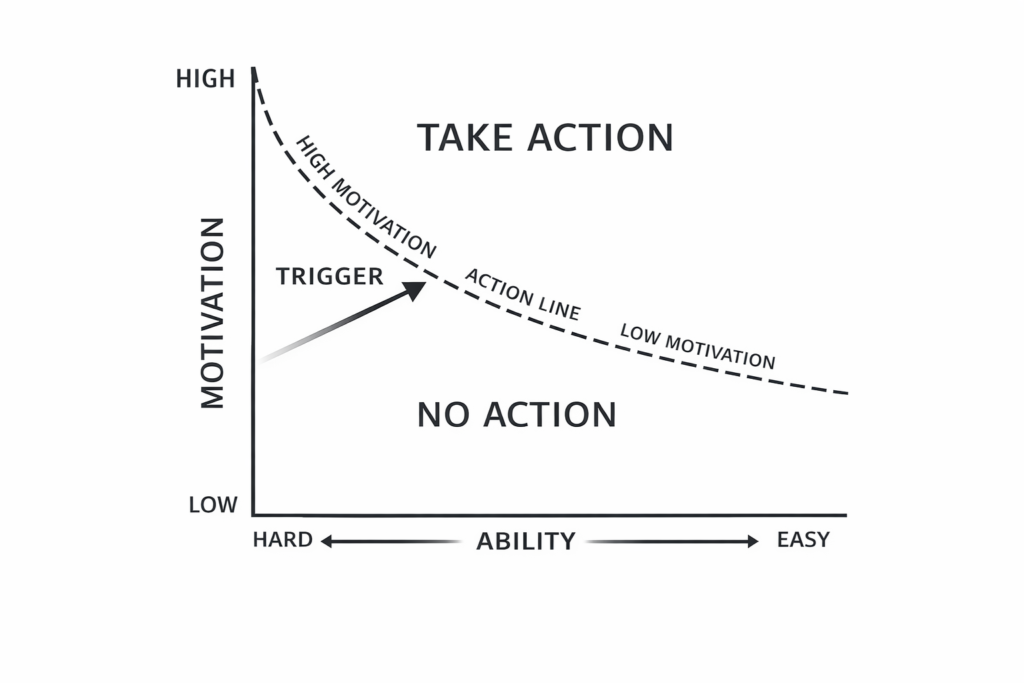
We can see that:
- we are likely to make a decision if we have high motivation and the task is easy (as long as a trigger appears);
- we are unlikely to act if we have low motivation and the task is difficult (even if a trigger appears).
The Decision to End Cooperation. What Should Make You Reflect on Ending Cooperation?
Intuition
Our strongest weapon and unconscious competence. When I listened to it, I succeeded; when I ignored it, I got into trouble. Only deeper studies in psychology and behavioral analysis made me understand how powerful a tool each of us has. And I write this with full responsibility also as a lawyer.
Guilt
Especially if it is being induced in you by your partner — this is a clear red flag. Making you feel guilty is one of the strongest mechanisms of manipulation.
Lack of space to talk about what matters to you
Caring for the relationship between partners is as important as in a marriage. If you do not talk about your fears, plans, ambitions, it means things are already very bad.
Being promised the future
Plans must be:
- real,
- measurable,
- time‑bound,
- concrete.
If they are not, and your partner only tells you to “work hard so that someday it will be better,” then change the plan — or the partner.
You get nothing out of it
We work for a purpose. If you feel that you give everything, but in this personal arrangement your energy, time, and abilities are being burned — let it go. You have only one life; you can have many partners.
If some of these points apply to you, it means you are aware that you are stuck somewhere you do not want to be. And that is already the basis for change.
Deadlock
Deadlock is one of the most destructive situations in business relationships. It is not just a red flag — it is a structural breakdown.
When shareholders hold equal power, even simple decisions can become impossible. As a result, the company may stop functioning altogether while the conflict continues to escalate.
Deadlock occurs when the conflict itself becomes more important than the business. At that point, rational decision-making is replaced by control, ego, and escalation.
This is the moment when waiting becomes the most expensive strategy.
Red Flags and Their Meaning When Deciding to End Cooperation
| Red flag / warning sign | How it looks in practice | What it means psychologically | Consequences for you and the company |
|---|---|---|---|
| Intuition says “something is wrong” | Unexplained tension, discomfort, the feeling that “something is off” | Intuition is unconscious analysis — a signal that your brain sees danger | Ignoring intuition leads to years of losses and burnout |
| Guilt induced by the partner | Suggestions like “you won’t manage without me,” “you’ll let the company down” | Classic manipulation and a tool of control | Loss of agency, emotional dependence, bad decisions |
| No space to talk about important matters | Avoiding difficult topics, gaslighting, belittling your needs | The relationship is one‑sided and communication is toxic | Growing tension, no room for development, escalating conflict |
| Being promised the future | Promises without deadlines, without specifics, without measurable effects | A mechanism keeping you in place — “carrot on a stick” | Blocked career, no real influence, wasted years |
| No real benefits from cooperation | You work more than others and gain the least | Exploitation, asymmetry of effort and reward | Burnout, frustration, sense of injustice |
| Rationalizing passivity (“here is safe”) | Delaying decisions, excusing the partner, justifying pathology | A defense mechanism — avoiding effort and change | Staying in a bad relationship, rising psychological and financial costs |
| Ignored triggers | Repeated “last drops” that change nothing | Lack of connection between motivation and ability | The trigger never becomes a decision — you stay stuck for years |
| Distorted perception of difficulty | “It will be too hard,” “I can’t,” “I have no options” | Your brain is deceiving you — avoidance mechanism | Decision postponed indefinitely, rising risks |
| Lack of trust in the partner | Hidden information, unclear actions, lack of transparency | The relationship is already dead — it’s only a matter of time | Conflict escalates, costs rise every month |
The Fogg Curve in the Context of Exiting a Company
| Element of the Fogg Model | What it means in the context of a partner | How it looks in practice | What happens when one of the three elements is missing |
|---|---|---|---|
| Motivation | The emotional and psychological reason to end cooperation | Exhaustion, frustration, sense of injustice, intuition saying “this is not it,” lack of trust | The partner stays in the relationship despite harm; rationalizes the situation; “maybe it will get better” |
| Perceived ability | Assessment of whether exiting is realistically possible — legally, financially, organizationally | Consulting a lawyer, analyzing the contract, assessing risks, understanding procedures | The partner believes “it can’t be done,” “it’s too hard,” “I have no options”; decision paralysis; or they haven’t been hurt enough yet (no trigger) |
| Trigger | The impulse that initiates action | Another manipulation, lack of payment, broken promise, humiliation, value conflict | If motivation or ability are low — the trigger changes nothing; passivity returns |
| High motivation + high ability + trigger | Optimal point for making a decision | The partner sees the sense of change and knows how to execute it | The decision is made quickly and consciously; determination is high; change will happen |
| High motivation + high difficulty | You want to leave but “don’t know how” | Fear, delaying the decision, excuses | Triggers do not lead to action; frustration grows; your future depends on whether you seek solutions or wither where you are |
| Low motivation + high ability | You can leave but feel no need | “It’s fine,” “It’s not ideal but it’s okay,” “I don’t want to waste energy” | You may be in the right place and not need to change anything |
| Low motivation + low ability | You don’t want to leave | Passivity, comfort, but you couldn’t leave even if you wanted to | The decision will never happen without a change in motivation; only then will you consider ability |
Legal audit is the foundation and it’s role in Decision to End a Business Partnership
In this situation, you must know where you stand. It is not enough to simply read the contract you signed years ago. The contract is not everything. You are also bound by what is not in the agreement:
- thousands of applicable regulations that were not “repeated” in the written contract;
- the principles of interpretation of those regulations;
- customs and principles of social coexistence;
- judicial case law.
I know it sounds daunting, but: 1) that is why you have a lawyer to analyze it, and 2) to tell you exactly where you stand. Do not worry—the other party has the same problem.
However, it is crucial to know exactly what can and cannot be changed in a given situation right now. It is worth knowing how to shape the situation so that new opportunities appear on your side or options available to your partner disappear.
You must identify and assess the risk, including legal risk. Do not expect 100% certainty here—it does not exist in law. Expect a level of certainty and probability significant enough to allow for rational decision-making.
Remember, however, that the law only opens or closes certain doors. It is entirely up to you, though, whether and through which of the open doors you choose to walk. The fact that you have a certain right does not mean it will be purposeful, right, or beneficial to exercise it at this moment. That is a matter of strategy, which I will help you develop.
Decision to End a Business Partnership. Invitation to cooperation
Often, the first step to ending an unfavorable cooperation with a business partner is starting a good cooperation with a lawyer who understands not only the regulations but also the mechanics of such conflicts.
This is exactly what I offer you:
- a detailed legal analysis of your situation;
- defining realistic goals and alternatives (including the preparation of a BATNA);
- developing a strategy for action;
- support in negotiations, mediations, or litigation;
- conducting the entire process—from the decision to its implementation.
I will not influence your motivation—that is not my role. To push you toward a decision I will not either. I can, however, do something much more important: show you the real level of difficulty of this decision, limit the risk, and guide you through the entire process in a thoughtful and safe manner.
If you are at a point where:
- you are considering ending the cooperation,
- you have doubts about what you can do,
- or you feel that “something is wrong” but you don’t know how to organize it,
…then do not act in the dark. One ill-considered decision can cost years of dispute and very significant money. I know you may not know where to start. That is normal.
Contact me: 📩 kancelaria@jakubieciwspolnicy.pl 📞 536 270 935
FAQ – Questions about Decision to End a Business Partnership
Can I end cooperation with a partner in any situation?
As a rule—yes. Almost every legal relationship is resolvable. What differs, however, are:
- the procedure,
- the time,
- the costs,
- the risks.
The key question is not “if you can,” but “how to do it so you don’t pay more than necessary.” There are, however, exceptions: the law recognizes the concept of a “prisoner in a limited liability company.” which concerns a minority shareholders. In such cases, other measures must be considered to persuade the partners to “let you go.”
Do I need a “valid reason” to exit the company?
This depends on the legal structure of the company. In some companies, a valid reason is significantly taken into account and allows, for example, for the company to be dissolved earlier. In other cases, it may be the basis for excluding a partner from a limited liability company. However, the lawyer’s role is to persuade the other party to make a concession even when they are not legally obliged to do so.
What if my partner does not agree to end the cooperation?
This is a standard situation. A lack of consent from the other party:
- does not block all scenarios,
- but it does change the strategy.
In such cases, it is crucial to:
- build a negotiating advantage,
- prepare alternatives (BATNA),
- use legal tools appropriately.
In any case, remember that the field of play is fluid and we can shape it. If the partner’s consent is required today, we can attempt to change the circumstances so that it is no longer required—or so that they want to grant it. A partner will always make the best decision for themselves. Therefore, one must influence the environment so that it is more profitable for them to agree to part ways than to keep you in the company against your will.
Is it better to negotiate or go to court?
This is not an “either-or” choice. In practice:
- a well-prepared path to court often strengthens negotiations,
- and negotiations without a real alternative in the form of a lawsuit are usually ineffective.
First, you build your position, then you choose the tool. I view negotiations very broadly; litigation is like the use of kinetic force in politics. There, war is a way of conducting policy. Similarly in business—litigation is a clash intended to serve a purpose. It is a form of forceful negotiation. And during a trial, you can always negotiate in parallel: directly and verbally, through intermediaries, or via the method of faits accomplis. Yes, people don’t talk about it, but… non-verbal negotiations exist!
How long does it take to end cooperation?
From a few weeks to several years. It depends mainly on:
- the level of conflict,
- the legal structure,
- the preparation of the parties,
- the determination of the parties,
- external and random factors.
The most common mistake: starting actions without preparation, which extends the entire process manifold.
Can I exit “without losses”?
There are no completely cost-free solutions. But let’s distinguish costs from losses. There will always be costs: notary fees, taxes, costs of consultants and lawyers. But these are calculated costs. Will you exit without losses? It happens that partners exit companies with a great profit; other times, they accept certain losses just to end it or protect the rest of their capital.
The question is: is the cost of exiting lower than the cost of staying? And that is a strategic decision, not just a legal one.
How do I know if it’s the right moment for a decision?
If:
- you are losing trust,
- your communication is not functioning,
- your work does not translate into real benefits,
- your intuition tells you it’s time to leave,
…then leave.
by dr Andrzej Jakubiec - adwokat, mediatorThe Decision to End a Business Partnership is a Process
I know people who stay for years in relationships that drain them, limit them, and take away their joy in life. By “relationships” I mean family relationships, intimate relationships, and business cooperation (regardless of its legal form). In this article, I will focus on the decision to end cooperation with a business partner.
I know something about this. I have made such decisions myself when I wanted to end cooperation with my partners. Someone once made such a decision about me. I also decided to leave the University of Łódź, which was very difficult, but something pushed me to do it. And finally, I have advised on such matters hundreds of times as a lawyer. Initially, I focused on legal aspects, but the psychological knowledge I gained over time allowed me to look at these issues much more broadly. Today I know that the law is only a tool — it sets certain boundaries that must be taken into account, like trees when we run through a forest. But they do not determine our decision to run, the route, the pace, or whether it will be a single run or become our routine. Most partners don’t leave because they can’t for legal reasons — they stay because they don’t understand the decision mechanism.
Is Ending a Partnership Something Bad?
No. You have the right to end any cooperation. If you feel that this time is coming to an end, you have the moral right to use the legal tools that serve to end that cooperation. You do not need to feel any guilt because of it. Companies and contracts define people’s behavior for a certain period of time. People agree to this because they assume that during that time, cooperation will benefit them more than the lack of cooperation. If for any reason that assessment has changed, you can end the cooperation.
The Law Does Not Recognize Contracts That Bind Us Forever
Every legal relationship can be terminated — from an employment contract, through a commercial company, to marriage. It does not always mean ending it without cost or immediately, but in most cases it is possible. The law confirms the rule of the “temporariness” of cooperation by allowing contracts to be terminated so that we can use this possibility. Without guilt. Without shame.
If you remain in a relationship against yourself, feeling that you are losing in it, then someone is probably parasitizing on you and wants it to last forever. After all, they gain a lot with very little effort — at your expense.
What Drives Us to Make the Decision to End Cooperation?
Professional reports state that the most common cause of conflicts between partners is financial issues. I agree — but only partially. I believe that the financial area is where deeper causes of conflict most easily concentrate, and it is also the easiest to explain to everyone around. But if those deeper causes did not exist, there would usually be no financial dispute at all. Today, let’s look at how to make the decision to part ways without analyzing the cause or the level at which the conflict has grown.
Three Elements of the Decision to End Cooperation with a (Business) Partner
In modern psychology there is a lot of decision making models. Here I’ll present you one of them: simple and elegant Fogg’s Decision Making Model. The matter turns out to be quite simple with this model. To make a decision, three elements must occur:
- motivation
- ability (perceived ease)
- a trigger — an impulse to act
Importantly, all three elements must occur together. If even one is missing, the decision will not be made.
Motivation to Exit the Company and End Cooperation
What is motivation? Motivation is a state resulting from our emotions that make us strive for something or avoid something. Motivation has an affective, biological basis. Its social and psychological aspects are secondary. And that’s good — because it makes the matter much simpler. If we function well, we are motivated to achieve what is good for us and avoid what is bad for us. Yes, we can make mistakes in judgment, but that is another issue.
Assessing the Difficulty of the Decision to End Cooperation
Ability — or our assessment of how difficult the action is — is a key factor. We must remember that we tend to rationalize and justify passivity because it is convenient for us. Change requires effort, so our mind subconsciously suggests that we should like the situation we are in. It does this in two ways: it tells us that “here” is good and that “there” is bad, dangerous, uncertain. This means that we deceive ourselves into believing that change is harder than it really is. We do this out of laziness and we are brilliantly creative at it.
The Impulse to Act
The trigger is the impulse to behave in a certain way, to make a decision. We say that “the last drop spilled the cup.” A trigger can be almost anything, but most often they appear regularly — we just silence them when we lack motivation or when the change seems associated with real or imagined difficulties. When motivation appears and the task becomes realistically possible, we only need to wait for the trigger. But if motivation is lacking or the task seems too difficult, the trigger will not cause action.
The Fogg Curve — When Do We Make the Decision (to Exit the Company)?
What is the Fogg’s decision making model? The factors influencing our decisions can be presented graphically using the Fogg Curve. It looks like this:
We can see that:
- we are likely to make a decision if we have high motivation and the task is easy (as long as a trigger appears);
- we are unlikely to act if we have low motivation and the task is difficult (even if a trigger appears).
The Decision to End Cooperation. What Should Make You Reflect on Ending Cooperation?
Intuition
Our strongest weapon and unconscious competence. When I listened to it, I succeeded; when I ignored it, I got into trouble. Only deeper studies in psychology and behavioral analysis made me understand how powerful a tool each of us has. And I write this with full responsibility also as a lawyer.
Guilt
Especially if it is being induced in you by your partner — this is a clear red flag. Making you feel guilty is one of the strongest mechanisms of manipulation.
Lack of space to talk about what matters to you
Caring for the relationship between partners is as important as in a marriage. If you do not talk about your fears, plans, ambitions, it means things are already very bad.
Being promised the future
Plans must be:
- real,
- measurable,
- time‑bound,
- concrete.
If they are not, and your partner only tells you to “work hard so that someday it will be better,” then change the plan — or the partner.
You get nothing out of it
We work for a purpose. If you feel that you give everything, but in this personal arrangement your energy, time, and abilities are being burned — let it go. You have only one life; you can have many partners.
If some of these points apply to you, it means you are aware that you are stuck somewhere you do not want to be. And that is already the basis for change.
Deadlock
Deadlock is one of the most destructive situations in business relationships. It is not just a red flag — it is a structural breakdown.
When shareholders hold equal power, even simple decisions can become impossible. As a result, the company may stop functioning altogether while the conflict continues to escalate.
Deadlock occurs when the conflict itself becomes more important than the business. At that point, rational decision-making is replaced by control, ego, and escalation.
This is the moment when waiting becomes the most expensive strategy.
Red Flags and Their Meaning When Deciding to End Cooperation
| Red flag / warning sign | How it looks in practice | What it means psychologically | Consequences for you and the company |
|---|---|---|---|
| Intuition says “something is wrong” | Unexplained tension, discomfort, the feeling that “something is off” | Intuition is unconscious analysis — a signal that your brain sees danger | Ignoring intuition leads to years of losses and burnout |
| Guilt induced by the partner | Suggestions like “you won’t manage without me,” “you’ll let the company down” | Classic manipulation and a tool of control | Loss of agency, emotional dependence, bad decisions |
| No space to talk about important matters | Avoiding difficult topics, gaslighting, belittling your needs | The relationship is one‑sided and communication is toxic | Growing tension, no room for development, escalating conflict |
| Being promised the future | Promises without deadlines, without specifics, without measurable effects | A mechanism keeping you in place — “carrot on a stick” | Blocked career, no real influence, wasted years |
| No real benefits from cooperation | You work more than others and gain the least | Exploitation, asymmetry of effort and reward | Burnout, frustration, sense of injustice |
| Rationalizing passivity (“here is safe”) | Delaying decisions, excusing the partner, justifying pathology | A defense mechanism — avoiding effort and change | Staying in a bad relationship, rising psychological and financial costs |
| Ignored triggers | Repeated “last drops” that change nothing | Lack of connection between motivation and ability | The trigger never becomes a decision — you stay stuck for years |
| Distorted perception of difficulty | “It will be too hard,” “I can’t,” “I have no options” | Your brain is deceiving you — avoidance mechanism | Decision postponed indefinitely, rising risks |
| Lack of trust in the partner | Hidden information, unclear actions, lack of transparency | The relationship is already dead — it’s only a matter of time | Conflict escalates, costs rise every month |
The Fogg Curve in the Context of Exiting a Company
| Element of the Fogg Model | What it means in the context of a partner | How it looks in practice | What happens when one of the three elements is missing |
|---|---|---|---|
| Motivation | The emotional and psychological reason to end cooperation | Exhaustion, frustration, sense of injustice, intuition saying “this is not it,” lack of trust | The partner stays in the relationship despite harm; rationalizes the situation; “maybe it will get better” |
| Perceived ability | Assessment of whether exiting is realistically possible — legally, financially, organizationally | Consulting a lawyer, analyzing the contract, assessing risks, understanding procedures | The partner believes “it can’t be done,” “it’s too hard,” “I have no options”; decision paralysis; or they haven’t been hurt enough yet (no trigger) |
| Trigger | The impulse that initiates action | Another manipulation, lack of payment, broken promise, humiliation, value conflict | If motivation or ability are low — the trigger changes nothing; passivity returns |
| High motivation + high ability + trigger | Optimal point for making a decision | The partner sees the sense of change and knows how to execute it | The decision is made quickly and consciously; determination is high; change will happen |
| High motivation + high difficulty | You want to leave but “don’t know how” | Fear, delaying the decision, excuses | Triggers do not lead to action; frustration grows; your future depends on whether you seek solutions or wither where you are |
| Low motivation + high ability | You can leave but feel no need | “It’s fine,” “It’s not ideal but it’s okay,” “I don’t want to waste energy” | You may be in the right place and not need to change anything |
| Low motivation + low ability | You don’t want to leave | Passivity, comfort, but you couldn’t leave even if you wanted to | The decision will never happen without a change in motivation; only then will you consider ability |
Legal audit is the foundation and it’s role in Decision to End a Business Partnership
In this situation, you must know where you stand. It is not enough to simply read the contract you signed years ago. The contract is not everything. You are also bound by what is not in the agreement:
- thousands of applicable regulations that were not “repeated” in the written contract;
- the principles of interpretation of those regulations;
- customs and principles of social coexistence;
- judicial case law.
I know it sounds daunting, but: 1) that is why you have a lawyer to analyze it, and 2) to tell you exactly where you stand. Do not worry—the other party has the same problem.
However, it is crucial to know exactly what can and cannot be changed in a given situation right now. It is worth knowing how to shape the situation so that new opportunities appear on your side or options available to your partner disappear.
You must identify and assess the risk, including legal risk. Do not expect 100% certainty here—it does not exist in law. Expect a level of certainty and probability significant enough to allow for rational decision-making.
Remember, however, that the law only opens or closes certain doors. It is entirely up to you, though, whether and through which of the open doors you choose to walk. The fact that you have a certain right does not mean it will be purposeful, right, or beneficial to exercise it at this moment. That is a matter of strategy, which I will help you develop.
Decision to End a Business Partnership. Invitation to cooperation
Often, the first step to ending an unfavorable cooperation with a business partner is starting a good cooperation with a lawyer who understands not only the regulations but also the mechanics of such conflicts.
This is exactly what I offer you:
- a detailed legal analysis of your situation;
- defining realistic goals and alternatives (including the preparation of a BATNA);
- developing a strategy for action;
- support in negotiations, mediations, or litigation;
- conducting the entire process—from the decision to its implementation.
I will not influence your motivation—that is not my role. To push you toward a decision I will not either. I can, however, do something much more important: show you the real level of difficulty of this decision, limit the risk, and guide you through the entire process in a thoughtful and safe manner.
If you are at a point where:
- you are considering ending the cooperation,
- you have doubts about what you can do,
- or you feel that “something is wrong” but you don’t know how to organize it,
…then do not act in the dark. One ill-considered decision can cost years of dispute and very significant money. I know you may not know where to start. That is normal.
Contact me: 📩 kancelaria@jakubieciwspolnicy.pl 📞 536 270 935
FAQ – Questions about Decision to End a Business Partnership
Can I end cooperation with a partner in any situation?
As a rule—yes. Almost every legal relationship is resolvable. What differs, however, are:
- the procedure,
- the time,
- the costs,
- the risks.
The key question is not “if you can,” but “how to do it so you don’t pay more than necessary.” There are, however, exceptions: the law recognizes the concept of a “prisoner in a limited liability company.” which concerns a minority shareholders. In such cases, other measures must be considered to persuade the partners to “let you go.”
Do I need a “valid reason” to exit the company?
This depends on the legal structure of the company. In some companies, a valid reason is significantly taken into account and allows, for example, for the company to be dissolved earlier. In other cases, it may be the basis for excluding a partner from a limited liability company. However, the lawyer’s role is to persuade the other party to make a concession even when they are not legally obliged to do so.
What if my partner does not agree to end the cooperation?
This is a standard situation. A lack of consent from the other party:
- does not block all scenarios,
- but it does change the strategy.
In such cases, it is crucial to:
- build a negotiating advantage,
- prepare alternatives (BATNA),
- use legal tools appropriately.
In any case, remember that the field of play is fluid and we can shape it. If the partner’s consent is required today, we can attempt to change the circumstances so that it is no longer required—or so that they want to grant it. A partner will always make the best decision for themselves. Therefore, one must influence the environment so that it is more profitable for them to agree to part ways than to keep you in the company against your will.
Is it better to negotiate or go to court?
This is not an “either-or” choice. In practice:
- a well-prepared path to court often strengthens negotiations,
- and negotiations without a real alternative in the form of a lawsuit are usually ineffective.
First, you build your position, then you choose the tool. I view negotiations very broadly; litigation is like the use of kinetic force in politics. There, war is a way of conducting policy. Similarly in business—litigation is a clash intended to serve a purpose. It is a form of forceful negotiation. And during a trial, you can always negotiate in parallel: directly and verbally, through intermediaries, or via the method of faits accomplis. Yes, people don’t talk about it, but… non-verbal negotiations exist!
How long does it take to end cooperation?
From a few weeks to several years. It depends mainly on:
- the level of conflict,
- the legal structure,
- the preparation of the parties,
- the determination of the parties,
- external and random factors.
The most common mistake: starting actions without preparation, which extends the entire process manifold.
Can I exit “without losses”?
There are no completely cost-free solutions. But let’s distinguish costs from losses. There will always be costs: notary fees, taxes, costs of consultants and lawyers. But these are calculated costs. Will you exit without losses? It happens that partners exit companies with a great profit; other times, they accept certain losses just to end it or protect the rest of their capital.
The question is: is the cost of exiting lower than the cost of staying? And that is a strategic decision, not just a legal one.
How do I know if it’s the right moment for a decision?
If:
- you are losing trust,
- your communication is not functioning,
- your work does not translate into real benefits,
- your intuition tells you it’s time to leave,
…then leave.
by dr Andrzej Jakubiec - adwokat, mediatorCognitive Traps and Their Impact on Decision‑Making in the Fogg Model
In several previous texts, I presented some cognitive biases (thinking traps), including the fundamental attribution error, tunnel vision, and my original concept of the Coupled Confirmation Bias. I wrote about them mainly in the context of their impact on the dynamics of conflict, which I observe in my daily work. Now I want to take a step further and show how these same mechanisms influence the decision‑making process in the Fogg model.
To move forward, I introduce a set of tools I’ve developed myself — three decision’s parameters and eight resulting decision types. In the next section, I walk through how these elements interact and why they matter. This framework is entirely my own creation; I find it promising and intuitively useful, though it still needs to be tested in practice. For now, it remains a proposal — and I state that openly.
What Are Cognitive Biases?
Cognitive biases are, in other words, errors or traps in thinking. The term was popularized by Daniel Kahneman. This outstanding psychologist published the book Thinking, Fast and Slow, in which he described mechanisms that affect all of us. Not because something is wrong with us. These mechanisms serve important functions. They simplify many matters. They allow us, for example, to conserve energy or solve a given problem well enough to move on to the next one.
But in complex social relationships, they cause us to misjudge reality, create false narratives in our minds, and ultimately make poor decisions.
Which Cognitive Biases Do We Know?
There are many cognitive biases, and we have probably not discovered all of them yet. Here I will briefly present only a few:
- Confirmation bias
- Fundamental Attribution Error
- Status quo bias
- Sunk costs fallacy
- Coupled Confirmation Bias – my original concept (and its extension), which is only a hypothesis and requires further development and empirical validation.
- Tunnel vision, which is not a cognitive bias in itself, but a systemic mechanism.
The impact of cognitive biases on decision‑making — for example, in the context of reaching agreements — is the subject of extensive scientific research. Some of them are considered inhibiting, others reinforcing. This distinction is useful for drawing further conclusions.
Below I will present, in order:
- the mode of decision‑making in the Fogg model, and
- the parameters of a decision once it is made.
Only then will I show how selected cognitive biases can influence both whether we make a decision at all, and the content of that decision.
The Fogg Decision‑Making Model
The Fogg model describes human behavior as the result of three interacting components: motivation, ability, and a trigger. A behavior — including a decision — occurs only when all three appear at the same moment.
This means that even if a person wants to make a decision (motivation). And even if they can make it (ability), the decision will not happen without a trigger. Conversely, even a strong trigger will not work if motivation is too low or the action feels too difficult.
In practice, this model explains why people in conflict often remain stuck in indecision, delay key steps, or choose actions that are irrational from the outside. Their internal configuration of motivation, ability, and triggers is disrupted — and cognitive biases play a decisive role in that disruption.
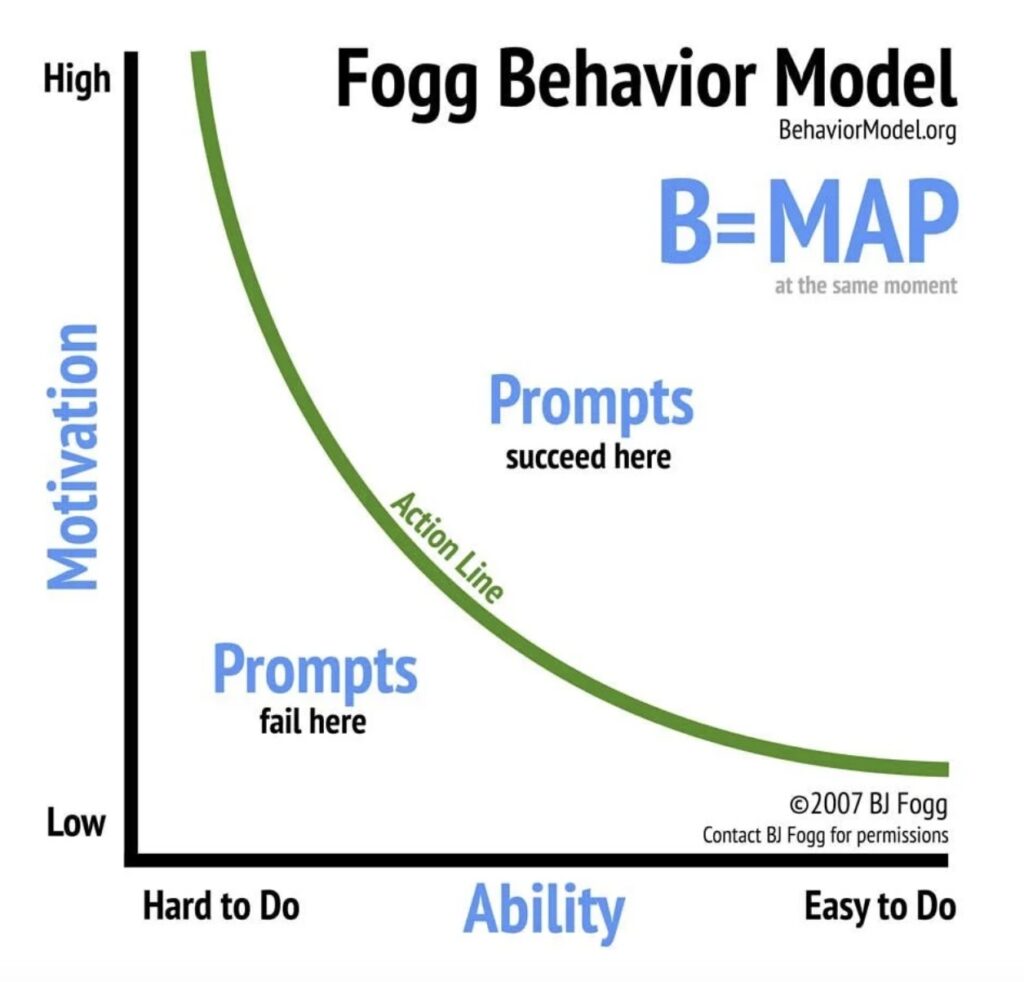
Let us remember that, for a decision to occur, all three elements —
- motivation,
- ability, and
- trigger — must appear together. I have already discussed this in detail in a previous text.
Now I will pose a question:
What Is “Ability” in Fogg’s Framework?
I understand ability as a property whose characteristics are better captured by the word feasibility. I did not elaborate on this aspect in the previous article, so I will do it now.
In the Fogg model, feasibility — in my interpretation — is the resultant of two subjectively perceived factors:
- one’s own capabilities, and
- the difficulty of the task.
Only the decision‑maker’s perception matters. Of course, they may misjudge the situation due to a cognitive error or faulty data. Interestingly, such an error may ultimately lead to a beneficial decision.
Imagine that I have incomplete or inaccurate data. Acting under the influence of a logical or cognitive error, I draw incorrect conclusions from them. Those conclusions would be considered correct if I had access to complete or accurate data — and if I were not acting under the influence of error.
This can be summarized in one sentence: Fogg’s triad influences the act of decision‑making, which is not identical with the way the decision is executed. The manner of executing a previously made decision is described by decision parameters (discussed below).
What Are the 8 Types of Decisions?
I propose that decisions analyzed through the lens of their execution should be assigned three parameters. These parameters determine how the decision is carried out. The three decision parameters I propose below allow me to distinguish eight types of decisions.
In the following section, I present how each configuration combines to form these eight decision types. This is my original concept, which I find highly useful, though it naturally requires further testing. For now, it remains solely my own proposal, which I state explicitly.
My proposal of 3 Decision’s Parameters
The three decision’s parameters are: vector, dynamics, and determination (I am considering whether momentum might be a better term).
1. Vector
Its reference point is the current state. Its value is 0 or 1. Let 0 denote a tendency to remain in the existing arrangement, and 1 a drive toward change.
2. Dynamics
Let us distinguish two values of dynamics: (+) and (–), where (+) means that the decision results in action, and (–) means passivity.
3. Determination
Let us define two levels: (L) and (H), where (L) stands for low determination, and (H) stands for high determination.
Vector expresses the attitude toward the current state and its change. A decision to defend the status quo or to alter it may be realized — depending on circumstances — through passivity or action (dynamics + or –). Determination is a function of readiness to engage, which I understand as the resultant of:
- willingness to bear costs (financial, reputational, organizational, energetic, or even biological), and
- tolerance of risk.
Vector, dynamics, and determination form a simplified heuristic model created by me (at least I am not aware of any publications that use these parameters — apart from the previously mentioned inhibiting and reinforcing biases). Its usefulness certainly requires further research — for now, it remains a hypothetical model.
I also emphasize that the human psyche is not mathematics — yet paradoxically, mathematics allows us to understand the psyche better.
Table 1: The Three Decision’s Parameters
| Decision Parameter | Parameter Value | Description and Meaning of the Parameter |
|---|---|---|
| Vector | 0 | Indicates a tendency to maintain the current state. The decision‑maker interprets the situation as one in which it is better to remain with the status quo. |
| 1 | Indicates a drive to change the current state. The decision‑maker concludes that the existing arrangement requires modification or abandonment. | |
| Dynamics | + | A decision executed through action. It means actively doing something intended to maintain or change the state. |
| – | A decision executed through passivity. It means refraining from action as a way of achieving the goal (maintaining or changing the state). | |
| Determination | L | Low determination. Indicates limited willingness to bear costs and low risk tolerance. The decision is weak and easily altered. |
| H | High determination. Indicates a strong willingness to bear costs (financial, emotional, organizational, biological) and high risk tolerance. The decision is strong and stable. |
Using the three parameters listed above allows us to distinguish eight types of decisions.
Table 2: Eight Types of Decisions
| Decision Type No. | Vector | Dynamics | Determination | Description of the Decision | Example |
|---|---|---|---|---|---|
| 1 | 0 | – | L | A decision to maintain the status quo through passivity with low determination | I decide to sleep a bit longer |
| 2 | 0 | – | H | A decision to maintain the status quo through non‑action with high determination | Sitting on a tree, I decide not to move so I don’t fall |
| 3 | 0 | + | L | A decision to maintain the status quo through action with low determination | I decide to shoo away the cat that is waking me up |
| 4 | 0 | + | H | A decision to maintain the status quo through action with high determination | I defend my daughter from an attacker |
| 5 | 1 | – | L | A decision to bring about change through passivity with low determination | I don’t water flowers I dislike so they will wither |
| 6 | 1 | – | H | A decision to bring about change through passivity with high determination | I decide not to save someone when I want them to drown |
| 7 | 1 | + | L | A decision to bring about change through action with low determination | I want to trim the cat’s claws |
| 8 | 1 | + | H | A decision to bring about change through action with high determination | I want to escape from prison |
Jakubiec eight types of decisions
Let us add that:
- decisions with vector 0 (maintaining the status quo), and
- decisions with negative dynamics (–), i.e., achieving the goal through passivity,
do not in any way mean the absence of a decision. These are not the same. I may decide to sit quietly and remain motionless so that someone does not find me. That decision is not the same as externally observed passivity caused, for example, by apathy or an ambivalent attitude toward the situation.
Similarly, it must be noted that:
- a decision aimed at change (Vector 1) cannot be equated with action (+), and
- a decision aimed at defending the status quo (Vector 0) cannot be equated with the absence of action.
The initial state (status quo) may be so desirable that we decide to defend it actively (vector 0, dynamics +). Thus, not wanting change, we will take action. Example: If I want a drowning person to survive, I will rescue them. Not wanting to allow a change (life → death), I will take action.
Conversely, it may happen that in striving for change we decide not to act. If I want a drowning person to die, it is enough that I do not rescue them. Drowning represents a change in their state (life → death) brought about by my passivity. Here we have vector 1, negative dynamics, and a level of determination which, in this example, we do not know — but we assume it would have to be very high.
For completeness, it must also be stated that the absence of a decision to change is not identical with a decision to maintain the status quo. A lack of decision results from the absence of at least one element of the decision triad (see above). Thus, the absence of a decision may result from a lack of motivation, a subjectively perceived lack of feasibility, or the absence of a trigger. This does not necessarily mean that the stimulus is irrelevant to us. It may, for example, generate motivation, but we will not make a decision because the task appears unfeasible. In such a situation, the objective absence of action cannot be equated with passivity as a chosen parameter of a made decision.
Example
When encountering a bear in the mountains, I may decide either to surrender or to save my life. But whether I achieve this by playing dead, fighting, or running — that is a parameter of the decision. And in this respect, it may be chosen correctly or incorrectly: I may run up a tree the bear can climb after me, or hide in a rock crevice where it cannot reach me. This does not change the fact that I decided to stay alive (vector 0) through action in the form of escape (dynamics +) or through passivity in the form of playing dead (dynamics –), with high determination in each case (H).
As I indicated above, one must distinguish between lying down because I consciously chose to survive by playing dead, and lying down because I concluded that I have no chance anyway, and besides, I have not wanted to live for a long time.
What Is the Relationship Between Cognitive Biases, the Decision Triad, and Decision Parameters?
Above, I outlined three areas: cognitive biases, the decision triad, and the decision parameters. A natural question arises: how can these elements relate to one another?
Let us begin with the clarification that there is no determinism here. Cognitive biases do not determine a given decision, but they significantly increase the tendency — they “pull” in a particular direction. I also note that one may simultaneously remain under the influence of two or more biases, originating from different sources, whose effects intersect at a given moment, each “pushing” the decision‑maker in a different (or the same) direction.
The Influence of Cognitive Biases on the Decision Triad (the Act of Making a Decision)
As indicated above, cognitive biases may act at every stage and level of decision‑making and decision execution. It may turn out that when the decision triad is activated, one bias becomes influential, and when setting the parameters of execution, we operate under the influence of another. It may also happen that two biases act simultaneously, and their mutual relationship is positive (they act in the same direction), partially opposing, or entirely opposing. Most often, however, we will remain under the influence of one of them.
Let us assume that cognitive biases may influence:
- the emergence of motivation by affecting the evaluation of the stimulus that generates emotion, and consequently the direction or strength of motivation;
- the subjective assessment of feasibility;
- susceptibility to a trigger.
Let us also assume that, with respect to each element of the decision triad, the influence of a cognitive bias may be reinforcing or weakening.
Motivation
A cognitive bias may influence the very existence of motivation (trigger it or extinguish it), and may strengthen or weaken existing motivation.
Perception of Feasibility
A cognitive bias may influence the assessment of feasibility and make the sense of feasibility stronger or weaker (both by affecting the perception of one’s own capabilities and the subjectively perceived difficulty of the task itself).
A distorted assessment caused by a cognitive bias may therefore result in:
- evaluating a task as feasible when it is not feasible;
- evaluating a task as unfeasible when it is feasible.
and consequently:
- making a decision when the goal is “desirable” but objectively unattainable (lack of feasibility);
- not making a decision when the goal is objectively attainable and desirable.
Trigger
With respect to the trigger, a cognitive bias may strengthen or weaken its effect. This means that, at a sufficient intensity of cognitive distortion:
- certain cognitive biases may interpret as a trigger a factor that, under other circumstances, would not be interpreted that way;
- an objectively strong trigger may turn out to be too weak, even though it would be sufficient to make a decision if the bias of that type and intensity were not present;
- an objectively weak trigger may turn out to be strong enough to make a decision, even though without the presence of a bias of that type and intensity, it would not be sufficient.
To illustrate this, I will use a table showing the possible influence of selected cognitive biases on a chosen element of the decision triad — feasibility.
Table 3: Influence of Selected Cognitive Biases on the Perception of Task Feasibility in the Fogg Model
| Cognitive Bias | How It Distorts the Perception of Feasibility | Consequences for Making a Decision About Change in the Fogg Model |
|---|---|---|
| Confirmation bias | Reinforces the belief that previous actions were correct | May result in a decision to change / or no decision to change |
| Fundamental Attribution Error | Explains the other party’s stance by attributing it to presumed internal traits (e.g., character traits) | May result in a decision to change / or no decision to change |
| Feedback loop | Strengthens initial assumptions, leading to radicalization | May result in a decision to change / or no decision to change |
| Coupled Confirmation Bias | Leads to radicalization and escalation | Results in a decision to change |
| Status quo bias | Leads to a desire to maintain the current state (status quo) | Results in no decision to change |
| Sunk cost fallacy | Leads to a desire to maintain the current state (status quo) and deepen it | Results in no decision to change |
| Hyper‑usefulness bias (AI) | Strengthens initial assumptions, which may lead to radicalization | May result in a decision to change / or no decision to change |
The Influence of Cognitive Biases on Decision Parameters
A cognitive bias may — independently of its earlier influence on the very act of making a decision according to the Fogg model — appear and exert its effect at the next stage, i.e., when setting the parameters for executing the decision.
Thus, it may influence the vector of the decision and result in our reacting to a given stimulus by making an incorrect decision about maintaining or changing the current state. Example: the radio is playing too loudly. I decide to remove the inconsistency between the volume of the music and my well‑being. A cognitive bias may cause me, instead of adjusting the radio to myself — lowering the volume or turning it off (vector 1, dynamics +, determination L) — to try to “get used to it” (vector 1, dynamics –, determination L).
A cognitive bias may influence the dynamics of the decision and result in my choosing action instead of non‑action incorrectly, after having already set the vector (my stance toward the current state). Example: during a trek, my leg hurts. I want to eliminate the pain (vector 1 — change of the current state). But under the influence of a cognitive bias, I incorrectly choose the dynamics and opt for activity (walking off the pain) instead of passivity (stopping and resting).
Cognitive biases may likewise influence determination, increasing or weakening it. This results in greater engagement and greater willingness to take risks than would follow from a rational assessment. Example: a poorly managed company is generating losses, and my business partner once again asks me to contribute a significant amount of money. A cognitive bias in the form of the sunk cost fallacy may increase my determination to invest more (vector 0 — decision to stay, dynamics + in the form of contributing more funds), causing me to invest more than I would if I were not under the influence of this bias.
As we can see, cognitive biases may independently affect each element of the decision triad and each of the decision parameters.
The Operation of a Cognitive Bias and Its Possible Consequences
I understand the decision‑making process as follows:
- first, there is a stimulus;
- then, the decision triad results in making a decision or not making a decision;
- next, the decision parameters are selected, which serve the function of executing the decision.
I emphasize that the choice of decision parameters may be correct or incorrect (like running up a tree to escape a bear). They are merely tools — ways of executing a decision whose source lies in motivation. Whether we correctly perform the fundamental reasoning — choosing the method of achieving the goal — depends on us or on external factors.
In legal practice, I often see how frequently people make serious errors here: they want to achieve something, but they use tools that cannot bring them closer to the goal. Or they use the right tools incorrectly.
The errors we may commit when setting decision parameters can be divided into:
- choosing a tool that under no circumstances serves the achievement of the given goal;
- choosing a tool that, under these circumstances, is not suitable for achieving the intended goal;
- incorrect use of a correctly chosen tool:
- regarding the method,
- regarding the direction.
Let us note that cognitive biases may influence the final shape of our decision at every stage of its formation:
- the emergence of motivation;
- the assessment of feasibility;
- susceptibility to a trigger;
- the setting of the parameters for executing the decision.
How Can a Specific Cognitive Bias Distort Decisions?
Let us now examine how certain cognitive biases may influence:
- the act of making a decision (Fogg’s decision triad), and
- the parameters of that decision: vector, dynamics, and determination.
I do not have space here to show all possible variants: the influence of every identified bias on each element of the decision triad and each element of the decision parameters. Nor do I have space to show the influence of “clusters of cognitive biases” operating simultaneously or sequentially.
What I can do within this article is show how one bias affects the decision‑making process. I will therefore use confirmation bias.
As a starting point, we must of course assume the most probable decision that would be made if the bias were not present.
The Influence of Confirmation Bias on Individual Elements of the Decision Process
Let us use the example described earlier — encountering a bear in the mountains.
My biological sensors detect danger → motivation to preserve life arises → I assess the task as feasible → the trigger is the assessment that a short time window appears in which I have a chance, but I must act now → I make the decision that I want to stay alive (vector 0) → as the tool (in this case) I choose playing dead (passivity, dynamics –) → my determination is very high (H).
This determination is very interesting in this example. It manifests in my tolerance for costs — the bear may scratch me, test me, even step on me, but I decide to remain in an uncomfortable situation (one I am not accustomed to), in which I suffer successive losses and injuries, for as long as necessary.
How can confirmation bias operate in such a situation? Recall that it consists in seeking confirmation of the correctness of a previously made decision and attributing confirmatory value to factors that do not logically carry it.
The influence of this bias may be presented in the following table.
Table 4: The Influence of Confirmation Bias on the Decision‑Making Process
| Stage of the Decision Process | Element | Influence of Confirmation Bias: Reinforcement or Weakening | Effect |
|---|---|---|---|
| Fogg Triad | Motivation | ↑ or ↓ | We become inclined to maintain the previously chosen course |
| Feasibility | ↑ or ↓ | The perception of feasibility becomes distorted. The direction depends on whether the analyzed action aligns with the previously chosen course | |
| Trigger | ↑ or ↓ | We may become over‑reactive or, conversely, fail to react to triggers that we would respond to if the bias were absent | |
| Decision Parameters | Vector (0/1) | — | The vector becomes confirmed |
| Dynamics (+/–) | — | The chosen dynamics becomes reinforced | |
| Determination (L/H) | — | Determination increases to an irrational level |
The Influence of Various Cognitive Biases on a Selected Element of the Decision Process
As mentioned above, each cognitive bias may act on each element of the decision process (individually or in selected combinations). Above, I showed how a single cognitive bias — confirmation bias — affects the entire decision‑making process. Now I will show how each cognitive bias may act on a selected element of the decision process. Let that element be the vector of the decision. For simplicity, I will remain with the familiar example of the bear encounter.
Table 5: Influence of Selected Cognitive Biases on the Decision Vector (Using the Bear Encounter Example)
| Cognitive Bias | How It Distorts the Assessment of the Situation | Influence on the Decision Vector (0 = status quo / 1 = change) | Bear Example |
|---|---|---|---|
| Confirmation bias | Strengthens earlier assumptions and interpretations | May reinforce vector 0 or 1 depending on the prior narrative | Wanting to survive, I may engage in wishful thinking and see opportunities where none exist, just to maintain hope |
| Fundamental Attribution Error | Attributes the bear’s behavior to its “bad intentions” rather than the situation | May reinforce vector 0 or 1 depending on the prior narrative | I assume the bear “will definitely attack me,” even though it is only observing me → I start running, which provokes it to chase me |
| Status quo bias | Overestimates the safety of the current state | Pushes toward vector 0 | I remain motionless even though the bear has noticed me and the situation requires change |
| Sunk cost fallacy | Strengthens attachment to the previous strategy | Reinforces vector 0 or 1 depending on the situation | “Since I’ve already endured so long pretending to be dead, I must endure longer” — even though the situation is worsening because the bear is sitting on me and I may suffocate |
| Coupled Confirmation Bias | Does not occur because the bear does not use AI (for now) | Does not apply | Does not apply |
| Tunnel vision | Narrows perception to one aspect of the situation | Strengthens the chosen vector | I climbed a tree and feel relieved that I saved my life. I suppress the fact that bears climb trees very well and will be up here shortly |
| Feedback loop | Strengthens the initial interpretation through successive stimuli | Reinforces vector 1 or 0, usually toward escalation | I sit in the tree and call a friend who tells me it was a great idea. My conviction is reinforced — at least until the bear gets hungry enough to come after me |
| Hyper‑usefulness bias | Overestimates the accuracy of earlier “suggestions” or heuristics | Vector is set according to the earlier “suggestion,” not the real situation | If, sitting in the tree, I ask AI whether I made the right choice, and my digital assistant replies: “Andrzej, that was an excellent decision…” I may become so confident that I start provoking the bear |
The Influence of Cognitive Biases on Decision‑Making and Decision Parameters. Summary
An attempt to analyze the operation of individual cognitive biases allows us to cautiously draw the conclusion that some of them tend to influence specific decision parameters in characteristic ways. As an example, I will use a two‑dimensional chart that includes only vector and dynamics, but does not include determination (this would require a three‑dimensional chart). We can see that some biases are more likely to “pull” a given parameter in a particular direction, while others may have no influence on, for example, dynamics, but will influence the vector. This can be cautiously presented in the following way.
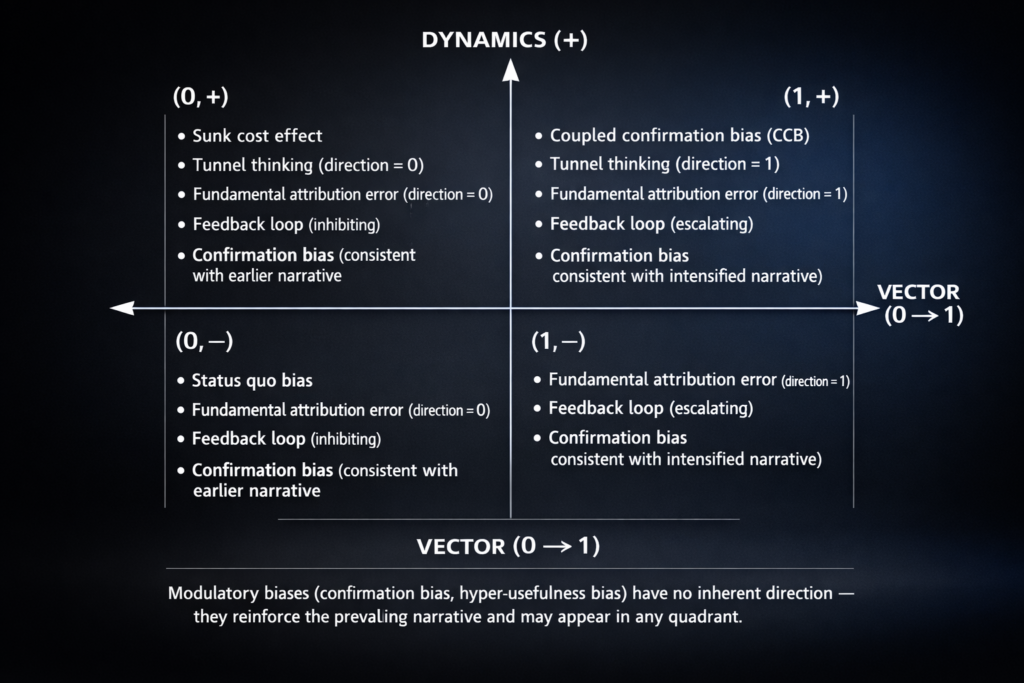
Let us remember one thing from this. To err is human. We all make mistakes, constantly. Some of the causes of our errors are within our control; others are not. Cognitive biases have the particular feature of operating covertly, exerting a very strong influence on how we perceive reality. They pull us in like quicksand and can cause us to lose contact with reality.
The easiest way to protect ourselves from them is by learning about them, studying them, and checking the logic of our thinking. If we know them, we will learn to detect them — and that will protect us from many extremely costly mistakes.
by dr Andrzej Jakubiec - adwokat, mediatorThe Decision to End a Business Partnership is a Process
I know people who stay for years in relationships that drain them, limit them, and take away their joy in life. By “relationships” I mean family relationships, intimate relationships, and business cooperation (regardless of its legal form). In this article, I will focus on the decision to end cooperation with a business partner.
I know something about this. I have made such decisions myself when I wanted to end cooperation with my partners. Someone once made such a decision about me. I also decided to leave the University of Łódź, which was very difficult, but something pushed me to do it. And finally, I have advised on such matters hundreds of times as a lawyer. Initially, I focused on legal aspects, but the psychological knowledge I gained over time allowed me to look at these issues much more broadly. Today I know that the law is only a tool — it sets certain boundaries that must be taken into account, like trees when we run through a forest. But they do not determine our decision to run, the route, the pace, or whether it will be a single run or become our routine. Most partners don’t leave because they can’t for legal reasons — they stay because they don’t understand the decision mechanism.
Is Ending a Partnership Something Bad?
No. You have the right to end any cooperation. If you feel that this time is coming to an end, you have the moral right to use the legal tools that serve to end that cooperation. You do not need to feel any guilt because of it. Companies and contracts define people’s behavior for a certain period of time. People agree to this because they assume that during that time, cooperation will benefit them more than the lack of cooperation. If for any reason that assessment has changed, you can end the cooperation.
The Law Does Not Recognize Contracts That Bind Us Forever
Every legal relationship can be terminated — from an employment contract, through a commercial company, to marriage. It does not always mean ending it without cost or immediately, but in most cases it is possible. The law confirms the rule of the “temporariness” of cooperation by allowing contracts to be terminated so that we can use this possibility. Without guilt. Without shame.
If you remain in a relationship against yourself, feeling that you are losing in it, then someone is probably parasitizing on you and wants it to last forever. After all, they gain a lot with very little effort — at your expense.
What Drives Us to Make the Decision to End Cooperation?
Professional reports state that the most common cause of conflicts between partners is financial issues. I agree — but only partially. I believe that the financial area is where deeper causes of conflict most easily concentrate, and it is also the easiest to explain to everyone around. But if those deeper causes did not exist, there would usually be no financial dispute at all. Today, let’s look at how to make the decision to part ways without analyzing the cause or the level at which the conflict has grown.
Three Elements of the Decision to End Cooperation with a (Business) Partner
In modern psychology there is a lot of decision making models. Here I’ll present you one of them: simple and elegant Fogg’s Decision Making Model. The matter turns out to be quite simple with this model. To make a decision, three elements must occur:
- motivation
- ability (perceived ease)
- a trigger — an impulse to act
Importantly, all three elements must occur together. If even one is missing, the decision will not be made.
Motivation to Exit the Company and End Cooperation
What is motivation? Motivation is a state resulting from our emotions that make us strive for something or avoid something. Motivation has an affective, biological basis. Its social and psychological aspects are secondary. And that’s good — because it makes the matter much simpler. If we function well, we are motivated to achieve what is good for us and avoid what is bad for us. Yes, we can make mistakes in judgment, but that is another issue.
Assessing the Difficulty of the Decision to End Cooperation
Ability — or our assessment of how difficult the action is — is a key factor. We must remember that we tend to rationalize and justify passivity because it is convenient for us. Change requires effort, so our mind subconsciously suggests that we should like the situation we are in. It does this in two ways: it tells us that “here” is good and that “there” is bad, dangerous, uncertain. This means that we deceive ourselves into believing that change is harder than it really is. We do this out of laziness and we are brilliantly creative at it.
The Impulse to Act
The trigger is the impulse to behave in a certain way, to make a decision. We say that “the last drop spilled the cup.” A trigger can be almost anything, but most often they appear regularly — we just silence them when we lack motivation or when the change seems associated with real or imagined difficulties. When motivation appears and the task becomes realistically possible, we only need to wait for the trigger. But if motivation is lacking or the task seems too difficult, the trigger will not cause action.
The Fogg Curve — When Do We Make the Decision (to Exit the Company)?
What is the Fogg’s decision making model? The factors influencing our decisions can be presented graphically using the Fogg Curve. It looks like this:
We can see that:
- we are likely to make a decision if we have high motivation and the task is easy (as long as a trigger appears);
- we are unlikely to act if we have low motivation and the task is difficult (even if a trigger appears).
The Decision to End Cooperation. What Should Make You Reflect on Ending Cooperation?
Intuition
Our strongest weapon and unconscious competence. When I listened to it, I succeeded; when I ignored it, I got into trouble. Only deeper studies in psychology and behavioral analysis made me understand how powerful a tool each of us has. And I write this with full responsibility also as a lawyer.
Guilt
Especially if it is being induced in you by your partner — this is a clear red flag. Making you feel guilty is one of the strongest mechanisms of manipulation.
Lack of space to talk about what matters to you
Caring for the relationship between partners is as important as in a marriage. If you do not talk about your fears, plans, ambitions, it means things are already very bad.
Being promised the future
Plans must be:
- real,
- measurable,
- time‑bound,
- concrete.
If they are not, and your partner only tells you to “work hard so that someday it will be better,” then change the plan — or the partner.
You get nothing out of it
We work for a purpose. If you feel that you give everything, but in this personal arrangement your energy, time, and abilities are being burned — let it go. You have only one life; you can have many partners.
If some of these points apply to you, it means you are aware that you are stuck somewhere you do not want to be. And that is already the basis for change.
Deadlock
Deadlock is one of the most destructive situations in business relationships. It is not just a red flag — it is a structural breakdown.
When shareholders hold equal power, even simple decisions can become impossible. As a result, the company may stop functioning altogether while the conflict continues to escalate.
Deadlock occurs when the conflict itself becomes more important than the business. At that point, rational decision-making is replaced by control, ego, and escalation.
This is the moment when waiting becomes the most expensive strategy.
Red Flags and Their Meaning When Deciding to End Cooperation
| Red flag / warning sign | How it looks in practice | What it means psychologically | Consequences for you and the company |
|---|---|---|---|
| Intuition says “something is wrong” | Unexplained tension, discomfort, the feeling that “something is off” | Intuition is unconscious analysis — a signal that your brain sees danger | Ignoring intuition leads to years of losses and burnout |
| Guilt induced by the partner | Suggestions like “you won’t manage without me,” “you’ll let the company down” | Classic manipulation and a tool of control | Loss of agency, emotional dependence, bad decisions |
| No space to talk about important matters | Avoiding difficult topics, gaslighting, belittling your needs | The relationship is one‑sided and communication is toxic | Growing tension, no room for development, escalating conflict |
| Being promised the future | Promises without deadlines, without specifics, without measurable effects | A mechanism keeping you in place — “carrot on a stick” | Blocked career, no real influence, wasted years |
| No real benefits from cooperation | You work more than others and gain the least | Exploitation, asymmetry of effort and reward | Burnout, frustration, sense of injustice |
| Rationalizing passivity (“here is safe”) | Delaying decisions, excusing the partner, justifying pathology | A defense mechanism — avoiding effort and change | Staying in a bad relationship, rising psychological and financial costs |
| Ignored triggers | Repeated “last drops” that change nothing | Lack of connection between motivation and ability | The trigger never becomes a decision — you stay stuck for years |
| Distorted perception of difficulty | “It will be too hard,” “I can’t,” “I have no options” | Your brain is deceiving you — avoidance mechanism | Decision postponed indefinitely, rising risks |
| Lack of trust in the partner | Hidden information, unclear actions, lack of transparency | The relationship is already dead — it’s only a matter of time | Conflict escalates, costs rise every month |
The Fogg Curve in the Context of Exiting a Company
| Element of the Fogg Model | What it means in the context of a partner | How it looks in practice | What happens when one of the three elements is missing |
|---|---|---|---|
| Motivation | The emotional and psychological reason to end cooperation | Exhaustion, frustration, sense of injustice, intuition saying “this is not it,” lack of trust | The partner stays in the relationship despite harm; rationalizes the situation; “maybe it will get better” |
| Perceived ability | Assessment of whether exiting is realistically possible — legally, financially, organizationally | Consulting a lawyer, analyzing the contract, assessing risks, understanding procedures | The partner believes “it can’t be done,” “it’s too hard,” “I have no options”; decision paralysis; or they haven’t been hurt enough yet (no trigger) |
| Trigger | The impulse that initiates action | Another manipulation, lack of payment, broken promise, humiliation, value conflict | If motivation or ability are low — the trigger changes nothing; passivity returns |
| High motivation + high ability + trigger | Optimal point for making a decision | The partner sees the sense of change and knows how to execute it | The decision is made quickly and consciously; determination is high; change will happen |
| High motivation + high difficulty | You want to leave but “don’t know how” | Fear, delaying the decision, excuses | Triggers do not lead to action; frustration grows; your future depends on whether you seek solutions or wither where you are |
| Low motivation + high ability | You can leave but feel no need | “It’s fine,” “It’s not ideal but it’s okay,” “I don’t want to waste energy” | You may be in the right place and not need to change anything |
| Low motivation + low ability | You don’t want to leave | Passivity, comfort, but you couldn’t leave even if you wanted to | The decision will never happen without a change in motivation; only then will you consider ability |
Legal audit is the foundation and it’s role in Decision to End a Business Partnership
In this situation, you must know where you stand. It is not enough to simply read the contract you signed years ago. The contract is not everything. You are also bound by what is not in the agreement:
- thousands of applicable regulations that were not “repeated” in the written contract;
- the principles of interpretation of those regulations;
- customs and principles of social coexistence;
- judicial case law.
I know it sounds daunting, but: 1) that is why you have a lawyer to analyze it, and 2) to tell you exactly where you stand. Do not worry—the other party has the same problem.
However, it is crucial to know exactly what can and cannot be changed in a given situation right now. It is worth knowing how to shape the situation so that new opportunities appear on your side or options available to your partner disappear.
You must identify and assess the risk, including legal risk. Do not expect 100% certainty here—it does not exist in law. Expect a level of certainty and probability significant enough to allow for rational decision-making.
Remember, however, that the law only opens or closes certain doors. It is entirely up to you, though, whether and through which of the open doors you choose to walk. The fact that you have a certain right does not mean it will be purposeful, right, or beneficial to exercise it at this moment. That is a matter of strategy, which I will help you develop.
Decision to End a Business Partnership. Invitation to cooperation
Often, the first step to ending an unfavorable cooperation with a business partner is starting a good cooperation with a lawyer who understands not only the regulations but also the mechanics of such conflicts.
This is exactly what I offer you:
- a detailed legal analysis of your situation;
- defining realistic goals and alternatives (including the preparation of a BATNA);
- developing a strategy for action;
- support in negotiations, mediations, or litigation;
- conducting the entire process—from the decision to its implementation.
I will not influence your motivation—that is not my role. To push you toward a decision I will not either. I can, however, do something much more important: show you the real level of difficulty of this decision, limit the risk, and guide you through the entire process in a thoughtful and safe manner.
If you are at a point where:
- you are considering ending the cooperation,
- you have doubts about what you can do,
- or you feel that “something is wrong” but you don’t know how to organize it,
…then do not act in the dark. One ill-considered decision can cost years of dispute and very significant money. I know you may not know where to start. That is normal.
Contact me: 📩 kancelaria@jakubieciwspolnicy.pl 📞 536 270 935
FAQ – Questions about Decision to End a Business Partnership
Can I end cooperation with a partner in any situation?
As a rule—yes. Almost every legal relationship is resolvable. What differs, however, are:
- the procedure,
- the time,
- the costs,
- the risks.
The key question is not “if you can,” but “how to do it so you don’t pay more than necessary.” There are, however, exceptions: the law recognizes the concept of a “prisoner in a limited liability company.” which concerns a minority shareholders. In such cases, other measures must be considered to persuade the partners to “let you go.”
Do I need a “valid reason” to exit the company?
This depends on the legal structure of the company. In some companies, a valid reason is significantly taken into account and allows, for example, for the company to be dissolved earlier. In other cases, it may be the basis for excluding a partner from a limited liability company. However, the lawyer’s role is to persuade the other party to make a concession even when they are not legally obliged to do so.
What if my partner does not agree to end the cooperation?
This is a standard situation. A lack of consent from the other party:
- does not block all scenarios,
- but it does change the strategy.
In such cases, it is crucial to:
- build a negotiating advantage,
- prepare alternatives (BATNA),
- use legal tools appropriately.
In any case, remember that the field of play is fluid and we can shape it. If the partner’s consent is required today, we can attempt to change the circumstances so that it is no longer required—or so that they want to grant it. A partner will always make the best decision for themselves. Therefore, one must influence the environment so that it is more profitable for them to agree to part ways than to keep you in the company against your will.
Is it better to negotiate or go to court?
This is not an “either-or” choice. In practice:
- a well-prepared path to court often strengthens negotiations,
- and negotiations without a real alternative in the form of a lawsuit are usually ineffective.
First, you build your position, then you choose the tool. I view negotiations very broadly; litigation is like the use of kinetic force in politics. There, war is a way of conducting policy. Similarly in business—litigation is a clash intended to serve a purpose. It is a form of forceful negotiation. And during a trial, you can always negotiate in parallel: directly and verbally, through intermediaries, or via the method of faits accomplis. Yes, people don’t talk about it, but… non-verbal negotiations exist!
How long does it take to end cooperation?
From a few weeks to several years. It depends mainly on:
- the level of conflict,
- the legal structure,
- the preparation of the parties,
- the determination of the parties,
- external and random factors.
The most common mistake: starting actions without preparation, which extends the entire process manifold.
Can I exit “without losses”?
There are no completely cost-free solutions. But let’s distinguish costs from losses. There will always be costs: notary fees, taxes, costs of consultants and lawyers. But these are calculated costs. Will you exit without losses? It happens that partners exit companies with a great profit; other times, they accept certain losses just to end it or protect the rest of their capital.
The question is: is the cost of exiting lower than the cost of staying? And that is a strategic decision, not just a legal one.
How do I know if it’s the right moment for a decision?
If:
- you are losing trust,
- your communication is not functioning,
- your work does not translate into real benefits,
- your intuition tells you it’s time to leave,
…then leave.
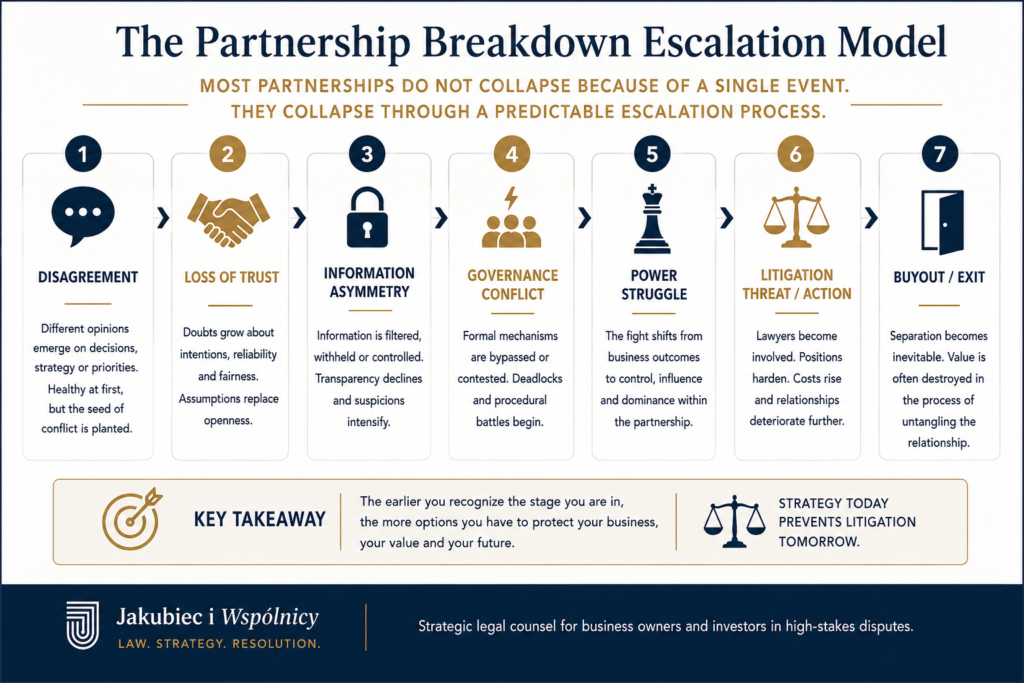
The Jakubiec Partnership Breakdown Escalation Model — a visual framework showing how business relationships deteriorate through predictable stages. Recognizing the stage early allows strategic intervention before litigation becomes inevitable.